


Most "best Shopify migration agency" lists do the same thing. They rank ten agencies, sprinkle in a few logos, and skip the one question that actually decides how your move goes: do you need a full agency at all, or a $300 app and a careful weekend?
That gap matters because a Shopify migration isn't one decision. It's a ladder, the pricing is famously opaque, and almost every guide you'll read stops talking the moment you go live. Which is a problem, because go-live is exactly when revenue and support tend to break.
Here's what this guide does instead. We'll show you how to tell which tier you actually need, what each one really costs in 2026, how to vet an agency without getting burned, and how to protect your SEO and your support volume through the cutover. There's a vetted shortlist at the end, with honest notes on who fits what.
Hear what AI support calls sound like for your store. Just paste your Shopify URL and get sample calls in under 20 seconds, no email required. Listen to demo calls for my store.
What a Shopify migration agency actually does
The phrase "migration" makes it sound like moving boxes. Move the products here, the customers there, done. The data move is real, but it's the cheapest, lowest-risk part of the whole job.
A full-service Shopify migration agency owns a chain of work. Discovery and a data audit. Mapping every product, variant, customer, and historical order to Shopify's structure. Rebuilding your theme. Re-architecting the apps and integrations you depended on. Building a 301 redirect map for every indexed URL. QA, then user acceptance testing. The cutover itself, with a rollback plan if it goes wrong. Then post-launch stabilization while things settle.
According to Shopify's enterprise data migration guide, a proper statement of work should include discovery, at least two migration runs, QA protocols, a cutover and rollback strategy, SEO migration support, staff training, and a two to four week post-launch support window. That's the real scope. Not "export, import, ship."
One line item predicts everything: discovery. It runs about two weeks and roughly $4,000 to $8,000, and it prices everything that comes after it. Skipping discovery is the single most common reason migrations blow their budget by 30 to 60 percent. If you want the full task list, our 47-step Shopify migration checklist walks through what happens before, during, and after cutover, and the broader Shopify replatforming guide covers the strategy side.
DIY app, freelancer, agency, or Shopify Plus partner: which tier fits you
This is the part the listicles skip. "Migration agency" isn't a single thing you either hire or don't. It's a ladder, and the trick is matching the rung to your store.
Self-serve migration app ($150 to $500)
Tools like Cart2Cart and LitExtension move your data for a one-time fee. For a store with around 1,000 products and 2,000 orders, expect roughly $200 to $400 with LitExtension (140+ source platforms, includes SEO URL migration) or a bit less with Cart2Cart, which is cheaper but weaker on blog and CMS pages.
Choose this if: under 500 SKUs, a standard theme, no custom integrations, and you're comfortable building your own redirect plan. These apps move data. They do not rebuild your theme, fix your app debt, or own your SEO for you.
Freelancer or Storetasker developer ($1,500 to $8,000)
Choose this if: a mid-sized catalog, light custom work, one clean source platform, and someone on your side who can project-manage the build. Good for stores that need more than an app but don't need a full agency layer.
Full-service agency ($8,000 to $30,000)
Choose this if: you need the theme rebuilt, integrations re-wired, and SEO protected, and you don't have an in-house dev team to run it. This is the sweet spot for most mid-market DTC brands.
Shopify Plus partner ($25,000 to $250,000+)
Choose this if: you're on or moving to Shopify Plus, with ERP or PIM systems, multi-store operations, B2B logic, or regulatory requirements. Retainers in this tier commonly run $2,700 to $10,000 per month, per the 2026 mid-market agency review.
| Tier | Typical cost | Timeline | Best for |
|---|---|---|---|
| Self-serve app | $150 to $500 one-time | 2 to 4 weeks | Under 500 SKUs, standard theme, no integrations |
| Freelancer / Storetasker | $1.5k to $8k | 3 to 6 weeks | Mid catalog, light custom, one source platform |
| Full-service agency | $8k to $30k | 4 to 12 weeks | Theme rebuild + integrations + SEO, no in-house dev |
| Shopify Plus partner | $25k to $250k+ | 12 to 24 weeks | Plus, ERP/PIM, multi-store, B2B, regulated |
Do you actually need a migration agency
Honest answer: probably not, and that's fine to say out loud.
You likely don't need an agency if you have under 500 SKUs, no custom integrations, a standard theme, your source platform exports cleanly (WooCommerce and BigCommerce usually do), and you're willing to build a redirect plan. As Soda Web Media puts it, not every store needs an agency, and most don't.
You likely do need one if your app debt is heavy, you run subscriptions or B2B or an ERP, your theme is custom, organic search is a material chunk of revenue, or you genuinely can't afford downtime. If support is already a strain, our ecommerce customer service guide covers what to fix before you add a replatform on top of it.
There's a smart middle a lot of stores miss. Use a migration app for the data, then hire a freelancer for the redirect map and theme polish. You get most of the agency outcome at a fraction of the cost. The risk you're paying an agency to remove isn't the data. It's everything around it.
One thing nobody mentions in these comparisons: the days right after you go live are when your phones light up. If you want to keep support covered through the move without scrambling, Ringly.io handles inbound calls automatically while your team is heads-down on the cutover. See what that looks like for your store.
How much a Shopify migration costs in 2026
Pricing in this space is deliberately fuzzy, so here are real numbers.
Self-serve apps run $150 to $500 one-time. Freelancer-led mid-market moves land around $1,500 to $8,000. Full-service agency projects sit in the $8,000 to $30,000 range. Shopify Plus and enterprise migrations run $10,000 to $50,000 and up, often stretching to 12 to 24 weeks.
What actually moves the number:
- Catalog size and variants: 50,000 SKUs with deep variant trees costs far more to map and validate than 500 clean products.
- Source platform: a WooCommerce export is cheap to work with. A custom or Magento source is not.
- Custom integrations and ERP: every connected system (NetSuite, a PIM, a subscription engine) is its own mini-project.
- App debt: the more third-party apps and plugins you've stacked up, the more there is to rebuild or replace.
- Theme complexity: a near-default theme rebuilds fast. A heavily customized storefront does not.
- Redirect volume: tens of thousands of indexed URLs means a bigger, more careful 301 map.
- Post-launch support window: a longer stabilization period costs more, and is usually worth it.
On pricing models, Shopify's guide describes three: fixed-bid for tightly defined scope, time-and-materials for flexible work, and phased pricing tied to milestones for larger projects. Here's the tell: if an agency hands you a firm fixed price before asking a single question about your catalog or integrations, that's not confidence. That's a guess, and you'll pay for it later. If you're on Plus, our Shopify Plus customer service guide covers the operational side of running at that scale.
How to vet a Shopify migration agency: questions and red flags
Marketing budgets and migration skill are not the same thing. Some of the loudest agencies are fine. Some are not. The way you tell is the questions you ask before signing.
Questions to ask
- How many migrations have you done at my revenue tier, from my source platform, and which are live and generating revenue today? Specifics, not a portfolio link.
- Are your engineers in-house or subcontracted? The agencies that scope and build with the same team tend to deliver more predictably.
- Will I get a written statement of work? A professional firm offers one before you ask.
- Do I own the theme, custom code, and checkout logic after final payment? Get this in writing.
- What's your redirect and SEO methodology? They should describe a 301 map and URL inventory without hesitating.
- Who's my contact after launch, and is it the same people who built it? Handoffs to a support queue are where projects go to die.
- What's the rollback plan if the cutover fails? "It won't fail" is not an answer.
- What's explicitly out of scope? The gaps are where the surprise invoices live.
Red flags
- "We've done several" with no number. Per Mgroup's agency-vetting guide, vagueness about track record is the first warning sign.
- A firm price before any scoping questions. They don't know your project yet.
- Unusually fast and unusually cheap. That combination usually hides a misunderstanding of your complexity.
- Reluctance to put scope in writing. "Trust us, we've got you" is not a contract. Storetasker's hiring guide is blunt about this: if they won't write it down, walk.
- "We hand off the docs and you take it from there." Fine for a simple store. Dangerous for anything with custom integrations.
Migration cost and risk change with your source platform
A migration is not a generic event. Where you're coming from changes the price, the timeline, and the risk more than almost anything else.
WooCommerce
The most common source, and usually the friendliest. Exports are clean and URL patterns are predictable. The hidden cost isn't the data. It's plugin debt. Most WooCommerce stores are running 30 to 60 active plugins by the time they migrate, and each one is a decision about what to rebuild, replace, or drop.
Magento / Adobe Commerce
The hardest source. Deeply nested URL hierarchies mean redirect mapping is largely manual, level by level. Catalog and pricing rules are often complex enough that discovery alone takes longer than an entire WooCommerce migration.
BigCommerce
Relatively clean exports. The main work is URL structure and getting the redirects right, similar in shape to WooCommerce but usually lighter on plugin debt.
Custom or headless
The most expensive and most discovery-heavy. There's no standard export, so everything is bespoke, and integration risk is the dominant cost. If your support is currently outsourced during a build like this, our guide on BPO for Shopify and Shopify customer support outsourcing is worth a read before you commit headcount.
Protect your SEO: the 301 redirect plan that decides your traffic
This is the section that keeps founders up at night, so let's be precise.
Shopify's own replatforming SEO guidance puts it cleanly: Shopify does not cause traffic loss. Poorly managed migrations do. A 5 to 10 percent traffic dip in the first month is normal even with clean execution, and full recovery typically takes three to six months. Skip or botch the redirect map and you're looking at a 30 to 50 percent drop that can take a year to claw back.
The plan that prevents that:
- Inventory every indexed URL. Pull them from Search Console, your sitemap, and a crawl. Miss none.
- Build a 1:1 301 map. Every old URL points to its closest new equivalent. Not the homepage. The actual matching page.
- Preserve titles and meta. Your existing metadata is part of an established ranking signal. Carry it over.
- Test HTTP status before cutover. Confirm every redirect returns a 301 to a live 200 page on staging.
- Monitor for four to six weeks after. Watch crawl errors and rankings daily, fix breaks immediately.
Our Shopify SEO guide goes deeper on protecting rankings, and the replatforming guide ties the SEO work to the rest of the timeline.
The part no agency owns: support volume after cutover
Here's the thing every migration guide leaves out. The moment you flip the switch, your support volume spikes.
Customers can't find the login they had. An order looks wrong because the order ID format changed. A saved promo code stopped working. The tracking link in an old email 404s. None of this is a bug exactly. It's the normal turbulence of a replatform, and it all lands on your phone and inbox in the same week your team is buried in cutover QA and your agency is winding down its engagement.
Nobody plans for this. Stores plan the redirect map down to the URL and then leave customer experience to chance. Your options when the spike hits are usually bad: hire temp support staff (slow and expensive), let calls go to voicemail (you lose revenue and trust), or pull people off the migration to answer phones (now the migration slips).
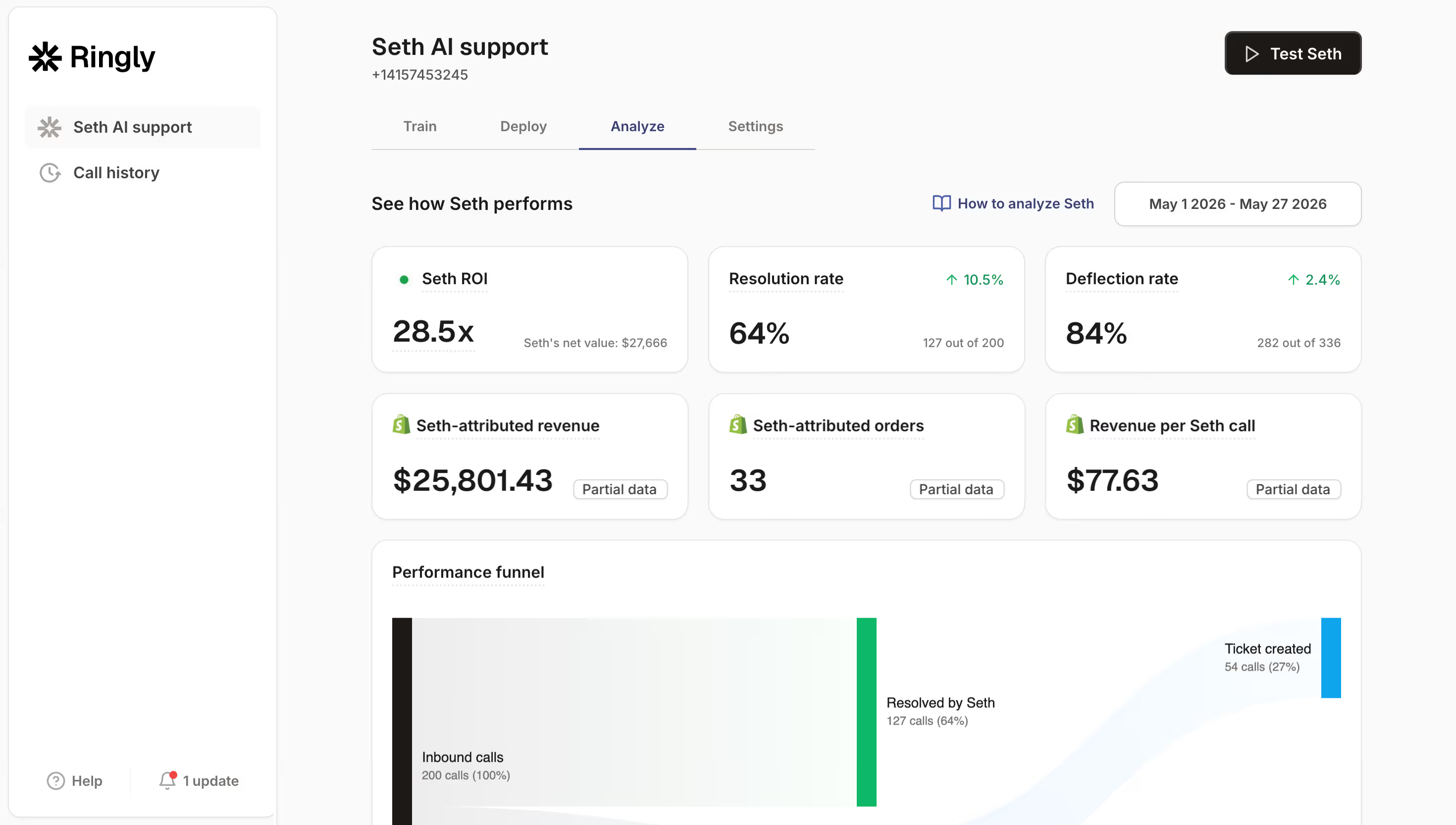
There's a fourth option, and it's the one that scales with the spike instead of fighting it. If you've been weighing 24/7 ecommerce phone support anyway, a migration is the moment it pays for itself. Ringly.io is AI phone support for Shopify brands. Instead of hiring and training a phone team for a temporary spike, the AI handles inbound calls 24/7: order status, returns, product questions, abandoned cart rescue. Across 50+ brands, the AI resolves 73% of calls autonomously at roughly $0.42 per resolved call, versus $7 to $16 per call for a human BPO. It keeps your current phone number and helpdesk, and calls that need a human escalate cleanly to whatever you already run. It's live in under an hour, which matters when the spike is happening now, not next quarter. The AI phone agent for Shopify plugs straight into your store data, so it can answer order questions on day one of the new site. If you want the background, see how AI voice agents handle ecommerce phone support, why WISMO calls balloon during transitions, and how Shopify voice agents plug into your store.
Ready to keep support covered through your migration? Start a free 14-day trial and have the AI answering calls before your cutover weekend.
The best Shopify migration agencies in 2026
This is a shortlist, not a sales sheet. We're not affiliated with any of these and pricing isn't public for most, so treat every number as a starting point and get a scoped statement of work before you sign anything.
- Netalico: best for mid-market DTC brands ($2M to $50M GMV). Fully in-house team, retainer model around $2,700 to $10,000 per month, strong on Magento and WooCommerce sources. Holds a 5.0 Clutch rating and reports zero organic traffic loss across 50+ migrations, which is the metric that actually matters.
- Swanky: best for Shopify Plus replatforms from legacy systems (Magento, WooCommerce, Neto, SuiteCommerce, PrestaShop). UK, Australia, and France teams, 5.0 Shopify Partner rating across 35 reviews.
- Fyresite: best for US brands prioritizing SEO preservation. Full-service migrations starting around $15,000, with redirect and ranking continuity as a stated focus.
- Arctic Grey: best for enterprise and growth-stage Plus stores with mixed source platforms (Magento, BigCommerce, Salesforce, Lightspeed, NetSuite). Founded 2015, top-ranked on Clutch, reports $1.5B+ generated for merchants.
- Shero Commerce: best for complex Magento and BigCommerce replatforms. 500+ migrations with a structured data-mapping and design-recreation process, strong when the source architecture is messy.
- Eastside Co: best for WooCommerce specialists at the mid-market level, roughly $10,000 to $30,000.
- Cart2Cart and LitExtension: not agencies. These are the self-serve apps for data-only moves when you don't need the rest of the stack.
| Agency | Best for | Source strength | Pricing signal |
|---|---|---|---|
| Netalico | Mid-market DTC $2M to $50M | Magento, WooCommerce | $2.7k to $10k/mo retainer |
| Swanky | Plus, legacy replatforms | Magento, SuiteCommerce | Scoped, not public |
| Fyresite | SEO-preservation focus | Multi-source | ~$15k+ |
| Arctic Grey | Enterprise/growth Plus | Magento, BigCommerce, SFCC | Scoped, not public |
| Shero Commerce | Complex replatforms | Magento, BigCommerce | Scoped, not public |
| Eastside Co | WooCommerce mid-market | WooCommerce | ~$10k to $30k |
For context on how big this shift is: Shopify now holds roughly 28% of the global ecommerce platform market with WooCommerce at about 21%, and Shopify Plus enterprise adoption grew 34% year over year to 47,000+ enterprise stores, much of it driven by brands leaving Magento and Salesforce Commerce Cloud (Shopify statistics 2026). You are not the first store to make this move, which means the playbook is well understood. Use that.
Frequently asked questions
Do I really need a Shopify migration agency? Not always. If you have under 500 SKUs, no custom integrations, and you're comfortable building a 301 redirect map, a migration app plus a freelancer often gets the job done. You need an agency when app debt, integrations, or SEO-sensitive revenue raise the stakes.
How much does a Shopify migration cost in 2026? Self-serve apps run $150 to $500. Freelancer-led moves are roughly $1,500 to $8,000, full-service agencies $8,000 to $30,000, and Shopify Plus or enterprise projects $10,000 to $50,000+. The single biggest cost driver is your source platform and how much app debt you've accumulated.
How long does a Shopify migration take? Simple stores take 2 to 4 weeks, mid-market with custom theme work 4 to 8 weeks, and Shopify Plus or enterprise projects 12 to 24 weeks. Skipping the two-week discovery phase is the fastest way to blow both the timeline and the budget.
Will I lose SEO traffic when I migrate to Shopify? A 5 to 10 percent dip in month one is normal and recovers in three to six months with clean execution. A skipped or sloppy 301 redirect map is what causes the 30 to 50 percent drops that take a year to recover.
Migration app vs agency, which should I use? Apps like Cart2Cart and LitExtension move data for a few hundred dollars and are perfect for simple stores. An agency is worth it when you also need theme rebuilds, integration work, and someone owning SEO continuity end to end.
How do I keep phone support running during the migration? This is the gap most plans miss, because call volume spikes right after cutover. Ringly.io is AI phone support for Shopify brands that handles inbound calls 24/7 and resolves 73% autonomously, so support stays covered while your team focuses on the move. It's live in under an hour, keeps your existing number, and pricing is straightforward on the Ringly pricing page.
What's the biggest reason migrations go over budget? Skipping or rushing discovery. That phase costs $4,000 to $8,000 and roughly two weeks, and it prices everything that follows. Stores that skip it routinely overrun by 30 to 60 percent.
The takeaway
Pick the tier, not the brand. Most "best agency" lists get this backwards: they sell you a logo when the real decision is whether you need an app, a freelancer, an agency, or a Plus partner. Get that right and the rest is execution.
Then protect the two things every guide forgets the moment you go live: your search traffic, with a redirect map you actually tested, and your support volume, which spikes the same week your team is least able to absorb it. Plan both like deliverables, because they are.
If you're moving to Shopify and want phone support that's covered before, during, and after the cutover, start your free 14-day trial of Ringly.io. It's live in under an hour, keeps your current number, and there's a 65% resolution guarantee: if the AI resolves under 65% of your calls in 90 days, we refund the last three months.
Article by Ruben Boonzaaijer. Co-founder of Ringly.io. We build AI phone support for Shopify brands so they can scale support without hiring a phone team.