
Most Shopify Plus stores hit a wall around 10,000 tickets a month. The shared inbox stops scaling. The chatbot starts misrouting. Phone calls go to voicemail at 6pm and the recovery rate quietly tanks.
Here's the thing: Plus support isn't a bigger version of small-store support. It's a different problem. Volume changes the playbook entirely.
In this guide, you'll get the channel mix that actually drives Plus support volume, real cost-per-contact numbers, the tools by channel (helpdesk, chat, AI voice), and the operational structure of a Plus support team that runs cleanly through BFCM. Including the one channel every other ranking article ignores: the phone.
Hear what AI support calls sound like for your store. Just paste your Shopify URL and get sample calls in under 20 seconds, no email required. Listen to demo calls for my store.
Why Shopify Plus customer service is a different problem
When you cross 10,000 monthly tickets, the tools that worked at $1M ARR start breaking. A shared inbox that handled 2,000 tickets cleanly turns into a backlog. Macros that solved 80% of cases at lower volume now miss the long-tail edge cases that flood in during peak.
A few things compound the problem at the Plus tier.
- Multi-store complexity: most Plus merchants run expansion stores in new regions. That fragments routing. A US support team gets EU tickets at 4am. Nobody planned for that.
- BFCM peak volume: traffic spikes 80%+ during BFCM. Shopify Plus brands set the pace (2025 BFCM peaked at $5.1M per minute on the platform). Support volume tracks that curve. If your tools and team aren't sized for it, you eat 4-day response times for two weeks.
- Per-agent pricing punishes seasonal staffing: scaling from 8 agents to 20 for the holidays costs serious money on per-seat tools. Most Plus brands don't realize this until they get the December invoice.
- Phone matters more, not less, at high AOV: the higher your AOV, the higher the phone-call rate per order. A $40-AOV store gets 3% of orders calling. A $250-AOV store gets 12-18%. We'll cover this below.
If you're running Shopify Plus and your ticket volume is climbing past 10K/month, the question stops being "which app should we use?" and becomes "what's the actual operational structure that works at this scale?"
The channels that actually drive Plus support volume
Most "best customer service apps for Shopify" posts list ten tools and call it a guide. But you can't pick tools without knowing your channel mix.
Here's the typical mix at the Plus tier, blended across our customer base and what we see across the industry:
| Channel | Share of total volume (Plus avg) | Cost per contact (human) | Cost per contact (AI) |
|---|---|---|---|
| 40-50% | $5-$15 | $0.50-$2 | |
| Live chat | 15-25% | $4-$12 | $0.30-$1 |
| Social DMs (IG/FB/TikTok) | 10-20% | $5-$15 | $0.50-$2 |
| Phone | 10-30% | $15-$25 | under $1 |
| SMS | 3-8% | $3-$10 | $0.20-$0.80 |
Two things stand out. First, phone has the highest per-contact cost when handled by humans. By a lot. Second, AI on the phone channel is the biggest cost-per-ticket lever in 2026.
Then there's the WISMO problem. "Where is my order?" is the #1 ticket type across every Plus brand we work with. According to Shopify's own WISMO research, WISMO accounts for 30-40% of tickets in normal periods and climbs above 50% during peak. Each WISMO inquiry costs $5-$22 to handle manually.
Run the math on your own store. If you do 30,000 tickets in November and 35% are WISMO at $10 average, that's $105,000 of mostly-routine work in a single month. WISMO is where deflection lives. It's also where AI eats the most labor cost.
We've covered the WISMO playbook in more depth and the broader Shopify customer service response time benchmarks elsewhere on the blog if you want the deeper dive.
The phone channel: the slot most Plus stores ignore
Almost every "best Shopify Plus customer service" article skips the phone channel entirely. They cover email helpdesks, chat widgets, and self-service portals. Phone gets one bullet point or none.
Here's why that's a mistake at the Plus tier.
High-AOV verticals get disproportionate phone traffic. Supplements. Jewelry. Pets. Baby. Skincare. Anywhere AOV runs over $150 and the customer feels real money is at stake, they pick up the phone. Customers calling about a $250 order are 3-4x more likely to repeat-purchase than customers who only emailed. The phone call IS the retention conversation.
After-hours phone is where Plus brands leak money. Your team logs off at 6pm. The phone keeps ringing. If those calls go to a generic voicemail, recovery rates collapse. Industry data on missed-call recovery puts it under 10% when callbacks are delayed past 24 hours. For a high-AOV brand, that's lost cart recovery, lost upsell, and lost CSAT all at once.
Per-call labor cost is the worst in the stack. A US-based human handling phone runs $15-$25 per resolved call. Even an offshore VA setup runs $4-$8. Compare that to a properly-trained AI voice agent running under $1 per resolved call.
This is the gap. AI voice agents can now handle 70-80% of routine inbound calls (WISMO, returns, store hours, product availability) end-to-end. They pick up in under 2 seconds. They look up orders in real time via the Shopify API. They escalate complex calls to humans cleanly. The good ones run at 70%+ resolution.
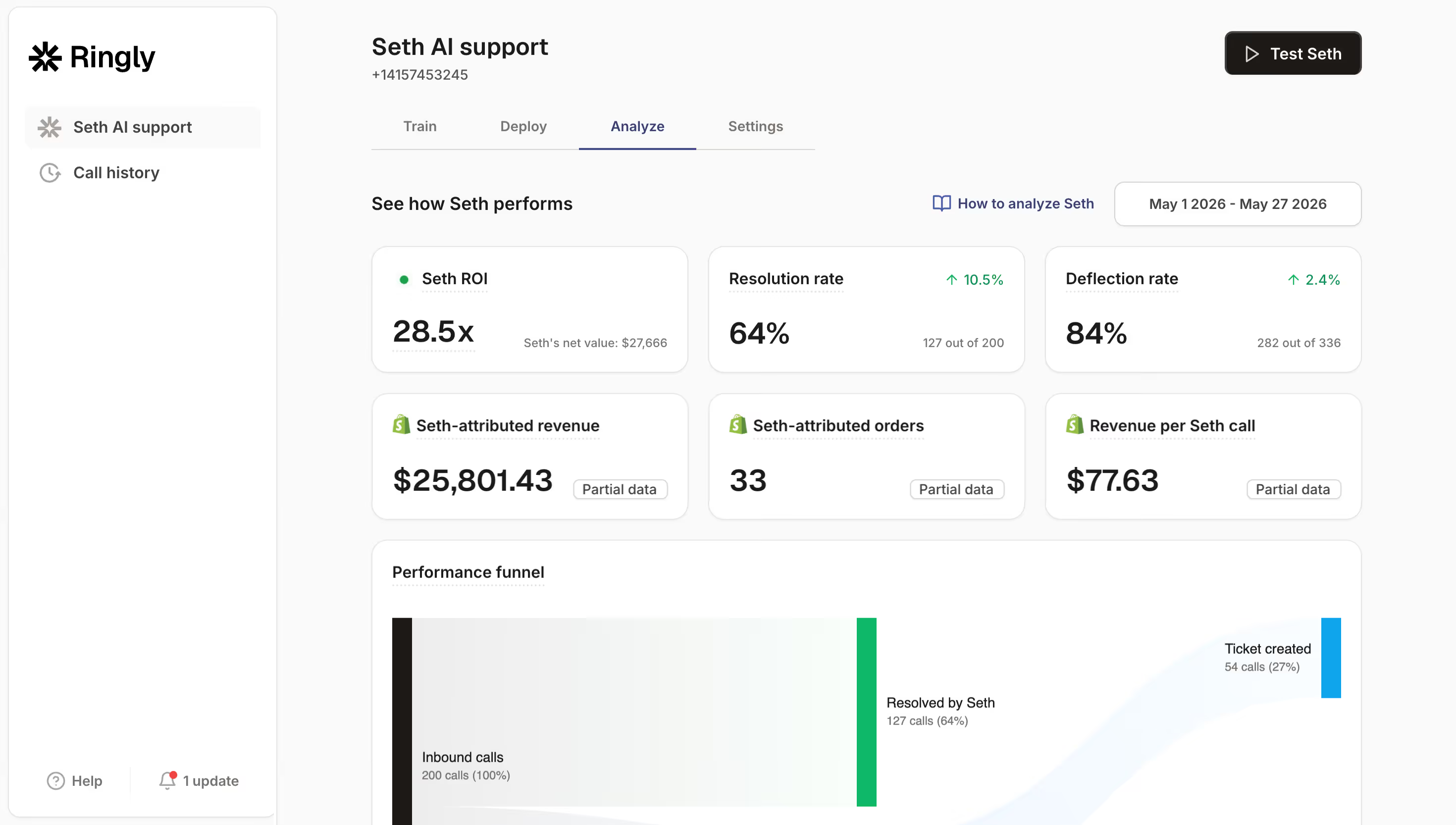
Across the 2,100+ Shopify stores using Ringly.io, the average resolution rate sits at 73% with a 65% money-back guarantee. We cover this in more depth in the AI customer support phone agent for Shopify.
If you're on Shopify Plus and your phone line goes to voicemail after 6pm, you have a recovery problem hiding in plain sight. Try Ringly.io free for 14 days and get Seth answering your calls in under three minutes.
The Shopify Plus customer service stack: tools by channel
The right stack at Plus volume usually involves 2-3 tools, not one. A helpdesk for email/chat/social, an AI voice layer for phone, and sometimes a deflection/self-service portal on top.
Here's how the main options stack up.
1. Ringly.io
Best for: high-AOV Shopify Plus brands handling 1,000-10,000+ inbound calls per month.
Ringly.io is AI phone support built specifically for Shopify. The AI agent, Seth, picks up calls 24/7 in 40 languages, looks up orders via native Shopify integration, processes returns and exchanges, answers product questions, and escalates complex calls to humans. It's used by 2,100+ Shopify stores and resolves 73% of calls without human intervention.
Pricing
| Plan | Price | Minutes (~calls) | Overage |
|---|---|---|---|
| Grow | $349/mo | 1,000 (~500 calls) | $0.29/min |
| Pro | $799/mo | 2,500 (~1,250 calls) | $0.19/min |
| Enterprise | Custom | 5,000+ | Contact sales |
14-day free trial on Pro. Full pricing at ringly.io/pricing.
What works
- Native Shopify integration: pulls live order data, processes returns, checks inventory in real time. No custom dev.
- 65% resolution guarantee: refund of last 3 months of subscription if Seth doesn't resolve 65% of calls in 90 days. Skin in the game.
- 40-language coverage: matters more than people think for Plus brands with EU/Asia expansion stores.
- 3-minute setup: paste your Shopify URL, Seth ingests your store, you're live.
- Smart escalation: complex calls (refund disputes, multi-issue) route to humans by rule, not by accident.
What doesn't
- Voice-first only: not an omnichannel helpdesk. You still need Gorgias / Zendesk / Help Scout for email and chat.
- Newer category for stores that haven't tried AI voice: takes a couple of test calls before you trust it with production volume.
Why it ranks first: at Plus volume, the phone channel is the single biggest unaddressed cost lever. Ringly.io is the only tool in this list that owns it well.
2. Gorgias
Best for: Shopify Plus stores wanting deep helpdesk-Shopify integration on email, chat, and social.
Gorgias is the most Shopify-native helpdesk on the market. Around 40% of the largest Shopify brands run on it. Native order/refund actions live inside the inbox so agents don't bounce between Shopify and a separate tool. Strong macro and automation engine. We have a deeper breakdown in our Gorgias vs Zendesk for Shopify guide and a list of Gorgias alternatives if you're shopping.
Pricing
Ticket-based, not per-agent. Starts at $10/mo (Starter, 50 tickets) and scales up. Most Plus brands run on the higher tiers, often $360-$900/mo depending on volume. G2 rating: 4.4-4.6/5 across 500+ reviews.
What works
- Deepest Shopify integration in helpdesks: order edits, refunds, customer data inline.
- Ticket-based pricing: unlimited seats. Your seasonal team doesn't blow up the bill.
- Strong automation: rule-based macros and AI auto-reply for repetitive tickets.
What doesn't
- Ticket caps create overage anxiety at peak: Black Friday volume can blow past your tier.
- AI deflection plateaus on simple cases: the smart-decline-to-escalate logic still has rough edges.
- No native phone channel: you'll still need Ringly.io or another voice layer for inbound calls.
Why it ranks second: best-in-class for the email/chat/social slice of the Plus stack.
3. Zendesk
Best for: Plus brands with 10+ agent teams, complex routing, and non-ecom support touchpoints.
Zendesk is the enterprise-grade helpdesk. Mature workflows, deep reporting, native voice/chat/email/social. The catch for Shopify Plus brands: the Shopify integration is read-only sidebar. Agents see order data but have to bounce to Shopify to issue refunds or edit orders. We've published a Zendesk alternatives list if you're comparing.
Pricing
| Plan | Price |
|---|---|
| Suite Team | $55/agent/mo |
| Suite Growth | $89/agent/mo |
| Suite Professional | $115/agent/mo |
| Suite Enterprise | from $169/agent/mo |
G2 rating: 4.3/5 across 6,000+ reviews.
What works
- Enterprise reporting: the deepest analytics in the helpdesk category.
- Mature workflows: complex SLAs, multi-team routing, escalation rules.
- Native voice + chat + email + social: closest thing to one platform.
What doesn't
- Sidebar-only Shopify integration: more clicks for routine ecom work.
- Per-agent pricing punishes seasonal staffing: scaling from 10 to 25 agents for BFCM is expensive.
- Steep learning curve: not a 3-minute setup.
Why it ranks third: powerful, but Plus brands often don't need this much tool, and the per-agent pricing hurts at peak.
4. Help Scout
Best for: Plus brands with email-led support and smaller teams (<15 agents).
Help Scout is the lean alternative. Clean shared inbox, knowledge base, decent chat layer. Email is its strongest channel. We've covered alternatives in our Help Scout alternatives roundup.
Pricing
Free up to 50 contacts; Standard $25/user/mo, Plus $50/user/mo, Pro from $65/user/mo. G2 rating: 4.4/5 across 400+ reviews.
What works
- Fast onboarding: minimal training overhead, agents productive day one.
- Clean UI: less click fatigue than Zendesk.
- Knowledge base built in: solid self-service layer without bolting on another tool.
What doesn't
- Per-user pricing penalizes larger teams: the math gets ugly past 15-20 agents.
- Shopify integration is functional but not deep: agents still bounce between systems for refunds.
- No native phone channel: same caveat as Gorgias.
Why it ranks fourth: a great pick for the smaller end of Plus, but underpowered if you're doing 10K+ tickets/month with a 20-agent team.
5. Richpanel
Best for: Plus brands obsessed with self-service deflection.
Richpanel is the AI-and-self-service-first ecommerce helpdesk. The pitch is its self-service portal, which the company says can deflect up to 50% of tickets. Strong native Shopify, multichannel inbox.
Pricing
Self-service Free; Starter $29/agent/mo, Regular $99/agent/mo, Pro $329/agent/mo, custom Enterprise. G2 rating: 4.7/5 across 200+ reviews.
What works
- Deflection-focused architecture: the self-service portal is the most polished in the category.
- Multichannel inbox: email, chat, IG, FB, WhatsApp, SMS all native.
- Strong AI auto-reply: meaningful tier-1 deflection.
What doesn't
- Per-agent pricing: same downside as Zendesk and Help Scout.
- AI voice is not a focus: phone channel is thin.
- Deflection numbers depend heavily on setup quality: getting to 50% requires real config investment.
Why it ranks fifth: solid choice if deflection is your #1 KPI. Less compelling if you want a one-platform experience.
6. Shopify Inbox
Best for: scrappy Plus stores adding chat without spend.
Shopify Inbox is Shopify's free messaging tool. It consolidates chats from your storefront, Facebook Messenger, and Instagram. No email, no phone, very thin automation. Useful as a chat baseline. Not viable as the primary stack at Plus volume.
Pricing: Free for all Shopify customers.
What works
- Free: zero spend.
- Native install: app store quick install, no migration overhead.
What doesn't
- Chat-only: no email, no phone.
- Thin automation: routing logic and macros are minimal.
- Not a Plus-tier primary stack: works as a layer, not as the foundation.
Why it ranks sixth: a useful chat layer for your storefront. Not the answer to "what helpdesk should we run on Plus."
If you want a broader walkthrough of Shopify customer service apps, we've published a tested-and-ranked list.
Operational structure: how Plus support teams actually run
Picking tools is half the work. The other half is the operational structure.
Here's what a clean Plus support team looks like at 10K-30K tickets/month.
- Tier 1 (60-70% of agents): handle WISMO, returns, simple product questions, basic order edits. Heavy macro and template use. AI deflection lives here. This is where AI voice on the phone channel slots in.
- Tier 2 (20-30% of agents): complex returns, refund disputes, fraud, escalated complaints. Faster keystroke productivity but slower per-ticket time.
- Specialist roles (5-10% of agents): VIP tier, B2B/wholesale, multi-region edge cases, escalations from social.
- Lead/manager (1-2 per 15-20 agents): QA, coaching, reporting, vendor relationships.
A few rules of thumb at Plus scale.
- Peak staffing math: BFCM volume runs 2.5-4x your November baseline. If you average 8 agents, you need 20-32 effective seats during peak. Mix of full-time, seasonal, offshore, and AI deflection.
- After-hours coverage: your phone channel is dead at 7pm Eastern unless you've built coverage. Options: offshore VA shifts, callback queue, or AI voice handling everything. AI voice is the lowest-cost path. We've written more on after-hours answering services.
- Multi-store routing: tag tickets by store at intake. Route by region. Don't make a US-day-shift agent answer EU-morning emails about a different brand.
- Documentation discipline: macros only work if your KB is current. Weekly KB review at the lead level. This is where most Plus teams quietly fall behind.
We cover the shopify call center operational model and how to handle high call volume in ecommerce if you want to dig deeper into the staffing math.
KPIs that actually matter at Plus scale
You can drown in dashboards. The Plus brands that run cleanly track a tight handful of metrics.
- First contact resolution (FCR): target 65-75% across all channels. Below 60% means your tier-1 macros and KB are stale.
- Average response time by channel: phone <30 sec to answer, chat <2 min, email <4 hr. 67% of customers expect a resolution under 3 hours, per Shopify's 2026 data.
- Cost per contact: track separately by channel. The cost-per-channel gap (email $10 vs phone $20 vs AI phone <$1) is where your biggest margin lever lives.
- Ticket-per-order ratio: target under 0.5 (meaning fewer than 1 ticket per 2 orders). Above 0.7 signals product, fulfillment, or comms issues upstream of support.
- CSAT and post-resolution NPS: track per channel. Phone CSAT typically beats chat and email when the call gets resolved.
- Phone-channel KPIs: average call duration (target 90-180 sec for routine), abandonment rate (under 5%), resolution without transfer.
We have a deeper customer service KPIs for ecommerce breakdown if you want the full benchmark sheet.
How to choose the right Shopify Plus customer service stack
The Plus stack is rarely one tool. It's usually two or three.
- Choose Ringly.io if your phone volume is meaningful (1,000+ calls/month), AOV is $100+, or after-hours phone goes to voicemail today.
- Choose Gorgias if you want the deepest Shopify integration on email/chat/social and seat-based pricing punishes you.
- Choose Zendesk if you have 10+ agents, complex multi-team routing, or non-ecom support volume.
- Choose Help Scout if you're email-led with a small team and value fast onboarding over deep config.
- Choose Richpanel if deflection is your #1 KPI and you have the time to invest in self-service portal config.
- Choose Shopify Inbox as a free chat layer on your storefront, never as the primary stack.
The most common Plus stack we see in the wild: Gorgias for email/chat/social, Ringly.io for phone, Shopify Inbox as the storefront chat hook. Three tools, none of them stepping on each other.
Try Ringly.io free for 14 days and get Seth answering your calls in under three minutes. Setup is the same whether you're on $1M ARR or $50M.
Frequently asked questions
What's the average ticket volume for Shopify Plus stores?
Most Plus brands handle between 5,000 and 30,000 tickets per month. The 10K mark is where most SMB-tier tools start breaking, especially during BFCM when volume spikes 2.5-4x. Expansion stores in new regions usually add another 15-25% on top.
How is Shopify Plus customer service different from regular Shopify support?
Shopify Plus merchants get dedicated Plus Support Advisors with priority phone, chat, and email. Standard Shopify is mostly chat-based now. From the merchant side, Plus customer service operations are different too: higher volume, multi-store complexity, BFCM peak spikes, and a phone channel that quietly drives 10-30% of contact volume.
What's the best customer service app for Shopify Plus?
There isn't one. The best Plus stacks usually combine a helpdesk (Gorgias for Shopify-native, Zendesk for enterprise reporting, Help Scout for lean teams) with an AI voice layer (Ringly.io) for phone. One tool can't cover all four major channels at Plus volume well.
How do I handle phone support at Shopify Plus scale?
Three options at Plus volume: hire an in-house phone team, outsource to a BPO, or run an AI voice agent. AI voice is the lowest cost-per-call and handles 70-80% of routine WISMO and returns calls. We've covered the phone tree vs AI phone agent trade-off in detail.
How much does customer service cost at Shopify Plus volume?
At 15K tickets/month, a typical Plus support operation runs $25,000-$75,000/month in fully-loaded labor + tools. The biggest cost lever is channel mix: pushing phone calls to AI voice cuts per-call cost from $15-$25 to under $1. That alone can save $10K+/month on a Plus volume profile.
Can AI handle WISMO calls for a Plus store?
Yes, and it's the highest-ROI use case. WISMO is 30-40% of tickets in normal periods and over 50% during peak. AI voice agents pull live order data from Shopify, give the customer the tracking link or status, and resolve in under 90 seconds. Top Plus brands now route 70-80% of WISMO calls to AI.
How do I prepare customer service for BFCM as a Plus merchant?
Three moves: lock in seasonal staffing by mid-October, push WISMO deflection (proactive SMS tracking + AI voice + self-service portal) before traffic spikes, and load-test your helpdesk and phone tools at 3x your November baseline. Most BFCM support disasters come from underestimating the phone channel.
The bottom line
Shopify Plus support isn't a bigger version of small-store support. It's a different problem with different economics, different channels, and different tools.
The brands that get it right cover all four major channels with the right tool for each. They don't ignore the phone channel. They track cost-per-contact like a P&L line. And they treat WISMO deflection as a top-3 priority, not an afterthought.
If you're running Shopify Plus and your phone line goes to voicemail at 6pm, that's the easiest fix in your stack. Start your free trial of Ringly.io and get Seth answering calls by this afternoon.