
Most Shopify stores walk into BFCM with a staffing plan built on hope. Then the wave hits. Ticket volume triples in 48 hours, the phones go dark for two days straight, CSAT tanks before anyone catches their breath, and the founder is taking calls at 1 AM on Cyber Monday.
Here's the harder truth: the math is usually off from the start. Hire too few, your team burns out before December 10. Hire too many, you're paying people in January with no tickets to work. And almost nobody plans for the returns wave that lands the week after Christmas, which is often bigger for support volume than the actual sales week.
This guide gives you the real headcount formula, a 6-month prep calendar, and the channel mix that actually scales (including the phone channel everyone underestimates). We'll cover what to staff, when to hire, and where AI voice fits as the elastic layer that absorbs the spike without burning your seasonal team or your budget.
Hear what AI support calls sound like for your store. Just paste your Shopify URL and get sample calls in under 20 seconds, no email required. Listen to demo calls for my store.
Why peak season breaks Shopify support teams
The volume math is what gets everybody. BFCM weekend hit $14.6 billion in Shopify sales in 2025, up 27% year over year, with 81 million shoppers buying across 94,900+ merchants (Shopify, BFCM 2025 data). All that revenue brings tickets. A lot of tickets.
Most stores see support volume jump 2.5x to 4x their normal baseline during the peak window. LiveAgent's holiday surge data puts the broader number at 200-300% above normal for the full Thanksgiving-through-Christmas stretch. Shopify Enterprise pegs the first week of December alone at a 79% spike. Pick your favorite source. They all say the same thing: get ready for two to four months of intensity, not just one weekend.
But raw volume isn't the real problem. The channel asymmetry is.
Email and chat queue gracefully. A 30-minute response time on email feels normal to most customers. A 2-minute wait on chat is fine. But phone? Phone is the channel that punishes you the second you understaff it. A missed call doesn't go in a queue. It goes to a competitor, a chargeback, or a one-star review.
WISMO (where is my order) makes it worse. Under normal conditions, "where is my order" is about 40% of your inbound. During peak, that climbs to 50-60% across every channel, and on phones it can hit 70% in the week after Black Friday. Most stores throw human agents at it. You're paying $20/hour for a real person to read off a tracking number that the customer could have found on a self-serve page.
Then there's the seasonal-hire trap. New CSRs take two to three weeks to get productive. Peak runs maybe four weeks. By the time your new hires are useful, you're already past the worst of it. And you've spent $7,000-$11,000 fully loaded on each one.
The fix isn't more humans. It's a smarter mix.
The real headcount formula (what peak actually demands)
You can't plan for peak with vibes. Here's the formula every Shopify operator should run before opening any seasonal requisitions.
Step 1: pull last year's BFCM ticket count by channel. If you don't have data because you launched this year, take your current monthly baseline and multiply by 2.5. That's your starting estimate.
Step 2: apply the peak multiplier per channel:
| Channel | Multiplier vs. baseline |
|---|---|
| 2.5x | |
| Chat | 3x |
| Phone | 3-4x at worst stretch |
| Returns (post-Dec 26) | 2.5-3x for 2 weeks |
Step 3: divide by agent productivity. Industry benchmarks: 4-6 tickets per agent per hour, or 6-10 calls per agent per hour. Newer hires fall to the low end. Trained agents hit the high end.
Step 4: add 20% buffer for shift coverage, sick days, escalations, and the inevitable "we underestimated this" moment.
Worked example for a 1,000-ticket/month store:
- Baseline: 1,000 tickets/mo split 60% email, 30% chat, 10% phone
- Peak volume: 2,500 email + 900 chat + 400 phone = 3,800 tickets over an 8-week window
- Tickets per hour per agent: 5 average
- Hours needed: 3,800 ÷ 5 = 760 hours over 8 weeks = 95 hours/week
- Effective seats: 95 ÷ 32 (productive hours/week per agent after breaks, meetings) = 3 full-time-equivalent seats baseline, peaking at 5-7 during the worst stretch with shift coverage
If you're running that math and the number is more than you can afford to hire, AI voice closes the phone-channel gap for $349/mo. Hear how it sounds for your store.
The 6-month peak prep calendar
The brands that ride the wave well plan in Q2. The brands that drown plan in Q4. DesignRush ran a 2026 readiness study and found teams that started planning in March maintained quality through peak. Teams that started in October burned out by Cyber Monday.
Here's the calendar that works.
| Month | Focus |
|---|---|
| May-June | Forecast volume from last year. Decide AI vs. human ratio. Approve budget. |
| July | Audit help docs, KB, macros. Refresh shipping and return policies. Build out FAQ pages. |
| August | Open seasonal hiring requisitions. Lock outsourcing contracts. Set up AI voice trial. |
| September | Onboard seasonal hires. Lock shift schedules. Load-test helpdesk at 3x baseline. |
| October 1-15 | Dry-run BFCM scenarios. Configure escalation paths. Train AI agents on holiday FAQs. |
| October 15-31 | Lock everything. No new tools, no new processes after this point. |
| November | Pre-BFCM warm-up (volume lifts 20-30% mid-November). Daily standups. |
| December | Hold the line. Watch CSAT and FRT. |
| January 1-15 | The returns wave. 2-3x normal volume. Keep AI voice running. |
The hardest part isn't the work. It's the discipline to actually lock the plan by October 31. Most stores keep tweaking through November, which means new hires are still learning new tools the week of Black Friday. That's where things break.
If you're starting the calendar mid-year, prioritize hiring and AI voice setup first. Help docs and KB cleanup can run in parallel. Everything else flexes around those two anchors.
The 4-layer channel mix that actually scales
No single channel or team can absorb a 4x volume spike. The brands that handle it cleanly stack four layers, each one catching what the previous one couldn't.
Layer 1: self-serve (target 40-60% deflection)
The cheapest ticket is the one that never gets created. Self-serve eats 40-60% of peak volume if your pages are good.
The basics: a real order tracking page, an updated FAQ that answers the actual questions people ask, a clear shipping policy (try the shipping policy generator if you need a template), and a self-serve return portal (the return policy generator helps here too).
Cost: near-zero. Effort: one week to refresh in August.
Layer 2: AI chat (20-30% of remaining volume)
Most Shopify stores already run Gorgias AI or Zendesk AI on chat. If you don't, plug one in by July. AI chat catches the next 20-30% of volume after self-serve, especially on order status, product questions, shipping ETAs, and return initiation.
Cost: $0.40-$1.00 per AI resolution depending on platform. Worth every penny against a $15-25 fully-loaded human cost per ticket.
The limitation: text only. AI chat doesn't pick up the phone. Which is where Layer 3 comes in.
Layer 3: AI voice (70-73% of phone volume)
This is the layer almost nobody is using yet, and it's the one that matters most for 2026 peak.
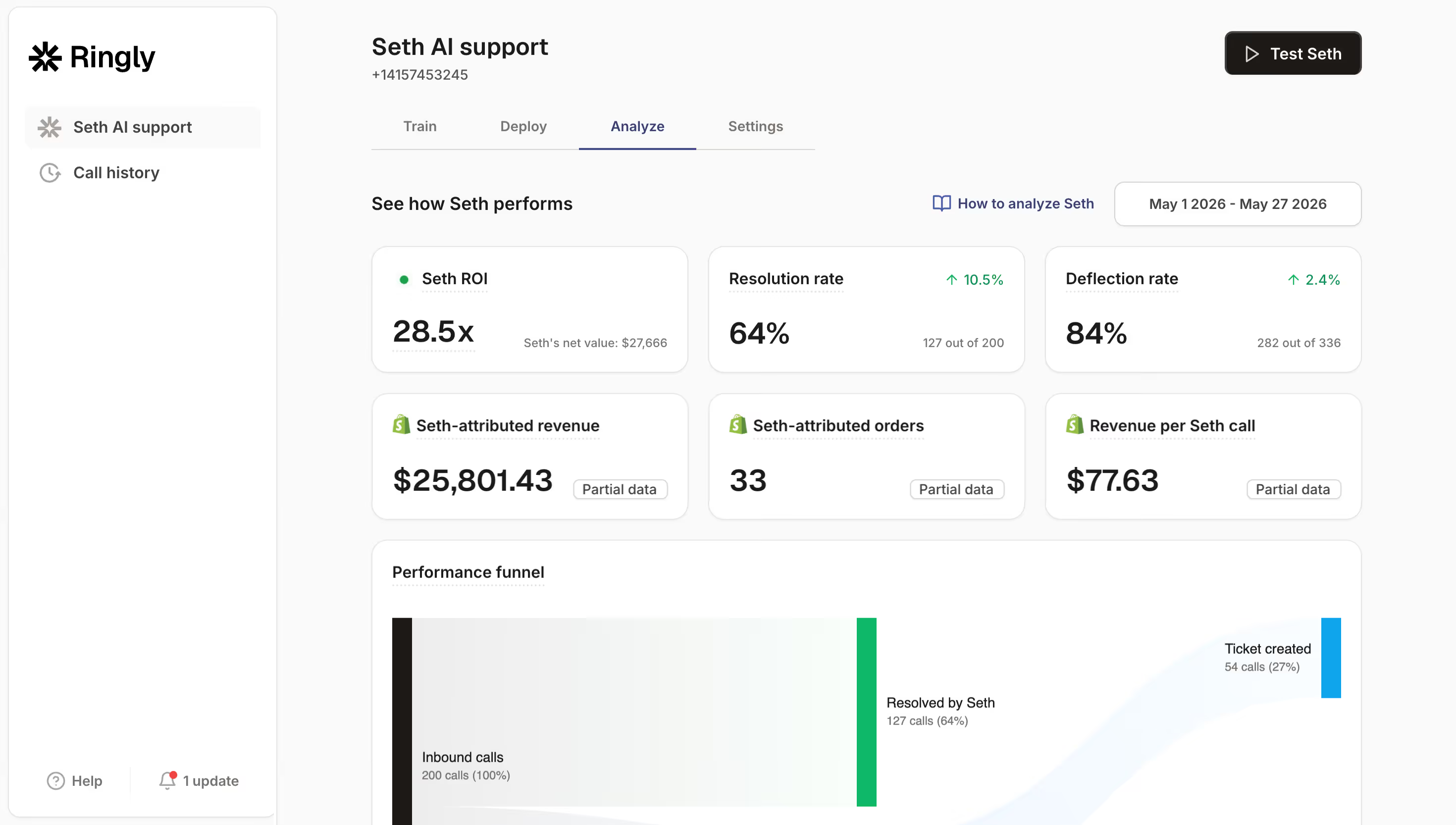
Ringly.io runs Seth, an AI phone agent for Shopify stores. Seth handles 73% of inbound calls automatically (order status, returns, shipping ETAs, simple order changes) and routes anything complex to a human. Setup takes about three minutes and plugs into Shopify natively.
Pricing is flat: $349/mo on Grow (1,000 minutes, ~500 calls), $799/mo on Pro (2,500 minutes), Enterprise custom for 5,000+. No per-seat scaling during BFCM. No surprise overage fees if your seasonal hires miss a shift.
The other thing AI voice does that humans can't: it stays on through January. The returns wave doesn't care that your seasonal team rolled off Dec 28. Seth keeps picking up. More on the returns wave in a minute.
Layer 4: human agents (the remaining 10-30%)
After the first three layers catch what they catch, your humans are left with the work that justifies their cost: complex returns, VIP customers, anything emotional, real product expertise calls. This is where your full-time team and any seasonal hires actually earn their keep.
Cross-train marketing, fulfillment, and ops on tier-1 support. During the worst 48 hours, you'll want people who can flex in.
Ready to see what the phone layer looks like for your store? Setup takes about three minutes. Listen to demo calls for your store.
Phone is the channel everyone underestimates
Most peak season guides spend 80% of their word count on email and chat. Phone gets a paragraph at the end. That's backwards.
Phone is 10-30% of total contact volume for Shopify Plus brands during BFCM, and 5-15% for smaller stores. It's a higher share in categories like supplements, baby, pets, and anything with returns complexity. The shopify call center breakdown has more on volume by category.
And phone is the only channel that can't queue gracefully. Email at 24-hour response feels fine to most customers. Chat at 5 minutes is OK. Phone at 60 seconds is borderline. Phone at 5 minutes is a lost customer.
WISMO drives 40-60% of phone volume during peak (see our WISMO calls breakdown and the WISMO automation guide for what to deflect). These are the easiest calls to automate. They're also the calls where customers feel best about an AI answer, because they just want a fast tracking number.
Salesforce's 2025 holiday data backs this up. They reported AI agents handled 142% more tasks (returns and shipping updates leading the list) compared to the prior two months, with no additional headcount required (Salesforce Cyber Week 2025). That's the playbook.
The asymmetry on hiring is brutal too. Phone-capable CSRs cost 1.5-2x a chat-only CSR. Their training takes longer because phone is harder to QA. Replace one, and you're looking at $10,000-$20,000 in turnover cost. AI voice doesn't churn.
Cost comparison: human seasonal seat vs. AI voice
Let's put numbers on it. Take a $2M GMV Shopify store expecting 1,500 inbound calls during the 8-week BFCM peak window.
| Model | Cost | Coverage | Notes |
|---|---|---|---|
| 5 seasonal CSRs in-house | $35K-$55K | 8 weeks, business hours | Recruit, train, wages, benefits. Drops off Jan 1. |
| 3 BPO outsourced agents | $24K-$43K | 8 weeks, business hours | Loses brand voice. Generic responses. |
| AI voice (Grow) + 1 human escalator | $1,047 + ~$8K = ~$9K | 24/7, year-round | Handles 73% of calls. Scales infinite. |
| Hybrid: AI voice + 2 seasonal phone CSRs | $1,047 + $15K-$22K = $16K-$23K | 24/7 + daytime humans | Best balance. |
A few caveats so the math doesn't lie.
AI voice doesn't replace humans for complex emotional calls. It absorbs the volume so humans can focus. You still need at least one human on call for escalations.
Seasonal CSR estimates include $3,000-$4,000 recruiting and onboarding plus 8-10 weeks of wages, benefits, and management overhead. Some sources put it lower for entry-level remote roles. Some put it higher in high-cost-of-living markets. The full breakdown is in the Shopify customer service cost guide.
Outsourced BPO can work if you find a partner that takes the time to learn your brand. Most don't. You get generic responses, miss product nuance, and customers can tell.
For the cleanest math on AI voice specifically, see voice AI pricing and AI voice agent pricing.
The January returns wave nobody plans for
Here's the part most BFCM playbooks skip. The peak isn't over on December 24. It just shifts channels.
Returns spike hard from December 26 through mid-January. Salesforce tracked $181 billion in returned merchandise during the 2025 holiday season, a 14% return rate of all purchases and a 10% increase year over year. That volume hits customer support directly, mostly as "where is my refund" calls, exchange questions, and angry "I never got this" inquiries.
Most seasonal teams roll off by January 1. Most BFCM playbooks end at Dec 24. So you have a 2-3x normal volume spike with a depleted team. CSAT tanks in the worst window of the year, which is also when angry customers leave reviews that hurt you in January marketing.
The fix is three moves.
First, keep your AI voice layer running through at least mid-January. The pricing is flat regardless, so it costs you nothing to leave it on.
Second, retain 1-2 of your better seasonal hires as part-time through January 15. Most are happy to keep the hours. Some you'll want to convert to full-time anyway.
Third, set up a real self-serve return portal in Shopify before November. The Shopify returns app options and ecommerce returns management guide cover the setup. Self-serve eats 50%+ of Jan return volume if it's good.
KPIs to track during peak
You can't manage what you don't measure. These are the metrics that matter during the spike. Track them daily, not weekly.
- First Response Time (FRT): under 15 minutes for chat, under 60 seconds for phone (AI voice picks up instantly), under 24 hours for email. Full benchmarks in our response time benchmarks guide.
- Average Handle Time (AHT): should hold steady or improve. A spike means your team is burning out and skipping steps.
- CSAT: 90%+ target during peak (MarketingLib benchmark). Track daily, not weekly.
- First Contact Resolution (FCR): 80%+ for tier-1 questions. Below that, your help docs need work.
- Ticket Backlog: never exceed 1.5x daily intake. Above that, you're in compounding catastrophe territory.
- Phone Answer Rate: 95%+ target. Below that, you're losing customers. AI voice hits 100% by design.
- Cost per Resolution: monitor AI vs. human cost. Push deflection where it makes sense.
Common peak staffing mistakes
The same seven mistakes show up every November. None of them are subtle.
- Hiring in October. Too late. Training eats your runway. Lock seasonal hires by August at the latest.
- Ignoring the phone. Email and chat queue gracefully. Phone doesn't. A missed call is a lost customer, not a delayed reply.
- Trusting AI chat to handle phone. Different channels, different tech. AI chat doesn't pick up the phone. You need AI voice for that.
- Forgetting January. Returns wave hits when your team is gone. Plan for it in August, not December 27.
- Per-seat helpdesk panic. Adding 5 Zendesk seats for 8 weeks of peak often bills you for the year. Read the contract.
- No load test. First time your helpdesk handles 3x volume should not be Black Friday morning.
- No escalation path. Tier-1 agents drowning in tier-3 issues because nobody defined the handoff before peak started.
If your phone strategy still depends on a seasonal hire who hasn't been trained yet, Ringly.io handles 73% of your phone volume automatically with a 65% resolution guarantee within 90 days. Start your free trial and get Seth answering your calls before your seasonal hires even start.
Frequently asked questions
How much does Shopify peak season support staffing cost?
For a $2M GMV store, expect $35K-$55K for 5 seasonal CSRs over 8 weeks, plus helpdesk overages and management overhead. AI voice cuts that bill by 60-80% by absorbing WISMO and tier-1 phone volume year-round at $349-$799/mo flat.
When should I start hiring for BFCM?
Open requisitions in August, onboard in September. By October, the best seasonal staff is already taken by competitors, and you won't have enough runway to train before peak hits in late November.
How many support agents do I need for BFCM?
Multiply your monthly baseline ticket count by 2.5-4x, divide by 4-6 tickets per agent per hour, then add 20% buffer for shift coverage. A 1,000-ticket/mo store typically needs 12-15 effective seats during the worst weeks of peak.
What is WISMO and why does it matter at peak?
WISMO stands for "where is my order" and accounts for 40-60% of peak phone volume across Shopify stores. It's also the easiest category to deflect with self-serve tracking pages, AI chat, or AI voice, which is why automating it is the highest-ROI move for peak.
Can AI handle phone calls during BFCM, not just chat?
Yes. AI voice agents like Seth on Ringly.io handle 73% of inbound phone calls automatically (order status, returns, shipping ETAs) and escalate the rest to humans. Setup takes about three minutes and the system stays live 24/7.
What's the difference between AI chat and AI voice?
AI chat handles text channels (live chat, messaging widgets, sometimes email). AI voice handles inbound phone calls in real time. They solve different problems, and most Shopify stores running peak season need both layers, not just one.
How do I plan for the January returns wave?
Keep AI voice running through mid-January, set up a self-serve return portal in Shopify before November, and retain 1-2 of your better seasonal hires as part-time through Jan 15. Expect 2-3x your normal volume from Dec 26 through Jan 15.
What if I'm too small for seasonal staffing?
Under 500 tickets/mo, you probably don't need to hire humans at all if your channel mix is right. Self-serve plus AI chat plus AI voice handles the spike, and your existing 1-2 humans take escalations. See AI phone agents for Shopify for the small-store setup.
The takeaway
Peak season is a planning problem, not a hiring problem. The brands that survive BFCM and the January returns wave aren't the ones with the biggest seasonal teams. They're the ones that locked the math in May, layered self-serve + AI chat + AI voice + a small human core, and refused to add new tools after October.
The cheapest seat you can add for peak is an AI voice agent that handles 73% of phone volume, scales infinite during BFCM, and stays live through the entire returns wave. It doesn't burn out. It doesn't roll off Dec 28. It costs less for the full quarter than one seasonal hire costs for one week.
Try Ringly.io free for 14 days. Setup takes three minutes, and Seth answers your phone before your seasonal hires finish onboarding.