


Magento isn't dying. That's a myth people repeat in agency pitches.
What's actually happening is more boring and more expensive. Magento 2.4.x still ships patches, Adobe Commerce still has releases, and about 100,000 stores still run on it in early 2026. The platform works. The math doesn't.
Three years of hosting, security patches, agency retainers, and extension licenses on Adobe Commerce can run anywhere from $225K to $975K (according to a 2026 ECommerce Partners TCO breakdown). The same window on Shopify Plus lands between $123K and $285K. That gap is what's pushing mid-market merchants off Magento, not feature envy.
This guide walks through the full Magento to Shopify Plus migration. The real 2026 pricing. The week-by-week timeline. What moves and what doesn't. The SEO playbook that keeps your rankings intact. And the one part every other guide skips: the customer-support spike during cutover week, which can break your team if you don't plan for it.
Hear what AI support calls sound like for your store. Just paste your Shopify URL and get sample calls in under 20 seconds, no email required. Listen to demo calls for my store.
Why merchants are leaving Magento for Shopify Plus in 2026
Magento built its reputation on flexibility. You could customize anything, integrate anything, ship anything. The trade-off was engineering overhead. Patches, hosting, security audits, custom extension maintenance. A stack that needs a full-time DevOps lead just to keep alive.
That trade-off used to be worth it. In 2026, fewer merchants think so.
A few numbers tell the story:
- Magento has roughly 100,000 live stores in early 2026, down from about 250,000 five years ago
- A fully loaded Adobe Commerce deployment can run $325,000+ per year all-in (platform license, hosting, dev retainer, extensions)
- The Shopify Plus equivalent runs $41K to $95K per year for similar functionality
- Shopify Plus's Winter 2026 Edition shipped 150+ updates, including native B2B improvements that closed long-standing gaps
Here's the operator-level take. If your engineering team spends more time on Magento maintenance than on features that drive revenue, the platform is costing you twice. Once in dev hours. Once in opportunity cost.
The decision isn't usually "Magento is broken." It's "we can't keep paying this tax." For most mid-market brands doing $5M to $100M in GMV, the Shopify Plus features story now covers 80% of what they actually use Magento for, and the rest can be solved with apps or custom dev.
Magento vs Shopify Plus at a glance
Quick side-by-side, fair to both platforms.
| Dimension | Magento (Adobe Commerce) | Shopify Plus |
|---|---|---|
| Architecture | Self-hosted or Cloud, open-source core | Fully hosted SaaS |
| Starting platform cost | $40K-$200K/yr license (Adobe Commerce); $0 (Open Source) | $2,300/mo on 3-yr term, $2,500/mo on 1-yr |
| Hosting | Self-managed or Adobe Cloud (extra) | Included |
| Security patches | Manual, ongoing | Automatic |
| Customization ceiling | Very high (open core) | High (Liquid, Functions, Hydrogen, Plus Certified Apps) |
| B2B | Native module, very flexible | Native B2B included, improved Winter 2026 |
| Checkout | Fully customizable | Checkout Extensibility (Plus only) + Branding API |
| Page speed | Depends on hosting + theme | Generally faster out of the box |
| Time to launch | 3-12 months typical | 6-16 weeks typical |
| Support | Agency-dependent | 24/7 Plus support + Merchant Success Manager |
What you gain. Predictable monthly cost. Hosting and security off your plate. Faster page speeds. A native Shopify Plus customer service toolset. A massive app ecosystem.
What you lose. Some URL flexibility. Deep checkout customization unless you adopt Checkout Extensibility. Certain Magento extensions have no direct equivalent. Multi-store architecture caps at 9 expansion stores (vs unlimited on Magento).
That second list isn't trivial. Skipping it would make this guide one more pile of marketing copy. The honest answer is most operators trade those losses gladly for the cost and speed wins.
The true cost of a Magento to Shopify Plus migration
The visible cost is the $2,300/month Shopify Plus subscription. The invisible costs are bigger.
There are three buckets to plan.
1. The Shopify Plus platform itself (2026 pricing)
| Item | Cost |
|---|---|
| Shopify Plus (3-yr term) | $2,300/mo |
| Shopify Plus (1-yr term) | $2,500/mo |
| Variable platform fee | 0.25% of GMV above ~$1M/mo |
| Extra expansion stores | $250/mo each beyond 9 included |
| Shopify Payments transaction fees | Varies by country (typically 2.15% + $0.30) |
| Third-party processor surcharge | 0.20% to Shopify on top of processor fees |
Source: Shopify Plus pricing page, May 2026.
2. The migration project
| Project Size | Total Cost | Timeline |
|---|---|---|
| Focused DTC catalog, low custom logic | $50K-$120K | 8-12 weeks |
| Mid-market DTC with apps + light B2B | $120K-$250K | 12-16 weeks |
| Complex B2B + DTC + ERP/OMS integrations | $250K-$400K+ | 16-24 weeks |
Integration rebuild typically eats 30-40% of that project budget. ERP connectors, OMS handoffs, ESP migrations, custom search. That's where unplanned hours show up.
3. Ongoing operating costs
- Apps: $500-$3,000/mo for a mid-size store, more for enterprise
- Dev retainer or in-house: $10K-$30K/year (vs $20K-$80K on Magento)
- A merchant success manager comes included with Plus
The hidden bucket: customer support. Cutover triggers a 2-3 week call spike. Forced password resets, "where's my order" calls, account confusion. Nobody bakes this into a migration budget but everyone pays for it one way or another. We cover this in detail below.
For a deeper read on platform pricing, see our breakdown of Shopify Plus pricing and our guide to voice AI pricing for the support side.
How long does a Magento to Shopify Plus migration take?
The honest answer is: it depends on your stack.
Three timelines that map to real projects:
- 8-12 weeks for a focused DTC catalog, basic apps, one storefront, no custom checkout logic
- 12-16 weeks for a mid-market merchant with light B2B, a few custom integrations, multi-language
- 16-24 weeks for a complex B2B + DTC operation with ERP, OMS, WMS, custom search, multi-region
Mejix publishes a phased week-by-week breakdown that maps cleanly to most projects:
| Phase | Weeks | What happens |
|---|---|---|
| Discovery | 1-2 | Audit Magento, document custom logic, map data |
| Architecture | 3-4 | Theme decisions, app stack picks, integration design |
| Build | 5-8 | Theme dev, app configuration, custom Functions/scripts |
| Data migration dry run | 7-10 | First full data import to staging, reconcile against Magento |
| Integration wiring | 9-12 | ERP, OMS, ESP, search, helpdesk connectors |
| UAT + performance | 11-14 | Stakeholder testing, load testing, security scan |
| SEO + redirects | 13-15 | Full 301 map, schema markup, on-page meta |
| Cutover | 14-16 | DNS flip (2-4 hours), monitor, fix any 4xx errors |
The cutover itself is usually a Saturday morning, takes a few hours, and is the calmest part of the project if the rehearsal was done twice on staging. Most chaos happens in the two weeks after, not on launch day.
Don't compress the timeline. Two-month emergency migrations exist, but they trade SEO recovery, data reconciliation, and customer comms for speed. You pay later.
What actually moves (and what doesn't)
Most operators assume data migration is a copy-paste job. It isn't. Shopify and Magento speak different data languages, and some things either don't port at all or need careful handling.
Quick reference table:
| Entity | Moves? | Notes |
|---|---|---|
| Products | Yes | Magento configurable products convert to Shopify variants (100 variant max per product) |
| Customer accounts | Yes | Profiles port, but passwords do not |
| Customer passwords | No | Magento bcrypt salts don't decrypt. Every customer gets a forced reset |
| Order history | Yes | Often imported as archive (searchable, non-operational) to avoid billing/fulfillment chaos |
| URLs | Manual | You build the 301 redirect map. Critical for SEO |
| Reviews | Manual | Yotpo, Judge.me, Junip all have importers |
| Blog content | Yes | Manual cleanup almost always needed |
| Subscriptions | Special handling | Recharge or Skio, with subscriber token re-auth |
| Gift cards | Partial | Active balances move, codes change |
| Coupons / promo rules | Partial | Logic rebuilds on Shopify Functions |
| Custom Magento modules | No | Need a Shopify app, a Function, or custom dev |
| SEO meta (titles, descriptions) | Manual | Recreate verbatim. Don't "improve" at launch |
A few of these deserve a real conversation.
Configurable products. Magento merchants who sold "size + color + material" with 200 variants per parent will hit Shopify's 100-variant cap. Workarounds: use metafields, split into related products, or use a third-party variant app.
Passwords. This single technical detail causes more support-ticket pain than anything else. Communicate the forced reset clearly in pre-launch emails. Many brands send a "we're upgrading, here's what's new" email two weeks before cutover that pre-positions the password reset as part of the upgrade, not a bug.
Subscriptions. If you run Magento subscriptions, the migration to Recharge or Skio requires careful token handling. Done wrong, you churn 10-15% of subscribers in the first 30 days. Done right, the lift is invisible to customers.
Custom modules. Audit your Magento extensions before you start. Some have direct Shopify equivalents. Some need rebuilds. A few have no replacement and force a workflow change.
The SEO playbook: don't lose your rankings
This is the single biggest risk of any replatform.
Done right, organic traffic stabilizes within two weeks and grows within 60 days. Done wrong, you lose 30 to 50% of organic traffic and never fully recover. The difference is execution, not luck.
Here's the playbook.
1. Export every indexed URL from Google Search Console. Pull the last 16 months of URL-level data. Sort by clicks and impressions. The top 1,000 URLs drive most of your traffic. They need 1:1 redirects.
2. Build the full 301 redirect map. Every product URL, collection URL, blog post URL, and high-traffic content page maps to the Shopify equivalent. Map all of it before launch, not after. Shopify's URL Redirects feature handles this natively.
3. Recreate page titles and meta descriptions exactly. Resist the urge to "improve" your meta at launch. Stability first. Optimize after 90 days. Same lesson if you're starting from scratch on ecommerce SEO for your new store.
4. Add schema.org markup. Product schema, BreadcrumbList, Organization JSON-LD. Shopify themes often have this built in but verify on launch.
5. Don't restructure URLs or change taxonomy for 90 days post-launch. No matter how tempting. Stability now. Optimization later.
6. Monitor GSC daily for the first two weeks. Watch impressions, positions, and 4xx errors. Fix anything broken within 24 hours.
The most common SEO failure mode is orphaning collection pages during a design refresh. The brand decides to "clean up the site" at the same time as the migration. The new theme drops 30 high-traffic collection URLs. Organic traffic drops 15% in week one. Eight weeks to recover, if it recovers at all.
If you take one thing from this section: do not redesign and replatform simultaneously. Migrate the brand as-is, stabilize SEO, then iterate.
The app stack swap (what replaces what)
Most Magento merchants have 15-30 extensions installed. Shopify's app ecosystem covers almost all of them, but the mapping isn't always one-to-one.
Common swaps:
| What you had on Magento | What you'll use on Shopify Plus |
|---|---|
| Magento subscriptions module | Recharge, Skio, or Bold Subscriptions |
| Mailchimp or Dotdigital | Klaviyo (see Klaviyo alternatives) |
| Magento reviews module | Yotpo, Judge.me, or Junip |
| Zendesk + Magento connector | Gorgias (see Gorgias alternatives) or Zendesk for Shopify |
| Klevu / Algolia | Stays, both have Shopify integrations |
| NetSuite / SAP via custom connector | Celigo, Patchworks, or custom GraphQL |
| Magento B2B module | Native Shopify Plus B2B (Winter 2026 improved) |
| Magento PIM extension | Akeneo, Plytix, or Salsify |
| Phone support via call center | AI phone agent (more on this below) |
A few of these are smoother than others.
Email and SMS. Klaviyo dominates the Shopify ecosystem for a reason. Migration from Mailchimp or Dotdigital is well-documented and usually painless. Plan two weeks for list cleanup and flow rebuild.
Helpdesk. If you ran Zendesk with Magento connectors, Gorgias is the Shopify-native equivalent that most brands move to. It pulls order data live from Shopify, which Zendesk can do but slower. Both work. Different ergonomics.
B2B. This used to be the strongest "stay on Magento" argument. Less true in 2026. Shopify Plus native B2B now supports company profiles, customer-specific catalogs, net payment terms, volume pricing, and B2B-specific checkout. The Winter 2026 Edition added per-market checkout customization. For 80% of B2B operators, native is enough.
Phone support. Here's where the swap gets interesting. Most Magento merchants had a phone-support stack tied to Zendesk Talk, RingCentral, or a contact center BPO. None of that breaks during migration, but the cutover triggers a call-volume spike that those setups weren't sized for. We get into that next.
Ready to handle your post-cutover support flood? Try Ringly free for 14 days and get Seth answering calls within three minutes.
The customer-support spike nobody warns you about
Cutover is calm. The two weeks after are not.
Here's what happens. The night of the DNS flip, your customers wake up to a new storefront. Half of them got the password-reset email and read it. Half didn't. Some try to log in, fail, and call you. Others log in, see no order history, and call you. A few notice their subscription seems to have charged twice, and call you. The phones light up.
Drivers of the spike:
- Forced password resets. Every customer needs one. Many call instead of clicking the email link.
- Order-history confusion. Orders imported as archive look "different" to customers. They call asking where their order is.
- Account-not-found errors. Customers who used a different email between Magento and Shopify can't log in.
- Subscription billing questions. Even smooth subscription migrations confuse customers about what they're being charged for.
- WISMO calls. Standard "where is my order" calls don't stop because you replatformed.
The data from operators who've done this: 2x to 3x normal call volume for the first three weeks. Larger catalogs and B2B operators sometimes see worse.
Your three real options.
Option 1: Temporarily overstaff CS. Train and hire two weeks before launch. Expensive and scheduling-chaotic. Most teams underestimate the surge by half.
Option 2: Outsource to a BPO. A 2-3 week ramp means they won't be ready for the spike that starts on day one. BPOs work for sustained volume, not surge.
Option 3: AI phone support. Deploys in minutes. Scales instantly. Handles password-reset flows, order lookups, basic subscription questions automatically. Escalates the genuinely complex calls to your human team.
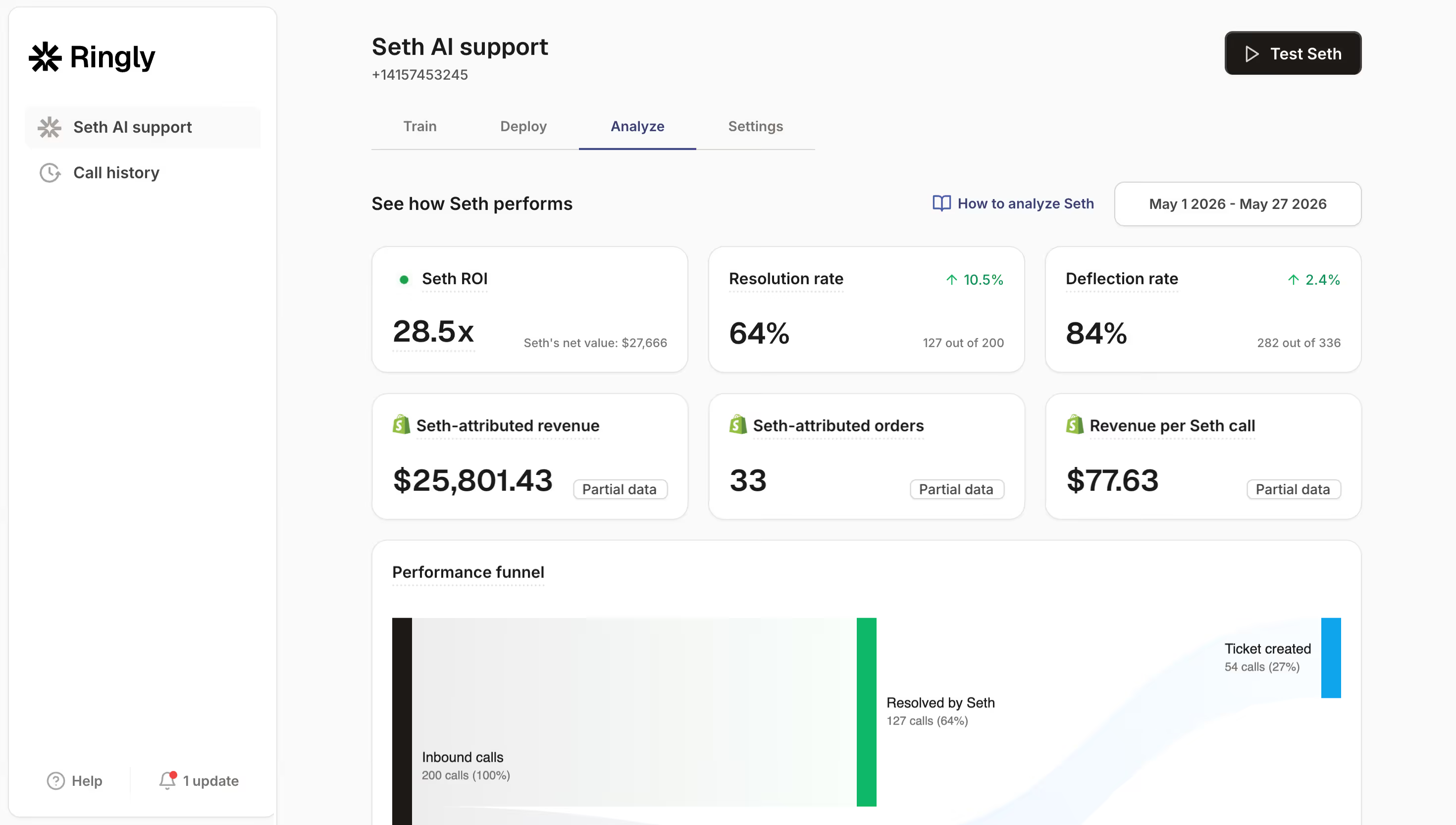
This is where Ringly fits. Seth, our AI phone agent, plugs into Shopify natively, looks up live order data, processes returns and exchanges, and resolves about 73% of inbound calls without a human ever picking up. Setup takes three minutes. He speaks 40 languages. Currently runs at 2,100+ Shopify stores.
For a Magento merchant migrating to Plus, the relevant move is: switch on Seth before cutover, let him absorb the spike, scale your team back to normal once the wave passes. The 14-day free trial covers most of the spike on its own.
Start your free trial here. For deeper reading, see our guides on ecommerce phone support and AI phone agents for Shopify.
8 mistakes that quietly cost six figures
Patterns we see across ecommerce customer service teams that managed migrations well versus ones that struggled.
Skipping weekly data reconciliation. Run a row count and spot-check against Magento every week during the project. Catch drift early.
Cutover not rehearsed end-to-end. Run the full cutover on staging at least twice before go-live. Time it. Document every step. Surprises on launch day are expensive.
Incomplete 301 redirect map. Orphan one collection page that drives 5% of organic traffic and you've cost yourself months of recovery. Map everything from the GSC export.
Hardcoded checkout logic. Shopify's checkout.liquid is fully sunset June 30, 2026. Any custom checkout work has to live in Checkout Extensibility. Plan this in the build phase, not after.
No password-reset comms plan. Send two pre-launch emails explaining the reset. Send a launch-day email with the reset link. Add a homepage banner for the first two weeks. Reduce the call volume before it happens.
Underestimating CS load. This is the section you just read. Plan for 2-3x normal volume for three weeks. Have a real plan, not a hope.
Redesigning during the replatform. Don't. Migrate as-is. Stabilize SEO. Iterate after 90 days. Compounding two big changes triples the risk.
Forgetting to retest cart and upsell apps. Cart conversion is 60-70% of revenue. Theme switches break cart drawer, upsell, and cross-sell configurations. Retest every cart flow before cutover.
90-day post-launch playbook
You're live. Now what.
Days 1-14. Monitor Google Search Console daily. Watch impressions, average position, and 4xx errors. Fix any orphaned URLs within 24 hours. Watch customer service response time benchmarks and call volume. Run one daily ops sync with engineering, CS, and marketing.
Days 15-30. App stack optimization. Audit every installed app for usage. Kill what's not used. Configure what is. Validate every email and SMS flow. Check that abandoned cart, post-purchase, and review-request flows are firing.
Days 31-60. No URL changes. No taxonomy changes. Run small CRO tests inside the new theme: hero copy, product page layout, cart drawer. Build a baseline for what's working before you start optimizing aggressively.
Days 61-90. SEO should be back to baseline. If it isn't, run a full audit. Plan the next-quarter roadmap. This is when you can finally consider the redesign or URL restructure you held back at launch.
Real outcomes to benchmark against:
- Spanx saw a 10% conversion rate lift after moving to Shopify, plus 30% more efficient content management and a 50% drop in customer-facing technical issues, according to the published Shopify Spanx case study.
- Molekule reported a 75% lift in device conversion rate, a 7% net subscriber gain, and a 10% traffic increase.
These aren't typical. They're the well-executed ones. The point isn't that you'll automatically get a 10% conversion lift. It's that the platform stops being the bottleneck. Whether the lift shows up depends on what your team does with the time it gets back.
Frequently asked questions
How much does a Magento to Shopify Plus migration cost in 2026?
The Shopify Plus subscription is $2,300/mo on a 3-year term, $2,500/mo on a 1-year term. The migration project itself ranges from $50K for a simple DTC catalog to $400K+ for complex B2B + ERP setups. Add apps ($500-$3,000/mo) and integration rebuilds (30-40% of project budget) for the full picture.
How long does it take to migrate from Magento to Shopify Plus?
A focused DTC catalog takes 8-12 weeks. A mid-market store with B2B and integrations takes 12-16 weeks. A complex enterprise with ERP, OMS, and custom search runs 16-24 weeks. Compressed timelines exist but trade SEO recovery and reconciliation for speed.
Will I lose my SEO rankings?
Not if you build a complete 301 redirect map, recreate meta titles and descriptions exactly, and don't restructure URLs at launch. Done right, organic traffic stabilizes within two weeks and grows within 60 days. Done wrong, you can lose 30-50% of traffic.
Can I keep my subscription customers running through the cutover?
Yes, with care. Magento subscriptions migrate to Recharge or Skio, but subscriber tokens need re-authorization. Botched migrations churn 10-15% of subscribers in the first 30 days. Communicate clearly with subscribers two weeks before cutover.
Do my customer accounts and order history move over?
Customer profiles and order history both port. Customer passwords do not, because Magento bcrypt salts can't decrypt to Shopify. Every customer needs a password reset on first login. Plan a clear comms sequence to reduce support tickets.
Do I need a Shopify Plus migration agency or can my team do it?
Most mid-market merchants use an agency for build and data migration, then handle ongoing ops in-house. DIY works for small catalogs without complex integrations. Anything with ERP, B2B, or custom checkout logic almost always needs experienced help.
What about B2B and wholesale on Shopify Plus?
Shopify Plus native B2B in 2026 supports company profiles, customer-specific catalogs, payment terms, volume pricing, and B2B-only checkout. Winter 2026 Edition added per-market checkout customization. For most B2B operators, this is enough. Very complex tiered pricing rules sometimes still need a B2B app like Sparklayer.
How do we handle the customer support spike during cutover?
Expect 2-3x normal call volume for two to three weeks after launch. Drivers are password resets, order-history confusion, and account-not-found errors. The fastest fix is an AI phone agent like Ringly that deploys in minutes, handles 73% of calls automatically, and scales with the spike. BPOs ramp too slowly. Overstaffing in-house is expensive and chaotic.
The takeaway
Migrating from Magento to Shopify Plus is a multi-month operating project, not a software swap. The platform fee is the smallest line on the budget.
The work that matters is the redirect map, the data reconciliation, the integration rebuild, and the customer-support spike. Get those four right and you'll be live in 12 to 16 weeks with SEO intact and customers happy. Get them wrong and you'll spend 12 months recovering.
If you're migrating and want phone support that handles the cutover wave without hiring six temporary agents, try Ringly free for 14 days. Setup takes three minutes. Seth picks up your calls in 40 languages and resolves about 73% of them automatically.