


Magento 1 has been end-of-life since June 2020. Magento 2 brands are paying $2,000 to $5,000 per security patch and $500 to $1,500 a month in basic developer retainers just to keep the lights on. The patches never stop. The dev bills never stop. And every quarter, the question gets a little louder: should we just move to Shopify?
If you're reading this, you've probably already decided. The real questions are how much it'll cost, how long it'll take, and what breaks on the way over.
This guide is the honest version. Not the one-week DIY fantasy, not the six-month enterprise project most readers don't need. Most stores migrating off Magento fall in the 1,000 to 10,000 SKU range, and that's the audience we're writing for. We cover the 8-step process, the four migration tools worth considering, real costs by store size, and the part most guides skip: the 2-4x phone support spike that hits the day you go live.
Hear what AI support calls sound like for your store. Just paste your Shopify URL and get sample calls in under 20 seconds, no email required. Listen to demo calls for my store.
Why brands are actually leaving Magento in 2026
The pitch on Magento was always "free and infinitely customizable." That was always misleading. It's free to download. Running it in production isn't.
Here's where the money actually goes:
- Security patches: $2,000 to $5,000 each in developer time, especially on stores with technical debt
- Hosting + DevOps: $20,000 to $30,000 per year for a well-managed mid-market setup on AWS
- Developer retainers: $500 to $1,500/mo basic, $2,000 to $8,000/mo full
- Extension maintenance: every Magento upgrade breaks something somewhere
According to multiple agency reports, merchants running Magento spend 60 to 70 percent of their engineering budget on platform maintenance, not new features. That's the real cost. Not the license. The opportunity cost of every product roadmap item that didn't ship because the team was patching the platform again.
Shopify Plus, by contrast, runs 30 to 40 percent lower TCO over a three-year window for mid-market merchants. According to ECommerce Partners, a fully loaded Adobe Commerce deployment runs around $325,000 per year compared to about $95,000 on Shopify Plus. That's a $230,000 annual difference that compounds.
Then there's Magento 1. End-of-life since June 2020. No security patches. No PCI compliance path forward. If you're still on M1, this isn't a strategic decision anymore. It's overdue.
Brands are leaving for a simpler reason than any agency case study captures. LAKOR's cofounder and CTO put it plainly in a Shopify case study: "It's that sinking feeling that at any moment, you might need to open your laptop and fix something that broke." Gresham Blake said Adobe Commerce "wasn't agile enough to keep up." That's the real reason. Founders are tired of being the IT department.
Across the brands that migrate, AppWrk reports an 8 to 15 percent checkout conversion lift post-launch, plus a 38 percent average reduction in total cost of ownership. That's the case for moving.
The decision: Shopify or Shopify Plus?
Before you do anything else, pick the tier.
Most brands reading this don't need Plus yet. Shopify's standard plans ($39 to $399/mo) cover the vast majority of mid-market stores. Plus starts at $2,300/mo on a 3-year term ($2,500 on a 1-year), and above $1M monthly GMV it switches to a 0.25% revenue share.
Here's the rough decision matrix:
| Need | Standard Shopify | Shopify Plus |
|---|---|---|
| GMV under $5M | Yes | Overkill |
| GMV $5M to $10M | Probably | Maybe |
| GMV $10M+ | No | Yes |
| Complex B2B (price lists, wholesale workflows) | No | Yes |
| Multi-store / multi-brand | No (1 store per plan) | Yes (9 expansion stores included) |
| Custom checkout (Checkout Extensibility) | Limited | Yes |
| Headless / API-heavy build | Possible | Better |
If you do go Plus, budget realistically. The base subscription is the starting point, not the ceiling. Most Plus merchants spend $4,000 to $10,000+ per month all-in once you add apps, ERP integration, a premium theme, and the inevitable post-launch dev work. For a deeper breakdown, see our Shopify Plus pricing guide and Shopify Plus vs Commerce Cloud comparison.
Pre-migration audit
Don't start exporting data until you've done the audit. This step saves more time downstream than any other.
Catalog audit:
- Total product count
- Configurable products with 4+ option dimensions (Shopify caps at 3 options + 100 variants per product)
- Image counts per product
- Categories and subcategories
- Custom attributes you actually use vs ones nobody touches
Extension audit:
- List every active Magento extension
- For each, find the Shopify app equivalent (or note: "no equivalent, custom build needed")
- Budget for app subscriptions. AppWrk pegs ongoing Shopify app costs at $700 to $1,400/mo for feature parity with a typical Magento stack.
URL audit:
- Export all URLs from Google Search Console (top-ranking pages especially)
- Crawl the site with Screaming Frog
- Save the URL list. You'll need it for the redirect map.
Integration audit:
- ERP, accounting (NetSuite, QuickBooks, Xero)
- Shipping (ShipStation, ShipBob)
- Tax (Avalara, TaxJar)
- Helpdesk (Gorgias, Zendesk, Reamaze, Richpanel)
- Email / SMS (Klaviyo, Postscript)
- Loyalty / reviews (Smile, Yotpo, Stamped)
- Phone support (this is where most plans break, see the support spike section below)
Customer + order audit:
- Customer count
- Average orders per customer
- Gift card balances + store credit (these need explicit handling)
The variant limit catches a lot of stores off guard. Shopify allows up to 3 option dimensions (e.g., color, size, material) and 100 variants per product. If your Magento configurables have 4+ option axes or more than 100 variants, you have to restructure before you migrate. Either collapse options, split products, or use a Shopify app like Infinite Options. Don't try to fix this mid-import.
The 8-step migration process
Step 1. Back up Magento and set up Shopify
In Magento 1: System > Tools > Backups. Take a full database + media backup. In Magento 2: use the CLI (magento setup:backup --code --media --db) or a manual DB dump.
Spin up a Shopify development store, not your production store. You'll do all import testing here. Once you're confident, you'll launch into production.
Step 2. Export from Magento
Run six core exports from Magento admin or via DB:
- Products (including configurable parent + child relationships)
- Customers (main file)
- Customer addresses
- Stock / inventory levels
- Orders
- Reviews
Export to CSV where possible. If your store has 50,000+ SKUs, a direct DB dump is cleaner than the admin export.
Step 3. Pick your migration tool
Four real options. Pick by store size and how hands-off you want the process.
| Tool | Price | Best for |
|---|---|---|
| Shopify Store Importer | Free | Under 1,000 SKUs, simple products, basic data |
| Cart2Cart | $29 to $1,500 | 1K-50K SKUs with configurables, orders, customers, reviews. Most popular for mid-market. |
| Matrixify | $20 to $200/mo | Technical users who want full CSV control and complex bulk operations |
| LitExtension | $500 to $5,000+ | Enterprise catalogs (50K+ SKUs) with hands-off "all-in-one" service |
Honestly, for the 1K to 10K SKU mid-market, Cart2Cart is the default. It handles configurable products correctly (most free tools don't), preserves customer-to-order relationships, and migrates reviews if you want them. Matrixify is the better choice if you have a developer who wants to control every column.
For deeper context on choosing a migration approach, see our Shopify migration partner guide and Shopify migration agency overview.
Step 4. Map fields and clean data
Magento and Shopify don't share column names. Here are the high-traffic ones:
| Magento column | Shopify column | Notes |
|---|---|---|
| `sku` | `Variant SKU` | Direct |
| `name` | `Title` | Direct |
| `url_key` | `Handle` | Strip the `.html` |
| `price` | `Variant Price` | Direct |
| `special_price` | `Compare At Price` | Logic inverts. In Magento, `special_price` is the sale price. In Shopify, the regular price is `Variant Price` and `Compare At` is what you cross out. |
| `description` | `Body (HTML)` | HTML mostly transfers, but Page Builder XML blocks don't |
| `qty` | `Variant Inventory Qty` | Direct |
| `manage_stock` | `Variant Inventory Tracker` | Convert blanks to "shopify" |
While you're in the spreadsheet, strip dead products (anything not sold in the last 12 months you don't plan to relist), fix broken image paths (Magento often uses relative paths that Shopify can't resolve), and confirm every variant fits the 3 options / 100 variants limit.
Step 5. Test import on the dev store
Always test. Always.
Run the import on your Shopify development store. Then spot-check:
- 10 simple products: title, price, image, description
- 10 configurable products: variants, options, inventory
- 10 customers: profile, addresses, no test orders bleeding through
- 10 orders: order number, line items, customer attached
- Reviews: present and attached to the right products
If you find issues, fix the source data and re-import. Do not fix individual records on Shopify after import. You'll do it ten times.
Step 6. Build the 301 redirect map
This is the single most important step for protecting SEO traffic.
Map old Magento URL patterns to new Shopify URLs:
- /category-name.html to /collections/category-name
- /product-name.html to /products/product-name
- /catalog/product/view/id/123 to /products/{handle}
- /customer/account/login to /account/login
Don't forget the .html suffix on the "from" side. Without it, the redirect won't fire and your indexed pages will 404.
Export your top 500 to 5,000 ranking URLs from Google Search Console first. Those are the ones that matter for traffic. Build the redirect CSV from that list, then upload it to Shopify admin under Online Store > Navigation > URL redirects.
Without proper redirects, you can lose 50 to 80 percent of organic traffic for 3 to 6 months. With proper redirects, expect a 10 to 20 percent dip for 4 to 6 weeks and full recovery in 6 to 12 weeks. See our Shopify SEO guide for the post-launch optimization playbook.
Step 7. Rebuild the theme and reinstall apps
Themes don't migrate. Period. Pick a Shopify theme (Dawn, Impulse, Symmetry, or a custom build) and rebuild your storefront.
Reinstall the equivalent of every Magento extension you depended on. Klaviyo for email, Yotpo or Stamped for reviews, Gorgias or Reamaze for helpdesk, ShipStation for shipping. For helpdesk specifically, see our comparison of Gorgias alternatives and Shopify helpdesk apps.
Then test on the dev store: checkout flow, search, navigation, mobile, account portal, password reset flow.
Step 8. Cut over to production
This is launch day. The order matters.
- Final data sync (re-import any orders placed between last test import and now)
- Point DNS to Shopify (allow 24-48 hours for full propagation)
- Send the customer password reset email blast (every customer needs to set up a new password, since passwords don't migrate, more on this below)
- Submit the new sitemap to Google Search Console and Bing Webmaster Tools
- Monitor analytics, error logs, and Google Search Console crawl errors hourly for 72 hours
- Have your support team standing by (or your AI phone agent, see below)
For a deeper drill-down, our Shopify migration timeline post maps the full week-by-week schedule.
What gets lost in migration (and what doesn't)
Here's the honest list. Some of this catches founders by surprise.
Doesn't migrate (gone or rebuilt):
- Customer passwords: hashed one-way, no recovery possible. Every customer needs a reset email at launch.
- Most Magento extensions: about 90% don't have direct Shopify equivalents. Find apps that do the same thing, or accept some features get cut.
- Custom Magento checkout flows: rebuild on Shopify or use Checkout Extensibility (Plus only)
- Page Builder content blocks: the XML doesn't translate. Rebuild as Shopify sections.
- Layered navigation as-is: requires the Search & Discovery app or a third-party rebuild
Migrates with restructuring:
- Configurable products with 4+ option dimensions: split into multiple products or use a variant-extension app
- Order numbers: format almost always changes (Magento "100000123" becomes Shopify "#1023")
- Categories to Collections: structure transfers but you'll usually want to clean up manually
Migrates cleanly:
- Products, descriptions, SKUs, images, inventory levels
- Customer profiles (name, email, addresses)
- Order history as historical records
- Reviews (if you use Cart2Cart or LitExtension)
Plan for the gaps. The customer password reality alone is responsible for a huge chunk of the post-launch support spike (more on that in a moment).
SEO during and after migration
This is where careful migrations beat sloppy ones.
The 301 redirect map is non-negotiable. Without it, you lose 50 to 80 percent of organic traffic for 3 to 6 months while Google figures out the new URLs. With proper redirects, you see a 10 to 20 percent dip for 4 to 6 weeks, then recovery in 6 to 12 weeks. AppWrk's data backs this up across their migration projects.
Three things to do day one:
- Submit the new sitemap to Google Search Console and Bing Webmaster Tools
- Keep meta titles and meta descriptions identical where possible. Don't take launch day as the excuse to rewrite them.
- Watch Google Search Console weekly for 90 days: 404 errors, indexing errors, coverage drops
Three things to avoid:
- Don't change URL structure casually. If Magento URLs were /widgets.html, your new Shopify URL should be /products/widgets. Set the redirect.
- Don't unpublish the old site immediately. Keep Magento up (read-only) for 30 days as a safety net while DNS settles.
- Don't change page H1s and on-page content the same week as migration. One change at a time.
Most ranking loss after a migration isn't from the platform switch. It's from incomplete redirects and well-meaning content rewrites the same week. Hold the content changes for 90 days.
Real migration costs by store size
The numbers vary widely. Here's the honest range, by SKU count:
| Store size | Tool cost | Theme/design | Custom dev | Integrations | Timeline | Total |
|---|---|---|---|---|---|---|
| <500 SKUs | $0-$300 | $0-$380 | $0-$2,000 | $0-$2,000 | 2-4 weeks | $1,500-$10,000 |
| 500-10K SKUs | $300-$1,500 | $380-$5,000 | $2,000-$10,000 | $2,000-$10,000 | 4-8 weeks | $10,000-$75,000 |
| 10K-100K SKUs | $1,500-$5,000 | $5,000-$25,000 | $10,000-$50,000 | $10,000-$30,000 | 2-4 months | $75,000-$200,000 |
| 100K+ SKUs | $5,000-$25,000 | $25,000-$150,000+ | $50,000-$200,000+ | $30,000-$100,000+ | 6-18 months | $200,000+ |
A few things to notice. First: the tool cost (the part most guides obsess over) is usually under 10% of the total. The dominant cost above 10K SKUs is the theme rebuild and integration work.
Second, hidden ongoing costs. Plan for:
- $700 to $1,400/mo in new Shopify app subscriptions for feature parity with your Magento stack (AppWrk)
- Revenue dip during cutover week (most stores see 10-20% lower revenue for 7-14 days, mostly from the support spike depressing conversion)
- Training time for your team on the new admin
- Post-launch fixes that didn't show up in QA
Third, who actually does the work. Three approaches:
- DIY ($300-$8,000 in tools + your time): small simple stores
- Blended ($10,000-$40,000 in tools + freelancers): growing brands with one technical person internally
- Full agency ($15,000-$75,000+): mid-market and enterprise that want hands-off delivery
For a deeper cost breakdown, see our Shopify replatforming guide.
Realistic timeline by store size
| Store size | Realistic timeline |
|---|---|
| <500 SKUs (simple catalog) | 2-4 weeks |
| 500-10K SKUs (most readers) | 4-8 weeks |
| 10K-100K SKUs (complex catalog) | 2-4 months |
| 100K+ SKUs / Plus / B2B | 6-18 months |
Add 2-3 weeks if you're migrating from Magento 1. Legacy M1 stores usually carry years of inconsistent product data, duplicate attributes, and broken media references that need cleanup before they're import-ready.
Here's the honest bit: the actual data import takes hours, not weeks. The data tool runs in an afternoon. What eats the months is the theme rebuild, the integration rebuild, and QA.
If you're running on Magento 1, don't wait for the perfect migration window. You've been past the safe window since 2020. See our Shopify migration timeline post for the week-by-week breakdown.
The post-launch support spike nobody warns you about
This is the part the migration guides skip.
Every store sees a 2 to 4x phone and ticket spike for the first two weeks after launch. Some stores see it for four to six weeks at lower intensity. It's not optional. It's caused by the migration itself.
Why the spike happens:
- Password resets: every customer has to set up a new password. Some don't get the email. Some ignore it. Some try the old password three times and call.
- WISMO ("Where is my order?"): order numbers usually change format, so customers can't find their order in their account portal. They call.
- Missing order history: even though orders migrate, the new account portal looks different, so customers think their history is gone.
- Product page concerns: if reviews didn't migrate cleanly, customers see a stripped-down product page and call to confirm it's the right brand.
- Promo code / loyalty point confusion: codes from Magento often don't carry over. Loyalty point balances need explicit handling.
A three-touch email sequence helps. A "we're moving" email two weeks out, a reactivation email on launch day, and a follow-up at day 7 cuts the support spike by about 60 percent. The other 40 percent calls anyway.
And here's the trap: trying to staff up phone support mid-spike is impossible. By the time you realize you need help, your existing team is buried in QA bugs and tickets are piling up faster than they can close. You can't hire and train phone agents in 48 hours.
You have to pre-deploy phone coverage before launch.
Ringly.io: AI phone support for Shopify brands
Ringly.io is AI phone support for Shopify brands. Hiring a phone team scales linearly with call volume; the AI doesn't. Instead of growing your support headcount the week you launch, the AI takes the routine inbound calls so your team can focus on the QA work that actually moves the migration forward.
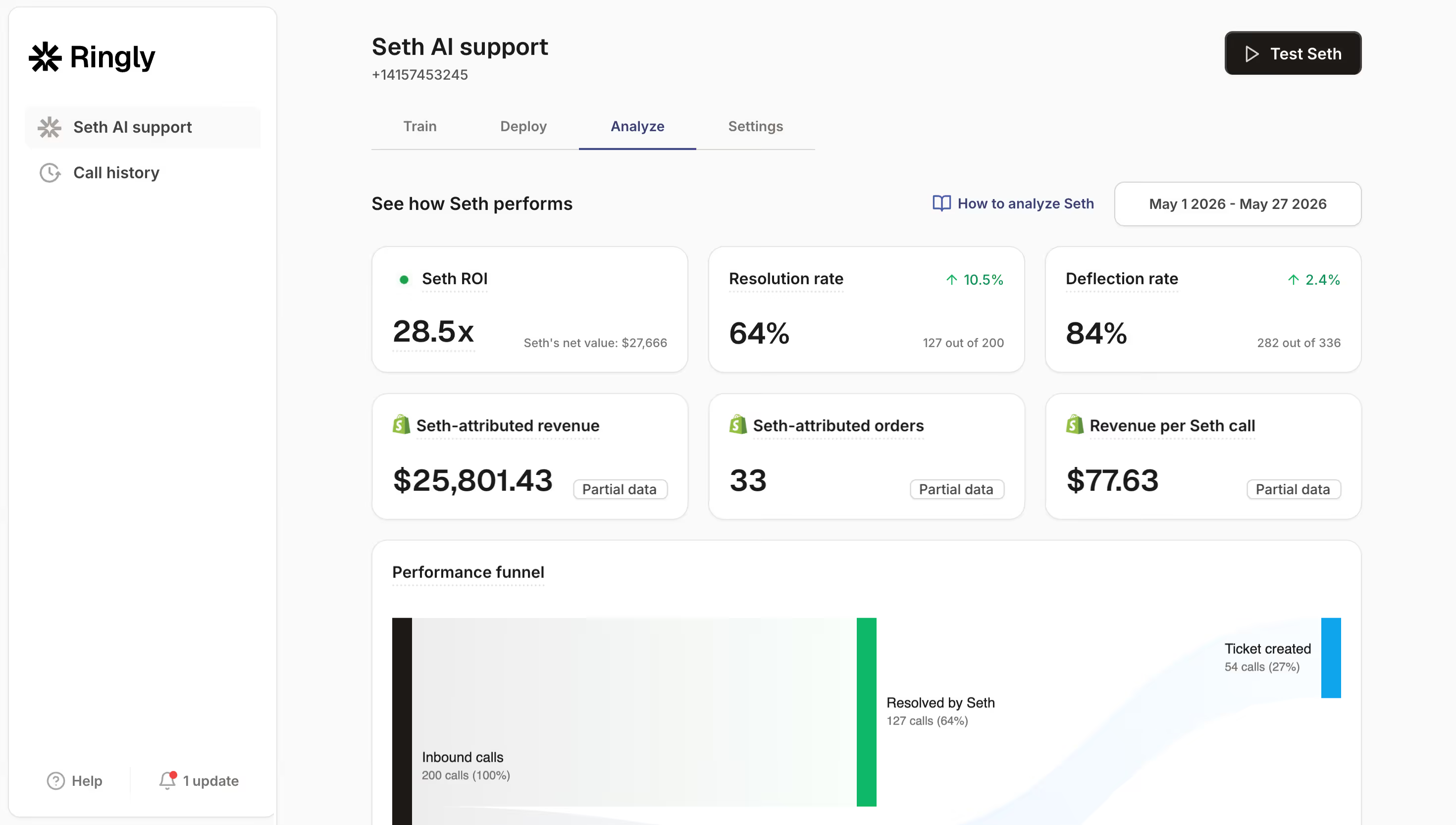
The AI answers inbound calls 24/7. It finds orders in your Shopify store, processes returns and exchanges, answers product questions from your knowledge base, and rescues abandoned carts via outbound follow-up. Across 50+ brands, the AI resolves 73% of calls autonomously at roughly $0.42 per resolved call. Calls that need a human escalate cleanly to Gorgias, Richpanel, Reamaze, or whatever helpdesk you already run.
Plans: Grow $349/mo (1,000 minutes), Pro $799/mo (2,500 minutes), Enterprise custom. 14-day free trial on Pro. Live in under an hour. 65% resolution guarantee: if the AI resolves under 65% of your calls in 90 days, we refund the last 3 months.
Try Ringly free for 14 days and get the AI answering migration calls before launch day.
For the full mechanics of the WISMO spike specifically, see our WISMO calls deep dive. For phone coverage strategy, see AI phone agents for Shopify and 24/7 ecommerce phone support.
Common migration mistakes
Here's what we see go wrong, in rough order of how often it happens:
- Skipping the .html suffix in 301 redirects: redirects silently fail, Google sees 404s, rankings drop. The single most expensive small mistake.
- Forgetting the customer password reset email blast: customers can't log in, support spike doubles, refund requests follow
- Not pre-testing on a development store: every import error becomes a production fix
- Underestimating theme rebuild time: data migrates in hours, the theme takes weeks
- Migrating during peak season: don't migrate in Q4. Don't migrate the week of a major sale. The cutover window deserves quiet traffic.
- Not warning customers a migration is coming: a "we're upgrading our store" email two weeks ahead cuts confusion in half
- Assuming Magento extensions have Shopify equivalents: about 90% don't. Audit before you start.
- Treating Shopify Plus as automatically necessary: only at $10M+ GMV usually
- Letting the variant limit catch you at import: audit configurables before. Restructure before. Don't fix mid-migration.
- Not staffing phone support for the launch spike: by far the most common mistake. Plan ahead.
For more on the helpdesk side, see our Shopify customer service app comparison and ecommerce phone support guide.
Frequently asked questions
How long does a Magento to Shopify migration take? Most stores in the 500 to 10,000 SKU range take 4 to 8 weeks. Smaller catalogs can ship in 2 to 4 weeks. Enterprise stores with deep integrations and Shopify Plus customization take 2 to 4 months for large catalogs and 6 to 18 months for the most complex setups.
Will I lose my SEO rankings? With a complete 301 redirect map, expect a 10 to 20 percent dip for 4 to 6 weeks and full recovery in 6 to 12 weeks. Without proper redirects, you can lose 50 to 80 percent of organic traffic for 3 to 6 months. The redirect work is the most important part of the migration.
Do customer passwords transfer from Magento to Shopify? No. Magento hashes passwords one-way, so they can't be decrypted and re-imported. Every customer needs to receive a password reset email at launch, and you should send a "we've moved" email two weeks before to set expectations.
How much does Magento to Shopify migration cost? For most mid-sized stores (500 to 10,000 SKUs), expect $10,000 to $75,000 all-in. Small simple stores can come in under $10,000 DIY, and enterprise migrations with Shopify Plus run $75,000 to $200,000+. The tool cost itself is usually under 10% of the total. Most of the spend is the theme rebuild and integration work.
Should I use Shopify or Shopify Plus? If you're under $5M annual GMV, regular Shopify ($39 to $399/mo) is fine. Plus ($2,300/mo+) makes sense at $10M+ GMV, for complex B2B, multi-store operations, or custom checkout requirements. Most brands migrating off mid-size Magento stores don't need Plus on day one.
Can I migrate Magento 1 to Shopify? Yes. Magento 1 to Shopify migrations typically take 2 to 3 weeks longer than Magento 2 migrations because M1 stores carry more legacy data inconsistencies. Given M1 has been end-of-life since June 2020 with no security patches or PCI compliance, the migration is now overdue rather than optional.
What happens to my Magento extensions? About 90% of Magento extensions don't have direct Shopify equivalents. You'll rebuild your tech stack with Shopify apps (Klaviyo for email, Yotpo or Stamped for reviews, Gorgias for helpdesk, etc.). Budget $700 to $1,400 per month in new app subscriptions for feature parity.
How do I keep phone support running during migration? Pre-deploy phone coverage before launch. The 2 to 4x spike hits day one and you can't hire and train phone agents in 48 hours. Either pre-staff with humans or deploy an AI phone agent like Ringly.io that's live in under an hour and handles 73% of inbound calls autonomously.
The takeaway
The platform switch doesn't break the business. A sloppy redirect map and an unstaffed phone line on launch day do.
Audit before you migrate. Build the redirect map from your real ranking URLs, not a guess. Pre-staff support for the spike, AI or human, doesn't matter as long as it's live before the first call hits.
If you're on Shopify and want the phones answered while your team handles the QA on launch day, try Ringly free for 14 days. Live in under an hour, 65% resolution guarantee.
Article by Ruben Boonzaaijer. Co-founder of Ringly.io. We build AI phone support for Shopify brands so they can scale support without hiring a phone team.