
Most enterprise teams don't actually compare Shopify Plus vs Commerce Cloud. They default to Salesforce Commerce Cloud because it feels like the safe enterprise choice, and then they find out what "safe" costs.
Here's the real question. Do you want to pay $800K to $1.5M a year and turn your dev team into the bottleneck on every merchandising change? Or do you want a platform your marketing team can actually run?
That's the decision underneath the feature checklist. This guide gives you the honest side-by-side, the real pricing both vendors won't put on a page, and the one thing every other comparison skips: what happens to your customer support and phone line when you pick or migrate between these platforms.
Hear what AI support calls sound like for your store. Just paste your Shopify URL and get sample calls in under 20 seconds, no email required. Listen to demo calls for my store.
Shopify Plus vs Commerce Cloud: the quick verdict
For most brands under $300M GMV selling DTC or hybrid, Shopify Plus is the stronger choice in 2026. It wins on total cost of ownership, speed to market, and the simple fact that your team can run it without a developer in the room.
Salesforce Commerce Cloud still has a real case, but a narrow one. If your whole business already runs on the Salesforce ecosystem and you sell complex B2B with contract pricing and buyer hierarchies, it can be the more defensible pick.
Here's the side-by-side:
| Factor | Shopify Plus | Salesforce Commerce Cloud |
|---|---|---|
| Pricing model | $2,300-$2,500/mo flat, or 0.25% GMV above ~$1M/mo | 1-3% of GMV revenue share |
| All-in annual (100-300M GMV) | Roughly $150K-$400K | $800K-$1.5M+ |
| Time to market | 8-12 weeks, full migration 4-8 months | 9-18 months for mid-complexity |
| Ease of use | Non-technical teams run it daily | Developer-dependent for most changes |
| B2B depth | Strong for mid-market | Deepest for complex enterprise B2B |
| Best for | DTC and hybrid under $300M GMV | Salesforce-native, complex B2B |
If you're a Shopify brand already, this is also a good moment to make sure your phone support keeps up with the platform. More on that below.
What each platform actually is
Both are SaaS commerce platforms aimed at bigger brands. They take very different roads to get there.
Shopify Plus
Shopify Plus is the enterprise tier of Shopify. It's fully hosted, updates automatically, and leans on a huge app ecosystem to fill feature gaps instead of building everything natively. Mattel, Glossier, Staples, and Gymshark run on it. The pitch is speed and operational simplicity: get selling fast, change things fast, and don't manage infrastructure. See our full breakdown of Shopify Plus features if you want the deep version.
The architectural bet is that no platform should try to do everything. Shopify owns the core (checkout, catalog, orders, hosting, security) and assumes you'll bring best-of-breed apps for search, reviews, loyalty, subscriptions, and support. That's a strength and a tradeoff. You move fast and pick the best tool per job. You also own the assembly, and the app subscriptions add up. For most brands that math still favors Shopify, but it's worth going in with eyes open about the stack you're signing up to maintain.
Salesforce Commerce Cloud
Salesforce Commerce Cloud, formerly Demandware, is an enterprise-only platform built for large retailers who want deep customization and tight integration with the rest of Salesforce. The model is the opposite of Shopify's. Instead of stitching together 10 to 20 third-party apps, you use the platform for most things and integrate inside the Salesforce ecosystem: Service Cloud, Marketing Cloud, Data Cloud. That depth is the whole point, and also the source of most of its cost. If Service Cloud is part of that stack, our take on Salesforce Service Cloud alternatives is worth a read before you commit.
SFCC comes in B2C and B2B Commerce editions, with Growth and Advanced tiers on the B2B side. The Growth edition supports up to six storefronts with lighter order management. Advanced expands to ten storefronts and adds full order management plus deeper analytics and personalization. That breadth is genuinely useful if your business is complex enough to need it. The trap is buying that complexity when your actual requirements are a fast DTC store and a couple of B2B price lists, which is the situation most brands are actually in.
Pricing and total cost of ownership
This is where the comparison actually gets decided, so let's use real numbers.
| Cost element | Shopify Plus | Salesforce Commerce Cloud |
|---|---|---|
| Platform fee | $2,300/mo (3-yr) or $2,500/mo (1-yr); 0.25% GMV above ~$1M/mo | 1-3% of GMV, contract-based |
| $50M GMV store, platform fees/yr | ~$60K-$150K | $500K-$1.5M |
| Implementation | $30K-$250K one-time | $200K-$1M+ |
| Developer rate | $100-$200/hr | $200-$350/hr |
| Hosting/security/PCI | Included | Add-on / managed services |
According to agency total-cost-of-ownership analyses, a mid-enterprise brand doing $100M to $300M GMV should expect $800K to $1.5M a year on Salesforce Commerce Cloud once you add licensing, hosting, managed services, developer costs, and what the agencies call the integration tax. Shopify Plus for the same brand lands far lower, with hosting, security, PCI compliance, and maintenance baked into the platform fee.
The integration tax is the part that hides. It isn't one line item. It's the dev hours and middleware to connect every system that doesn't live on the platform:
- Order management and OMS: syncing fulfillment, inventory, and returns state across systems
- Site search and merchandising: bolt-on engines, plus the work to wire them in
- Customer support and phone: order-lookup automations, IVR routing, helpdesk coupling (the one nobody quantifies)
- CRM and marketing: keeping customer data in sync between commerce and CRM
On Shopify Plus that tax is smaller and the talent to pay it is cheaper. The developer pool is large, so hiring is faster and rates run roughly half of SFCC-certified contractors. SFCC-certified developers typically bill $200 to $350 an hour, and there are fewer of them, which means longer hiring cycles and more leverage for the people you do find. Shopify developers run $100 to $200 an hour with a far deeper bench. Over a multi-year platform lifetime, that gap compounds into real money, and it's the part of TCO that never makes it onto a vendor pricing page. If you're already weighing support spend, compare it against outsourcing Shopify customer service before you assume the platform is the only line that matters.
One more thing on the SFCC revenue-share model. Because the platform fee is a percentage of GMV, your costs scale with your success, not with the value the platform adds. A great sales year doesn't make the platform more useful, but it does make it more expensive. Shopify's flat fee (or low 0.25% share above ~$1M/mo) breaks that link, which is exactly why finance teams at growing brands keep pushing the migration conversation. Our breakdown of Shopify customer support outsourcing covers a similar dynamic on the support side: fixed beats variable when volume is climbing.
Want to see what the support layer costs on its own, separate from the platform? Compare it against your current setup.
Feature-by-feature breakdown
Both platforms can run a large store. The differences show up in how the work gets done and who has to do it.
Ease of use and team autonomy
- Shopify Plus: marketing and merchandising teams handle product updates, promotions, and content without filing a dev ticket. This is the single biggest day-to-day difference.
- Salesforce Commerce Cloud: most changes route through developers or a managed-services partner. Reviewers consistently flag the steep learning curve and developer dependency.
Capterra reviewers rate Shopify Plus 4.7/5 across roughly 121 reviews and Salesforce Commerce Cloud 4.5/5 across roughly 100. Close on paper, but the qualitative complaints diverge: SFCC users cite complexity and declining experience, Shopify Plus users mostly cite app-stack cost and post-launch account management.
Customization and headless
- Shopify Plus: open APIs plus Hydrogen and Remix for headless builds. Deep backend customization often means apps rather than core changes.
- Salesforce Commerce Cloud: SFRA gives near-unlimited customization if you have the budget and the certified developers to use it.
B2B depth
- Shopify Plus: native company profiles, custom price lists, payment terms, and running B2B plus DTC from one store. Strong for mid-market B2B.
- Salesforce Commerce Cloud: contract pricing, quote management, buyer account hierarchies, and per-account catalog segmentation. Still the deepest set for complex enterprise B2B with hundreds of accounts.
If your B2B is a few price lists and payment terms, Shopify Plus covers it. If it's 800 enterprise accounts each with unique catalogs and approval chains, SFCC still has the edge. Be honest about which one you actually are. Most brands describe themselves as "complex B2B" and turn out to need three price tiers and net-30 terms, both of which Shopify Plus handles natively today. The genuinely complex case (deep buyer hierarchies, contract-level negotiated pricing, multi-step approval routing) is real, but it's a minority, and buying for it when you don't need it is the single most common way brands overpay on platform.
Internationalization and scalability
- Shopify Plus: Shopify Markets handles multi-currency, multi-language, and regional catalogs without a separate build per region.
- Salesforce Commerce Cloud: scales to very high traffic and complexity, which matters at the largest tier but is rarely the deciding factor under $300M GMV.
Ecosystem and integrations
- Shopify Plus: 8,000+ apps and a large partner network. You assemble a stack.
- Salesforce Commerce Cloud: native depth across the Salesforce ecosystem. You stay inside one vendor.
The migration question, and what breaks that nobody warns you about
The 2026 story is consistent everywhere: brands are leaving Salesforce Commerce Cloud for Shopify Plus. Mattel, Glossier, Staples, Gaiam, Crabtree & Evelyn, and The Cambridge Satchel Co. have all made the move, almost always to cut total cost of ownership and move faster.
A migration with an experienced Shopify Plus partner typically runs 4 to 8 months depending on store complexity. The visible work is what everyone plans for:
- Theme and storefront: rebuilt, not ported
- Product and customer data: migrated and reconciled
- Integrations: every connected system re-pointed at the new platform
Here's the part the other comparisons skip. Your customer support stack is coupled to your commerce platform, and a replatform breaks it. Order-lookup automations that pull "where is my order" answers, IVR routing rules, and helpdesk integrations are all wired into the old platform's data model. When the platform changes, those connections go down right when call volume spikes from confused customers during the cutover.
Think about the sequence. You cut over on a weekend. Monday morning, order numbers change format, the customer account portal looks different, tracking links break for in-flight orders, and shipping timelines slip while the new fulfillment integration settles. Every one of those is a phone call. A migration doesn't just risk technical downtime, it manufactures a support spike, and it does it at the exact moment your support tooling is least connected to live order data.
That's not a reason to avoid migrating. It's a reason to plan the support layer as its own workstream, not an afterthought. The brands that do this well decouple phone support from the platform so the line keeps answering through the cutover, with the AI handling order status and returns against whichever data source is live. Our guides on ecommerce customer service and the Shopify customer service app landscape go deeper, and the WISMO call volume during a migration is exactly the kind of thing you want automated before, not after. According to ecommerce customer support benchmarks for 2026, order-status questions are the single largest category of inbound contacts, so a migration spike hits the exact volume you can automate most reliably.
Where Ringly.io fits: phone support on either platform
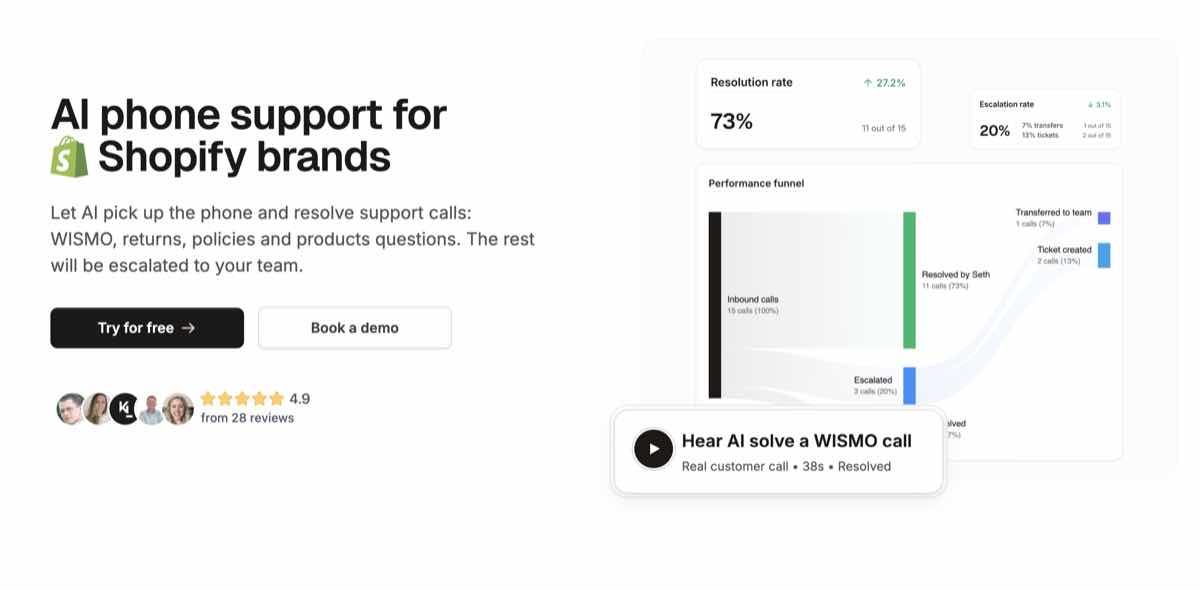
Ringly.io is AI phone support for Shopify brands. It isn't a commerce platform and it doesn't compete with Shopify Plus or Salesforce Commerce Cloud. It sits on top of whichever one you run.
Hiring a phone team scales linearly with call volume. The AI doesn't. Instead of growing support headcount every time call volume goes up, or rebuilding your phone stack from scratch every time you replatform, the AI takes the routine inbound calls so your team can focus on the work that actually moves revenue.
The AI answers inbound calls 24/7 in 40 languages. It finds orders in your Shopify store, processes returns and exchanges, answers product questions from your knowledge base, and rescues abandoned carts via outbound follow-up. Across 50+ brands, the AI resolves 73% of calls autonomously at roughly $0.42 per resolved call, versus $7 to $16 per call for the human BPO industry average. Calls that need a human escalate cleanly to Gorgias, Richpanel, Reamaze, or whatever helpdesk you already run.
The migration angle matters here. Because the phone layer is decoupled from the commerce platform, your line keeps answering whether you're on Shopify Plus, mid-migration off Salesforce Commerce Cloud, or settling into a new stack. You keep your number, your helpdesk, and your workflows. See how this works for phone agents on Shopify and the broader Shopify call center setup.
Plans: Grow $349/mo (1,000 minutes), Pro $799/mo (2,500 minutes), Enterprise custom. 14-day free trial on Pro. Live in under an hour. We guarantee a 65% AI call resolution rate within 90 days, or we'll refund all your subscription fees.
Ready to keep your phone line answering no matter which platform you land on? Start your free trial. Setup takes under an hour.
How to choose between Shopify Plus and Commerce Cloud
Skip the feature spreadsheet. The decision comes down to your GMV band, your business model, and how much you're already locked into Salesforce.
Choose Shopify Plus if:
- You're under $300M GMV and selling DTC or hybrid. This is the clear answer for most brands in 2026.
- Speed matters: you want to launch and change things in days, not dev sprints.
- Your team should run the store, not file tickets to a managed-services partner.
- You want predictable cost: a flat or low-revenue-share fee with hosting included.
- Your B2B is mid-market: price lists, payment terms, B2B plus DTC from one admin.
Choose Salesforce Commerce Cloud if:
- You're deep in the Salesforce ecosystem: Service Cloud, Marketing Cloud, and CRM are already core to operations.
- Your B2B is genuinely complex: hundreds of enterprise accounts, contract pricing, buyer hierarchies, per-account catalogs and approvals.
- You have the budget and the team for $800K-$1.5M a year and certified developers on retainer.
Quick read by GMV band:
| Annual GMV | Likely best fit |
|---|---|
| Under $50M | Shopify Plus, almost always |
| $50M-$300M, DTC/hybrid | Shopify Plus |
| $50M-$300M, complex B2B | Depends on Salesforce lock-in |
| $300M+ or Salesforce-native | Evaluate SFCC seriously |
Whichever you pick, treat customer service for Shopify and your Shopify voice agents as a separate decision from the platform itself.
Frequently asked questions
Is Shopify Plus cheaper than Salesforce Commerce Cloud?
Yes, for almost every brand under $300M GMV. Shopify Plus runs $2,300-$2,500/mo flat (or 0.25% of GMV above ~$1M/mo) with hosting included, while Salesforce Commerce Cloud charges 1-3% of GMV plus implementation and managed services, often $800K-$1.5M a year all-in.
Can Shopify Plus handle enterprise B2B?
For mid-market B2B, yes. It has native company profiles, custom price lists, payment terms, and B2B plus DTC from one store. For the most complex enterprise B2B (hundreds of accounts, contract pricing, deep approval chains), Salesforce Commerce Cloud still has the deeper feature set.
What is Salesforce Commerce Cloud, and is it the same as Demandware?
Yes, Salesforce Commerce Cloud was formerly Demandware before Salesforce acquired and rebranded it. It's an enterprise-only commerce platform built for deep customization and tight integration with the rest of the Salesforce ecosystem.
How long does it take to migrate from Salesforce Commerce Cloud to Shopify Plus?
Typically 4 to 8 months with an experienced Shopify Plus partner, depending on store complexity. The storefront is rebuilt rather than ported, and every integration has to be re-pointed, including your customer support and phone stack.
Which big brands use Shopify Plus vs Salesforce Commerce Cloud?
Shopify Plus powers Mattel, Glossier, Staples, and Gymshark, and has absorbed migrations from Gaiam, Crabtree & Evelyn, and others. Salesforce Commerce Cloud still runs many large legacy retailers, especially ones standardized on the broader Salesforce stack.
Does Shopify Plus integrate with Salesforce CRM?
Yes, through connectors and middleware rather than the native depth SFCC offers inside its own ecosystem. If Salesforce CRM is the center of your operation, that native integration is one of SFCC's strongest remaining arguments.
What happens to customer phone support when you replatform?
Order-lookup automations, IVR routing, and helpdesk integrations are coupled to your commerce platform, so they break during a migration right as call volume spikes. Decoupling phone support from the platform (with something like Ringly.io) keeps the line answering through the cutover.
The bottom line
For most brands under $300M GMV selling DTC or hybrid, Shopify Plus is the better platform in 2026. It costs a fraction of Salesforce Commerce Cloud, ships in weeks instead of quarters, and lets your team run the store without a developer babysitting every change. Salesforce Commerce Cloud's case is real but narrow: deep Salesforce lock-in or genuinely complex enterprise B2B.
Whichever way you go, don't let the phone line be the thing that breaks. Try Ringly.io free for 14 days and keep support answering on any platform.
Article by Ruben Boonzaaijer. Co-founder of Ringly.io. We build AI phone support for Shopify brands so they can scale support without hiring a phone team.