

Alorica is one of the biggest names in customer service outsourcing, with over 100,000 employees handling millions of interactions annually.
But bigger isn't always better. Many businesses find themselves searching for Alorica alternatives due to rigid contracts, inconsistent quality across locations, or simply wanting a more modern approach to customer support.
You have options. Whether you're looking for a traditional BPO with better flexibility, a tech-forward solution with AI capabilities, or something in between, this guide covers seven alternatives worth considering in 2026.
Editor’s note: Want to hear some sample AI support calls made for your Shopify store?
- Just paste your store URL
- Hear sample calls for your store (no email required)
- Listen to demo calls for my store
What to look for in an Alorica alternative
Before diving into the options, here's what separates a good alternative from a mediocre one:
- Pricing transparency. Many BPOs hide rates behind "contact us" forms. Look for providers that at least offer starting prices or clear hourly rates.
- Scalability. Can they handle your peak seasons without breaking a sweat? Can you scale down just as easily?
- Technology integration. Modern support isn't just phone calls. You need seamless connections to your CRM, helpdesk, and e-commerce platform.
- Industry expertise. A provider that understands your business will deliver better results than a generic call center.
With those criteria in mind, let's compare your options.
Alorica alternatives at a glance
| Provider | Model | Pricing | Best For |
|---|---|---|---|
| Ringly | AI phone agent | $99/mo for the first 50 conversations, then $1.99 per conversation | Shopify stores, e-commerce |
| TaskUs | Human BPO | Custom | Tech companies, enterprises |
| Concentrix | Human BPO + AI | Custom | Large global enterprises |
| NeoWork | Human BPO | $11-14/hr | Startups, small businesses |
| VXI | Human BPO | Custom | Mid-size companies |
| Helplama | Human BPO (US) | From $399/mo | US-focused businesses |
| Foundever | Human BPO + AI | Custom | Global enterprises |
1. Ringly

Ringly takes a different approach from traditional BPOs. Instead of hiring human agents, you get the AI, an AI phone support rep designed specifically for e-commerce businesses.
the AI answers calls 24/7, looks up orders, handles returns and exchanges, and only escalates to your team when necessary. The AI integrates directly with Shopify, so it can access real-time order information without any manual data entry.
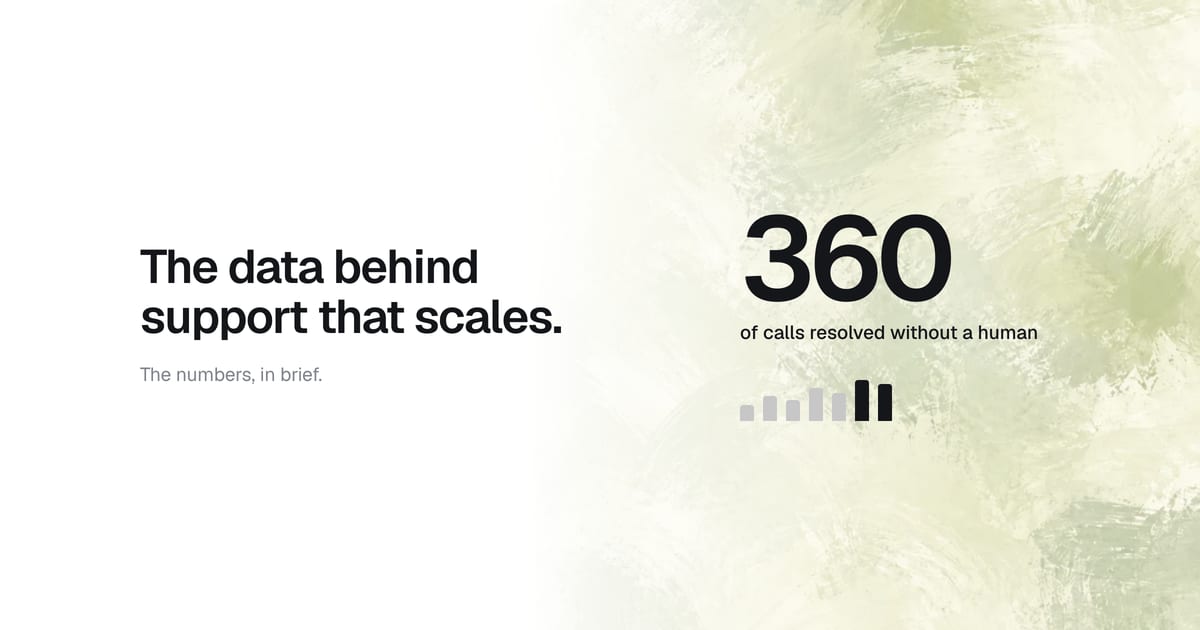
The numbers are compelling. The AI resolves up to 90% of calls without human intervention, and the average cost per call runs about $0.38 compared to roughly $2.35 for a human agent. That's an 83% cost reduction. Plus, there's no hiring, training, or scheduling to manage.
| Plan | Monthly Price | Conversations | Key Features |
|---|---|---|---|
| Pay as you go | $99/mo | First 50 included, then $1.99 per conversation | 30 languages, Shopify integration, core features |
| Custom | Custom | 1,000+ calls a month | Custom setup, custom integrations, private Slack channel |
Spam calls, hang-ups and wrong numbers are not billed (see Ringly's pricing).
Pros:
- Fast setup (under 1 hour)
- 24/7 availability without shift management
- 40+ languages supported
- Scales instantly (handles 15+ simultaneous calls per AI agent)
Cons:
- Best suited for e-commerce (Shopify stores specifically)
- Not ideal for complex enterprise needs requiring nuanced human judgment
Best for: Shopify store owners and e-commerce businesses that want automated phone support without the overhead of a traditional BPO.
2. TaskUs
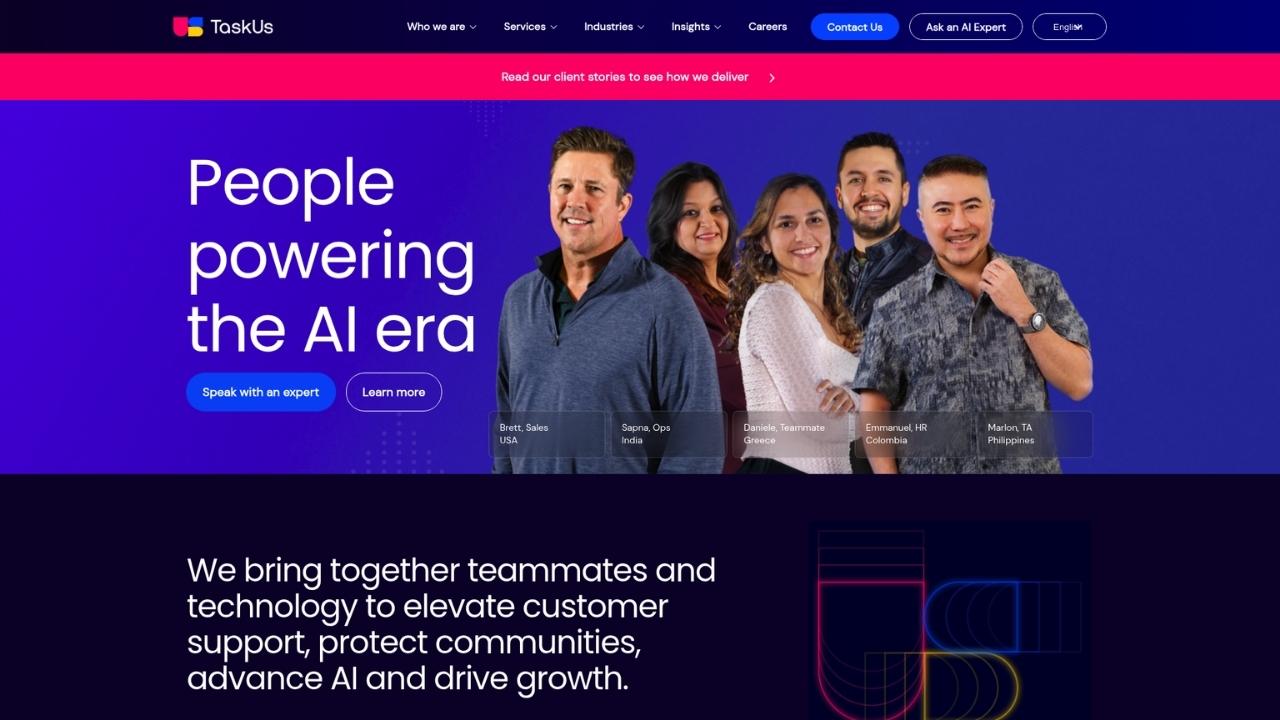
TaskUs has built a reputation as a digital-first BPO that treats employee culture seriously. With a 4.8/5 rating on Gartner and an NPS score of 34, they're consistently ranked among the top BPO providers.
The company operates across 13 countries with 30+ languages supported. What sets them apart is their focus on teammate well-being. Happy employees tend to stick around, and that stability translates to better service quality for clients.
TaskUs offers a broad range of services including customer experience, trust and safety, AI data services, financial crime compliance, and sales. They also have their own AI platform called TaskGPT designed to boost agent productivity.
Pros:
- Strong culture scores (84/100) and CEO approval (91%)
- 3x Everest "Leader" in Trust and Safety
- Technology partnerships with NVIDIA, AWS, and Zendesk
- Comprehensive certifications (PCI-DSS, HIPAA, HiTrust)
Cons:
- Enterprise-focused pricing (custom quotes only)
- May be overkill for smaller businesses
Best for: Tech companies and high-growth startups that need well-trained human agents and value cultural alignment.
3. Concentrix

Concentrix is a massive player with over 440,000 employees across 70+ countries serving 2,000+ brands. If you need global scale, they're hard to beat.
Their approach combines human expertise with AI-driven capabilities. They recently launched the Agentic Operating Framework to help enterprises deploy AI more effectively. Their iX Hero platform brings the entire advisor workflow into one AI-powered workspace.
Services span strategy and design, data and analytics, enterprise technology, and digital operations. They serve virtually every major industry including retail, healthcare, financial services, and technology.
Pros:
- Massive global footprint (440K employees, 70 countries)
- End-to-end solutions from strategy through execution
- Strong AI focus with iX Hero platform
- 4.6/5 Gartner rating
Cons:
- Complex contracts typical of large BPOs
- Less flexible for small businesses
Best for: Large enterprises that need global coverage and comprehensive digital transformation services.
4. NeoWork
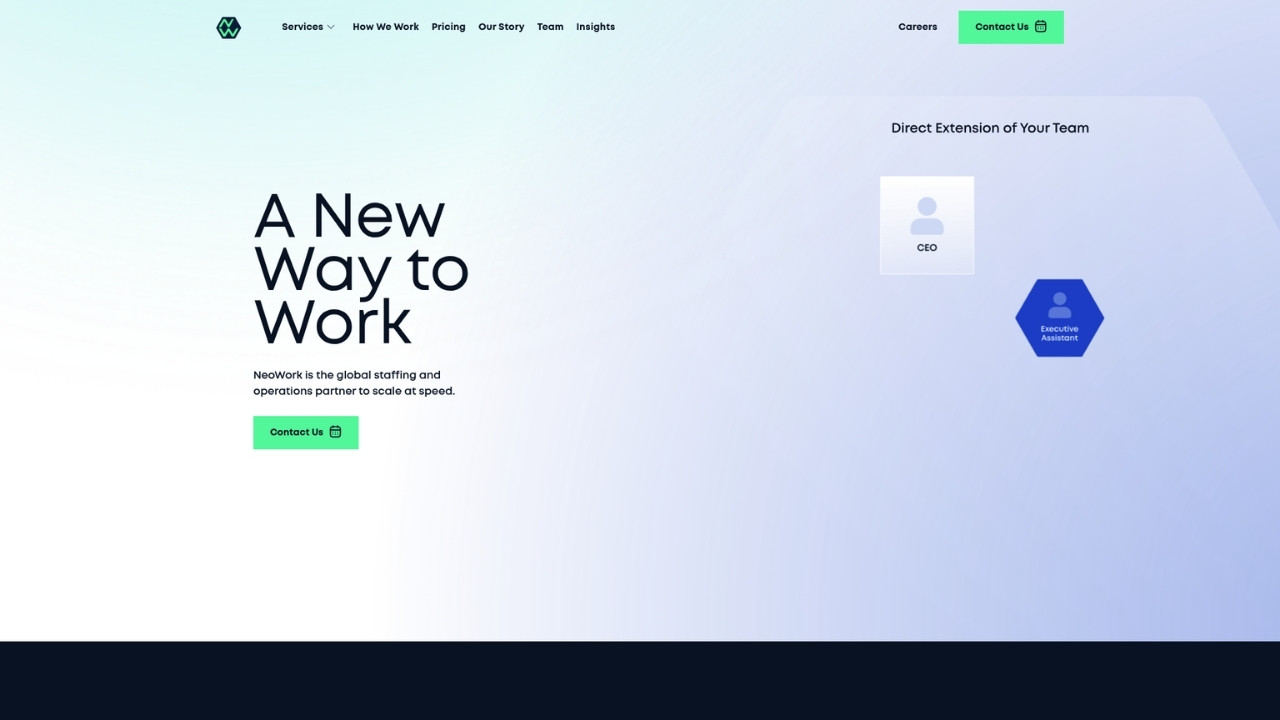
NeoWork stands out for one simple reason: transparent pricing. While most BPOs hide behind "contact us" buttons, NeoWork publishes their rates openly.
They hire only 3.2% of candidates they interview, emphasizing quality over quantity. The result is a 91% employee retention rate compared to the industry average of 60%. That stability matters when you're building a support team.
Services include customer experience, virtual assistants, IT and development, AI training, and creative services. They work with notable clients like CareRev, Batch, and Podium Education.
| Plan | Hourly Rate | Best For |
|---|---|---|
| Starter | $11/hr | Data labeling, data entry, content moderation, chat/email |
| Premium | $14/hr | Virtual assistants, SDRs, bookkeepers, voice support |
| Enterprise | Custom | Bilingual support, software engineers, designers |
Volume discounts apply for larger teams.
Pros:
- Transparent pricing (rare in the BPO world)
- No setup fees (competitors often charge $5,000+)
- 30-day cancellation (vs. 60+ days elsewhere)
- 94% average CSAT rating
Cons:
- Smaller scale than established BPOs
- Less brand recognition
Best for: Startups and small businesses that want flexible outsourcing without enterprise complexity.
5. VXI Global Solutions
Founded in 1998, VXI brings decades of experience to the table. They've earned a 4.8/5 rating on Gartner and recently won Gold at the 2025 Stevie Awards for Sales Outsourcing Provider of the Year.
VXI positions itself as a strategic partner rather than just a vendor. Their CX Acceleration Hub helps brands turn customer service into a competitive advantage. They also have a unique partnership with Harvard Business School for employee development.
As a certified Minority Business Enterprise (MBE), VXI can help companies meet supplier diversity goals while delivering quality service.
Pros:
- Strategic partnership approach
- Innovation-focused CX Acceleration Hub
- Harvard Business School employee development program
- MBE certification for diversity initiatives
Cons:
- Smaller global footprint than TaskUs or Concentrix
- Custom pricing only
Best for: Mid-size companies that want a strategic CX partnership with flexibility and reasonable pricing.
6. Helplama

Helplama focuses on one thing: US-based support agents. If you want your customers speaking with people who understand American culture and communication norms, they're worth a look.
Their "Zero Risk Model" means agents are fully trained on your business before going live. You don't pay until you're satisfied. They also promise dedicated agents (no rotation), so your customers talk to the same people over time.
Services cover phone support, live chat, email, and social media. They work with Fortune 500 companies like McDonald's as well as startups.
| Metric | Value |
|---|---|
| Starting price | $399/month |
| CSAT month 1 | 90% |
| CSAT month 3 | 98% |
| Coverage | 20+ countries |
Pros:
- US-based agents for clear communication
- Zero Risk Model (trained before billing)
- Dedicated agents (no rotation)
- Omnichannel coverage
Cons:
- Limited global reach compared to larger BPOs
- Premium pricing for US-based talent
Best for: US-focused businesses that want domestic agents and consistent brand voice.
7. Foundever
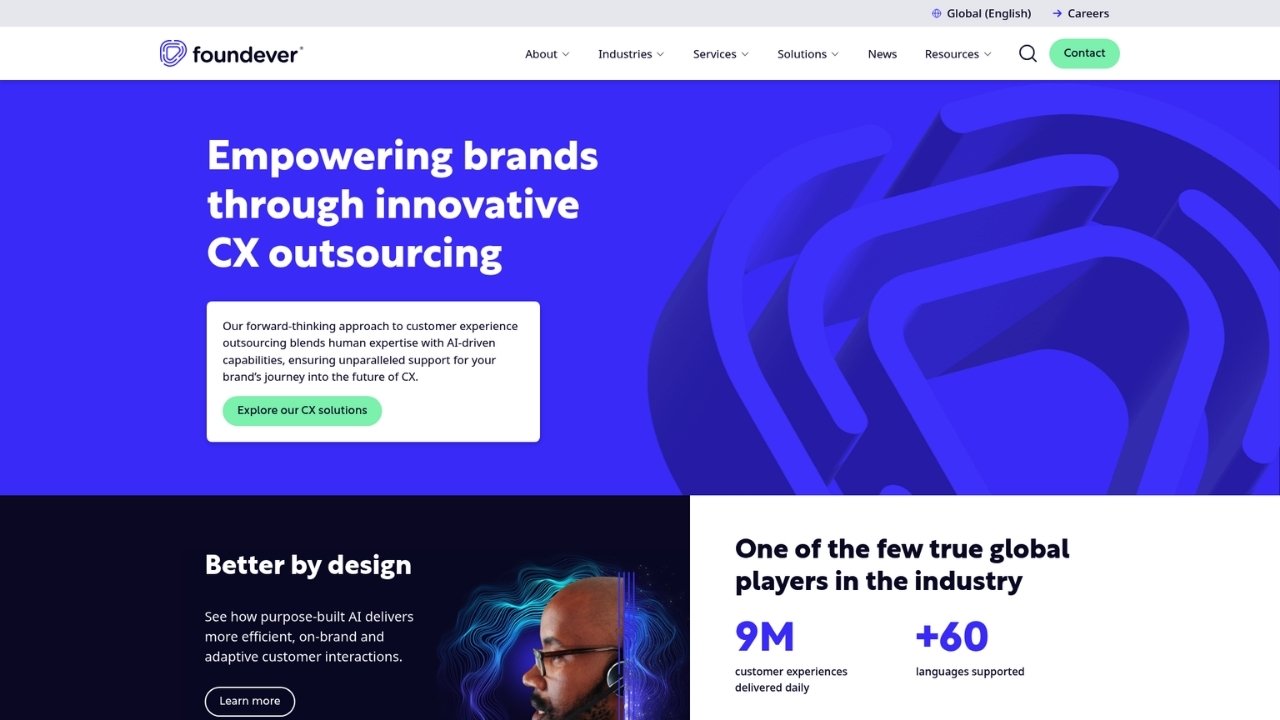
You might know them as Sitel. Foundever is the rebranded, modernized version of one of the industry's oldest names. They deliver 9 million customer experiences daily across 45 countries with 150,000+ associates.
The rebrand signals a shift toward AI-enhanced service delivery. Their purpose-built AI aims to make interactions more efficient while maintaining the human touch where it matters.
As an established player, Foundever brings decades of BPO experience combined with modern technology investments. They hold certifications including HITRUST and have won multiple awards for workplace culture.
Pros:
- Massive scale (150K associates, 45 countries)
- 60+ languages supported
- Established reputation with modern AI focus
- Strong compliance certifications
Cons:
- Traditional BPO model with AI layered on top
- Custom pricing only
Best for: Companies wanting an established BPO partnership with the backing of a major global provider.
How to choose the right Alorica alternative
With seven options, how do you decide? Here's a simple framework:
Choose AI (Ringly) if:
- You run a Shopify store or e-commerce business
- You want 24/7 coverage without hiring
- Cost efficiency is a priority
- Your support needs are relatively straightforward (order status, returns, FAQs)
Choose a modern BPO (NeoWork, Helplama) if:
- You're a startup or small business
- You want transparent pricing
- You need flexibility to scale up and down
- You prefer US-based agents (Helplama) or don't mind offshore (NeoWork)
Choose an enterprise BPO (TaskUs, Concentrix, VXI, Foundever) if:
- You need global coverage
- You have complex support requirements
- You want strategic partnership, not just staffing
- Budget is less constrained than flexibility
Start automating your customer support today
Traditional BPOs like Alorica have their place, but they're not the only option anymore. For e-commerce businesses specifically, AI phone agents like the AI agent from Ringly offer a compelling alternative: instant setup, 24/7 availability, and significant cost savings.
The best approach? Start with a free trial and see what works for your specific needs. Most providers offer some form of trial or pilot program.
Ready to explore AI-powered phone support? Try it for free and see how the AI can handle your customer calls.
Frequently Asked Questions
What companies are similar to Alorica?
Companies like TaskUs, Concentrix, VXI Global Solutions, Sutherland Global Services, and Foundever offer similar BPO services. For a different approach, AI-powered solutions like Ringly provide automated phone support as an alternative to traditional human agent models.
How much do Alorica alternatives typically cost?
Pricing varies widely. Traditional BPOs like TaskUs and Concentrix use custom enterprise pricing. More transparent options include NeoWork ($11-14/hr), Helplama (from $399/mo), and Ringly (prices per conversation; see Ringly's pricing). Most BPOs charge $25-199/hr depending on location and service level.
Is it better to choose a human BPO or AI phone agent?
It depends on your needs. Human BPOs excel at complex, nuanced interactions requiring empathy and judgment. AI agents work best for high-volume, routine tasks like order lookups, returns, and FAQs. Many businesses use AI for tier-1 support and escalate complex issues to humans.
What should I look for when evaluating Alorica alternatives?
Focus on pricing transparency, scalability, technology integration capabilities, and industry expertise. Also consider employee retention rates (higher is better for service consistency) and contract flexibility.
Can small businesses afford BPO services?
Yes. While enterprise BPOs target large companies, providers like NeoWork, Helplama, and Ringly cater specifically to small and midsize businesses with transparent, affordable pricing and flexible contracts.
How quickly can I get started with an Alorica alternative?
Setup times vary. AI solutions like Ringly can be configured in under 1 hour. Human BPOs typically need 2-4 weeks for recruitment and training. NeoWork quotes 3 weeks (2 weeks recruitment + 1 week training).