

This post in 30 seconds.
- The 7 supplement-specific call categories an AI phone agent has to handle, and the 5 DSHEA-safe scripts that keep it on the right side of the FDA line.
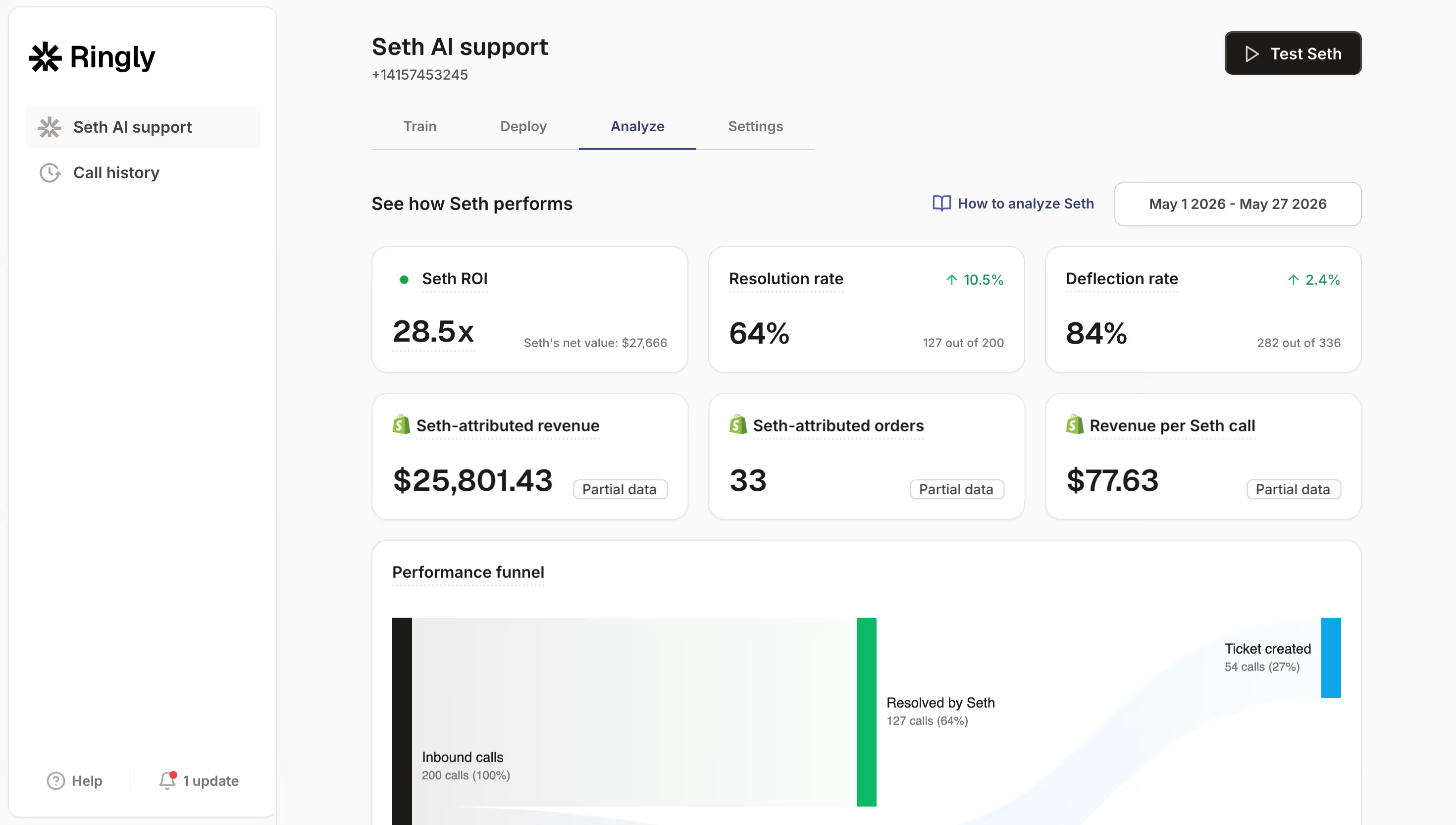
- BioLongevity Labs, a supplement brand on Ringly, hits 79% resolution autonomously at roughly $0.42 per resolved call versus $7-$16 for human BPO.
- Built for $10M-$100M Shopify supplement brands running a paid helpdesk with a visible phone number and a real subscription cohort.
A supplement call is not a normal ecommerce call. A customer ringing your line at 8pm is usually not asking "where is my order?" They're holding two bottles, reading a label, trying to figure out if the new magnesium is safe with the Lipitor their doctor put them on last month. They're a little anxious. They want a real answer in 30 seconds.
Most AI phone tools were built for generic Shopify use cases. They handle WISMO well. They struggle the moment a customer mentions a prescription, a pregnancy, or a dose above the label. And for supplement brands, that's where most of the hard calls live.
If you're the founder, COO, or Head of CX at a $10M-$100M supplement brand on Shopify and your phone routes to voicemail half the day, a 30-min call is the fastest way to see what's leaving with those callers. Book a 30-min call and we'll pull your last 7 days of missed calls live, on the call.
Why supplement brands need a different phone playbook
Supplements sit in a weird middle. They aren't drugs, so you can't make medical claims. They aren't socks, so you can't pretend the questions are simple. And the customer is usually putting something in their body that costs $40-$120 a bottle, often on a subscription, often while juggling other health stuff.
That changes the call.
76% of consumers prefer phone for complex support issues, and phone has a 91% satisfaction rate, higher than chat or email. For supplement brands, that gap is even wider. Health-loaded questions don't translate well to chatbots. People want to hear a calm voice say "yes, that's fine" or "no, check with your doctor first."
The economics are unforgiving. According to DTC ecommerce statistics for 2026, health and supplement brands carry the highest CAC in DTC at $89 per customer. The global dietary supplement market is roughly $192 billion and growing at 9% annually, which means more brands chasing the same customer. Lose one to a botched call and you've burned $89 plus the LTV of their subscription.
Then there's compliance. The Dietary Supplement Health and Education Act (DSHEA) is the rule that lets supplement brands say "supports immune function" but never "cures the flu." Anyone answering the phone for you, human or AI, has to stay on the right side of that line. The AI agent has the advantage: it never freelances. It says exactly what you wrote in the knowledge base, and not a word more.
Add subscriptions on top. A pause request is a retention save in disguise. A cancel call is the last touchpoint before $89 walks out the door. If voice is the channel they're using to leave, voice better be the channel that can save them.
The 7 call categories a supplement AI phone agent must handle
Across supplement brand customer service data, roughly 80% of inbound supplement calls fall into these seven categories. Build for all seven, or stop calling it a supplement-ready agent.
1. Dosage questions
"How many of these do I take?" "Can I take two scoops instead of one?" "If I miss a day, do I double up?"
What the AI should do: read the label dose from the product knowledge base. Repeat the label dose verbatim. Never recommend exceeding it. If the customer pushes, escalate with the compliance line.
What it should not do: improvise. Even if "two is probably fine," the AI doesn't say that.
2. Drug interactions
"Can I take this with my Lipitor?" "Is this OK with my SSRIs?" "I'm on blood thinners, can I add fish oil?"
This is a hard escalation, every single time. The AI should acknowledge the question, refuse to advise on prescription interactions, and route the customer to their physician or pharmacist. No exceptions.
3. Subscription mods
"I want to pause my next shipment." "Can I switch to every two months?" "I want to swap the chocolate for vanilla."
This is the biggest revenue moment in supplement support. Most brands shove subscription mods into a customer portal or a Skio / ReCharge link. The customer who calls instead of clicking is usually one click from cancelling. A voice agent that can pause, skip, swap flavor, change frequency, or change product on the call is doing churn-prevention work disguised as customer service.
4. Allergen, sourcing, and testing
"Is this gluten-free?" "Is the gelatin animal-based?" "Is this third-party tested?" "Do you have an NSF or USP certificate?"
These are knowledge-base questions. The AI should answer from the source of truth (ingredient deck, COA, manufacturing details). If you don't have it in the KB, the AI shouldn't guess. It should offer to email the customer the document or escalate.
5. Where is my order (WISMO)
The boring one. The volume one. Roughly 30-40% of calls in ecommerce are still WISMO calls, and supplement subscribers ask too, especially around expected refill dates. The AI pulls the order from Shopify, reads the tracking, offers SMS of the link. Done in 45 seconds.
6. Pre-purchase: samples and "which one is right for me?"
"Do you sell a 7-day trial?" "What's the difference between your magnesium glycinate and the citrate?" "Which one helps with sleep?"
The first two are knowledge-base answers. The third is a compliance line: the AI shares what the ingredient does at the body-function level ("magnesium glycinate is often chosen for relaxation and sleep support") and stops there. No diagnosis. No promise.
7. Returns, refunds, and opened-bottle policy
"I opened it and didn't like it, can I return it?" Supplements have unusual return rules (opened products often non-returnable for safety / compliance reasons). The AI reads your actual policy, offers what your policy allows (often a store credit on first opens), and escalates if the customer asks for an exception.
BioLongevity Labs hits 79% resolution autonomously on this 7-category mix, and the only category they hard-escalate every time is drug interactions. That's the model. If a vendor can't tell you which categories they actually handle versus deflect, that's a sign they were built for generic ecommerce, not supplements.
The compliance script (real lines the AI says)
Compliance is a script problem, not a model problem. The AI doesn't have to "understand" DSHEA. It has to say specific lines when specific topics come up.
The framing your AI should run on:
- Supplements are food, not drugs, under DSHEA.
- The AI can describe structure / function ("supports immune function").
- The AI cannot describe disease treatment ("cures the cold").
- The AI defers to a physician on anything medical.
These are the actual lines that should be in your knowledge base, ready for the AI to read verbatim:
On prescription interactions: "I'm not able to advise on prescription interactions. Please check with your doctor or pharmacist before combining this with any prescription medication. I can email you our ingredient deck so you have it for that conversation, want me to?"
On disease or condition claims: "I can share what the ingredients are designed to support at the body-function level. For anything related to a medical condition or treatment, your physician is the right person to talk to."
On dosing above the label: "Our recommended dose is on the label at [X]. I'm not able to advise on going above that. Your doctor can help if you're considering a different dose."
On pregnancy and nursing: "For anything during pregnancy or while nursing, the right call is always your OB before adding a new supplement, even one available over the counter."
On warm-transfer cues: If the customer pushes after the script, the AI offers a human callback within a defined window, captures the question, and creates a ticket in your helpdesk. This is where a clean smart call transfer matters: the human picks up with full context, not a cold "who is this?"
Bake those five lines into your knowledge base, and the compliance posture is solved on day one. According to Alhena.ai's compliance breakdown for supplement brands, most AI agents fail compliance not because the model is bad, but because the operator never wrote the scripts and never set the escalation rules.
Subscription mods on the phone (the channel nobody uses)
Here's the unsexy retention play most supplement brands miss.
Customers who call to cancel a subscription are not the same as customers who click "cancel" in the portal. They've gone out of their way. They want to be heard. They're often one good conversation away from staying.
Voice is the best save channel for this, and almost no one runs it well. The playbook:
- Offer the pause before they ask. "Want to pause your next shipment for 30 or 60 days instead of cancelling?" Most cancel calls in the supplement world are really "I have too many bottles right now" calls.
- Offer the skip-one. "I can skip your November shipment and keep December on the schedule."
- Offer the swap. Flavor, format (capsule vs. powder), or a different SKU entirely.
- Offer the frequency change. Every 60 days instead of every 30. This alone retains a meaningful chunk of "I'm not finishing the bottle" cancels.
- Only then accept the cancel. And if they cancel, the AI confirms, sends the email, and offers a 1-tap re-subscribe link via SMS for later.
This isn't a fantasy. A modern AI phone agent connected to ReCharge, Skio, Stay, or Awtomic can do all five of those actions on the call. The flow lives in the AI's instructions, not in a customer portal that gets clicked at 11pm in a "screw this, I'm out" mood.
For deeper background, see ecommerce customer retention. The phone is the most underused retention channel in supplement DTC.
ROI math at supplement subscription economics
Run the numbers on a typical supplement brand. $89 CAC, $52 AOV (one bottle plus subscription anchor), 27% subscription rate, 350 calls per month. Here's how the cost stacks up.
| Setup | Cost per call | Monthly cost | Notes |
|---|---|---|---|
| In-house phone agent (US, fully loaded) | ~$8-$12 | ~$5,000-$7,500 | One person, regular hours only |
| BPO outsource | $7-$16 | $2,450-$5,600 | Industry average per Deloitte 2024 |
| Ringly Grow plan | ~$0.70 all-in | $349 + overage | 1,000 minutes included |
| Ringly Pro plan | ~$0.64 all-in | $799 + overage | 2,500 minutes included |
The bigger ROI lever for supplements is the subscription save. One retained $52/month subscription on a 30-day cadence is $624 in annual LTV. If your phone agent saves 4 cancel calls a month at a 25% save rate, that's $7,488 in annualized retention. Pro pays for itself on a single save call per quarter.
The best AI phone tools for supplement brands in 2026
Honest list. Four tools, ranked by fit for a Shopify supplement brand doing $10M-$100M in revenue.
| Tool | Best for | Pricing | Shopify-native | Phone-native |
|---|---|---|---|---|
| Ringly.io | Shopify supplement brands wanting phone-first AI | From $349/mo | Yes | Yes |
| Gorgias AI Voice | Brands already on Gorgias helpdesk | Helpdesk + voice add-on | Yes | No (chat-first DNA) |
| Zendesk Talk + AI | Large multi-vertical CS orgs ($25M+ rev) | From $89/agent/mo + AI | Via integration | Partly |
| Smith.ai | Founder-led, low call volume, want humans + AI | From $292/mo | No | Hybrid |
1. Ringly.io: AI phone support for Shopify brands
Best for: Shopify supplement brands that want phone support live without hiring a phone team.
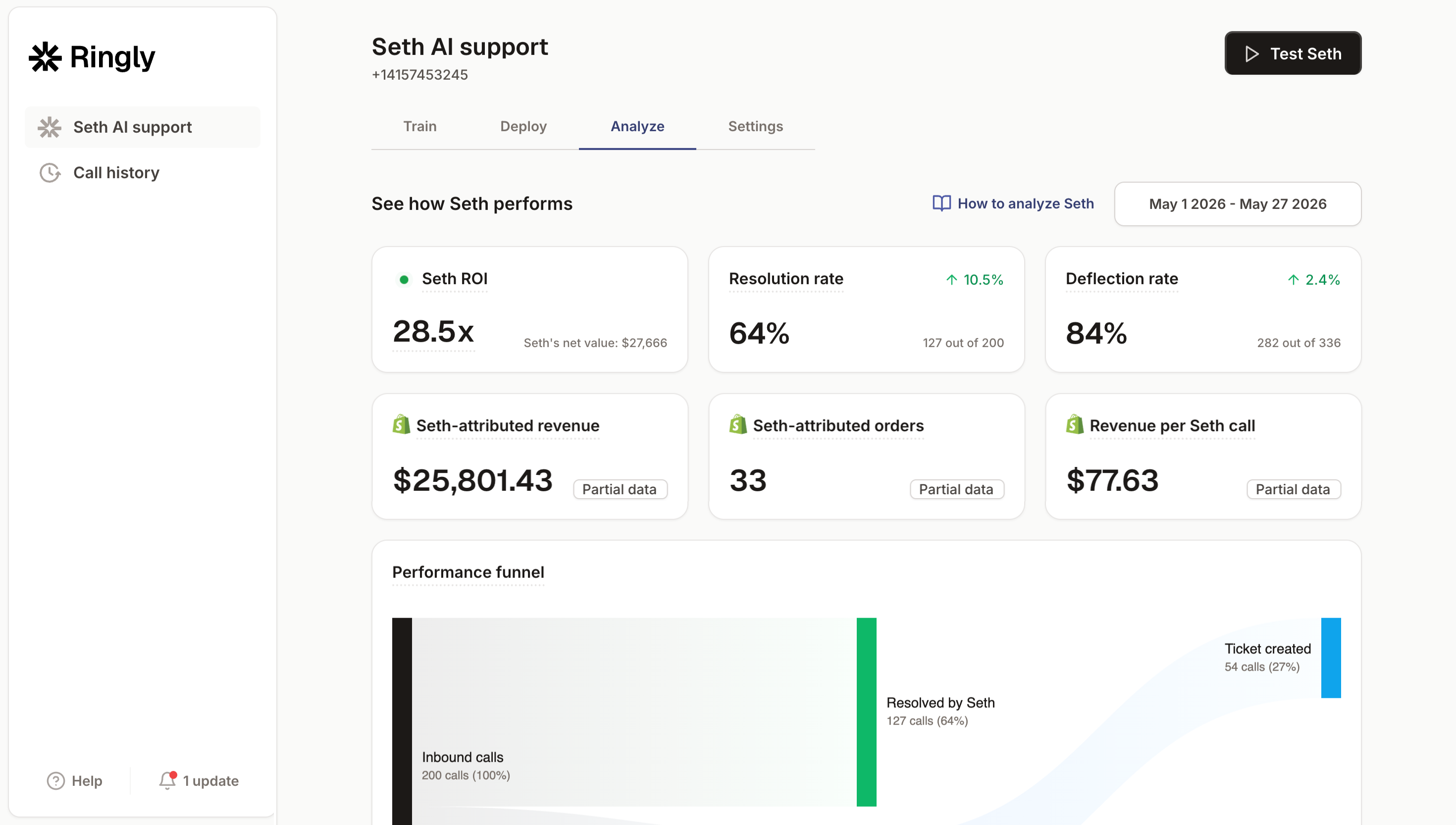
Ringly.io is AI phone support for Shopify brands. Hiring a phone team scales linearly with call volume. The AI doesn't. The agent answers inbound calls 24/7 in 40 languages, pulls orders from Shopify, processes returns and exchanges, answers product questions from your knowledge base, and escalates the calls that need a human into Gorgias, Richpanel, or Reamaze.
For supplement brands, the build is straightforward. You feed Ringly your product knowledge base (ingredients, COAs, allergen info, dosage instructions, subscription mod flows). You write the five compliance script lines from above. You set the warm-transfer rules for category 2 (drug interactions). The agent is live in under an hour.
Pricing
| Plan | Price | Minutes | Best for |
|---|---|---|---|
| Grow | $349/mo | 1,000 (~500 calls) | First-timers, low volume |
| Pro | $799/mo | 2,500 (~1,250 calls) | Growing brands with steady volume |
| Enterprise | Custom | 5,000+ | High volume, custom integrations |
What works
- Shopify-native order lookup: pulls orders, tracking, and customer history without custom dev. See check order status.
- Knowledge-base-grounded answers: the AI never improvises. It reads from the knowledge base you control, which makes DSHEA compliance enforceable.
- 65% resolution guarantee: if the AI resolves under 65% of calls in 90 days, Ringly refunds the last 3 months of subscription fees.
- Live in under an hour: no integration project. Add your site, docs, and KB, the agent picks up.
- Cleans up subscription mods on the call: pause, skip, swap, frequency change all handled by voice.
- Warm transfer to your existing helpdesk: smart call transfer passes the full transcript and customer context.
What doesn't
- Only Shopify natively today: if you're on BigCommerce, WooCommerce, or Magento, it's not the right fit.
- Not built for outbound sales dialing: it does outbound abandoned cart recovery, but it's not a sales dialer.
Why it ranks first
Phone-native, Shopify-native, with a published guarantee that puts real money on the table. For a supplement brand on Shopify, this is the closest tool to "drop in and go" in the category. Also see the dedicated supplement stores industry page.
2. Gorgias AI Voice
Best for: Brands already running Gorgias as their helpdesk and want to layer voice into the same inbox.
Gorgias is the dominant Shopify helpdesk for ecommerce. AI Voice is their newer phone layer. The fit is obvious: if you live in Gorgias for chat and email, having voice land in the same ticket queue is convenient.
Pricing
Gorgias helpdesk runs from roughly $10/mo (Starter) up to $900/mo (Advanced). AI Voice is a separate add-on with per-conversation or per-minute pricing that isn't fully published.
What works
- Unified inbox: voice, chat, email, social in one ticket queue
- Macros across channels: your existing chat playbooks translate
- Trusted Shopify integration: deep order data already wired in
What doesn't
- Chat-first DNA: voice is newer than the rest of the platform
- Layered cost: helpdesk plus AI plus voice add fast
- Less phone-native than purpose-built voice tools
3. Zendesk Talk + AI
Best for: $25M+ supplement brands with a dedicated CS operations team and a multi-vertical setup.
Zendesk Talk is the cloud telephony layer in the Zendesk stack. Combined with Zendesk's AI agent, it's the enterprise option. Built for orgs with a CS director, a WFM lead, and 20+ seats.
Pricing
Suite Growth from $89/agent/mo, Suite Professional $115/agent/mo. AI agent priced per resolution on top.
What works
- Enterprise reporting and WFM: deep dashboards, scheduling, QA tooling
- Battle-tested compliance posture: HIPAA-adjacent industries trust Zendesk
- Heavy customization: build anything if you have the team
What doesn't
- Heavy admin: weeks to deploy properly, not hours
- Per-seat pricing: scales fast in a high-headcount CS org
- Not Shopify-native: integrations are an engineering project
4. Smith.ai
Best for: Small supplement brands, founder-led, with low call volume that want a human-plus-AI hybrid.
Smith.ai is a US-based virtual receptionist service with an AI layer added. Real humans answer alongside the AI.
Pricing
Plans start around $292/mo for ~30 calls and scale per-call from there.
What works
- US-based humans: the receptionist actually sounds American
- Hybrid model: AI handles simple, humans handle complex
What doesn't
- Per-call pricing scales painfully: at 500+ calls/mo the math breaks
- No Shopify-native integration: order lookups are manual
- Not voice-AI-first: AI is an add-on, not the core product
How to choose the right AI phone tool for your supplement brand
Short decision framework. Pick one:
- Choose Ringly if: you're on Shopify, you want phone-native AI, and you want a real published resolution guarantee. This is the default for a supplement brand doing $10M-$100M.
- Choose Gorgias AI Voice if: you already live in Gorgias and don't want to introduce a second tool. Accept the chat-first DNA tradeoff.
- Choose Zendesk + AI if: you're $25M+, have a dedicated CS ops team, and need enterprise reporting more than you need fast deployment.
- Choose Smith.ai if: you're sub-100 calls a month, founder-led, and willing to pay per-call for a human-AI hybrid.
If you're not sure which side of the decision you're on, the cheapest move is a 30-min call where we pull your last 7 days of missed calls live and show you which tool the volume actually supports. There's also a dedicated Shopify customer service app comparison if you want the broader landscape.
What happens on the call.
- We pull your last 7 days of missed calls live, on the call. No homework for you.
- We show you the recovered revenue at typical resolution rates we see for supplement brands.
- You decide if it's worth a deeper conversation. No deck, no follow-up sequence.
The call makes sense if:
- You're a Shopify (or Shopify Plus) supplement brand doing $10M-$100M
- You run a paid helpdesk (Gorgias, Zendesk, Gladly, Re:amaze, or Intercom)
- You have a visible phone number on your store
- Your CS team is 3-12 people
Frequently asked questions
Can an AI phone agent legally answer supplement dosage questions?
Yes, as long as it reads the label dose verbatim from your knowledge base and never recommends exceeding it. Dosage instructions printed on the bottle are product facts, not medical advice. The line gets crossed the moment the AI suggests a higher dose or makes a clinical recommendation, which is why a knowledge-base-grounded agent (that never improvises) is the safe architecture.
How does the AI handle "can I take this with my prescription?" calls?
It refuses to advise, every single time. The AI says one scripted line ("I'm not able to advise on prescription interactions, please check with your doctor or pharmacist"), offers to email the ingredient deck, and either escalates or ends the call cleanly. This is a hard rule, not a judgment call.
Will the AI sound human enough for anxious health-related calls?
Modern voice AI from category leaders is close enough that most customers don't ask. The tells are mostly latency and how the agent handles interruptions, both of which the better tools handle well in 2026. The best test is to listen to a few sample calls on your own product data and see how it lands.
Can it actually cancel, pause, swap, or change frequency on the phone?
Yes, if it's integrated with your subscription platform (ReCharge, Skio, Stay, Awtomic). The AI runs the save flow first (pause, skip, swap, frequency change) and only processes the cancel if all of those are declined. This is the biggest retention lift voice has over a self-serve portal.
How much does AI phone support for a supplement brand cost?
For most supplement DTC brands, expect $349-$799/mo on Ringly (Grow or Pro), or per-conversation pricing on add-ons to Gorgias / Zendesk that lands in a similar range at modest volume. Compared to $7-$16 per call for human BPO, AI at roughly $0.42 per resolved call is the obvious play once you're past 100 calls a month. See voice AI pricing.
How fast can a supplement brand actually go live?
On Ringly, under an hour: add your site, docs, KB, and the five compliance script lines. On Gorgias AI Voice if you're already on Gorgias, a few hours of setup plus your existing helpdesk config. On Zendesk, plan in weeks, not hours. Smith.ai onboarding takes a few days for script approval and number porting.
Talk to us
If you run a $10M-$100M Shopify supplement brand and your phone is leaking subscription saves and after-hours WISMO calls, a 30-min call is the fastest way to see what you're leaving on the table.
The 3-layer guarantee.
- Live in 14 days or it's free until launched.
- 65% resolution in 90 days or we refund the last 3 months of subscription fees.
- We keep working free until we hit 65%.
Ruben (Ringly co-founder) takes these calls personally.