
This post in 30 seconds.
- At Shopify Plus volume the phone is a revenue line, not an overhead line, and most brands are leaking it after 6 p.m. and during drops.
- The "virtual receptionist" that works at this scale isn't a remote human reading a script. It's an AI phone agent wired into your Shopify store that resolves the call instead of taking a message.
- Built for $10M-$100M Shopify Plus brands with a visible phone number and a paid helpdesk (Gorgias, Zendesk, Gladly, Re:amaze, Intercom).
If you run a Shopify Plus brand doing $10M-$100M, your store takes calls in a way a dentist's office never will. Drop days. After-hours reorders. The same WISMO question 200 times a Monday. A typical answering service quotes you a tidy monthly number, then the per-minute overage triples the bill once your real volume hits. And most of the time the "receptionist" on the other end just takes a message, because they can't see the order in your Shopify admin.
You searched "virtual receptionist for Shopify Plus brands," so let's meet that term head-on, then show you what actually holds up at Plus volume. This sits next to the broader question of Shopify Plus customer service at scale. We've launched AI phone agents for 50+ Shopify brands trying to solve exactly this, and the deciding factor is almost never price per minute. It's whether the thing answering the phone can resolve the call inside your store. If your line goes to voicemail after 6 p.m., book a 30-min call and we'll show you what your store is leaving on the table after-hours.
In this post:
What a virtual receptionist actually means for a Shopify Plus brand
A virtual receptionist is anything that answers your inbound calls without you hiring a person to sit at a desk. That's the plain definition, and it covers three very different things: a remote human answering service, a generic AI answering app, and an AI phone agent built to work inside Shopify.
For a small office, all three look similar, because a small office mostly needs someone to pick up, screen spam, and take a message. At Shopify Plus volume the job changes completely, because your callers aren't asking to book an appointment, they're asking where their order is and whether they can change it before it ships. That's a resolution problem, not a message problem, and it's why a high-volume brand needs a real ecommerce call center approach, not an office answering line.
Here's the scale gap nobody writes about. A Plus brand running 800 to 2,000 inbound calls a day during a busy week needs the receptionist to actually look up the order, read the tracking, process the return, and send the SMS, not write "customer called about order" on a sticky note your team works through tomorrow. Salesforce puts WISMO at 30-40% of support tickets in normal periods and over 50% at peak. If your receptionist can't resolve WISMO on the call, you haven't solved anything, you've just moved the backlog to a different inbox.
And the after-hours math is brutal. Ambs reports that online stores miss around 40% of calls outside normal hours, and 80% of voicemail-routed callers won't leave a message. PCN found that 85% of callers who can't reach a person never call back, and 62% switch to a competitor. For a brand your size, every one of those is a real order, which is the whole case for 24/7 ecommerce phone support.
The 4 ways Shopify Plus brands cover the phone
There are four real ways to handle inbound calls at this scale. Here's the honest version, side by side, before we go deep on each.
| Option | How it works | Cost shape | Best for | Resolves in Shopify? |
|---|---|---|---|---|
| Ringly (Shopify-native AI phone agent) | AI answers 24/7, looks up orders, processes returns, escalates to your helpdesk | Flat monthly, predictable | Plus brands at volume needing real resolution | Yes |
| Human answering service | Remote agents answer from a script, take messages, route | Per-minute or per-call, spikes on overage | Low-volume, emotional or complex calls | No, takes a message |
| Generic AI answering app | AI voice picks up, shallow integrations, you tune it | Cheap base plus per-minute | Tiny brands testing the water | Rarely |
| In-house phone reps | You hire, train, and staff a CS phone team | ~$4,000/mo loaded per rep, linear | Brands wanting full control + deep brand training | Yes, but expensive |
The split that matters at Plus scale isn't AI versus human, it's resolve-the-call versus take-a-message. A remote human answering service and a generic AI app land on the same side of that line for most ecommerce calls: they pick up, but they can't see your Shopify data, so the customer still waits.
Want to compare these against your current setup? Book a 30-min call and we'll do the math on your real call volume live.
How I evaluated these options
I'm Ruben, co-founder of Ringly. Over the last few weeks I evaluated every one of these options the way a Shopify Plus operator would, not as a critic but as a buyer trying to keep a phone line alive without hiring a night shift.
Here's what I scored against:
- Shopify integration depth. I checked whether each option could pull a real order, read the tracking, modify or pause a subscription, and write back, or whether it could only take a message and pass it to a human later.
- Cost at real volume. I priced four human answering services at 1,500 calls a month and watched the per-minute overage triple the tidy base quote. Flat-monthly options got scored on predictability, not just headline price.
- Resolution, not message-taking. I counted how many common ecommerce calls (order status, returns, product questions) each option could close on the call versus how many got punted to a queue.
- Voice quality. I listened to how natural each one sounded, because the fastest way to a Twitter screenshot is a robotic receptionist on a premium brand's line.
- Failure mode. I called each option's own customer service line at 11 p.m. on a Tuesday to see whether a human picked up, a bot stalled, or nobody answered at all.
I don't take affiliate commissions on anything below. I sell Ringly, which appears first for the same reasons everyone else is ranked, and against the same five criteria. The thing that separated the field wasn't price, it was integration depth: most options pick up the phone, but only a couple can actually resolve a Shopify order on the call.
The four options, compared
1. Ringly.io: AI phone support for Shopify brands
Best for: Shopify Plus brands at volume that need calls resolved inside the store, not messages taken. Ringly.io is AI phone support for Shopify brands. Your team wasn't hired to answer the same call 50 times a day, so the AI takes the routine inbound calls and your reps get the hard ones back.
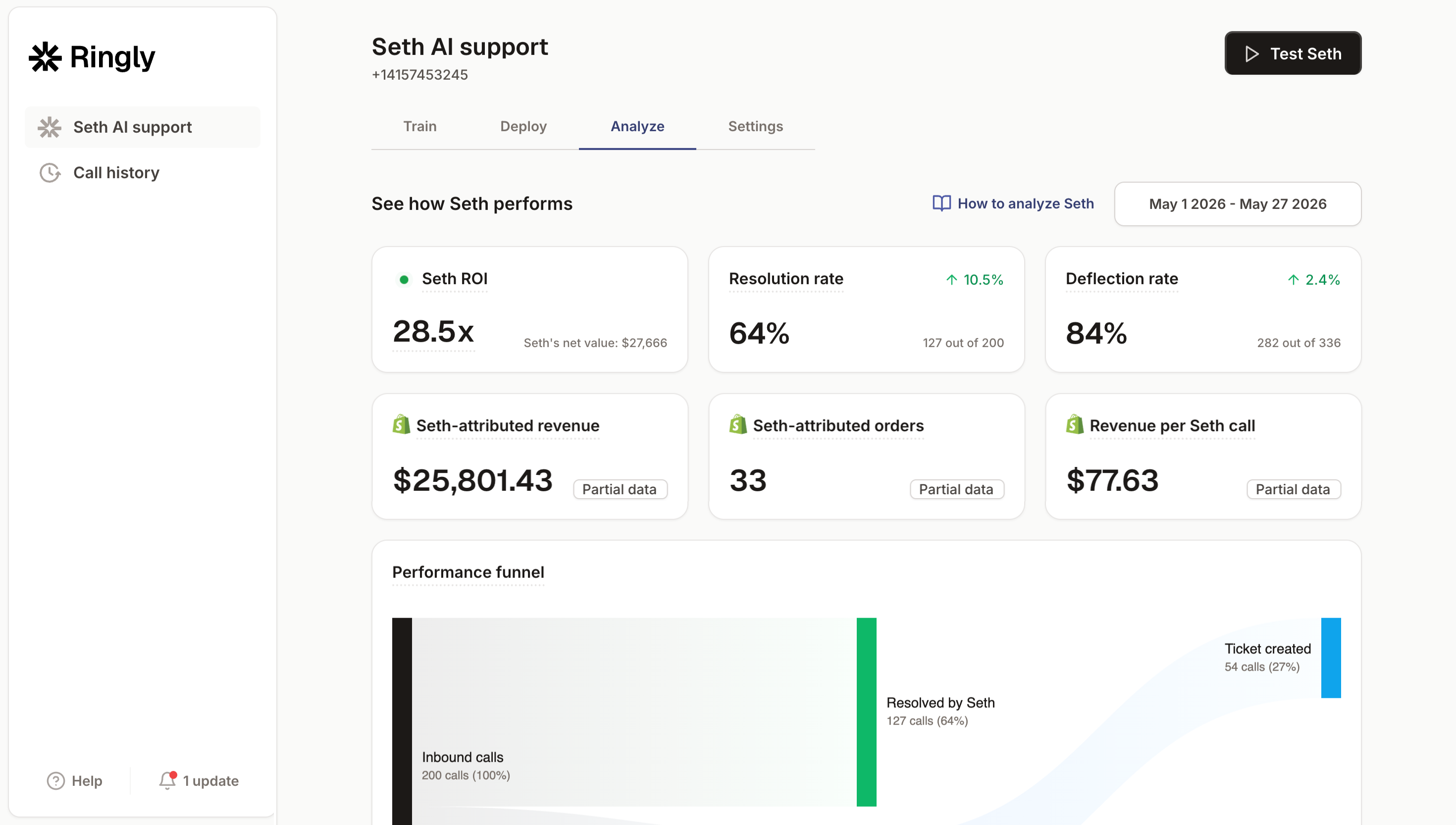
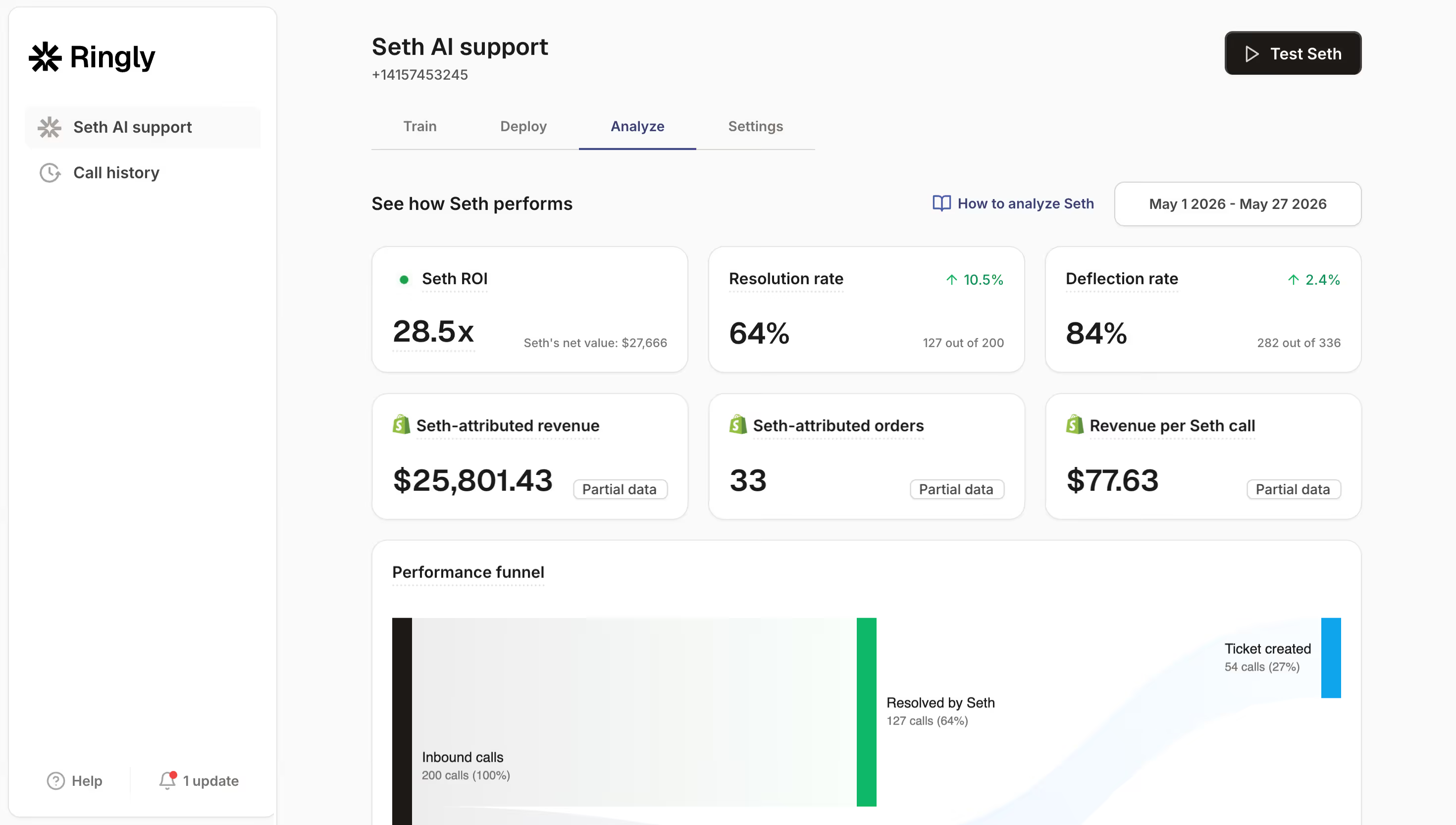
The AI answers inbound calls 24/7 in 40 languages. It finds orders in your Shopify store, processes returns and exchanges, answers product questions from your knowledge base, and rescues abandoned carts via outbound follow-up. Calls that need a human escalate cleanly to Gorgias, Richpanel, Re:amaze, or whatever helpdesk you already run, so it sits in front of your stack instead of replacing it. This is the same idea as a purpose-built AI customer support phone agent for Shopify, tuned for Plus volume. WashCo, a Shopify brand we launched, recovered $22,664 in its first 7 days on the phone.
Pricing
| Plan | Price | Included | Best for |
|---|---|---|---|
| Grow | $349/mo | 1,000 min (~500 calls), $0.29/min overage | First-timers, low volume |
| Pro | $799/mo | 2,500 min (~1,250 calls), $0.19/min overage | Growing brands with clear phone volume |
| Enterprise | By call | Custom, never publicly quoted | $10M-$100M Plus brands with 3-12 reps |
14-day free trial on Pro. The Enterprise tier is set on a call and roughly tracks 20% of your current CS team spend.
What works
- Native Shopify integration: pulls the order, reads tracking, processes returns, and acts on the customer's account during the call, not after it.
- Sits in front of your helpdesk: keep your phone number, Gorgias or Zendesk, and workflows. The AI handles the routine, escalates the rest.
- Done-for-you build: we build and tune it in a 14-day Launch Sprint. You're not the implementation team.
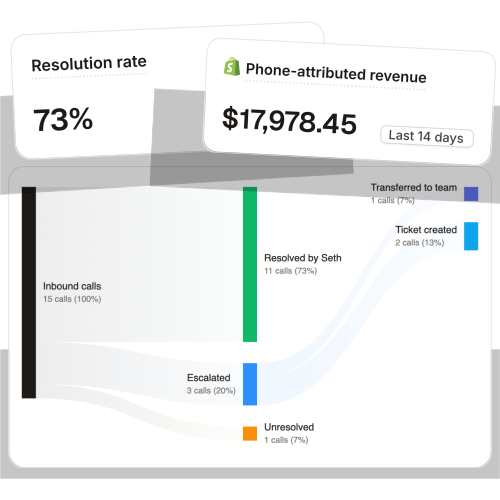
- Real resolution at scale: across 50+ brands the AI resolves 73% of calls autonomously at roughly $0.42 per resolved call.
- It doesn't sound like AI: the most repeated thing customers say after a call.
What doesn't
- No phone orders or payment by voice: it sends an SMS payment link instead of taking a card over the phone.
- Subscription cancel is a custom action: pause and skip are standard, full cancel needs setup.
- Inventory is a daily refresh, not real-time: fine for most, worth flagging if you run live stock counts.
- Phone-first, not all-in-one: it does phone better than anyone rather than being a mediocre chat-email-voice bundle.
Why it ranks first
For a Shopify Plus brand, integration depth is the whole game, and Ringly is the only option here built around resolving the call inside your store with a guarantee behind it. The done-for-you build plus the 65% resolution guarantee takes the implementation risk off your team.
2. Human virtual receptionist or answering service
Best for: lower-volume brands with a high share of emotional or genuinely complex calls. Services like Ruby, Smith.ai, PATLive, Nexa, and AnswerConnect put a remote human on your line to answer from a script, screen spam, take messages, and route.
These are real people, which is great for the call that needs empathy. The catch for an ecommerce brand is that the agent usually can't see your Shopify admin, so for an order-status or returns call they take a message and your team resolves it later. You've added a friendly voice, not a resolution.
Pricing
| Service | Typical monthly | Overage model |
|---|---|---|
| Ruby | ~$385/mo | per-minute, rounds up |
| Smith.ai | ~$292.50/mo | per-call |
| PATLive | ~$235/mo | per-minute |
| Nexa | ~$239/mo | per-minute |
| AnswerConnect | ~$350/mo | per-minute |
Setup fees run $100-500, after-hours often carries a 1.5-2x premium, and many lock you into an annual contract.
What works
- Real humans: great for grief, complaints, and the call that needs a person.
- Fast to start: you can be live in days.
- US-based options: several services staff domestic agents, which matters for older demographics.
What doesn't
- Takes a message, doesn't resolve: no access to your Shopify order data on the call.
- Per-minute bill spirals at volume: the headline price is not what you pay once real volume hits (more on that below).
- Quality varies by agent: you don't control who picks up.
Why it ranks second
For the genuinely human call it's solid, and Smith.ai earns a 4.6/5 on G2 for lead intake. For high-volume ecommerce WISMO at Plus scale, message-taking plus a per-minute meter is the wrong shape.
3. Generic AI answering app
Best for: tiny brands testing whether AI on the phone is bearable at all. These are off-the-shelf AI voice apps, some right in the Shopify App Store, that pick up 24/7 with no coding and cost less than a human.
They're cheap and they're always on, which is the appeal. The problem is depth: most can answer a scripted FAQ but can't do a live order lookup, a return, or a subscription change, and the voice is generic enough that customers clock it fast.
Pricing
Usually $25-$200+/mo base, with per-minute on top. No done-for-you build, so the tuning is on you.
What works
- Cheapest 24/7 coverage: no human payroll.
- Fast self-serve setup: install and go.
- Good enough for scripted FAQs: hours, location, return policy.
What doesn't
- Shallow Shopify integration: often can't resolve an order on the call.
- Generic voice: reads as a bot on a premium brand line.
- No build or guarantee: you own the tuning and the misses.
Why it ranks third
It clears the "is anyone picking up" bar but not the "did the customer get their answer" bar, which is the only bar that matters at Plus volume.
4. In-house phone reps
Best for: brands that want full control and have the margin to staff it. You hire, train, and roster a CS phone team to answer everything in your brand voice.
It's the deepest control you can get, and it's the most expensive way to cover the phone. A US rep runs roughly $4,000/mo loaded, and the hiring cycle never really ends.
Pricing
Roughly $4,000/mo loaded per US rep (salary, benefits, payroll tax, training, attrition). Offshore runs about $2,000/mo.
What works
- Full control: brand-trained humans who can handle anything.
- No integration limits: a person can do whatever your tools allow.
What doesn't
- Cost scales linearly with volume: every call-volume jump means another hire.
- Hiring is broken: $14,113 to replace one rep and most quit inside year one.
- After-hours gaps: you either pay reps to sit idle overnight or you miss the calls.
Why it ranks fourth
It works, but it's the most expensive line on the P&L and it leaves the after-hours queue uncovered unless you overstaff.
"My customers also feel like it's a normal person. They feel like they can communicate if they have questions."
Claudia Droge, TechCraft Studio
The per-minute trap at Shopify Plus volume
Here's the part that catches Plus brands off guard. A per-minute answering service that's cheap for a dentist's office becomes a runaway bill at ecommerce call volume.
Run the math. A common plan is $325 base plus $2.95 per minute of overage. At 1,500 calls a month with a 2-minute average, that's $325 plus roughly $885 in overage, around $1,210/mo for a service that still mostly takes messages. Push into a drop week and the overage doesn't stop, because the meter runs on every call.
Then the quiet multipliers stack on top:
- Round-up to the nearest minute: a 65-second call bills as 2 minutes. Across thousands of calls that's real money.
- After-hours premium: 1.5-2x the normal rate exactly when you most need coverage.
- Setup fees: $100-500 to start.
- Annual lock-in: early termination penalties if it doesn't work out.
A flat-monthly AI phone agent flips the model. You know the number, the overage is small and published on the pricing page, and the bill doesn't punish you for being busy. Predictability is the point, because Plus brands plan headcount and margin a quarter ahead and can't run on a meter that spikes with traffic. It's the same logic behind moving to automated phone support for Shopify Plus brands instead of a per-minute service.
What this costs vs an AI phone agent
Put real numbers on it. Take a Shopify Plus brand running a 6-rep CS team to cover the phone.
| Line item | Today | With Ringly |
|---|---|---|
| 6 reps × $4K loaded per rep | $24,000/mo | n/a |
| Ringly Enterprise (~$5K/mo) | n/a | $5,000/mo |
| Net monthly CS spend | $24,000/mo | $5,000/mo |
| Monthly savings | n/a | $19,000/mo |
| Annual savings | n/a | $228,000/yr |
That's roughly 70% of repeatable calls (order status, returns, product questions, the same five things over and over) routed to the AI. The other 30%, the genuinely complex calls, still go to your CS team, who now have time to actually solve them.
Per call, the gap is just as stark. An in-house rep call runs about $2.70 loaded. Ringly resolves at roughly $0.42 per resolved call, and a per-minute answering service sits well above both once overage hits. You're not paying for a friendlier voicemail, you're paying for the call to be over.
If you run a Plus brand and you're guessing at what after-hours is costing you, book a 30-min call and we'll pull the math on your real volume.
How to choose a virtual receptionist for your Plus brand
The decision comes down to one question: do you need the call resolved, or just answered? Here's the quick framework.
- Choose a Shopify-native AI phone agent if your call volume is high, most of it is repeatable (WISMO, returns, product questions), and you need the call resolved inside Shopify without growing headcount. This is the fit for most Plus brands.
- Choose a human answering service if your call volume is low and a high share of calls are emotional or genuinely complex, and you're fine with message-taking plus a per-minute bill. An after-hours answering service can patch the overnight gap, but it won't resolve the order.
- Choose a generic AI app only if you're a small brand testing whether phone AI is bearable, and you don't need real order resolution yet.
- Choose in-house reps if you have the margin, want total brand control, and can staff after-hours without paying people to sit idle.
The trap is picking on headline price. At Plus volume the cheapest base plan with a per-minute meter is rarely the cheapest bill, and message-taking just relocates your backlog. Weight integration depth first.
Frequently asked questions
What is a virtual receptionist for an ecommerce brand? It's anything that answers your inbound calls without you hiring an in-house person, from a remote human answering service to an AI phone agent. For a Shopify brand the useful version can look up orders and resolve calls inside your store, not just take a message.
Is an AI or human virtual receptionist better for a Shopify Plus brand? At high volume, an AI phone agent wired into Shopify usually wins on cost and resolution because it can close WISMO and returns calls on the spot. Keep a human path for the emotional or complex calls, which a good AI agent escalates automatically.
Does a virtual receptionist integrate with Shopify? A purpose-built one does. Ringly pulls live order data, processes returns and exchanges, and answers from your knowledge base. Most generic answering services and many AI apps can't, so they take a message and your team resolves it later.
How much does a virtual receptionist cost for a Shopify Plus brand? Human services run roughly $235-$385/mo base plus $1.25-2.95/min overage that spikes at volume. Ringly is flat monthly: Grow $349, Pro $799, Enterprise by call. The predictable number matters more than the headline at Plus scale.
Does it replace Gorgias or Zendesk? No. Ringly sits in front of your helpdesk and handles the routine phone calls, then escalates the rest into Gorgias, Zendesk, Re:amaze, or whatever you run. You keep your stack and your number.
Will customers know they're talking to AI? The single most repeated thing customers say after a call is "you don't sound like AI." You stay in control of what escalates to a human, so the calls that need a person get one.
How fast can a Shopify Plus brand get set up? The self-serve plans go live in under an hour. For Enterprise, the done-for-you 14-day Launch Sprint handles the build and tuning so your team isn't the implementation crew.
Is there a guarantee? Yes. If the AI resolves under 65% of your calls in 90 days, we refund the last 3 months of subscription fees, and we keep working free until we hit it.
Talk to us

If you run a $10M-$100M Shopify Plus brand and you're losing calls after-hours or watching a per-minute bill climb, a 30-min call is the fastest way to see what you're leaving on the table. We'll look at your real call volume and route the math live.
The 3-layer guarantee.
- Live in 14 days or it's free until launched.
- 65% resolution in 90 days or we refund the last 3 months of subscription fees.
- We keep working free until we hit 65%.
Ruben (Ringly co-founder) takes these calls personally.