

Every WISMO email, every refund dispute, every "where's my replacement" message is a trouble ticket. Whether or not your team calls it that. If you're running a Shopify brand, your support queue already behaves like one, with SLAs that get missed, tickets that bounce between agents, and a phone line that nobody owns.
The phrase "help desk trouble ticket software" comes out of the IT world, where every server alert and password reset gets logged, routed, and resolved against an SLA. DTC ops borrowed the model because it works. Issues need owners, owners need deadlines, and customers need somebody to actually close the loop.
The problem is that most ticketing tools were built for IT teams or generic B2B support, not for ecommerce. And almost none of them own the voice channel, which is the one place where 10-15x of your conversion-ready customers actually call you. We'll cover the 9 best help desk trouble ticket software platforms for DTC, plus the gap you'll have to fill separately.
Hear what AI support calls sound like for your store. Just paste your Shopify URL and get sample calls in under 20 seconds, no email required. Listen to demo calls for my store.
Quick comparison of the 9 best help desk trouble ticket software platforms
| Tool | Starting price | Pricing model | Shopify integration | Best for |
|---|---|---|---|---|
| Ringly.io | $349/mo | Flat monthly | Native | Voice channel for Shopify brands |
| Zendesk | $19/agent/mo | Per-agent | App | Large support teams (50+ agents) |
| Freshdesk | $15/agent/mo | Per-agent | App | Mid-size teams, multichannel |
| Gorgias | $10/mo (Starter) | Per-ticket | Native | Sub-1,000 tickets/mo Shopify stores |
| Re:amaze | $29/agent/mo | Per-agent or per-conv | App | Small DTC teams with chatbot needs |
| HappyFox | $29/agent/mo | Per-agent | Limited | Workflow-heavy support ops |
| ProProfs Help Desk | $20/user/mo | Per-user | Limited | Lean teams with knowledge-base focus |
| ManageEngine ServiceDesk Plus | Quote | Per-tech | None | Internal IT, not ecom |
| Spiceworks Cloud Help Desk | Free | Per-seat | None | Free internal IT helpdesk |
Pricing is current as of May 2026 and pulled from each vendor's public pricing page.
What "trouble ticket software" actually means for DTC
The original IT version is straightforward. Something breaks. A ticket gets opened. It gets routed to the right tech, prioritized, tracked against an SLA, and closed. If it sits too long, it escalates.
DTC ops took the same model and applied it to customer issues. A customer emails about a late delivery. A ticket opens. It gets tagged WISMO, routed to whoever owns shipping issues, and resolved within your stated response-time target.
The reason this matters more in ecommerce than people think: WISMO queries make up 30-40% of all ecommerce tickets, and that number climbs above 50% in peak season. Without routing rules and SLAs, those tickets pile up and customers end up filing chargebacks instead of waiting for an answer.
A good help desk trouble ticket platform gives you four things: structured ticket intake, automated routing, SLA management, and reporting on what's slipping. The platforms below all do those four things, with different opinions on how. For a deeper read on the SLA side specifically, our guide on ecommerce customer service SLAs goes into the math.
How we evaluated these platforms
We picked these nine platforms and ranked them based on five things:
- Ticket-routing depth: round robin is the bare minimum. Skill-based routing, load balancing, and auto-assignment by intent are what separates good from great.
- SLA management: response-time SLAs are easy. Resolution-time SLAs with breach alerts and escalation paths are harder, and most teams need them.
- Shopify integration: order data in the ticket sidebar, refund actions one click away, customer history visible. Native > app > Zapier > none.
- Mobile UX: support leads check the queue from their phone. If the mobile app is bad, the team's response time suffers.
- Pricing transparency: per-agent, per-ticket, per-conversation, or unlimited. We flag tools where the headline price misleads.
The 9 best help desk trouble ticket software platforms
1. Ringly.io: AI phone support for Shopify brands
Best for: the voice channel that every ticketing tool ignores. Ringly is AI phone support for Shopify brands.
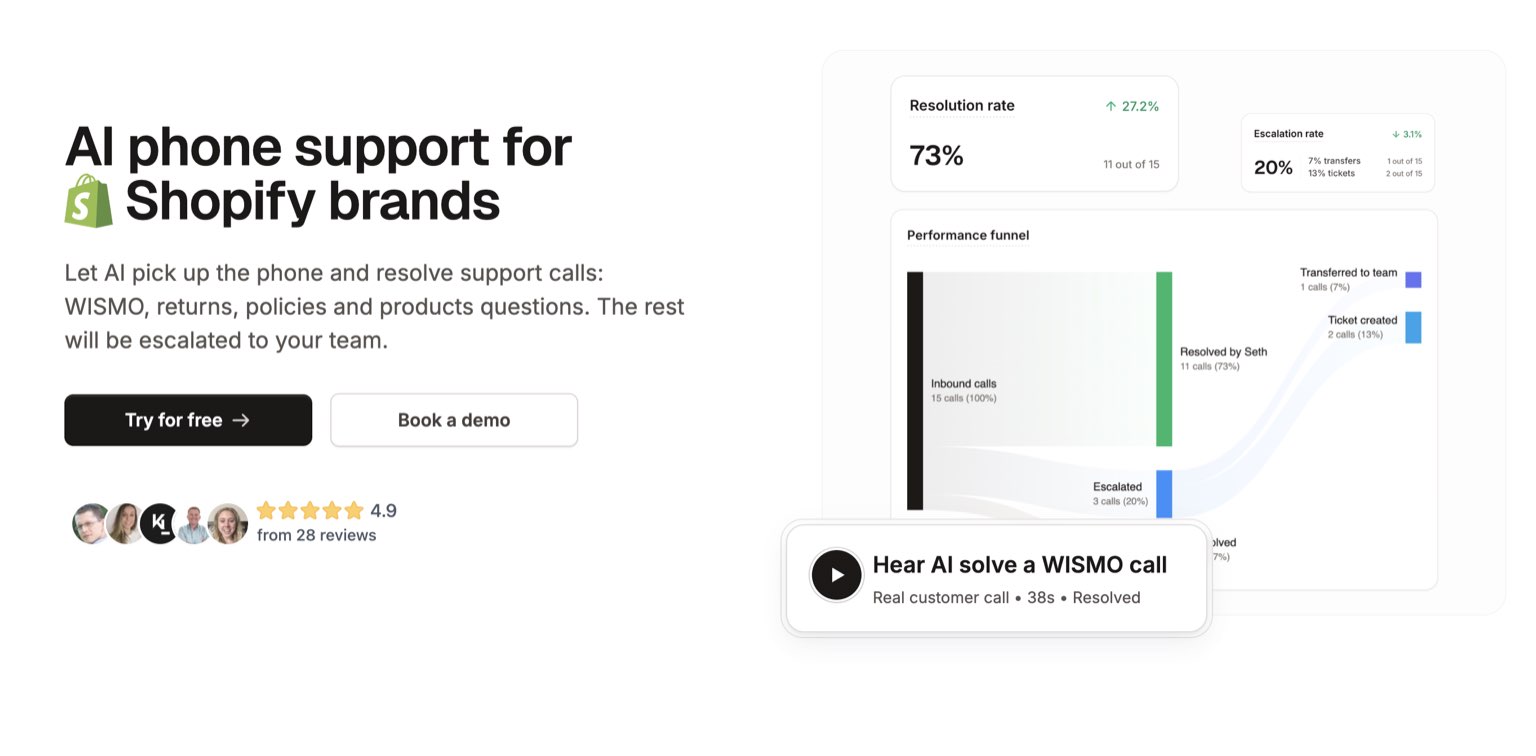
Hiring a phone team scales linearly with call volume. The AI doesn't. Instead of growing your support headcount every time call volume goes up, the AI takes the routine inbound calls so your team can focus on the work that actually moves revenue.
The AI answers inbound calls 24/7. It finds orders in your Shopify store, processes returns and exchanges, answers product questions from your knowledge base, and rescues abandoned carts via outbound follow-up. Across 50+ brands, the AI resolves 73% of calls autonomously at roughly $0.42 per resolved call. Calls that need a human escalate cleanly to Gorgias, Richpanel, Reamaze, or whatever helpdesk you already run, either via call transfer or email-in.
Worth being clear: Ringly is not a ticketing tool. It's the voice layer that pairs with your ticketing tool. Every other platform on this list owns email, chat, and forms. Ringly owns the phone, then hands off cleanly when a call needs a human or a follow-up ticket.
Pricing
| Plan | Price | Minutes | Best for |
|---|---|---|---|
| Grow | $349/mo | 1,000 (~500 calls) | First-timers, low call volume |
| Pro | $799/mo | 2,500 (~1,250 calls) | Growing brands with steady phone volume |
| Enterprise | Custom | 5,000+ | High-volume or custom integrations |
14-day free trial on Pro. 65% resolution guarantee: if the AI resolves under 65% of your calls in 90 days, we refund the last 3 months of subscription fees. Full pricing detail is on our pricing page.
What works
- Native Shopify integration: pulls order data, processes returns, checks inventory without custom dev
- Live in under an hour: add your website, docs, or knowledge base and the AI is ready
- Resolution-rate guarantee: 65% threshold backed by a 3-month subscription refund, which almost no AI vendor offers
- Clean handoff: calls that need a human escalate via smart call transfer or email-in to your existing helpdesk
- Outbound use cases too: abandoned cart recovery, order follow-ups, return logistics
What doesn't
- Not a ticketing tool: you still need one of the eight ticketing platforms below for email, chat, and form-based tickets
- Shopify-first: best fit if you're on Shopify. Brands on other platforms get less native integration depth
- Voice-only: text channels stay in your existing helpdesk
Why it ranks first
Because for DTC ops, the gap on this list isn't a ninth ticketing tool, it's the voice channel. Everyone else handles email and chat well. Nobody handles phone for ecommerce the way Ringly does.
Try Ringly.io free for 14 days and hear what the AI sounds like on your store's calls.
2. Zendesk
Best for: large support teams with complex routing and multichannel intake. Zendesk is the category default, with the heaviest feature depth and the steepest learning curve.
Zendesk Suite bundles ticketing, chat, voice, messaging, and a help center. Support-only plans cover ticketing. Most DTC teams above 50 agents end up here, and most below that find it overkill.
Pricing
| Plan | Price (annual) | Highlights |
|---|---|---|
| Support Team | $19/agent/mo | Ticketing only |
| Suite Team | $55/agent/mo | + chat, voice, messaging, help center |
| Suite Growth | $89/agent/mo | + SLAs, multilingual |
| Suite Pro | $115/agent/mo | + skills-based routing, side conversations |
| Suite Enterprise | $169/agent/mo | + custom roles, sandbox |
AI add-on runs $25-$50/agent/mo on top. G2 rates Zendesk 4.3/5 across 6,000+ reviews.
What works
- Deepest routing engine: skills-based, load-balanced, round robin, custom triggers
- Mature SLA management: multi-tier response and resolution SLAs with escalation policies
- Massive integration marketplace: Shopify, Slack, Jira, dozens of CRMs
- Reporting depth: custom dashboards, ticket-level analytics, agent performance
What doesn't
- Cost climbs fast: add AI, voice, and the WFM module and you're past $200/agent/mo
- Setup time: weeks, not days. Plan for a Zendesk admin
- DTC fit: built for general support, not Shopify-specific. Order data lives in a sidebar app, not natively
Why it ranks second
Best-in-class ticketing if you have the scale and the budget. If you have neither, look further down the list. We cover competitors specifically in our Zendesk alternatives guide.
3. Freshdesk
Best for: mid-size teams that want omnichannel from day one without paying Zendesk-level prices.
Freshdesk gives you ticketing, email, chat (via Freshchat), voice (via Freshcaller), and a knowledge base in a single bundle. Pricing is per-agent and stays cleaner than Zendesk's tier matrix.
Pricing
| Plan | Price (annual) | Highlights |
|---|---|---|
| Free | $0 | Up to 2 agents, basic ticketing |
| Growth | $15/agent/mo | SLAs, automations, knowledge base |
| Pro | $47/agent/mo | Multi-product, custom roles, AI |
| Enterprise | $79/agent/mo | Skill-based routing, sandbox |
G2 rates Freshdesk 4.4/5 across 3,000+ reviews.
What works
- Omnichannel in the base plan: email, social, web forms included
- Cleaner pricing than Zendesk: predictable per-agent, no module-by-module add-ons
- Good mobile app: agents work the queue from their phone without losing context
- Native Shopify app: order data, customer history in the ticket sidebar
What doesn't
- AI gated to Pro tier: smaller teams pay $47/agent/mo to get assistive AI
- Voice via Freshcaller: separate product to provision, not an AI agent
- Workflow editor is fiddly: powerful but not intuitive
Why it ranks third
Best-balance pick for mid-size DTC support teams (5-30 agents). Worth checking Freshdesk alternatives if your volume is tiny or if you need deeper ecommerce features. The official Freshdesk Shopify integration guide covers the setup details.
4. Gorgias
Best for: Shopify stores under 1,000 tickets/month that want native ecom-first ticketing.
Gorgias was built for Shopify, Magento, and BigCommerce. The integration is the deepest of any helpdesk on this list. Per-ticket pricing is unusual and works well for small stores, less well at scale.
Pricing
| Plan | Price | Tickets included |
|---|---|---|
| Starter | $10/mo | 50 tickets |
| Basic | $60/mo | 300 tickets |
| Pro | $360/mo | 2,000 tickets |
| Advanced | $900/mo | 5,000 tickets |
| Enterprise | Custom | Custom |
Overages run $0.36-$0.40 per ticket. AI Agent interactions are billed separately at $0.90-$1.00 each. G2 rates Gorgias 4.6/5 across 500+ reviews.
What works
- Native Shopify: order data, refund and replacement actions one click from the ticket
- Per-ticket pricing: works for low-volume stores. No agent seat tax
- Macros plus rules: macro library tuned for ecommerce out of the box
- Multi-store: handles multiple Shopify storefronts in one inbox
What doesn't
- Pricing climbs fast: above 1,000 tickets/mo, per-ticket math gets expensive
- Per-ticket can punish: spam, duplicate replies, and bounces eat your allowance
- Voice support is thin: Twilio integration exists, but it's routing, not answering
Why it ranks fourth
If you're a Shopify store and you're under 1,000 tickets/mo, Gorgias is hard to beat. Above that line, the math and the Gorgias alternatives start to matter.
5. Re:amaze
Best for: small DTC teams that want a lighter, friendlier feel than Gorgias plus built-in chatbot.
Re:amaze is the chill alternative in the ecommerce helpdesk space. Per-agent on most tiers, with a per-conversation Starter option for teams who want unlimited seats.
Pricing
| Plan | Price | Notes |
|---|---|---|
| Basic | $29/agent/mo | Email, chat, social, basic chatbot |
| Pro | $49/agent/mo | + multi-brand, SMS/voice via Twilio |
| Plus | $69/agent/mo | + team management, screensharing |
| Starter | $59/mo | Unlimited team, 500 conversations |
14-day free trial. G2 rates Re:amaze 4.4/5 across 200+ reviews.
What works
- Built-in chatbot: not an add-on, included in the base plan
- Starter plan is unique: flat $59 for unlimited seats works for tiny teams
- Shopify integration: order context in the ticket
- Multi-brand support: handles multiple storefronts on Pro+
What doesn't
- Smaller integration ecosystem: fewer connectors than Zendesk or Freshdesk
- Voice channel is Twilio-DIY: you wire up your own number
- Reporting depth: thinner than Zendesk and Freshdesk
Why it ranks fifth
Solid pick for small DTC teams. Loses points against Gorgias for native Shopify depth, against Freshdesk for omnichannel polish.
6. HappyFox
Best for: teams that want heavy workflow customization and custom ticket fields.
HappyFox does ticket categorization and workflow automation better than most. The catch is that the features that matter (AI, BI, chat) are sold as separate paid modules, which makes the headline price misleading.
Pricing
Plans start at $29/agent/mo (annual) for the Basic tier and climb to ~$89/agent/mo for higher tiers. Monthly billing pushes the entry point closer to $49/agent/mo. Add-on modules for AI, Chat, Workflows, BI, and Autopilot are priced separately.
G2 rates HappyFox 4.5/5 across 130+ reviews.
What works
- Custom ticket fields and forms: per-category, per-channel, deeply configurable
- Strong SLA engine: response, resolution, and breach escalations
- Multi-language support: 12+ languages handled in the agent UI
- Solid mobile app: iOS and Android both maintained
What doesn't
- A la carte pricing: real cost for a working setup is usually 2-3x the headline
- No native Shopify: integration is via Zapier or custom API
- AI tier required for assistive features: don't expect any GenAI without paying extra
Why it ranks sixth
Powerful if you need deep customization, expensive once you turn on the features that make it worth it. Not the first pick for a typical DTC store.
7. ProProfs Help Desk
Best for: lean teams who pair the helpdesk with ProProfs' knowledge base.
ProProfs Help Desk is opinionated and simple. Shared inbox, ticket assignment, basic automations, and a tight integration with ProProfs Knowledge Base. If your support model is mostly "answer the same five questions and link the article," this fits.
Pricing
- Free: up to 1 user, basic features
- Team: $20/user/mo annual ($30/user monthly)
G2 rates ProProfs Help Desk 4.6/5 across 60+ reviews. Worth noting the review count is much smaller than Zendesk or Freshdesk.
What works
- Simple onboarding: setup in an afternoon, not a week
- Tight knowledge-base pairing: deflection works well if you use both products
- Predictable pricing: one tier, one price
- Decent automations: assignment rules, SLA timers, canned responses
What doesn't
- Shallow routing: no skill-based routing or load balancing
- Limited Shopify integration: nothing native
- Reporting is basic: enough for small teams, not enough for ops leads
Why it ranks seventh
Honest tool, narrow fit. Best for small support teams whose biggest unlock is deflection through articles. If you're hunting for a simple help desk software for a lean team, it's worth a look.
8. ManageEngine ServiceDesk Plus
Best for: internal IT helpdesks, not customer support.
We include ServiceDesk Plus because it's the platform most associated with the literal phrase "trouble ticket software." It's ITIL-aligned (incident, problem, change, asset, CMDB) and used by IT teams at mid-size and large companies.
Pricing
Quote-based. Pricing depends on technician count and the number of IT assets managed. A free Standard tier supports up to 5 technicians. G2 rates ServiceDesk Plus 4.2/5 across 200+ reviews.
What works
- ITIL-aligned: incident, problem, change, asset, release management
- On-prem or cloud: rare in 2026, useful for regulated industries
- Asset management: hardware and software inventory built in
- Free up to 5 techs: real free tier, not a trial
What doesn't
- Not built for ecommerce: customer-facing intake (email, chat, social) is not the focus
- Quote-based pricing: no public list price
- UI feels dated: especially next to Zendesk or Freshdesk
Why it ranks eighth
Right tool if you're running internal IT at a 200-person company. Wrong tool if you're running a Shopify support team.
9. Spiceworks Cloud Help Desk
Best for: small internal IT teams that want free.
Spiceworks built the free-IT-helpdesk category. Cloud Help Desk is the modern hosted version. Free up to five seats. Premium tier removes ads and adds bulk actions, tasklists, and 24/5 chat support.
Pricing
- Free Core: up to 5 seats, ad-supported
- Premium: $6/seat/mo, ad-free, additional features
G2 rates Spiceworks 4.3/5 across 300+ reviews.
What works
- Free for small teams: real free tier, not a 14-day trial
- Easy setup: account in minutes
- Active community: 8M+ IT pros on the Spiceworks community, useful for troubleshooting
- Mobile app: ticket management on the go
What doesn't
- Internal IT only: no customer-facing ecommerce channels
- Free tier is ad-supported: pay for Premium to remove
- Reporting is basic: fine for small IT, not enough for ops
Why it ranks ninth
Solid free internal IT helpdesk. Has nothing to do with running a Shopify support queue.
But what about the calls that bypass the ticket system?
Here's the gap nobody on this list owns. Tickets show up in your queue when somebody emails, chats, or fills a form. They don't show up when somebody calls.
The phone is the orphan channel. And it's the channel where the most valuable customers live. Phone callers convert 10-15x higher than form-fillers because they're calling about something urgent: a missing order, a payment that failed at checkout, a return that's two days from the cutoff. The call doesn't enter the ticket system because the ticket system isn't designed to capture it. So you have three options.
Option one: hire a phone team. Headcount scales linearly with call volume. Each call costs $5-$22 when a human handles it. For most DTC brands under $20M, this math doesn't work.
Option two: route to voicemail or an IVR. Customers hate both. WISMO callers want an answer, not a callback in 4 hours. IVRs convert urgency into rage.
Option three: an AI phone agent that resolves the call. This is where Ringly fits. The AI answers, looks up the order in Shopify, gives the customer an answer, processes a return if needed, and either closes the loop or escalates to a human via call transfer or email-in to your helpdesk.
The point is that your help desk trouble ticket software handles tickets that arrive in writing. Phone calls need their own layer. You can read more about how DTC teams are wiring this up in our AI call center for Shopify guide, and our breakdown of AI phone agents for Shopify.
Ready to see what AI phone support looks like for your store? Start your free trial. Setup takes about three minutes.
How to choose
Different tools, different fits. Here's the quick decision matrix.
Choose Ringly.io if
- You're on Shopify and the phone line is being ignored
- You want to handle inbound calls 24/7 without hiring
- You already have a ticketing tool for email and chat
Choose Zendesk if
- You have 50+ support agents and complex routing needs
- You can afford $80-$200/agent/mo all-in
- You have a Zendesk admin or budget to hire one
Choose Freshdesk if
- You have 5-30 agents and want omnichannel from day one
- You want predictable per-agent pricing without module add-ons
- You need solid mobile and a clean SLA engine
Choose Gorgias if
- You're on Shopify with under 1,000 tickets/month
- You want the deepest ecommerce-native integration on the market
- You're okay with per-ticket pricing math
Choose Re:amaze if
- You're a small DTC team that wants a built-in chatbot
- You like the unlimited-seat flat plan for tiny teams
- Gorgias feels too aggressive on pricing
Choose HappyFox if
- You need heavy workflow customization
- You'll actually use the BI and AI modules (and pay for them)
- You don't need native ecommerce
Choose ProProfs if
- You're tiny, lean, and pair it with ProProfs Knowledge Base
- Your support model is mostly article deflection
Choose ManageEngine or Spiceworks if
- You're running internal IT, not customer support
- You need ITIL alignment or want a free internal helpdesk
For a broader look at where this all sits in the Shopify support stack, our Shopify ticketing system breakdown and the Shopify helpdesk app roundup are good next reads.
FAQ
What's the difference between trouble ticket software and helpdesk software?
"Trouble ticket" leans IT-incident: SLAs, technician routing, escalation paths, asset tracking. "Helpdesk" leans customer-support: multichannel intake, knowledge base, customer-facing reply tools. In practice modern platforms blur the line, and most of the tools on this list do both.
Do I need separate tools for tickets and phone calls?
In most cases, yes. Email and chat tickets fit naturally into a helpdesk queue. Phone calls need their own layer because the urgency, the resolution path, and the cost structure are different. Pairing a ticketing tool with an AI phone agent like Ringly is the most cost-effective approach for DTC stores.
What's the cheapest help desk trouble ticket software?
For internal IT, Spiceworks Cloud Help Desk is free up to 5 seats. For customer support, Freshdesk has a free plan for up to 2 agents and Gorgias starts at $10/mo. Free plans always trade off feature depth for price, so the real question is what you'll outgrow first.
How long does it take to set up a help desk trouble ticket system?
Light tools (ProProfs, Re:amaze, Spiceworks) take a few hours. Mid-tier (Freshdesk, Gorgias, HappyFox) take a few days for a basic configuration. Heavy tools (Zendesk, ManageEngine) take weeks if you want SLAs, routing rules, and integrations done right. Ringly itself goes live in under an hour once you connect your Shopify store and add your docs.
Does Ringly replace my ticketing tool?
No. Ringly is the voice layer. It answers inbound calls, resolves the routine ones, and escalates the rest to whatever helpdesk you already run via call transfer or email-in. You still need a ticketing tool for email, chat, and form-based tickets.
Which platform has the best Shopify integration?
For ecommerce-native ticketing, Gorgias wins on depth. Freshdesk and Re:amaze have working Shopify apps that pull order data into the ticket. Zendesk has a Shopify app via the marketplace but ticket integration depth varies. For the phone channel specifically, Ringly has a native Shopify integration so the AI can look up orders, process returns, and handle WISMO without custom dev.
The takeaway
The right help desk trouble ticket software for your DTC brand depends on size, volume, and how deep your Shopify integration needs to go. For most teams the stack ends up looking like this: a ticketing platform (Gorgias, Freshdesk, or Zendesk) for email and chat, plus a voice layer for the phone calls that ticketing tools never were designed to handle.
If the phone is currently a black hole for your support team, that's the gap to close first. Hiring more humans is the old answer. An AI phone agent that resolves 73% of calls and escalates the rest to your helpdesk is the 2026 answer.
Try Ringly.io free for 14 days and hear what AI phone support sounds like on your store's calls.
About the author
Article by Ruben Boonzaaijer. Co-founder of Ringly.io. We build AI phone support for Shopify brands so they can scale support without hiring a phone team.