

HaloITSM has earned respect in the IT service management space, particularly for mid-market organizations looking for ITIL compliance.
But at £45 per user per month, it's not the right fit for every team. Some organizations need more advanced AI capabilities.
Others want something simpler and more affordable. Many are looking for tools that integrate better with their existing tech stack.
This guide compares seven of the best HaloITSM alternatives available in 2026.
Each option has been evaluated based on real pricing data, feature sets, and user feedback from actual deployments.
Whether you're looking to reduce costs, scale up enterprise capabilities, or find a tool that better fits your team's workflow, there's an option here worth considering.
Editor’s note: Want to hear some sample AI support calls made for your Shopify store?
- Just paste your store URL
- Hear sample calls for your store (no email required)
- Listen to demo calls for my store
What is HaloITSM?
HaloITSM is an IT service management platform built around ITIL best practices. It covers the core ITSM functions you'd expect: incident management, problem management, change management, and asset management. The platform also includes a self-service portal where employees can submit requests and find answers without opening tickets.
The tool scores well on review platforms, typically earning around 4.7 out of 5 stars. Users frequently praise its responsive support team and easy setup process. At £45 per user per month, it sits in the mid-market pricing tier, offering more features than budget options but without the enterprise price tag of platforms like ServiceNow.
That said, HaloITSM isn't perfect for everyone. Some teams find its reporting capabilities limited compared to competitors. Others outgrow the platform as they scale, particularly when they need more advanced automation or AI features. For organizations that don't need the full ITIL feature set, there are more affordable alternatives that cover the essentials just as well.
Quick comparison of HaloITSM alternatives
Here's how the seven alternatives stack up at a glance:
| Tool | Starting Price | Best For | Deployment | AI Features |
|---|---|---|---|---|
| Jira Service Management | Free ($20 Standard) | Dev teams, Atlassian users | Cloud, Data Center | Virtual Service Agent (Premium+) |
| Freshservice | $19/agent/month | Mid-market, quick implementation | Cloud | Freddy AI (Pro+) |
| ServiceNow | Enterprise ($100+) | Large enterprises | Cloud | Advanced AI agents |
| SysAid | Free (5 techs) | Asset-focused teams | Cloud, On-premise | AI ticket escalation |
| Zendesk Suite | $19/agent/month | Customer + IT support | Cloud | AI agents (Suite+) |
| ServiceDesk Plus | $8-13/tech/month | Budget ITIL needs | Cloud, On-premise | Limited AI |
| BMC Helix | Enterprise | Large enterprises | Multi-cloud | Cognitive service management |
Now let's dive into each option in detail.
Top 7 HaloITSM alternatives
1. Jira Service Management
Jira Service Management takes a different approach than most ITSM tools. Instead of building IT processes in isolation, it connects them directly to development workflows. This makes it a natural choice for organizations already using Jira for project tracking or Confluence for documentation.
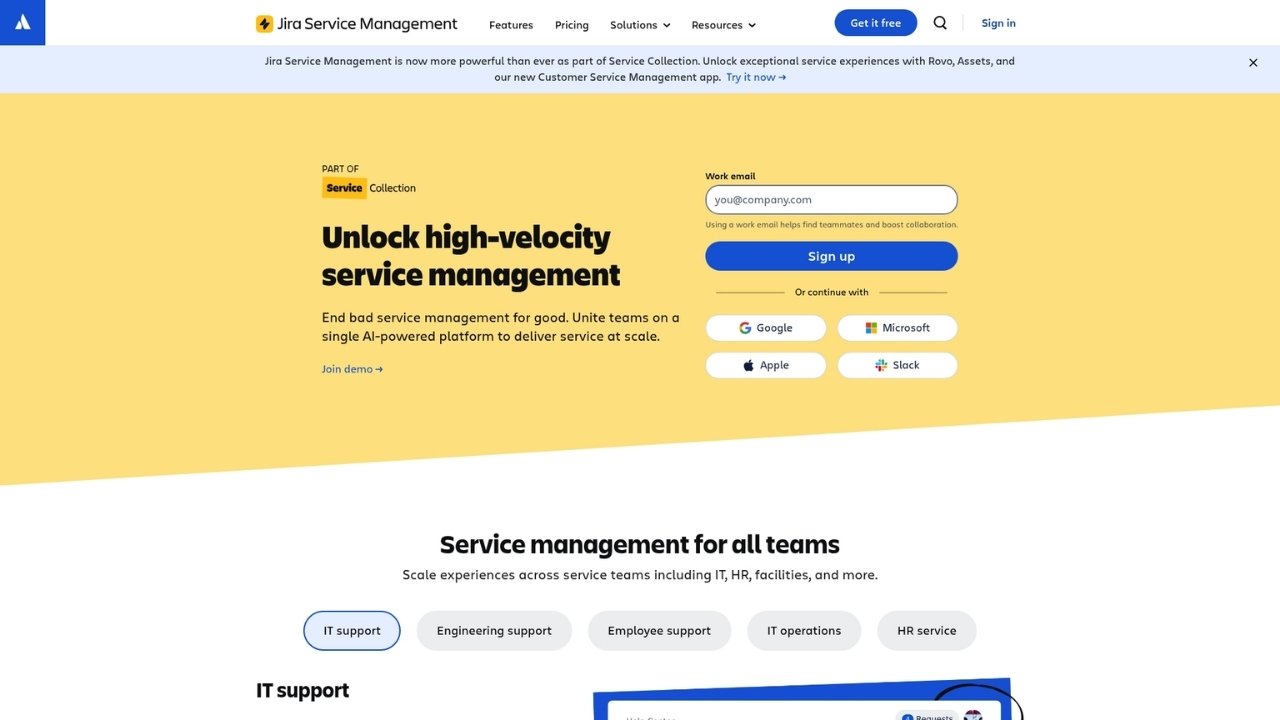
The pricing structure is particularly attractive for small teams. The free tier supports up to three agents with full functionality, making it genuinely usable for startups and small IT departments. Paid plans start at $20 per agent per month for the Standard tier, which unlocks support for up to 20,000 agents and adds features like asset management and custom branding.
What sets Jira Service Management apart is its flexibility. The platform uses the same workflow engine that powers Jira, which means you can build highly customized processes. Need a complex approval chain for infrastructure changes? You can build it. Want to automatically route tickets based on custom fields? That's straightforward too.
The Premium tier ($51.42 per agent per month) adds AI capabilities through the Virtual Service Agent, which can handle routine requests through conversational interfaces. It also includes AIOps features for alert correlation and incident prediction. For most teams, though, the Standard tier provides everything needed for solid ITSM.
Key strengths:
- Deep integration with Atlassian ecosystem
- Highly customizable workflows
- Free tier that's actually usable
- Strong asset management with dependency mapping
Potential drawbacks:
- Can be complex for non-technical users
- Requires configuration to get full value
- Asset management limits on lower tiers
Best for: Development teams, organizations already using Atlassian tools, teams needing customizable workflows
2. Freshservice
Freshservice positions itself as the modern alternative to legacy ITSM tools. The interface feels more like a contemporary SaaS product than traditional enterprise software, which translates to faster adoption and less training time for new users.

Pricing starts at $19 per agent per month for the Starter plan, which covers basic ITSM functions including incident management, knowledge base, and service catalog. The Growth plan at $49 adds problem management, change management, and release management. For asset management and AI features, you'll need the Pro plan at $99 per agent per month.
The standout feature here is Freddy AI, Freshservice's built-in AI assistant. Unlike bolted-on AI features in some competing products, Freddy is integrated throughout the platform. It can suggest ticket fields to speed up categorization, recommend solutions based on past tickets, and even handle routine requests automatically through chat interfaces.
Freshservice also emphasizes quick implementation. The company claims an average deployment time of under three months, with many customers seeing value within weeks. This is backed by pre-built templates for common IT processes and an intuitive configuration interface that doesn't require coding.
Key strengths:
- Modern, intuitive interface
- Strong AI capabilities with Freddy
- Fast implementation timeline
- 200+ pre-built integrations
Potential drawbacks:
- Asset management only on Pro+ tier
- Limited customization compared to enterprise tools
- Some advanced features require higher tiers
Best for: Mid-market companies wanting quick time-to-value, teams prioritizing AI capabilities, organizations seeking modern UI
3. ServiceNow
ServiceNow is the undisputed leader in enterprise ITSM. If you're managing IT for a Fortune 500 company or a large government organization, you've probably already evaluated it. The platform's depth and breadth are unmatched, but that comes with complexity and cost.
Pricing isn't publicly listed, which tells you something about the target market. Enterprise deployments typically run $100 to $200+ per user per month, with annual contracts and professional services engagements often required. This isn't a tool you set up over a weekend.
What you get for that investment is a platform that can handle virtually any IT process at scale. ServiceNow's AI capabilities go beyond simple chatbots. The platform uses machine learning for predictive routing, automated categorization, and even proactive issue detection. The Now Assist feature provides AI-powered assistance directly in the agent workspace, summarizing tickets and suggesting next steps.
Real-world results back up the claims. Fonterra reported a 92% improvement in mean time to resolution for high-priority incidents after implementing ServiceNow. Griffith University saw an 87% increase in self-service rates. These aren't marginal gains; they're transformative improvements.
Key strengths:
- Unmatched enterprise scalability
- Advanced AI and automation capabilities
- Comprehensive ITIL coverage
- Proven results at scale
Potential drawbacks:
- High cost (enterprise-only)
- Complex implementation requiring dedicated resources
- Steep learning curve for administrators
Best for: Large enterprises with complex IT environments, organizations requiring extensive customization, companies needing advanced AI
4. SysAid
SysAid offers something increasingly rare in the ITSM market: a genuinely free tier that supports up to five technicians. This isn't a limited trial or a stripped-down version; it's a fully functional ITSM platform with incident management, self-service portal, and basic automation.

For teams that outgrow the free tier, paid plans add features like advanced asset management, license optimization, and AI-powered ticket escalation. Pricing is customized based on team size and requirements, so you'll need to contact sales for specific numbers.
The platform's AI capabilities focus on practical automation rather than flashy features. The AI can analyze ticket content to suggest categorization and priority, route requests to the right team members, and even identify patterns that might indicate larger problems. SysAid also includes an Advanced License Manager that automatically identifies underutilized software licenses, potentially saving organizations significant money.
SysAid supports both cloud and on-premise deployments, which matters for organizations with strict data residency requirements or those in regulated industries. The mobile app is particularly well-regarded, allowing IT staff to manage tickets and assets from anywhere.
Key strengths:
- Generous free tier (5 technicians)
- Strong asset management capabilities
- Both cloud and on-premise options
- AI-powered license optimization
Potential drawbacks:
- UI can feel dated compared to newer competitors
- Limited public pricing information
- Learning curve for advanced features
Best for: Organizations prioritizing asset management, teams wanting AI-powered automation, companies needing deployment flexibility
5. Zendesk Suite

Zendesk built its reputation on customer service, but the Suite product has evolved into a capable ITSM platform. The key difference from other tools on this list is Zendesk's strength in omnichannel support. If your IT team handles requests through email, chat, phone, and social channels, Zendesk handles all of them natively.
Pricing starts at $19 per agent per month for the Support Team plan, which focuses on email and ticketing. For ITSM use cases, most teams will want the Suite Team plan at $55 per agent per month, which adds messaging, live chat, phone support, and AI agents. The Suite Professional plan at $115 adds more advanced features like skills-based routing, SLA management, and HIPAA compliance.
The AI capabilities are built around Zendesk's extensive customer service experience. The AI agents can handle routine requests across any channel, not just email or portal. The Knowledge Builder feature uses AI to identify gaps in your documentation and suggest new articles based on common ticket themes.
Where Zendesk differs from dedicated ITSM tools is in its approach to IT processes. It doesn't have built-in ITIL process templates like some competitors. Instead, it provides flexible workflow tools that you can configure to match your processes. This is either a strength or a limitation depending on your perspective and existing workflows.
Key strengths:
- Excellent omnichannel capabilities
- Strong AI powered by customer service expertise
- Intuitive interface with quick setup
- Robust knowledge management
Potential drawbacks:
- Less IT-specific than dedicated ITSM tools
- Advanced AI features require add-ons
- ITIL processes require custom configuration
Best for: Teams blending customer support with internal IT, organizations wanting strong omnichannel capabilities, companies prioritizing AI-powered service
6. ServiceDesk Plus
ServiceDesk Plus from ManageEngine is the budget-friendly option that doesn't skimp on ITIL compliance. The Standard edition starts at just $13 per technician per month, and there's even a free version for up to five technicians. For organizations that need asset management, the Professional edition at $27 per technician per month adds hardware and software tracking, CMDB, and discovery capabilities.
What makes ServiceDesk Plus stand out is its deployment flexibility. You can run it in the cloud, on Windows servers, or on Linux. This matters for organizations with specific compliance requirements or those that prefer to keep their service desk infrastructure on-premise. The platform also supports up to 15 separate service desk instances, making it suitable for managed service providers or large organizations with multiple IT departments.
The feature set covers all the ITIL basics: incident management, problem management, change management, and service catalog. The Enterprise edition adds project management and more advanced change workflows. While it doesn't have the AI capabilities of some newer competitors, it provides solid, reliable ITSM functionality at a fraction of the cost.
ManageEngine was named in the 2025 Gartner Magic Quadrant for AI Applications in ITSM, indicating the platform is keeping pace with industry developments even at its lower price point.
Key strengths:
- Most affordable full-featured ITSM option
- Both cloud and on-premise deployment
- Complete ITIL coverage even on lower tiers
- Free version available
Potential drawbacks:
- Interface less modern than cloud-native competitors
- Limited AI capabilities
- Add-ons required for complete coverage on lower tiers
Best for: Budget-conscious teams needing full ITIL capabilities, organizations wanting on-premise deployment, teams requiring integrated asset management
7. BMC Helix
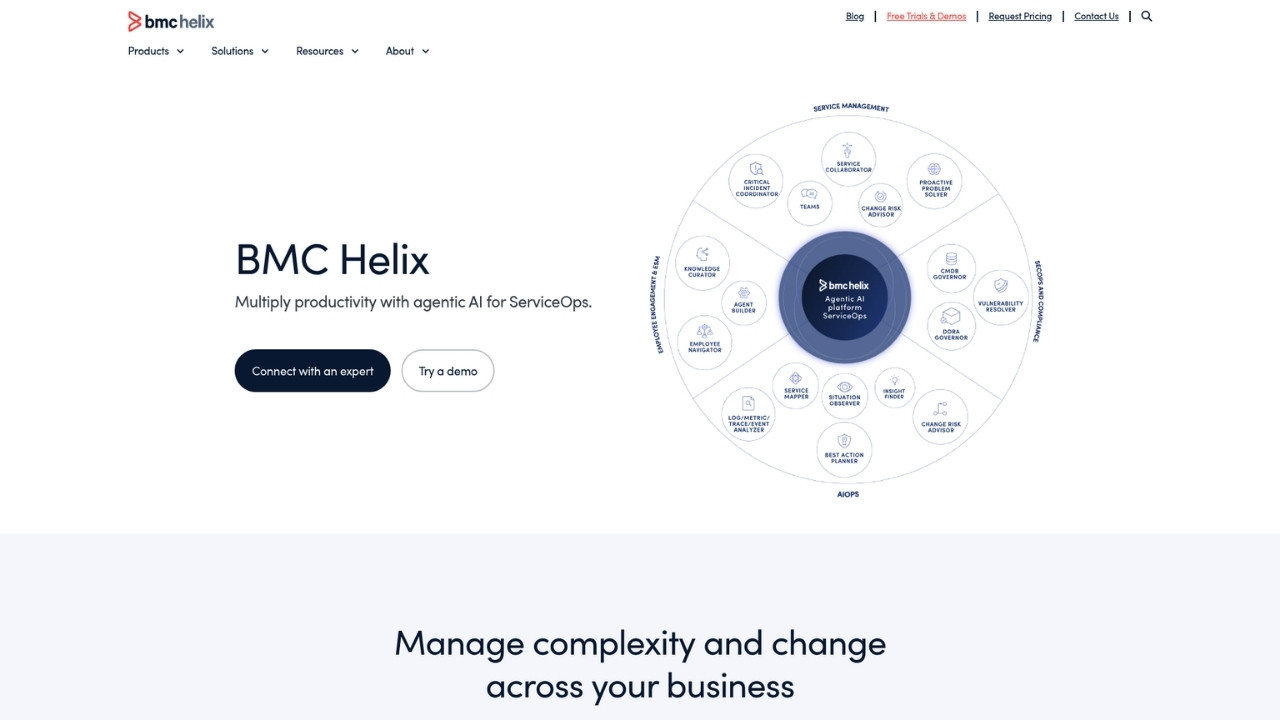
BMC Helix represents the high end of enterprise ITSM. It's designed for large organizations that need cutting-edge AI, multi-cloud deployment options, and the ability to handle massive scale. Think global enterprises with thousands of IT staff and complex service delivery requirements.
Pricing is enterprise-only and requires contacting BMC sales. Based on industry reports, deployments typically start in the six-figure range annually. This isn't a tool for small or mid-market teams.
The platform's cognitive service management capabilities use AI to predict issues before they impact users, automatically categorize and route tickets, and provide agents with contextual information to speed resolution. BMC Helix also integrates with major cloud providers, allowing organizations to manage IT services across AWS, Azure, and Google Cloud from a single interface.
One challenge with researching BMC Helix is that the company has restructured its product portfolio recently, and some product pages have moved or been consolidated. Organizations interested in BMC Helix should contact BMC directly for current product information and pricing.
Key strengths:
- Advanced AI and cognitive service management
- Multi-cloud deployment options
- Enterprise-grade scalability
- Comprehensive ITIL coverage
Potential drawbacks:
- Enterprise-only pricing
- Complex implementation
- Product portfolio recently restructured
Best for: Large enterprises with complex IT environments, organizations needing multi-cloud management, companies requiring cutting-edge AI
How to choose the right HaloITSM alternative
With seven solid options, how do you pick the right one? Start by being honest about your current situation and future needs.
Consider your team size and budget. Small teams (under 10 people) should seriously consider Jira Service Management's free tier or ServiceDesk Plus's affordable plans. Mid-market teams (10-100 people) have the most options, with Freshservice and Zendesk Suite offering strong value. Enterprise teams (100+) should evaluate ServiceNow, BMC Helix, or the higher tiers of Jira Service Management and Freshservice.
Think about your existing tools. If you're already using Atlassian products, Jira Service Management is the obvious choice. If you use Freshworks' other products, Freshservice integrates seamlessly. Teams heavily invested in customer service tools might find Zendesk Suite a natural extension.
Evaluate your AI needs. If AI-powered automation is a priority, focus on Freshservice (Freddy AI), ServiceNow (Now Assist), or Zendesk Suite (AI agents). For teams that prefer traditional workflow automation without AI, ServiceDesk Plus and SysAid offer solid alternatives.
Assess your deployment requirements. Organizations with strict data residency needs or regulatory requirements should prioritize tools with on-premise options: SysAid, ServiceDesk Plus, or Jira Service Management Data Center.
Don't overbuy. It's easy to get excited about enterprise features you'll never use. Start with a clear list of must-have capabilities and focus on tools that deliver those well. You can always upgrade later as your needs evolve.
Start improving your IT service management today
HaloITSM is a solid platform, but it's not the only option. Whether you're looking to reduce costs with ServiceDesk Plus, embrace AI with Freshservice, or scale up to ServiceNow's enterprise capabilities, there's an alternative that fits your needs.
The key is matching the tool to your specific situation. Small teams should take advantage of free tiers and affordable options. Growing organizations should prioritize tools that scale smoothly. And enterprises should invest in platforms that can handle complexity without creating more of it.
Whatever you choose, remember that the tool is just the starting point. Great IT service management comes from clear processes, well-trained staff, and a commitment to continuous improvement. The right platform makes all of that easier, but it's still up to you to make it happen.
If you're also looking to improve your customer phone support, check out Ringly.io. the AI, our AI phone agent, handles customer calls 24/7, integrates with your existing systems, and only escalates when necessary. It's a simple way to extend your service capabilities without extending your team.
Looking for HaloITSM alternatives? Compare 7 top ITSM tools including Jira Service Management, Freshservice, ServiceNow, and more. Find pricing, features, and best fit for your team.
Frequently Asked Questions
What should you look for in a HaloITSM alternative before making a decision?
Focus on three things: pricing that fits your budget without surprising overage fees, deployment options that match your infrastructure needs (cloud vs. on-premise), and AI capabilities that actually solve problems rather than creating more work. Also check how well each option integrates with tools you already use.
Do HaloITSM alternatives offer better AI features than the original platform?
Several alternatives have stronger AI capabilities. Freshservice's Freddy AI and ServiceNow's Now Assist offer more advanced automation than HaloITSM. Jira Service Management's Virtual Service Agent and Zendesk's AI agents also provide sophisticated capabilities for handling routine requests and assisting human agents.
Which HaloITSM alternative works best for small teams with limited budgets?
Jira Service Management offers a genuinely free tier for up to three agents with full functionality. ServiceDesk Plus provides a free version for up to five technicians. SysAid also offers a free tier for five technicians. All three are solid choices for small teams that don't want to compromise on features.
Can HaloITSM alternatives handle enterprise-scale IT operations?
Absolutely. ServiceNow is the industry standard for enterprise ITSM and handles some of the world's largest IT organizations. BMC Helix and the Enterprise tiers of Jira Service Management and Freshservice are also built for large-scale deployments with thousands of users and complex processes.
How long does it typically take to migrate from HaloITSM to an alternative?
Migration timelines vary based on data complexity and customization. Simple deployments can be completed in 2-4 weeks. More complex enterprise migrations typically take 3-6 months. Freshservice and Jira Service Management are known for faster implementations, while ServiceNow deployments tend to take longer due to their complexity.
Are there HaloITSM alternatives that work better for teams using specific development tools?
Teams using Atlassian products (Jira, Confluence, Bitbucket) should strongly consider Jira Service Management for its native integration. Development teams using other toolchains might prefer Freshservice or Zendesk Suite for their extensive integration marketplaces and API capabilities.
What is the most affordable HaloITSM alternative that still offers full ITIL compliance?
ServiceDesk Plus offers the best value for full ITIL compliance, with plans starting at $8-13 per technician per month. The platform includes incident, problem, change, and asset management even on lower tiers, making it significantly more affordable than HaloITSM while covering the same core capabilities.