


Jira Service Management has been a go-to ITSM platform for years, especially for teams already using the Atlassian ecosystem.
The steep learning curve, plugin dependency, and unpredictable costs have many IT leaders looking elsewhere.
The good news? The ITSM market has evolved significantly.
Modern alternatives offer better user experiences, AI-powered automation, and transparent pricing without sacrificing the features you actually need.
Let's look at seven of the best Jira Service Management alternatives worth considering in 2026.
Editor’s note: Want to hear some sample AI support calls made for your Shopify store?
- Just paste your store URL
- Get sample calls in under 20 seconds (no email required)
- Listen to demo calls for my store
What is Jira Service Management?
Jira Service Management is Atlassian's IT service management platform designed for incident, problem, change, and request management. It integrates tightly with other Atlassian tools like Jira Software and Confluence, making it appealing for development-heavy organizations.
The platform offers ITIL-aligned workflows, automation capabilities, and a self-service portal. For teams already invested in the Atlassian ecosystem, it can be a logical choice. But that tight integration is also its limitation: it works best when you're all-in on Atlassian, and the "build it yourself" approach means significant setup time before you see value.
Why consider a Jira Service Management alternative?
Before diving into the alternatives, let's look at why teams are making the switch:
- Steep learning curve: Many users report needing extensive ITIL training and technical expertise just to configure basic workflows
- Complex setup: Unlike tools that work out of the box, Jira requires you to build most processes from scratch
- Plugin dependency: Core capabilities often require third-party add-ons, adding cost and complexity
- Pricing surprises: Tiered features and per-agent pricing can balloon budgets as teams scale
- Performance issues: Larger setups frequently report slow load times and laggy interfaces
If any of these sound familiar, one of the alternatives below might be a better fit.
Quick comparison: Jira Service Management alternatives
| Tool | Starting Price | Free Trial | Best For |
|---|---|---|---|
| Zendesk | $19/agent/month | 14 days | Customer-facing support teams |
| ServiceNow | Contact sales | - | Large enterprises with complex ITSM needs |
| Freshservice | $19/agent/month | 14 days | Mid-market IT teams wanting modern ITSM |
| SysAid | Contact sales | Available | AI-first automation focus |
| ManageEngine ServiceDesk Plus | $13/tech/month | 30 days | Asset management and compliance |
| Zoho Desk | $7/user/month | 15 days | Budget-conscious small to mid-size teams |
| SolarWinds Service Desk | $39/tech/month | 30 days | AI-powered incident management |
1. Zendesk

Zendesk has built its reputation on being the customer support platform that "just works." While it's primarily known for customer-facing support, many IT teams use it for internal service delivery too.
The unified agent workspace brings together email, chat, phone, and social channels in one place. Agents can see full conversation history and customer context without switching tabs. The AI-powered features, including automated ticket routing and knowledge base suggestions, help teams resolve issues faster.
Key features:
- Omnichannel support (email, chat, phone, social)
- AI agents for automated responses
- 1,500+ integrations via the Zendesk Marketplace
- Real-time reporting and analytics
- Self-service knowledge base
Pricing:
- Support Team: $19/agent/month
- Suite Team: $55/agent/month
- Suite Professional: $115/agent/month
- Suite Enterprise: $169/agent/month
Pros:
- Intuitive interface with minimal training required
- Strong reporting and analytics out of the box
- Extensive app marketplace for integrations
Cons:
- Limited ITSM depth (no CMDB or advanced change management)
- Designed primarily for customer support, not internal IT
- Can get expensive at higher tiers
Best for: Teams prioritizing customer-facing support and ease of use over deep ITSM capabilities.
2. ServiceNow
ServiceNow is the heavyweight of enterprise ITSM. If you need governance, compliance, and deep customization at scale, this is where you look.
The platform goes far beyond ticketing. It offers comprehensive ITIL-certified processes, a robust CMDB, and workflow automation that spans IT, HR, security, and customer service. The new AI Control Tower gives enterprises visibility into all AI activities across the platform.
Key features:
- Enterprise-grade CMDB and asset management
- ITIL-certified processes
- Low-code app development platform
- Risk and security operations management
- AI-powered automation and insights
Pricing:Contact sales for custom enterprise pricing.
Pros:
- Highly customizable for complex enterprise needs
- Mature platform with strong compliance features
- Comprehensive workflow automation across departments
Cons:
- Complex implementation requiring dedicated resources
- High cost, especially for smaller organizations
- Steep learning curve for administrators
Best for: Large enterprises with mature IT processes, complex compliance requirements, and budgets to match.
3. Freshservice

Freshservice strikes a balance between capability and usability. It offers modern ITSM features without the complexity that bogs down some enterprise tools.
The platform includes ITIL-aligned incident, problem, and change management, plus asset management and a service catalog. Freddy AI handles automated ticket routing and can even resolve common issues without human intervention. The orchestration capabilities let you automate workflows across multiple tools.
Key features:
- AI-powered ticketing with Freddy AI
- ITIL-aligned processes
- Asset management and CMDB
- Project portfolio management
- Service catalog and self-service portal
Pricing:
- Starter: $19/agent/month
- Growth: $49/agent/month
- Pro: $99/agent/month
- Enterprise: Custom pricing
Pros:
- Quick setup and intuitive interface
- Strong automation capabilities
- Good balance of features and simplicity
Cons:
- Reporting could be more customizable
- Some advanced features require higher tiers
Best for: Mid-market IT teams that want modern ITSM capabilities without enterprise complexity.
4. SysAid

SysAid positions itself as the AI-first ITSM platform. The focus is on eliminating repetitive tasks so IT teams can focus on strategic work.
The platform uses AI for ticket routing, workload analysis, and even building custom automation. The Advanced License Manager helps identify software savings by spotting underutilized licenses. For teams drowning in tickets, SysAid's approach to automation can significantly reduce manual work.
Key features:
- AI-powered ticket routing and automation
- Advanced License Manager for software optimization
- Self-service portal with AI agents
- Mobile app for IT management on the go
- 100+ integrations including Microsoft Teams and Slack
Pricing:Custom pricing based on agents and assets. Contact sales for a quote.
Pros:
- Strong AI capabilities for automation
- Good mobile experience
- Focus on reducing manual work
Cons:
- Pricing not transparent
- Can be complex for smaller teams
Best for: IT teams ready to embrace AI-driven automation and reduce manual ticket handling.
5. ManageEngine ServiceDesk Plus
ManageEngine ServiceDesk Plus combines IT help desk, asset management, and change management in a single platform. It's particularly strong for organizations with compliance requirements or those needing on-premise deployment.
The platform offers both cloud and on-premises options, which is increasingly rare. The asset management capabilities include software license tracking and CMDB with dependency mapping. For IT departments juggling multiple priorities, having everything in one tool reduces complexity.
Key features:
- IT help desk + asset management + change management
- CMDB with dependency mapping
- ITIL-aligned processes
- On-premise and cloud deployment options
- Project management capabilities
Pricing:
- Standard: $13/technician/month
- Professional: $27/technician/month
- Enterprise: $67/technician/month
Pros:
- Affordable pricing, especially for asset management
- On-premise option available
- Comprehensive feature set in one platform
Cons:
- UI feels dated compared to newer tools
- Limited third-party integrations
Best for: IT departments focused on asset management, compliance, or those needing on-premise deployment.
6. Zoho Desk

Zoho Desk is the budget-friendly option that doesn't feel cheap. It's part of the broader Zoho ecosystem, which can be a significant advantage if you're already using Zoho CRM or other Zoho apps.
The platform includes AI-powered features through Zia, which can analyze sentiment, suggest replies, and auto-tag tickets. The Blueprints feature lets you build automation with a drag-and-drop interface. For small to mid-size teams, the value proposition is hard to beat.
Key features:
- Zia AI for sentiment analysis and reply suggestions
- Multi-brand help center support
- Blueprints for visual workflow automation
- Integration with Zoho ecosystem
- ASAP self-service widget
Pricing:
- Free: $0 (3 agents)
- Express: $7/user/month
- Standard: $14/user/month
- Professional: $23/user/month
- Enterprise: $40/user/month
Pros:
- Very affordable, especially the free tier
- Easy to set up and use
- Strong integration with Zoho apps
Cons:
- Limited ITSM-specific features
- Fewer enterprise capabilities
Best for: Small to mid-size teams wanting affordable IT support, especially those already in the Zoho ecosystem.
7. SolarWinds Service Desk
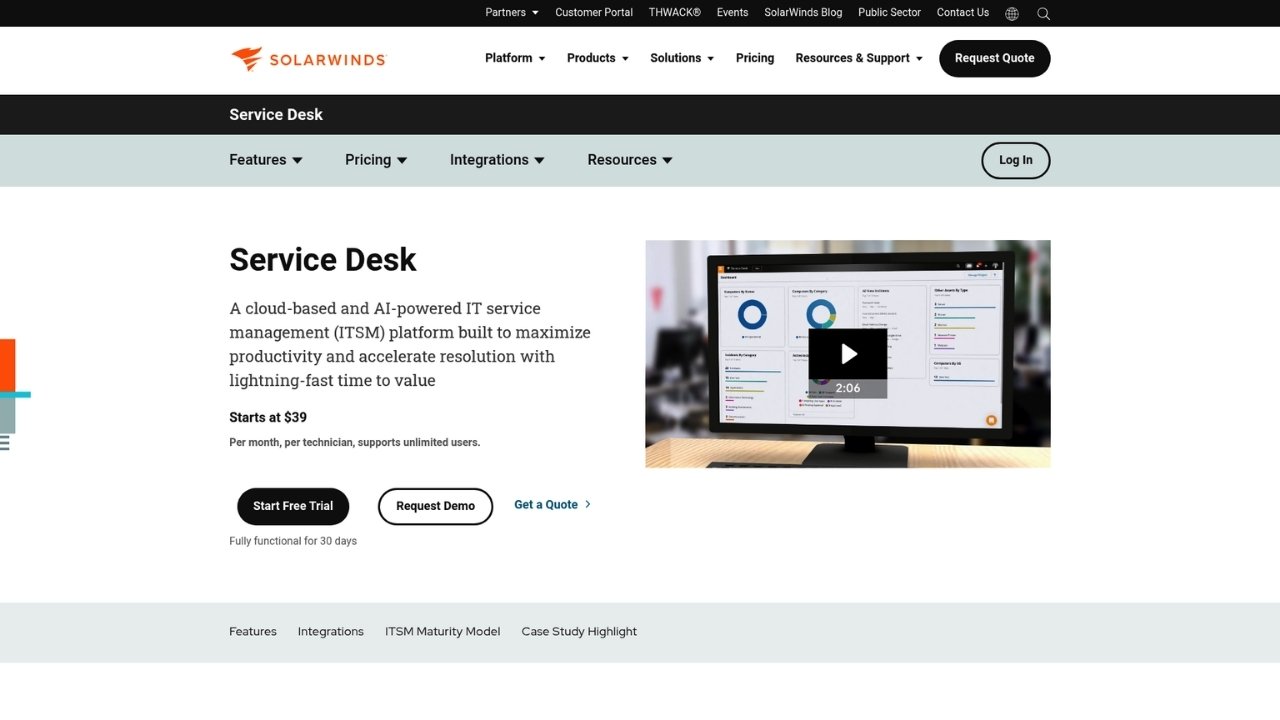
SolarWinds Service Desk (formerly Samanage) brings AI-powered capabilities to incident and asset management. It's a solid choice for teams wanting intelligent automation without the enterprise overhead of ServiceNow.
The platform includes a virtual agent for handling common requests, network discovery for asset management, and visual CMDB in the Premier tier. Integration with other SolarWinds tools is a plus if you're already using their monitoring solutions.
Key features:
- AI-assisted ticketing and virtual agent
- Asset management with network discovery
- Visual CMDB with dependency mapping
- Service catalog and change management
- Integration with SolarWinds monitoring suite
Pricing:
- Essentials: $39/technician/month
- Advanced: $79/technician/month
- Premier: $99/technician/month
Source: SolarWinds Service Desk pricing
Pros:
- Good AI features for ticket handling
- Strong incident management
- Integrates well with SolarWinds ecosystem
Cons:
- Can get expensive at scale
- Complex for simple use cases
Best for: Teams wanting AI-powered ITSM with strong incident management, especially those using other SolarWinds tools.
How to choose the right Jira Service Management alternative
With seven solid options, how do you pick? Here's a simple framework:
Consider your team size and budget:
- Small teams (under 10): Zoho Desk or ManageEngine's free tiers
- Mid-market (10-100): Freshservice, Zendesk, or SolarWinds
- Enterprise (100+): ServiceNow or SysAid
Evaluate deployment needs:
- Need on-premise? ManageEngine ServiceDesk Plus is your best bet
- Cloud-only? All others offer cloud deployment
Assess integration requirements:
- Using Zoho apps? Zoho Desk is the obvious choice
- Heavy Microsoft or Slack user? SysAid or Freshservice integrate well
- Need 1,500+ app integrations? Zendesk has the largest marketplace
Factor in implementation timeline:
- Need something running this week? Zendesk or Zoho Desk can be live in days
- Have months for implementation? ServiceNow or SysAid offer deeper capabilities
Plan for scaling:
- Growing fast? Check how pricing scales with users
- Need enterprise features later? Ensure your choice can grow with you
Don't forget about phone support
While you're evaluating ITSM platforms, there's one channel many organizations overlook: phone support. Most ITSM tools handle digital channels well, but phone calls often fall through the cracks.
This is where modern AI phone agents can fill the gap. Our platform, Ringly.io, handles inbound calls just like your ITSM handles tickets. the AI, our AI phone support rep, can answer common questions, look up ticket status, and escalate complex issues to your team. It integrates with the tools you're already using, giving you a complete support solution across every channel.
If phone support is still part of your IT service delivery, consider how an AI phone agent could complement your chosen ITSM platform. Start a free trial and see how it works with your setup.
Frequently Asked Questions
Which Jira Service Management alternative is best for small IT teams?
For small teams, Zoho Desk and ManageEngine ServiceDesk Plus offer the best value. Zoho Desk has a free tier for up to 3 agents, while ManageEngine offers a free Standard edition for up to 5 technicians. Both provide core ITSM features without the complexity or cost of enterprise tools.
Can I migrate from Jira Service Management to another platform easily?
Most alternatives offer migration tools or services. Freshservice, Zendesk, and Zoho Desk specifically advertise migration assistance from Jira. The complexity depends on how heavily customized your Jira instance is. Simple ticket data migrates easily; complex workflows may need rebuilding.
Do any Jira Service Management alternatives offer better AI capabilities?
Several alternatives have stronger AI features than Jira. SysAid is built around AI automation. Freshservice's Freddy AI and Zendesk's AI agents offer sophisticated automation. SolarWinds includes a virtual agent for handling common requests. If AI is a priority, these tools are worth evaluating.
Is ServiceNow the only enterprise-grade alternative to Jira Service Management?
While ServiceNow is the most well-known enterprise option, SysAid and Freshservice also serve enterprise customers. The right choice depends on your specific needs: ServiceNow for maximum customization, SysAid for AI automation, or Freshservice for a balance of capability and usability.
What should I look for in a Jira Service Management alternative if I'm focused on cost reduction?
Look for transparent pricing that scales predictably. Zoho Desk and ManageEngine offer the lowest starting prices. Consider total cost of ownership, including implementation, training, and required add-ons. Tools that work out of the box (like Freshservice or Zendesk) often cost less to implement than highly customizable platforms.
Which alternative works best for teams using the Atlassian ecosystem?
If you're staying within the Atlassian ecosystem, Jira Service Management is hard to beat for integration. However, if you're leaving Jira specifically, Freshservice and Zendesk both offer integrations with Confluence and other Atlassian tools. The integration won't be as deep, but you'll get a better overall user experience.
Also read: