


Vision Helpdesk has been around for years, offering a satellite help desk model that lets companies manage multiple brands from one place.
But here's the reality: many teams are hitting a wall with its dated interface and missing features.
If you're tired of clunky workflows and limited automation, you're not alone.
This guide covers 7 Vision Helpdesk alternatives that actually deliver on modern support needs.
We've tested each one, verified pricing from official sources, and broken down exactly who each tool is best for.
Whether you need enterprise power, budget-friendly options, or specialized phone support, you'll find a fit here.
Editor’s note: Want to hear some sample AI support calls made for your Shopify store?
- Just paste your store URL
- Get sample calls in under 20 seconds (no email required)
- Listen to demo calls for my store
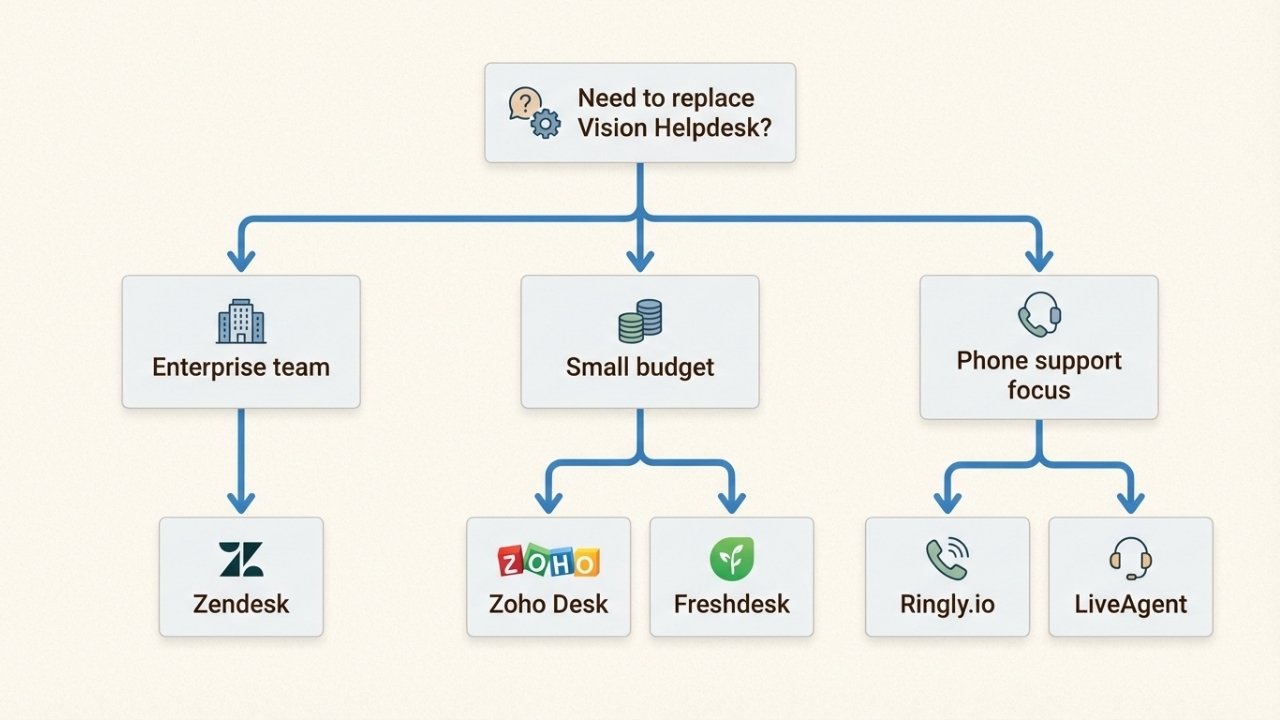
Why Teams Switch from Vision Helpdesk
The Main Pain Points
Vision Helpdesk isn't terrible, but it shows its age. Users consistently report the same frustrations:
- Outdated interface that feels cluttered and slows agents down
- No built-in live chat you need external integrations just to talk to customers in real time
- Limited automation without AI-powered routing or smart suggestions
- Performance issues including lag and delayed ticket updates
- Weak reporting with basic dashboards that lack deep analytics
- Integration challenges with a complicated setup process for modern tools
What Teams Want Instead
The best Vision Helpdesk alternatives solve these problems without creating new ones. Teams are looking for:
- Clean, modern interfaces that agents actually enjoy using
- Built-in multichannel support (email, chat, phone, social) out of the box
- AI features that actually help, not just buzzwords
- Reporting that shows what matters
- Integrations that work without a computer science degree
Comparison at a Glance
| Tool | Starting Price | 14-day free trial | Live Chat | AI Features | Phone Support | Best For |
|---|---|---|---|---|---|---|
| Zendesk | $55/agent/month | No | Yes | Yes | Add-on | Enterprise teams |
| Freshdesk | $19/agent/month | Yes (limited) | Yes | Yes (Freddy) | Yes | Small to mid-sized teams |
| Zoho Desk | $7/user/month | Yes (3 agents) | Yes | Yes (Zia) | Yes | Budget-conscious teams |
| Help Scout | $25/user/month | Yes (5 users) | Yes | Yes | No | Small teams, simplicity |
| LiveAgent | $15/agent/month | Yes (limited) | Yes | Yes (Answer Assistant) | Built-in | Teams needing phone + ticketing |
| HappyFox | $21/agent/month | No | Yes | Limited | Yes | IT teams, asset management |
| Ringly.io | $349/month | 14-day trial | No | Yes (Seth AI) | Core feature | Ecommerce phone support |
The 7 Best Vision Helpdesk Alternatives
1. Zendesk

Zendesk is the heavyweight in this space. If you need enterprise-grade features and don't mind paying for them, it's hard to beat.
Key features:
- Omnichannel support across email, chat, phone, and social
- AI agents for email and messaging (included in Suite Team+)
- 1,000+ pre-built integrations
- Advanced analytics with customizable dashboards
- Skills-based routing and IVR phone trees
Pricing:
| Plan | Annual Price | Key Features |
|---|---|---|
| Suite Team | $55/agent/month | AI agents (Essential), messaging, live chat, 1 help center |
| Suite Growth | $79/agent/month | Light agents, multilingual content, custom ticket forms |
| Suite Professional | $115/agent/month | Copilot writing, up to 5 help centers, skills-based routing |
| Suite Enterprise | $169/agent/month | Up to 300 help centers, sandbox, custom roles |
What works:
- Scales from small teams to massive enterprises
- Integration ecosystem is unmatched
- Automation and routing are genuinely powerful
What doesn't:
- Can feel overwhelming for small teams
- Pricing escalates quickly as you add features
- Setup requires significant time investment
Best for: Large teams needing enterprise features, deep customization, and scalability.
2. Freshdesk

Freshdesk hits a sweet spot between features and affordability. It's approachable without feeling stripped down.
Key features:
- Freddy AI Agent and Copilot for automation
- Omnichannel inbox (email, phone, SMS, WhatsApp, social)
- Field service management for on-site teams
- Knowledge base with multi-language support
- Custom reporting and automation rules
Pricing:
| Plan | Annual Price | Key Features |
|---|---|---|
| Free (Sprout) | $0 | 1-2 agents for 6 months, basic ticketing |
| Growth | $19/agent/month | Ticketing, customer portal, 500 AI sessions |
| Pro | $55/agent/month | Custom portals, Freddy AI Copilot, advanced ticketing |
| Enterprise | $89/agent/month | Audit logs, approval workflows, skills-based assignments |
What works:
- Intuitive interface that agents pick up quickly
- Solid free plan for getting started
- AI features are actually useful, not gimmicks
What doesn't:
- Advanced features require higher tiers
- Additional AI sessions cost $49 per 100 beyond included limits
Best for: Small to mid-sized teams wanting AI features without enterprise complexity.
3. Zoho Desk

Zoho Desk is the budget champion, especially if you're already in the Zoho ecosystem.
Key features:
- Zia AI assistant for sentiment analysis and auto-tagging
- Multi-brand help center support
- Blueprint automation builder (visual workflow designer)
- Telephony integration
- ASAP self-service widget
Pricing:
| Plan | Annual Price | Key Features |
|---|---|---|
| Free | $0 | 3 agents, email ticketing, basic features |
| Express | $7/user/month | Email, social media, web forms, workflows |
| Standard | $14/user/month | Business messaging, WhatsApp/Telegram, knowledge base |
| Professional | $23/user/month | Telephony, blueprints, multi-department support |
| Enterprise | $40/user/month | AI agents, live chat, multi-brand help center, sandbox |
What works:
- Most affordable option with real features
- Integrates seamlessly with Zoho CRM
- Blueprint automation is genuinely intuitive
What doesn't:
- Interface isn't as polished as premium competitors
- Best value requires committing to the Zoho ecosystem
Best for: Budget-conscious teams already using Zoho products, or those needing multi-brand support on a budget.
4. Help Scout

Help Scout takes a different approach. Instead of feature overload, it focuses on human-centered support that feels personal.
Key features:
- Shared inbox with an email-like interface
- Knowledge base (Docs) for self-service
- Beacon widget combining live chat and contact forms
- AI Assist, AI Drafts, and AI Summarize
- Customer management with conversation history
Pricing:
| Plan | Annual Price | Key Features |
|---|---|---|
| Free | $0 | Up to 5 users, 1 inbox, 1 docs site, 100 contacts/month |
| Standard | $25/user/month | Multiple inboxes, multiple knowledge bases, AI inbox assistant |
| Plus | $45/user/month | Advanced workflows, unlimited AI drafts, round robin routing |
| Pro | $75/user/month | Unlimited workflows, SSO/SAML, HIPAA compliance |
What works:
- Clean interface that feels like Gmail, not a ticketing system
- Easy setup most teams are running in hours, not days
- Great for small teams that prioritize relationships over metrics
What doesn't:
- Limited advanced features compared to enterprise tools
- Fewer integrations than competitors like Zendesk
Best for: Small teams, nonprofits, and anyone prioritizing simplicity over complexity.
5. LiveAgent
LiveAgent stands out for one reason: built-in call center capabilities. If phone support matters to you, this deserves a look.
Key features:
- Universal inbox for email, chat, calls, and social
- Built-in call center with IVR and call routing
- Real-time visitor monitoring
- Gamification features to motivate agents
- 200+ integrations
Pricing:
| Plan | Annual Price | Key Features |
|---|---|---|
| Small business | $15/agent/month | Ticketing, live chat, knowledge base, AI Answer Assistant |
| Medium business | $29/agent/month | Call center & IVR, time rules, reports, proactive chat |
| Large business | $49/agent/month | SSO, custom roles, social channels (Facebook, Instagram, Twitter) |
| Enterprise | $69/agent/month | Dedicated account manager, priority support, branding free |
What works:
- Phone support included, not an expensive add-on
- Competitive pricing for the feature set
- Gamification actually helps team engagement
What doesn't:
- Interface can feel dated compared to newer tools
- Learning curve for advanced features
Best for: Teams needing integrated phone support alongside ticketing, especially those with high call volumes.
6. HappyFox

HappyFox bridges the gap between IT service management and customer support. If you handle both internal and external requests, it's worth considering.
Key features:
- Smart rule automation for ticket routing
- Asset management for IT teams
- Multi-brand help desk support
- Internal and external knowledge bases
- SLA management with live timer
Pricing:
| Plan | Annual Price | Key Features |
|---|---|---|
| Basic | $21/agent/month | Up to 5 agents, unlimited tickets, SLA management, knowledge base |
| Team | $39/agent/month | Multi-brand (5 brands), custom email/domain, custom roles |
| Pro | $89/agent/month | Asset management, task management, scheduled tickets |
| Enterprise PRO | Contact sales | Agent scripting, 2TB storage, 24/7 phone support |
What works:
- Clean interface that's easy to navigate
- Strong ITSM capabilities for internal support
- Customizable workflows without coding
What doesn't:
- No 14-day free trial to test before committing
- Enterprise pricing requires contacting sales
Best for: IT teams handling both internal and external support requests, companies needing asset management.
7. Ringly.io

Ringly.io is different from everything else on this list. Instead of being a traditional help desk, it's an AI phone agent that handles inbound calls 24/7.
Key features:
- the AI AI handles inbound calls automatically
- Deep Shopify integration for order lookups and returns
- 40-language support for global customers
- Call recordings and analytics
- Smart escalation to human agents when needed
Pricing:
| Plan | Price | Key Features |
|---|---|---|
| Grow | $349/month | 1,000 minutes, self-learning AI, Shopify integration |
| Enterprise | Customnth | 5,000+ minutes, private Slack channel, custom integrations |
What works:
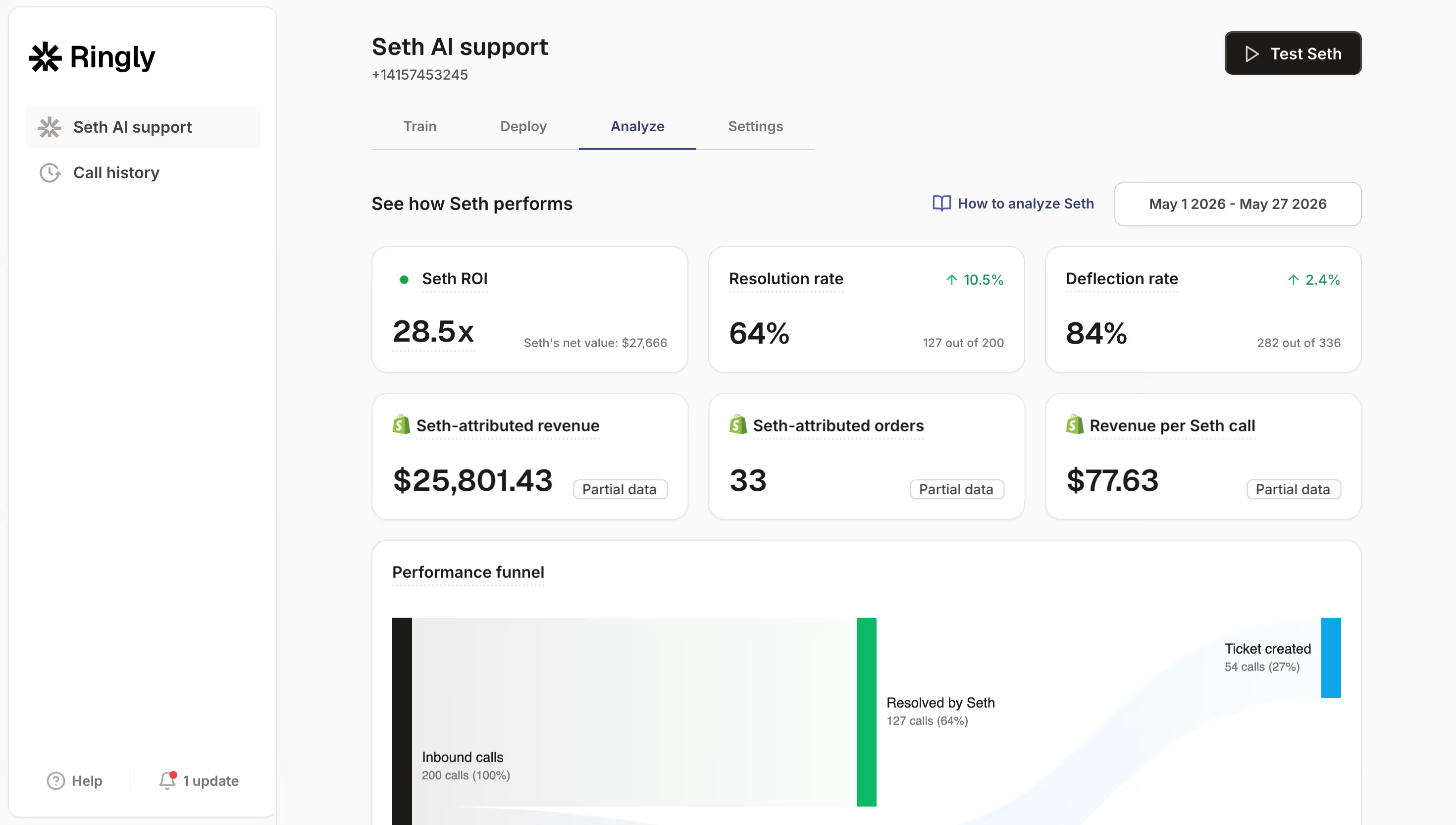
- Resolves ~73% of calls without human intervention
- Setup takes about 3 minutes, not 3 weeks
- 30 languages means you can support global customers
What doesn't:
- Phone-focused, not a full help desk replacement for email/chat teams
- Per-minute pricing requires monitoring usage
Best for: Ecommerce stores and teams drowning in phone support volume who want to automate repetitive calls. If you're handling hundreds of "where's my order" calls, the AI can handle those while your team focuses on complex issues.

How to Choose the Right Alternative
Decision Framework
Picking the right tool comes down to five factors:
- Team size and budget Small teams should start with free plans (Freshdesk, Zoho Desk, Help Scout). Enterprise teams need Zendesk's scale.
- Channel priorities If phone is critical, look at LiveAgent or Ringly.io. For email/chat focus, Help Scout or Freshdesk work well.
- Integration requirements Check your CRM, ecommerce platform, and collaboration tools. Zoho Desk wins for Zoho users. Ringly.io integrates deeply with Shopify.
- AI and automation needs All these tools have AI features, but they differ. Freshdesk's Freddy and Zendesk's AI agents are mature. Ringly.io's the AI is purpose-built for phone automation.
- Migration complexity Consider data migration (tickets, contacts, knowledge base) and team training time.
Migration Tips
- Start with free trials to test workflows with real tickets
- Plan data migration before committing some tools offer migration assistance
- Train your team before the full cutover, not after
- Monitor metrics post-switch to ensure you're actually improving
Switch to a Help Desk That Fits Your Workflow
Vision Helpdesk alternatives range from enterprise powerhouses like Zendesk to specialized tools like Ringly.io for phone support. The right choice depends on your specific needs:
- Need enterprise scale? Go with Zendesk.
- Want the best free plan? Try Freshdesk or Zoho Desk.
- Prioritize simplicity? Help Scout is your friend.
- Need built-in phone? LiveAgent delivers.
- Handle IT assets? HappyFox has you covered.
- Drowning in phone calls? Ringly.io's the AI AI can resolve most of them automatically.
Most of these tools offer free trials. Pick 2-3 that fit your budget and channel needs, then test them with real workflows. The best help desk is the one your team actually wants to use.
If phone support is eating up your team's time, start a free trial with Ringly.io and see how The AI handles your call volume.
Frequently Asked Questions
What are the best Vision Helpdesk alternatives for small teams?
For small teams, Freshdesk and Zoho Desk offer solid free plans. Help Scout is also great if you prioritize simplicity and want an email-like interface.
Which Vision Helpdesk alternative has the best AI features?
Freshdesk has Freddy AI for automation and copilot features. Zendesk offers AI agents in their Suite Team plan and up. For phone-specific AI, Ringly.io resolves ~73% of calls automatically.
Are there any free Vision Helpdesk alternatives?
Yes. Freshdesk offers a free Sprout plan for up to 2 agents. Zoho Desk has a 14-day free trial for 3 agents. Help Scout offers a 14-day free trial for up to 5 users with limited features.
What Vision Helpdesk alternative is best for phone support?
LiveAgent includes built-in call center features at competitive prices. For AI-powered phone automation, Ringly.io specializes in handling inbound calls with their the AI AI agent.
How do I migrate from Vision Helpdesk to another platform?
Start with free trials to test workflows. Plan your data migration (tickets, contacts, knowledge base) many platforms offer migration tools or services. Train your team before the full cutover and monitor metrics to ensure improvement.
Which Vision Helpdesk alternative works best with Shopify?
Ringly.io has deep Shopify integration for order lookups, returns, and customer data. For traditional help desks, Zendesk and Freshdesk both offer Shopify integrations.
What is the most affordable Vision Helpdesk alternative?
Zoho Desk starts at $7/user/month with a 14-day free trial for 3 agents. LiveAgent starts at $15/agent/month. If you only need phone support, Ringly.io starts at $349/month regardless of agent count.