
HappyFox has been a popular choice for help desk software, but it isn't the right fit for everyone.
Maybe you're frustrated with the limited reporting capabilities, the dated interface, or the pricing structure that puts key features behind higher tiers.
Whatever your reason for looking elsewhere, there are plenty of reliable HappyFox alternatives worth considering.
We tested seven of the top help desk platforms to see how they stack up. Here's what we found.
Editor’s note: Want to hear some sample AI support calls made for your Shopify store?
- Just paste your store URL
- Get sample calls in under 20 seconds (no email required)
- Listen to demo calls for my store

What is HappyFox and why look for alternatives?
HappyFox is a help desk software designed for medium to large organizations. It offers solutions for customer support, IT service desks, and operations teams.
The platform includes features like ticket management, automation rules, asset management, and knowledge bases.
That said, HappyFox has its limitations. Users frequently mention the clunky UX, limited integrations compared to competitors, and restricted customization on lower-tier plans. The reporting capabilities feel shallow next to platforms like Zendesk or Freshdesk.
The web-only interface can also be limiting for teams that need offline access or a desktop app.
If any of these pain points sound familiar, it's time to explore your options.
How we evaluated these HappyFox alternatives
To make this comparison useful, we looked at each platform across the same criteria:
- Pricing transparency clear plans without hidden costs
- Ease of use how quickly teams can get productive
- AI and automation modern features that reduce manual work
- Integration ecosystem connections to tools you already use
- Support channels email, chat, phone, and social capabilities
We focused on tools that solve common complaints about HappyFox while offering their own unique strengths.
Comparison table: HappyFox alternatives at a glance
| Tool | Best For | Starting Price | Free Trial | Key Differentiator |
|---|---|---|---|---|
| Zendesk | Enterprise omnichannel | $19/agent/month | 14 days | 1000+ integrations, advanced AI |
| Freshdesk | Growing teams with AI | $15/agent/month | 14 days + 14-day free trial | Freddy AI, gamification |
| Zoho Desk | Budget-conscious SMBs | $7/user/month | 15 days + 14-day free trial | Zoho ecosystem integration |
| Help Scout | Small teams, simplicity | $25/user/month | 15 days + 14-day free trial | Shared inbox focus |
| Kayako | Unified conversations | $79/month flat | Demo | AI-powered help center |
| Hiver | Gmail-based teams | $25/user/month | 7 days + 14-day free trial | Works inside Gmail |
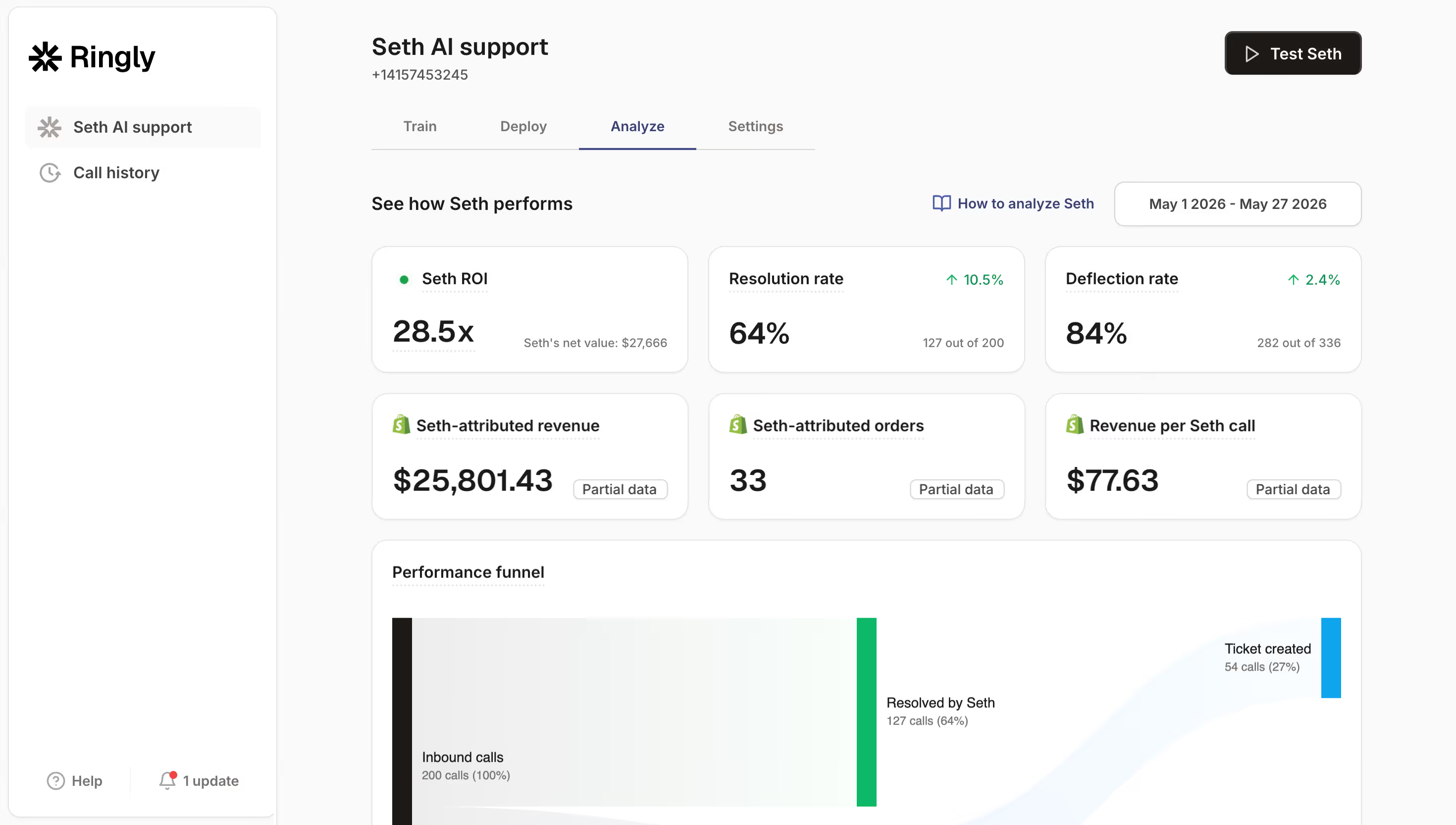
| Ringly.io | E-commerce phone support | $349/month | 14 days | AI phone agent, Shopify integration |
The 7 best HappyFox alternatives
1. Zendesk

Zendesk is the heavyweight in customer support software. It's built for teams that want to transform their entire customer experience, not just manage tickets more efficiently.
The platform brings together email, chat, social media, and voice into a unified interface. AI agents can handle routine queries automatically. The analytics go far beyond basic metrics to provide insights that drive strategic decisions.
Key features:
- AI agents with 80%+ resolution rates
- 1000+ pre-built integrations
- Omnichannel support (email, chat, voice, social)
- Advanced analytics and customizable dashboards
- Skills-based routing and SLA management
Pricing:
- Support Team: $19/agent/month
- Suite Team: $55/agent/month
- Suite Professional: $115/agent/month
- Suite Enterprise: $169/agent/month
Pros:
- Most comprehensive feature set on the market
- Scales from small teams to enterprise
- AI capabilities are practical, not gimmicks
Cons:
- Can be overkill for simple use cases
- Advanced features require higher tiers
- Learning curve for complex configurations
Why it's a good HappyFox alternative:Zendesk solves the reporting and integration limitations of HappyFox while offering smart automation. If you need enterprise-grade infrastructure that scales with your business, this is the investment that pays dividends.
2. Freshdesk

Freshdesk shows that strong customer support fits smaller budgets too. The intuitive interface gets new team members productive immediately. Freddy AI handles ticket categorization, routing, and responses.
One standout feature is gamification. Agents earn points and badges for performance. This boosts morale and productivity in a way that feels meaningful rather than patronizing.
Key features:
- Freddy AI for automated ticket handling
- Gamification for agent engagement
- Free plan for up to 2 agents
- Multi-channel support including field service
- 650+ app integrations
Pricing:
- Free: $0 (1-2 agents)
- Growth: $19/agent/month
- Pro: $55/agent/month
- Enterprise: $89/agent/month
Pros:
- Free plan actually usable for small teams
- AI features included at reasonable tiers
- Easy to learn and deploy
Cons:
- UI can slow down with high ticket volumes
- Advanced analytics limited to higher tiers
- Some features require third-party add-ons
Why it's a good HappyFox alternative:Freshdesk offers similar core functionality to HappyFox at a lower price point, with better AI features and a more modern interface. The free plan lets you test thoroughly before committing.
3. Zoho Desk

Zoho Desk is the most affordable option on this list, but don't let the price fool you. It packs serious features. You get AI-powered sentiment analysis, automated ticket tagging, and a visual workflow builder called Blueprints.
If you're already using Zoho CRM or other Zoho products, the integration is seamless. Customer data flows naturally between systems without manual imports or sync headaches.
Key features:
- Zia AI assistant with sentiment analysis
- AI agents for autonomous support tasks
- Blueprint visual automation builder
- Multi-brand help center support
- 40+ language support
Pricing:
- Free: $0 (3 users)
- Express: $7/user/month
- Standard: $14/user/month
- Professional: $23/user/month
- Enterprise: $40/user/month
Pros:
- Most affordable full-featured option
- Tight Zoho ecosystem integration
- Fast deployment compared to competitors
Cons:
- Steep learning curve for advanced features
- UI can feel cluttered
- Some AI features limited to specific data centers
Why it's a good HappyFox alternative:Zoho Desk gives you comparable functionality to HappyFox at roughly half the price, with better AI capabilities and more transparent pricing.
4. Help Scout

Help Scout takes a different approach. Instead of trying to be everything to everyone, it focuses on doing email-based support exceptionally well. The shared inbox feels like a natural extension of your regular email. That means almost zero onboarding time.
The Beacon widget lets you embed help articles and contact forms anywhere on your site. Customers get answers without leaving the page they're on.
Key features:
- Shared inbox that feels like email
- Beacon embeddable support widget
- AI Assist, Drafts, and Summarize
- Knowledge base with custom branding
- 100+ app integrations
Pricing:
- Free: $0 (5 users, 1 inbox)
- Standard: $25/user/month
- Plus: $45/user/month
- Pro: $75/user/month
Pros:
- Extremely easy to learn
- Fast setup and deployment
- Human-centered design philosophy
Cons:
- Less suited for complex enterprise needs
- Limited phone support capabilities
- Fewer advanced automation options
Why it's a good HappyFox alternative:If HappyFox felt overwhelming or unnecessarily complex, Help Scout offers a refreshing alternative. It's ideal for teams that want powerful support software without the enterprise baggage.
5. Kayako

Kayako built its platform around a simple idea: customer support should be about conversations, not tickets. The unified timeline shows every interaction with a customer across all channels. This gives agents context instead of just chronological ticket history.
The AI-powered help center learns from successful resolutions and gets smarter with every interaction. It's not just suggesting articles. It's understanding what actually solved the problem.
Key features:
- Unified customer timeline across channels
- AI-powered help center
- Conversational ticketing
- Multi-brand messenger
- Simple flat-rate pricing
Pricing:
- Kayako One: $79/month + $1 per AI resolved ticket
Pros:
- Unique conversation-focused approach
- Simple, predictable pricing
- Strong multi-channel capabilities
Cons:
- Less established than Zendesk/Freshdesk
- Smaller integration ecosystem
- Single plan limits flexibility
Why it's a good HappyFox alternative:Kayako offers a fundamentally different approach to support that many teams find more natural than traditional ticketing. The flat pricing can also be more predictable than per-agent models.
6. Hiver

Hiver is built for teams that live in Gmail. It transforms your Google Workspace into a full help desk without forcing you to learn a new interface. Everything happens inside Gmail. That means your team can start using it immediately.
The AI features are impressive for a Gmail-based tool. AI agents can triage tickets, predict sentiment, and even extract data like order numbers automatically.
Key features:
- Gmail-based shared inboxes
- AI agents for triaging and sentiment analysis
- AI Copilot for suggested responses
- Voice and WhatsApp integration (Pro+)
- 70%+ deflection rate with AI Answers
Pricing:
- Free: $0 (unlimited users)
- Growth: $25/user/month
- Pro: $65/user/month
- Elite: $105/user/month
Pros:
- Zero learning curve for Gmail users
- Powerful AI features
- Works with existing Google Workspace setup
Cons:
- Limited to Google/Outlook ecosystems
- Less suited for non-email channels
- Advanced features require higher tiers
Why it's a good HappyFox alternative:If your team primarily handles email support and you want to avoid the complexity of traditional help desks, Hiver is the obvious choice. It solves the "clunky UX" complaint about HappyFox by eliminating the separate interface entirely.
7. Ringly.io

Ringly.io takes a different approach from the others on this list. Instead of focusing on tickets and chat, it specializes in AI-powered phone support for e-commerce businesses.
The AI phone agent handles inbound calls 24/7. It can look up orders, process returns, answer FAQs, and escalate to humans when needed. For Shopify stores, the integration is particularly deep. the AI pulls order data directly from your store. This gives customers real-time answers.
Key features:
- the AI AI phone agent with 73% resolution rate
- 24/7 availability with 40-language support
- Deep Shopify integration
- Call recordings and transcripts
- Automatic escalation to human agents
Pricing:
- Grow: $349/month (1,000 minutes)
- Enterprise: custom pricingnth (3,000+ minutes)
Pros:
- Unique phone-focused approach
- Handles calls without human intervention
- Multilingual support out of the box
Cons:
- Not a full help desk replacement
- Specialized for e-commerce/phone use cases
- Per-minute pricing requires monitoring
Why it's a good HappyFox alternative:HappyFox offers phone support as an add-on. Ringly.io makes it the primary focus with AI that actually understands customer requests. If phone support is critical to your business and you want to reduce the load on human agents, this is worth considering alongside your main help desk.
Choosing the right HappyFox alternative for your needs
With seven solid options, how do you pick? Here's a simple framework:
Enterprise teams with complex needs:Zendesk or Freshdesk offer the depth and scalability you need. Zendesk has the edge for massive operations, while Freshdesk provides better value for mid-market teams.
Small teams on tight budgets:Zoho Desk gives you the most features per dollar, especially if you're already in the Zoho ecosystem. Help Scout is perfect if you want simplicity over complexity.
Email-centric workflows:Hiver is the obvious choice if your team lives in Gmail. It eliminates the friction of switching between tools entirely.
E-commerce with heavy phone support:Ringly.io complements your existing help desk by handling the phone channel autonomously. The Shopify integration makes it particularly valuable for online stores.
Conversation-focused teams:Kayako offers a refreshing alternative to traditional ticketing if you believe support should feel like natural conversations.
Start improving your customer support today
The best help desk software is the one your team actually uses. HappyFox isn't bad software, but it isn't the right fit for every team. Whether you need better AI, simpler pricing, or specialized phone support, one of these alternatives likely fits your needs better.
If phone support is a pain point for your business, start a free trial with Ringly.io and see how The AI handles your customer calls. For everything else, take advantage of the free trials from Zendesk, Freshdesk, or Zoho Desk to test what works for your workflow.
Frequently Asked Questions
Which HappyFox alternative offers the best value for small teams?
Zoho Desk and Freshdesk both offer generous free plans. Zoho Desk gives you 3 users on the free tier, while Freshdesk offers 2 agents with essential features. For paid plans, Zoho Desk starts at just $7/user/month.
Can I migrate my existing HappyFox data to these alternatives?
Most platforms offer migration assistance. Freshdesk and Zoho Desk specifically mention free migration support. Zendesk and Help Scout also provide import tools and documentation for transferring tickets and customer data.
Do these HappyFox alternatives offer better AI features?
Yes, generally. Zendesk's AI agents resolve 80%+ of queries autonomously. Freshdesk's Freddy AI handles 75%+ of live chat conversations. Even budget options like Zoho Desk include AI sentiment analysis and automated tagging that HappyFox reserves for higher tiers.
Which HappyFox alternative is easiest to set up?
Help Scout and Hiver are the fastest to deploy. Help Scout's shared inbox feels like regular email, and Hiver works directly inside Gmail. Both can be operational within hours, not days.
Is there a HappyFox alternative specifically for phone support?
Ringly.io specializes in AI phone support for e-commerce. Unlike HappyFox where phone is an add-on, Ringly makes it the primary focus with the AI, an AI agent that resolves 73% of calls without human intervention.
Which alternative has the most integrations?
Zendesk leads with 1000+ pre-built integrations via its Marketplace. Freshdesk offers 650+ integrations. All major alternatives connect with Slack, Salesforce, HubSpot, and other common business tools.