
If you run a Shopify store, you're already writing constantly. Product descriptions for every new SKU. Blog posts to rank for the keywords you care about. Email flows. SMS campaigns. Meta descriptions. Ad copy for Google and Meta. It piles up fast, and most of it never gets done well because there aren't enough hours.
AI writing tools promise to absorb that load. The good ones do. The bad ones spit out generic copy that sounds like every other DTC brand on the internet.
We tested ten of the most-recommended AI writing tools on a real Shopify catalog over the past few weeks. We checked output quality, brand voice training, bulk capability, Shopify integration depth, and real pricing at scale. We also looked at use cases beyond product descriptions, because most Shopify stores need help with blog posts, emails, and ads too.
This post ranks the ten best AI writing tools for Shopify in 2026, with honest verdicts on which ones are worth the money and which ones aren't.
Hear what AI support calls sound like for your store. Just paste your Shopify URL and get sample calls in under 20 seconds, no email required. Listen to demo calls for my store.
How we evaluated these AI writing tools
We didn't just collect features off pricing pages. We ran each tool on the same test product, scored the output, and compared cost-per-description at a 1,000-SKU catalog.
Here's what we measured:
- Output quality: does the copy sound human, or like AI slop?
- Brand voice training: can it learn your tone from your past content, or are you stuck prompting from scratch every time?
- Shopify integration: does it push back to Shopify, or is it a copy-paste tax?
- Bulk capability: can you generate 100+ descriptions at once without quality dropping?
- Use-case range: PDPs only, or also email, blog, ads, and SEO meta?
- Real pricing at scale: per-description math at 1,000 SKUs
- SEO friendliness: keyword targeting, meta descriptions, schema support
Honestly, no single tool nails all seven. The best Shopify content operations stitch 2-3 tools together. The cheap free option for quick drafts, a flexible workhorse for the hard stuff, and sometimes a specialized bulk tool for huge catalogs.
If you're juggling all this and your phone is also ringing all day with order questions, you're stretched thin in two directions. Ringly.io handles the inbound calls so you can actually write. Try it free for 14 days.
Quick comparison of the best AI writing tools for Shopify
| Tool | Best for | Starting price | Bulk? | Shopify push-back | G2 rating |
|---|---|---|---|---|---|
| Shopify Magic | Free single-PDP drafts | Free | No | Native | N/A (native) |
| ChatGPT | Flexible generalist | $20/mo | Yes (via API) | No | 4.7/5 |
| Claude | Brand voice + long-form | $20/mo | Yes (via API) | Toolkit (dev) | 4.5/5 |
| Jasper | Marketing teams, multi-channel | $59/mo | Limited | Browser extension | 4.7/5 |
| Copy.ai | Short-form at scale | $29/mo | Yes (workflows) | No native | 4.6/5 |
| Describely | Bulk PDP descriptions | $0.75/SKU | Yes | Native | 4.6/5 |
| Hypotenuse AI | Huge catalogs | Custom | Yes | Native | 4.6/5 |
| Writesonic | SEO + AI search blogs | $79/mo | Limited | No | 4.5/5 |
| Anyword | Predictive copy scoring | $39/mo | Yes | Connector | 4.6/5 |
| Frase | SEO research + articles | $49/mo | No | No | 4.7/5 |
The 10 best AI writing tools for Shopify
We're starting with the free native option, then moving through the generalists, then specialized ecom tools, then niche SEO-first tools. Order reflects how broadly useful each tool is for the average Shopify store, not raw quality.
1. Shopify Magic: best free starting point
Best for: any Shopify merchant doing single-product drafts inside the admin
Shopify Magic is the AI writer baked into the Shopify admin. It generates product descriptions, blog posts, email subject lines, FAQ answers, and image edits. It's free with any paid Shopify plan, which means most stores already have access and just haven't turned it on.
The 2026 version accepts more inputs than the original release. You can paste a competitor link, define a target persona, and add SEO keywords to bias the output. PageFly's 2026 guide claims the average merchant saves 15-20 hours per week and roughly $8,700 per year in content costs using it.
Pricing
| Plan | Price | Included |
|---|---|---|
| Any paid Shopify plan | Free | All Magic features |
What works
- Native and free: zero setup, zero new subscription. If you already pay for Shopify, you have it.
- Persona + competitor inputs: lets you steer tone and differentiate from the brand next door.
- Image editing: background removal, hero banner generation, logo generation are bundled in.
- Speed: a usable PDP draft in under 10 seconds.
What doesn't
- No bulk generation: one product at a time. If you have 500 SKUs, that's 500 manual clicks.
- Output skews generic: without strong inputs, descriptions read like every other Shopify store.
- Limited beyond PDPs: titles, meta descriptions, and schema markup are still mostly manual.
Why it ranks #1
Free, native, and good enough for most single-product workflows. Start here. If you outgrow it, layer on a generalist or a bulk tool.
2. ChatGPT: best generalist for custom work
Best for: founders who write smart prompts and want maximum flexibility
ChatGPT is the workhorse most Shopify operators reach for when Shopify Magic isn't enough. With GPT-5 on Plus ($20/month), you get image-to-text for product photos, file upload for catalog CSVs, custom GPTs you can train on your brand voice, and a browser that can read live competitor pages.
It doesn't push back into Shopify automatically. You're copy-pasting from ChatGPT into the product page. That's a real tax at scale, but the output quality with a good prompt is hard to beat.
Pricing
| Plan | Price | Included |
|---|---|---|
| Free | $0 | GPT-5 mini, limited messages |
| Go | $8/mo | Higher limits, basic features |
| Plus | $20/mo | GPT-5, custom GPTs, image, browsing |
| Pro | $200/mo | GPT-5 Pro, 20x usage, 1M token context |
Via API, GPT-5 runs roughly $1.25 per million input tokens and $10 per million output. That works out to about $5-10 to generate 1,000 product descriptions if you're scripting it.
What works
- Most flexible tool on this list: you can build any workflow with the right prompt.
- Custom GPTs: train one on your existing PDPs and it'll stay on-brand without prompting every time.
- File upload for catalog CSV: paste your spreadsheet, get descriptions out.
- Image-to-text: describe a product from a photo if you're missing copy.
What doesn't
- No Shopify push-back: copy-paste workflow at the per-product level.
- Quality is prompt-dependent: a lazy prompt gets you the same vanilla output everyone else publishes.
- Bulk workflows need API or scripting: not for non-technical operators out of the box.
Why it ranks #2
If you're going to pay for one AI tool, this is the one. The flexibility wins. Combine with Shopify Magic for in-admin drafts and you've got 80% of what most stores need.
3. Claude (Sonnet 4.5): best for brand-voice consistency
Best for: long-form storytelling, blog posts, and copy that needs to stay on-brand across hundreds of outputs
Claude is the other major frontier model. In our testing, it edges out ChatGPT for two things: maintaining tone across a long batch of outputs, and writing flagship product stories that actually sound like a brand wrote them. It also has a 200K token context window, so you can drop your entire brand guidelines, customer interview transcripts, and 20 sample PDPs into a single conversation and it'll absorb all of it.
Shopify released an official AI toolkit for Claude Code in April 2026 that connects Claude directly to your store APIs and CLI. That's powerful for technical operators, but it isn't a UI you point and click through.
Pricing
| Plan | Price | Included |
|---|---|---|
| Free | $0 | Sonnet 4.5, limited messages |
| Pro | $20/mo | Sonnet 4.5, higher limits, Claude Code |
| Max 5x | $100/mo | 5x usage, Opus access |
| Max 20x | $200/mo | 20x usage, priority access |
API pricing for Sonnet 4.5 is roughly $3 per million input and $15 per million output. Generating 1,000 product descriptions costs around $5-10 via API.
What works
- Brand voice consistency: noticeably better than ChatGPT at staying on-brand across long batches.
- 200K context window: you can drop entire style guides plus sample PDPs in one prompt.
- Better at long-form: blog posts and category-page copy read more like human writing.
- Shopify AI toolkit: developer-flavored but powerful for technical teams.
What doesn't
- No native Shopify UI: copy-paste or use the toolkit (which is CLI-based).
- No built-in templates: you're prompting from scratch each session unless you build a project.
- Image generation is weaker: ChatGPT and Jasper handle this better.
Why it ranks #3
Pick Claude over ChatGPT if your brand voice is distinctive and you want it preserved across hundreds of pieces of copy. The brand voice win matters more than people realize once you're publishing at volume.
4. Jasper: best for marketing teams with brand-voice rigor
Best for: in-house marketing teams running multi-channel campaigns (PDPs, ads, email, blog)
Jasper has been the marketing-team AI writer for a few years now, and the 2026 product reflects that focus. Brand Voices (you train it on past content and it maintains the tone), Knowledge assets (you upload product specs and brand guidelines), and Audiences (saved customer personas) are all included on the Pro plan. Plus templates for product descriptions, Facebook and Meta ads, email subject lines, and SEO meta titles.
G2 rates Jasper 4.7/5 across more than 8,000 reviews. The complaints are predictable: pricing, learning curve, and tightened usage limits since the 2024 redesign.
Pricing
| Plan | Price (monthly) | Price (annual) | Seats |
|---|---|---|---|
| Pro | $69/mo | $59/mo | 1 |
| Business | Custom | Custom | Custom |
7-day free trial on Pro.
What works
- Brand Voice training: this is the genuine differentiator. Train it once, get consistent output across every template.
- Multi-channel templates: PDPs, Meta ads, email, blog, SEO meta titles are all built-in.
- Browser extension: write inside Shopify admin, Klaviyo, or wherever.
- 30+ languages: useful for international stores.
What doesn't
- Pricey for solopreneurs: $59-69/mo for one seat hurts vs ChatGPT/Claude at $20.
- Learning curve: more dials and templates means more setup time.
- Bulk Shopify push-back: not native. Works via browser extension on the product page, one at a time.
Why it ranks #4
If you have a marketing team and a real brand voice you care about, Jasper earns its price. Solo operators usually get more mileage from ChatGPT or Claude plus a free Shopify Magic layer.
5. Copy.ai: best for short-form variations at scale
Best for: ad copy, email subject lines, social captions, and short-form variations
Copy.ai used to be the cheaper Jasper. In 2026 it's pivoted hard into "GTM AI" workflows, which is enterprise-speak for marketing automation. The Chat plan at $29/month is still useful for solopreneurs, but the next tier up jumps to $1,000/mo, which is a brutal cliff.
It's strongest at short-form: ad headlines, subject lines, social captions, product description bullet points. Long-form blog content is where it falls behind Jasper and Claude.
Pricing
| Plan | Price | Seats | Included |
|---|---|---|---|
| Chat | $29/mo ($24 annual) | 5 | Unlimited words, 90+ templates |
| Growth | $1,000/mo | 75 | Workflow credits, 20K/mo |
| Expansion | $2,000/mo | 150 | 45K credits |
| Scale | $3,000/mo | 200 | 75K credits |
G2 rating: 4.6/5 across 200+ reviews.
What works
- Cheap Chat plan: $29/mo with 5 seats is one of the better small-team deals.
- 90+ templates: covers most short-form ecom use cases.
- Unlimited words on Chat: no word-quota anxiety.
- Workflow automation: bulk product description generation via spreadsheet input.
What doesn't
- Long-form is weaker: blog posts feel thinner than Jasper or Claude output.
- Pricing cliff: jump from $29 to $1,000 is brutal if you outgrow the Chat plan.
- Workflow credits burn fast: bulk runs eat the monthly allowance.
Why it ranks #5
Great for short-form. If you mostly write Meta ad copy and SMS messages, this is fine. For PDPs and blog at scale, you'll outgrow it.
6. Describely: best for bulk Shopify product descriptions
Best for: Shopify stores with 100-1,000 SKUs that need bulk PDP generation
Describely is one of the few tools on this list built specifically for ecommerce product content. It plugs directly into Shopify, pulls your entire catalog, and generates descriptions, meta titles, and meta descriptions in bulk. Then it pushes the content back to your store. No copy-paste.
Pricing is per-product at $0.75 each. That's affordable for 100-300 SKUs but adds up at 1,000+ (around $750). The High Volume tier is custom-priced for catalogs over 500.
Pricing
| Plan | Price | Best for |
|---|---|---|
| Pay-as-you-go | $0.75/product | Up to 500 SKUs |
| High Volume | Custom | 500+ SKUs |
| Done-with-you | Custom | Concierge onboarding |
What works
- Native Shopify integration: descriptions push back into the product page automatically.
- Bulk generation: kick off 500 PDPs in one go.
- SEO bundle: meta titles, meta descriptions, alt text generated alongside the description.
- Unlimited regenerations: edit and re-run without burning credits.
What doesn't
- Cost scales linearly: $750 for 1,000 products feels high vs scripting with the OpenAI or Claude API for under $10.
- No blog or email: ecom PDP-focused only.
- Brand voice training is shallow: you set rules per project, not train on past content.
Why it ranks #6
If you have a mid-size catalog and don't want to script API calls yourself, Describely is the cleanest path to bulk PDP generation. Compare against Shopify Magic + ChatGPT manual loop for smaller catalogs.
7. Hypotenuse AI: best for huge catalogs (1,000+ SKUs)
Best for: enterprise ecommerce teams with 1,000+ products and complex content workflows
Hypotenuse is the bigger-catalog cousin of Describely. It connects to Shopify directly, supports CSV bulk import, and handles 20+ content types: product descriptions, meta titles, category pages, blog articles, and AI image edits on the enterprise tier. It supports 40+ languages and integrates with PIM and ERP systems on the enterprise plan.
The downside: pricing is opaque. You have to request a demo to get a quote, which usually signals "this is going to cost more than you want." Free trial is available without a credit card, so you can at least test it.
Pricing
| Plan | Price | Best for |
|---|---|---|
| Basic | Custom (small) | <100 products |
| Ecommerce Enterprise | Custom | Large catalogs + teams |
Free trial: yes, no credit card.
What works
- Built for scale: CSV bulk import, queueing, regeneration at thousands of SKUs.
- Multi-content: PDPs, category pages, blog, and meta data in one tool.
- Image editing: bulk image background removal, model swaps on enterprise.
- PIM/ERP integrations: useful for stores syncing across multiple channels.
What doesn't
- Opaque pricing: must talk to sales.
- Overkill for small stores: solopreneurs get more value from ChatGPT plus Shopify Magic.
- Setup curve: enterprise tooling, enterprise setup time.
Why it ranks #7
If you have 1,000+ products and an actual content team, this is worth the demo call. For everyone else, it's overkill.
8. Writesonic: best for SEO-heavy blog content
Best for: Shopify stores investing heavily in blog SEO and tracking visibility in AI search engines
Writesonic spent 2024-2025 pivoting from a Jasper competitor into an AI search optimization platform. The 2026 version tracks how your content ranks in ChatGPT, Gemini, and Google AI Overviews. It still generates blog posts, but the focus is on AI search visibility rather than product description writing.
If most of your traffic comes from organic blog content and you're worried about AI Overviews eating your clicks, this is one of the few tools actively building for that. If you mostly need PDP copy, look elsewhere.
Pricing
| Plan | Price (monthly) | Articles/mo | AI search tracking |
|---|---|---|---|
| Starter | $79/mo | 15 | ChatGPT only |
| Basic | $199/mo | 25 | + Gemini + Google AIO |
| Growth | $399/mo | 50 | Sentiment analysis |
| Enterprise | Custom | Custom | All 10 platforms |
What works
- AI search optimization focus: tracks visibility in ChatGPT, Gemini, Google AIO.
- Site audits + content briefs: useful for SEO-first content teams.
- Article generation: still solid for blog drafts.
What doesn't
- Pricey for low-volume bloggers: $79/mo for 15 articles isn't cheap.
- Pivoted away from product descriptions: no longer the core use case.
- Fewer ecom-specific templates: vs Jasper or Copy.ai.
Why it ranks #8
Niche but useful. If Shopify SEO and AI search visibility are core to your strategy, worth a look. Otherwise, skip.
9. Anyword: best for predicting copy performance
Best for: marketing teams that want to predict copy performance before A/B testing
Anyword's pitch is performance prediction: every piece of copy gets a score based on its training data of past A/B tests. The idea is that you can pick the highest-scoring variant before running paid traffic. In practice the scoring accuracy is hard to audit independently, but operators we talked to say it does narrow the field of options usefully.
It's ecommerce-flavored, has a Shopify connector, and supports brand voices. Pricing starts at $39/month annual on the Starter plan.
Pricing
| Plan | Price (monthly) | Price (annual) | Performance predictions |
|---|---|---|---|
| Starter | $49/mo | $39/mo | 50/mo |
| Data-Driven | $99/mo | $79/mo | 100/mo |
| Business | Custom | Custom | 250/mo |
| Enterprise | Custom | Custom | 500+ |
7-day free trial, 2,500 words.
What works
- Performance prediction scoring: novel feature, useful for ad copy iteration.
- Brand voices included: 1 on Starter, 5 on Business.
- Unlimited word generation: no quota panic.
- Shopify connector: pulls product data in.
What doesn't
- Scoring accuracy is hard to verify: take it as directional, not absolute.
- Ecom integrations are second-tier: not as deep as Describely or Hypotenuse.
- Step-up to Business is custom: pricing transparency hurts.
Why it ranks #9
If you're spending $5K+/month on Meta or Google Ads, the prediction scoring can pay for the subscription. Otherwise, the ROI is harder to justify.
10. Frase: best for SEO research-to-article workflow
Best for: content marketers who want one tool for keyword research, content briefs, and article drafting
Frase is more of an SEO tool with a writer attached than an AI writer with SEO features. You start with a keyword, it pulls the SERP, builds a content brief based on what's ranking, then helps you write against that brief. The AI agent has 80+ skills for different content types.
It's blog-focused, not PDP-focused. No Shopify push-back. But for stores that take blog content seriously as a traffic channel, this is one of the cheaper end-to-end research-and-write workflows.
Pricing
| Plan | Price (monthly) | Articles/mo | Seats |
|---|---|---|---|
| Starter | $49/mo | 10 | 1 |
| Professional | $129/mo | 40 | 3 |
| Scale | $299/mo | 100 | 5 |
| Enterprise | Custom | Custom | Custom |
7-day free trial, no credit card.
What works
- Built-in SERP analysis: see what's ranking before you write.
- Content brief generator: outlines built from the top 10 results.
- Cheaper than Writesonic and Jasper at the entry tier.
- AI agent with 80+ skills: workflows for specific content jobs.
What doesn't
- Blog-focused: limited use for PDPs.
- Article quotas are tight on Starter: 10/mo is fine for a side project, thin for a real content op.
- No Shopify integration: copy-paste workflow.
Why it ranks #10
Best entry-level price for SEO-first content workflows. Underpowered for stores that need PDP, email, and blog covered.
Try Ringly.io free for 14 days and get Seth answering your inbound calls in under three minutes.
How to choose the right AI writing tool for your Shopify store
Most stores don't pick one tool. They stack two or three. Here's how to think about it by use case and store size.
Choose Shopify Magic if you need a free starting point for occasional single-product drafts and you're already on a paid Shopify plan.
Choose ChatGPT if you want maximum flexibility, you can write decent prompts, and you're fine with copy-paste workflow. Combine with Shopify Magic for 80% of most stores' needs.
Choose Claude if your brand voice is distinctive, you publish at volume, and you want consistency across hundreds of outputs without re-prompting.
Choose Jasper if you have a marketing team running multi-channel campaigns and you'll actually use the Brand Voice and Audiences features. Solo operators usually don't.
Choose Copy.ai if you mostly write ad copy, email subject lines, and SMS at scale, and you want a cheap entry plan.
Choose Describely if you have 100-500 SKUs that need bulk PDPs pushed back into Shopify and you don't want to script API calls.
Choose Hypotenuse AI if you have 1,000+ products and an actual content team for your Shopify store.
Choose Writesonic if AI search visibility is core to your SEO strategy.
Choose Anyword if you spend $5K+/month on paid ads and prediction scoring would actually inform decisions.
Choose Frase if you're investing in blog SEO and want a cheap research-to-article tool.
The most common stack we see for Shopify stores: Shopify Magic (free) + ChatGPT or Claude ($20/mo) + one specialized bulk tool only if catalog volume justifies it.
Will Google penalize AI-written product descriptions?
This is the question every operator asks. Short answer: no, not by default.
Google's official guidance on AI-generated content (last updated 2024) is that the source of the content doesn't matter. What matters is whether the content is helpful, original, and useful to the reader. AI content that meets those bars ranks. AI content that's scraped, regurgitated, or thin gets demoted.
The risk isn't AI. The risk is publishing unedited slop. Run every AI-generated PDP through a human review for accuracy, brand voice, and specificity. Add the things only you know: the actual ingredient sourcing story, the founder's reason for picking this material, the customer feedback that shaped the product. That's what makes content rank.
For Shopify SEO specifically, the bigger wins are still on-page basics: unique titles, descriptive URLs, fast page speed, and product schema. AI writing accelerates the bottleneck, but it doesn't replace SEO fundamentals. Pair AI-written copy with ecommerce conversion rate optimization to actually move the needle.
But writing isn't the only operator bottleneck
You can fix the writing bottleneck with the right stack. The problem is that most Shopify operators we talk to aren't only stuck on copy. They're also drowning in inbound phone calls. Order status questions. Return requests. "Did you ship yet?" Three times a day from the same customer.
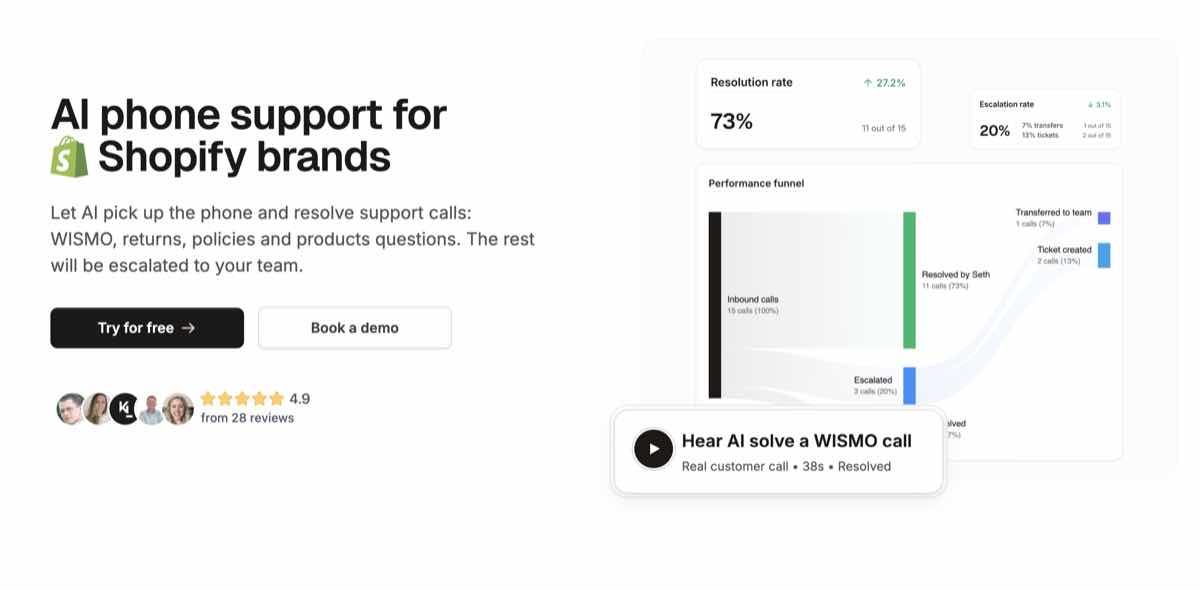
Phone calls are the bottleneck nobody talks about. They eat the same founder hours that AI writing tools just freed up. According to the 2026 ecommerce customer support statistics, 30% of store owners report being "always busy" because of fragmented work, with customer support cited as a top three time drain.
This is what we built Ringly.io for. Seth is an AI phone agent for Shopify stores. He looks up orders in real time, processes returns and exchanges, answers product questions from your knowledge base, and escalates to a human when the call gets complex. The setup takes about three minutes. He resolves around 73% of calls on his own, and we guarantee 65% resolution within 90 days or we refund your subscription.
Try it free for 14 days. If you're already automating writing with AI, automating phone support is the natural next move. Same logic, different channel.
Frequently asked questions
What's the best free AI writing tool for Shopify?
Shopify Magic. It's free with any paid Shopify plan, native to the admin, and good enough for single-product drafts. ChatGPT's free tier is also usable for occasional copy-paste work.
Can AI write product descriptions in bulk?
Yes. Describely, Hypotenuse AI, and Copy.ai workflows all support bulk generation. If you can script, the OpenAI or Claude API can generate 1,000 descriptions for under $10. Shopify Magic does not support bulk natively.
Will AI-written content hurt my SEO rankings?
Not by default. Google's official guidance is that helpful content ranks regardless of source. The risk is publishing unedited generic copy. Run AI output through a human review, add your unique perspective, and your rankings are fine.
Jasper vs Copy.ai for ecommerce, which is better?
Jasper for long-form, brand voice rigor, and multi-channel marketing teams. Copy.ai for short-form, ad copy, and cheaper entry pricing. Solo Shopify operators usually do better with ChatGPT or Claude at $20/mo instead of either.
How much does it cost to write descriptions for 1,000 products?
Via Describely at $0.75 each: $750. Via Hypotenuse AI: custom enterprise pricing. Via OpenAI or Claude API with a script: $5-15. Via ChatGPT Plus or Claude Pro manually: $20/mo plus your time.
Does Shopify Magic work for product titles and meta descriptions?
Mostly for descriptions. Title and meta description support is limited compared to dedicated tools like Describely or Hypotenuse, which generate titles, meta descriptions, and alt text alongside the body copy.
What's the best AI tool for email marketing on Shopify?
Jasper and Copy.ai both have strong email templates. Klaviyo also has native AI features for subject lines and send-time optimization. For pure copy generation, ChatGPT or Claude can match either with the right prompts.
Final picks
The honest answer for most Shopify stores in 2026: start with Shopify Magic because it's free. Add ChatGPT or Claude at $20/month for anything Magic can't handle. Only add a specialized bulk tool like Describely or Hypotenuse if your catalog volume justifies the cost.
AI writing tools have closed the content gap that used to take weeks. The bottleneck has moved elsewhere. If you're a Shopify operator who just freed up 10 hours of writing time, the next bottleneck to attack is usually phone support. Try Ringly.io free for 14 days and see what AI phone support looks like for your store.