
This post in 30 seconds.
- The 70/20 model: AI handles 70-80% of routine DTC calls, humans take the 20-30% that actually moves retention and brand.
- Per-call math: $0.42 per resolved AI call vs $7 to $16 per human BPO call. Phone goes from $20K headcount decision to $349/mo line item.
- Built for $10M to $100M DTC brands on Shopify running a paid helpdesk and a visible phone number.
Most DTC brands skip phone support. The reason isn't customer demand. It's headcount math.
A one-person phone team costs about $4,000 to $5,500 a month. Two people lands closer to $9,000. Most founders run that math once, then quietly hide the phone number on a contact page nobody finds.
That's a mistake that's been getting more expensive every year. Phone has a 91% customer satisfaction rate, higher than any other support channel. According to Baymard Institute, 17% of cart abandonments are trust-related. A visible phone number is one of the cheapest trust signals a DTC store can ship. Older buyers (50+) call before they even find your help center. Gen Z calls more than people think too.
This guide maps the four DTC call patterns to a 70/20/10 model. AI takes the routine, your team takes the high-stakes 20%, and you finally have a phone line worth picking up.
If you'd rather skip the reading: if you're a founder or Head of CX at a $10M to $100M DTC brand losing calls after-hours, book a 30-min call. We'll look at your last 7 days of missed calls live and run the recovered-revenue math.
Why DTC brands underrate phone (the $349/mo headcount math)
Most DTC founders never staffed a phone team. They started with chat and ecommerce customer service over email, then scaled both. Phone got skipped because the unit economics of a human-only phone team are genuinely brutal.
Here's the trap. A single phone agent runs $4,000 to $5,500 a month fully loaded. To cover business hours plus a backup you need two. That's $9,000 to $11,000 monthly. To cover 24/7 you need four or five. Now phone is a $20,000+ line item on a brand doing $200,000 in monthly revenue. The CFO kills it.
So founders make a different decision. They bury the phone number, drive everyone to a contact form, and tell themselves customers prefer chat anyway.
Customers do not prefer chat.
Industry research keeps confirming the same pattern: when something goes wrong with an order, a meaningful chunk of customers want to talk to a person. Older buyers reach for the phone first. Gen Z reaches for it second. Only the middle band defaults to chat. And the brands that don't pick up the phone lose those orders, not to a competitor with better chat, but to a competitor with a phone number on the header.
The math changes when AI takes the routine calls. Resolution cost drops to around $0.42 per call. A DTC brand can stand up 24/7 phone support for $349 a month at the Grow tier or run an enterprise done-for-you engagement at higher volume, instead of $20,000 in headcount. That's the entire pitch.
Real examples already exist. Naadam, the DTC cashmere brand, runs all frontline support through AI. Ridge reports about 60% of their tickets answered automatically. WashCo generated $22,664 in attributed revenue in the first 7 days post-launch, with 271 calls handled and 85% deflection. These aren't pilot programs anymore.
If you've been postponing phone for budget reasons, the budget reason is gone. The work now is figuring out which calls AI should take and which ones should escalate. That's what the next section does.
The 4 DTC call patterns AI handles cleanly
Every DTC phone line gets the same four call types, in roughly the same ratios. Map them up front and the staffing question answers itself.
1. WISMO: the 40-60% bucket
WISMO stands for "where is my order." It's the single biggest call category in DTC, and by some measures it's the easiest to fully automate.
WISMOlabs and Salesforce both peg WISMO at 40 to 60% of all inbound support volume. Some sources put it closer to 50%. Either way, it's massive. And every WISMO call has the same structure: customer wants tracking info, AI pulls live order data plus carrier status, AI reads the answer out loud, call ends in 30 seconds.
The cost difference is wild. Without automation, resolving a single WISMO inquiry costs $6 to $10 in agent time and tooling. With AI plus proactive tracking notifications, brands typically cut WISMO from 40-60% of ticket volume to 5-15% within a quarter.
There's a second-order benefit too. Every WISMO call your humans don't take is 4-6 minutes of agent time recovered. On a brand fielding 200 WISMO calls a week, that's 14-20 hours of human attention freed up for retention, complaints, and the calls where empathy actually moves a number.
If you're not automating WISMO calls yet, this is the easiest win in DTC support. Set up WISMO automation for Shopify and you free your humans for the calls that actually need them.
2. Drop launches: the 3-10x spike
Drop launches are the moment a phone team built for normal volume catastrophically fails.
A drop release, an influencer post, or a paid push routinely spikes call volume 3 to 10x normal in a 4-6 hour window. One DTC brand saw inbound volume quadruple after a celebrity posted about their product (per a 3PL Bridge case study). A human team can't surge that fast. You get hold music, missed calls, and lost orders during the exact window you spent six figures driving traffic.
AI doesn't care. 50 calls an hour or 500, it handles each one the same way. There is no queue. There is no abandon rate. The drop becomes the highest-revenue week instead of the highest-stress week.
If your brand does drops, influencer pushes, or seasonal launches, the case for AI phone isn't ROI. It's not losing the day.
The pattern repeats every holiday season too. Black Friday, Cyber Monday, and the December gifting window stack 30-day volume into 5 days. Brands that pre-staged temp agents still got crushed in 2025. Brands that ran AI on top of a small team handled the peak without overtime budget.
3. Returns: the call-before-portal pattern
Most DTC brands invested in a self-serve returns portal. Most of those brands still get return-initiation calls.
The reason is simple. Older customers don't hunt for the portal. They open their order confirmation, find a phone number, and call. If you don't have a phone number, they email and wait. By the time you respond, half of them have written the order off as a bad experience and the chargeback risk has gone up.
AI on the phone solves this two ways. It can walk the caller through the existing returns portal step by step, or it can initiate the return directly via ecommerce returns management integrations and send the label by SMS while still on the call.
Bonus, the AI captures the return reason verbatim. Sizing, quality, wrong item, didn't match expectations. That's structured data your merchandising team usually doesn't get from a self-serve portal.
4. Subscription cancels: the save-rate moment
This is the call most DTC operators have no playbook for.
Brightback's retention research found that 51.7% of would-be cancellers would pause instead of cancelling if offered the option. Recharge tracks save rate as a core subscription KPI for a reason. According to SubJolt's DTC subscription playbook, replenishment subs retain about 45% at 12 months, curation lands closer to 35%, and meal kits fall under 15%. Every save matters.
The problem with humans on cancel calls is consistency. Some agents push too hard, some too soft, some forget to offer the pause option. AI runs the script the same way every time. Pause? Skip a cycle? Switch SKU? Discount as a last resort?
The pattern that works: AI handles the cancel calls where the reason is price, timing, or "too much product." It hands off cleanly to a human for the emotional ones, medical changes, financial hardship, or a quality complaint that needs apology and a refund. That's the ecommerce customer retention playbook condensed into one call.
Even a modest 25% lift in save rate on a $80 AOV replenishment sub compounds fast. That's where AI phone earns its rent.
The other underrated benefit, AI never has a bad day on a cancel call. Human agents on the 47th cancel of the week run out of patience, skip the pause offer, or accidentally push the discount too hard and tank the LTV math. AI runs the flow the same way at 9am and 9pm.
The 20% that should stay human
Just because AI can take a call doesn't mean it should.
Pushing for 100% automation is the failure mode every vendor demo glosses over. The right number is 70 to 80%. The 20 to 30% that stays human is where you protect brand, retention, and legal exposure.
Five call types that should escalate every time:
- Adverse reactions on supplements, beauty, or skincare: regulatory exposure plus duty of care. AI captures the report, a human takes the call. Never the other way around.
- Damaged-product or wrong-item complaints from VIPs: high LTV, easy churn risk, needs a tone the AI doesn't have yet.
- Wholesale, influencer, or PR accounts: persona-aware handling, often pricing-flexible, almost always needs a real person.
- Legal, compliance, or chargeback disputes: never automate.
- Anyone audibly angry: AI should recognize the tone, apologize, and transfer. A good voice AI for customer support catches this in the first 10 seconds.
The escalation rule is simple. If the cost of getting one call wrong is bigger than the revenue from a hundred routine ones, hand it off.
This is also why "AI replaces your CS team" is a bad headline. AI replaces the WISMO answering and the routine cancel scripts. It does not replace the person who saves the $500/year subscription with a 90-second empathetic phone call. The right setup makes that person more useful, not redundant.
How AI phone support actually works on a DTC stack
The setup is less complicated than most operators expect.
What it plugs into
- Your Shopify store (live order and customer data)
- Your helpdesk (Gorgias, Reamaze, Richpanel, Zendesk, whatever you run today)
- Your knowledge base or docs site
- Your phone number (port the existing one or get a new one)
What it does in a call
- Answers in your brand voice within two rings, 24/7
- Identifies the caller by phone number or order ID
- Pulls their order, subscription, and history live
- Takes the action: track shipment, initiate return, modify subscription, send SMS confirmation, transfer to a human
- Logs everything as a ticket in your helpdesk so your team has continuity
What it doesn't do
- Replace your helpdesk (it sits in front of it)
- Have a long sales conversation
- Handle medical, legal, or adverse-reaction calls (those escalate)
Setup time is about an hour. Add your website URL, point it at your docs, the AI pulls everything else. No code. No CSV imports. No three-month implementation. This is the difference between modern AI phone agents for Shopify and the IVR systems that gave phone a bad name in the first place.
If you're already running customer service for Shopify through Gorgias or Reamaze, the AI plugs in as another channel. Calls that escalate land as tickets, with full transcript and order context attached. Your CS team picks up where the AI left off, not from zero.
The metrics that matter once phone is live
Most DTC operators set up phone, then don't measure it. That's how the channel quietly underperforms for 18 months.
Six numbers worth tracking from day one:
- Call answer rate: target 95%+. AI should never drop a call.
- Resolution rate (AI-only): target 65-75% on routine, 70-80% blended.
- Average handle time: AI calls run 1-3 minutes vs human 5-8.
- Escalation rate: 20-30% is healthy. Below 15% means the AI is bluffing on calls it should escalate.
- Save rate on cancel calls: track separately. Goal: 25%+ on price-sensitive cancels.
- Post-call CSAT: optional SMS survey. Phone CSAT should hold around 90%.
Track these monthly. If escalation rate creeps up, your KB needs an update. If save rate drops, your cancel flow needs more offer paths. The dashboard is the management surface.
Brand-stage rollout: when to add what
The 70/20 model scales with revenue. Here's the stage-by-stage breakdown.
$1M to $10M ARR (small CS team)
AI handles WISMO, drop spikes, and routine returns. One part-time human (often the CS lead or a contracted VA) handles cancels, complaints, and VIPs.
Save rate becomes a tracked KPI. Start measuring CSAT on AI calls vs human calls. You'll find they're close, especially on WISMO.
$10M to $25M ARR
AI takes 70-80%, 2-3 humans cover the 20% that matters (T2 retention, T3 escalations). WISMO automation has dropped volume by 70%+, so humans go deeper on retention conversations instead of reading tracking numbers.
Phone becomes a measured revenue channel via save rate, AOV uplift on inbound, and post-purchase upsell. Plug into your customer service KPIs for ecommerce dashboard.
$25M to $100M ARR
AI plus a small specialist team. The team is structured around saving subscriptions and protecting brand-reputation calls. WISMO, returns initiation, and routine cancels are 95%+ automated. The team's KPI is retention dollars saved, not calls answered.
This is the stage where "phone as a profit center" becomes literally true.
The call makes sense if:
- You're a Shopify (or Shopify Plus) DTC brand doing $10M to $100M
- You run a paid helpdesk (Gorgias, Zendesk, Gladly, Re:amaze, or Intercom)
- You have a visible phone number on your store
- Your CS team is 3 to 12 people
What happens on the call.
- We pull your last 7 days of missed calls live, on the call. No homework for you.
- We show you the recovered revenue at typical resolution rates for DTC brands.
- You decide if it's worth a deeper conversation. No deck, no follow-up sequence.
Book a 30-min call and we'll have the recovered-revenue number before you finish your coffee.
Ringly.io: AI phone support built for DTC brands
Ringly.io is AI phone support for Shopify brands. Hiring a phone team scales linearly with call volume. The AI doesn't. Instead of growing your support headcount every time call volume goes up, the AI takes the routine inbound calls so your team can focus on the work that actually moves revenue.
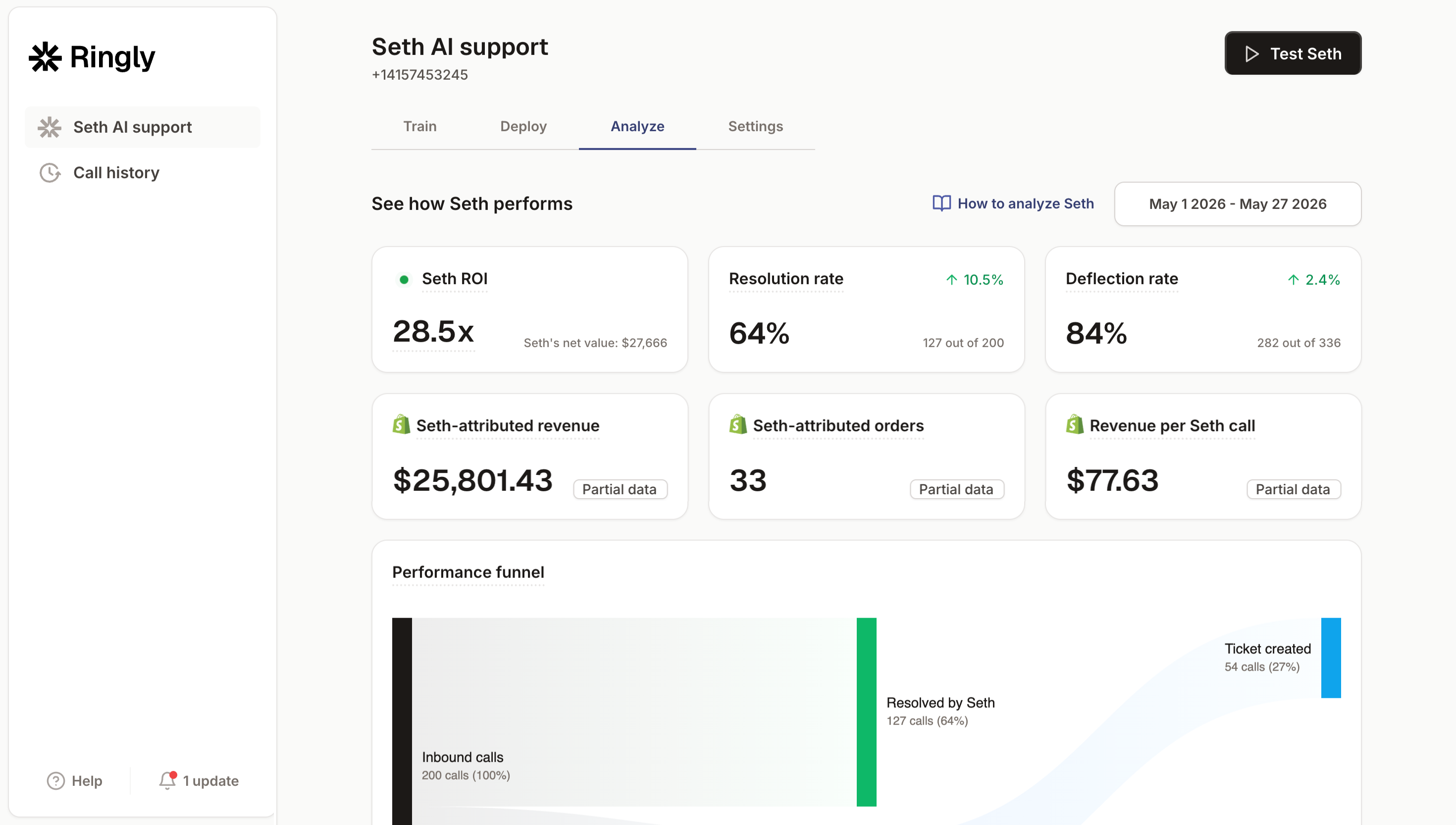
The AI answers inbound calls 24/7 in 40 languages. It finds orders in your Shopify store, processes returns and exchanges, answers product questions from your knowledge base, and rescues abandoned carts via outbound follow-up. Across 50+ active brands, the AI resolves 73% of calls autonomously at roughly $0.42 per resolved call. Calls that need a human escalate cleanly to Gorgias, Richpanel, Reamaze, or whatever helpdesk you already run.
For DTC brands specifically, Ringly.io handles all four call patterns out of the box. WISMO is fully automated against live Shopify + carrier data. Drop-launch spikes don't queue, the AI scales to any volume. Returns get initiated live on the call. Subscription cancels go through a configurable save flow that offers pause, skip, swap, or discount before letting the customer drop.
| Plan | Price | Minutes | Best for |
|---|---|---|---|
| Grow | $349/mo | 1,000 (~500 calls) | $1M-10M ARR, getting phone live |
| Pro | $799/mo | 2,500 (~1,250 calls) | $10M-25M ARR, growing call volume |
| Enterprise | By call only | 5,000+ | $25M+ ARR, done-for-you, multi-store |
Live in under an hour. 65% resolution guarantee: if the AI resolves under 65% of your calls in 90 days, we refund the last 3 months. See full pricing at ringly.io/pricing.
"My customers also feel like it's a normal person. They feel like they can communicate if they have questions."
Claudia Droge, TechCraft Studio
Frequently asked questions
Does AI phone support work for small DTC brands?
Yes, and it's where the math is most compelling. A $349/mo Grow tier replaces what used to be a $5K/mo human commitment. Small brands get the conversion-lift benefit of a visible phone number without the headcount drag.
What's the difference between AI phone support and a chatbot?
A chatbot lives on your site and handles typed messages. AI phone support answers the phone, has a real voice, and integrates live with Shopify and your helpdesk. Different channel, different muscle.
How is automated phone support different from an IVR?
An IVR makes the caller press numbers ("press 1 for orders"). Modern AI phone agents understand natural speech, take actions live, and don't force menus. Same channel, completely different experience.
Will AI handle subscription cancellations without losing the customer?
The good ones run a configurable save flow: ask the cancel reason, offer pause or skip first, then discount, then escalate to a human if the reason is emotional. Save rates often improve because the AI runs the same script every time, no agent variability.
What happens if the AI can't answer the question?
It transfers the call to a human, hands over the full context (caller, order, what they asked, what the AI tried), and logs it as a ticket in your helpdesk. The customer doesn't have to repeat anything.
How does this work with my helpdesk (Gorgias, Reamaze, Richpanel)?
The AI sits in front of your helpdesk, not instead of it. Calls that escalate become tickets with full transcripts attached. Your existing workflows stay intact.
How long does setup take?
Under an hour. Add your website URL and docs, the AI pulls product, FAQ, and policy info automatically. Point your phone number at it. Done.
Talk to us
If you're running a $10M to $100M DTC brand and the founder is still answering calls at 8pm, a 30-min call is the fastest way to see what changes when AI takes the routine 70%. We'll pull your last 7 days of missed calls live, run the recovered-revenue math against your call mix, and you decide whether it's worth a deeper conversation.
The 3-layer guarantee.
- Live in 14 days or it's free until launched.
- 65% resolution in 90 days or we refund the last 3 months of subscription fees.
- We keep working free until we hit 65%.
Ruben (Ringly co-founder) takes these calls personally.