
Your gourmet phone line gets busy at exactly the wrong times: 11pm and the week before Christmas.
- What an AI customer support agent actually does for a gourmet brand, and where it stops.
- How it stacks up against your four real options: hire rep #5, a BPO, a chatbot, or a DIY voice tool.
- Built for $10M-$100M Shopify gourmet and specialty-food brands with a phone number on the site and a paid helpdesk behind it.
A customer orders a box of single-origin chocolate as a birthday gift. It has to arrive cold, and it has to arrive by Friday. At 11pm on a Tuesday they call to ask if it's on track, and your line goes to voicemail. By Wednesday morning that voicemail is buried under forty others, and the customer has already opened a chat with the brand that did pick up.
If you run a $10M-$100M Shopify gourmet or specialty-food brand, you know this queue. It runs quiet most of the year and then floods every December, and it skews older and more phone-first than most ecommerce verticals. An AI customer support agent is the support hire that picks up that line at 2am and in the gift rush, finds the order, and answers the freshness or allergen question without anyone clocking in.
We've built these for 50+ Shopify brands, and the gourmet ones have the most lopsided call calendar of any vertical we work with. If your phone backlog spikes in Q4 and you'd rather not staff for one month a year, book a 30-min call and we'll look at your last week of missed calls together.
What an AI customer support agent actually is for a gourmet brand
Strip out the buzzwords and it's a trained teammate that lives on your phone line. It answers every inbound call, 24/7, in the brand's voice. It looks up the order in Shopify, reads the tracking, and tells the customer whether the box is going to arrive cold and on time. It answers the storage, shelf-life, gift, and ingredient questions from a knowledge base you control. And when a call needs a person, it hands off cleanly to whoever's on your team.
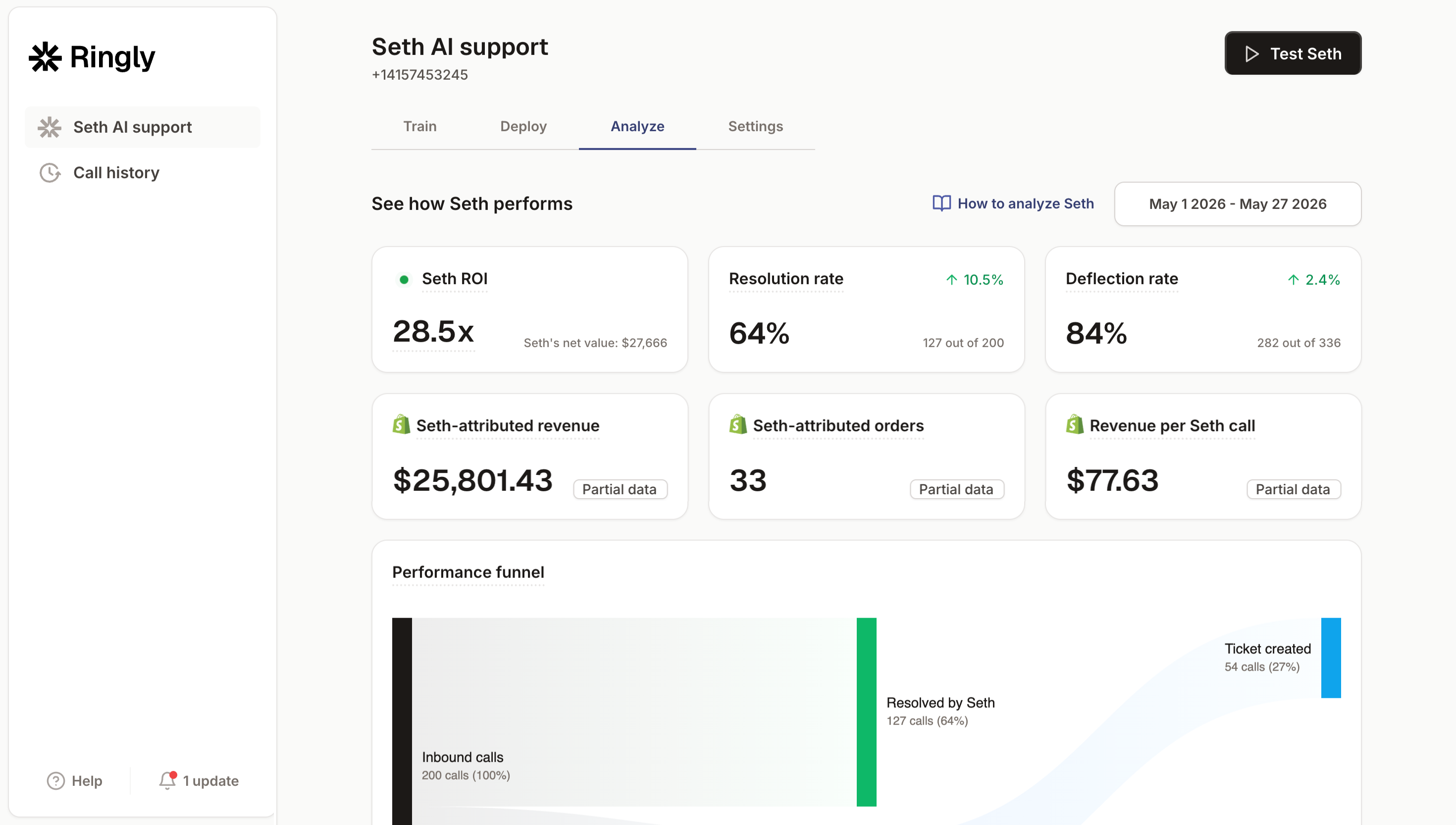
The point isn't to replace your CS team, it's to take the calls they were never hired to take. Across the 50+ brands on Ringly the AI resolves about 73% of inbound calls on its own, at roughly $0.42 per resolved call. The other 27% are the genuinely hard ones, a spoiled order, an upset gift-giver, a wholesale question, and those still go to a human. Your reps stop being a voicemail-clearing service and go back to the calls that actually need them.
The reason this matters more for gourmet than for, say, a hardware brand is the kind of question that comes in. "Will it still be fresh?" isn't a complaint. It's a pre-purchase nerve and a post-purchase nerve, and it's the same question over and over. That's exactly the work an agent is good at, and exactly the work that burns out a small team.
It's worth being precise about what "resolves" means here. A resolved call is one where the customer got their answer and hung up satisfied without a rep ever touching it. For a gourmet line that's most of the day-to-day ecommerce support: the order's on track, the chocolate keeps for two weeks at room temperature, the gift note went on the right box. None of that needs a person. It just needs to be answered fast, in a voice the caller trusts, at whatever hour they happen to dial.
Why the gourmet support job is harder than generic ecommerce
Three things make a gourmet phone line different, and any tool that ignores them will underperform.
First, the volume is seasonal and bursty. You run a small team eleven months of the year and then the gift rush hits and call volume can triple in a week. Hiring for that peak means paying a full team to wait around the rest of the year.
Second, the demographic skews older and phone-first. A real chunk of gourmet buyers won't place an order on the website, they'll call to do it, and they expect a person. WISMO ("where's my order") already runs 30-40% of tickets in a normal week and over 50% at peak, according to Salesforce. On a phone-first audience, that lands on the line, not the inbox.
Third, the calls carry weight. A gift that arrives late or melted isn't a refund, it's a ruined birthday, and the caller knows it. The stakes feel personal, which is why a dropped call costs more here than almost anywhere. PCN's 2026 research found that 85% of callers who can't reach a person never call back, and 62% switch to a competitor. There's a legal edge to it too. The FTC requires sellers to ship within the time they promised or give the buyer the choice to cancel for a full refund, and gift deadlines are exactly where that gets tested, so the brand that can actually answer "is it going to make it by Friday" is the one that keeps the order.
Put those three together and you get a support load that a generic ecommerce playbook handles badly. It's why an after-hours answering setup tuned for other verticals tends to fall over on a gourmet line: it wasn't built for the spike, the demographic, or the stakes.
"My customers also feel like it's a normal person. They feel like they can communicate if they have questions."
Claudia Droge, TechCraft Studio
The gourmet calls cluster into a handful of repeatable types, and most of them don't need a human at all:
- Cold-chain ETA: "will it arrive cold and on time?"
- Gift orders: arrive-by deadlines, gift messages, ship-to-recipient details
- Allergen and ingredient: gluten-free status, cross-contamination, what's actually in it
- Storage and shelf-life: "how long does this keep once it's open?"
- Damaged or spoiled in transit: the one that does need a person
- WISMO: plain order status, the single biggest bucket
What to look for in an AI customer support agent for a gourmet brand
Most AI support tools were built for chat tickets on a generic store. Here's what actually matters when the store sells perishable food and the customers call.
- Phone-native, not chat-bolted-on: a lot of "AI agents" are chat widgets with a phone feature stapled on. Your audience calls. The agent has to be built for voice first.
- Real Shopify order lookup: it should pull the actual order and tracking, not read a script. Look for native order-status lookup.
- Allergen escalation by design: this is the one to be strict about. The agent should answer simple ingredient questions from the knowledge base and hand off the moment a question crosses into "someone could get hurt if this is wrong." A severe-allergy caller asking about trace nuts goes to a human, full stop.
- Cold-chain answers from live tracking: it should read the carrier ETA and tell the caller whether the box arrives in time, not just repeat the ship date.
- Gift-order handling: gift messages, recipient addresses, and arrive-by dates are their own workflow in Q4. The agent has to handle them.
- Clean helpdesk escalation: it should sit in front of Gorgias, Gladly, Zendesk, Re:amaze, or whatever you run and transfer cleanly when a human's needed.
- Voice quality that doesn't announce itself: with an older, skeptical audience this is the whole ballgame. The most repeated thing customers say after talking to ours is "you don't sound like AI."
- Done-for-you build, not a toolkit: you don't want to be the implementation team in November. Look for someone who builds and tunes it for you.
- A resolution guarantee: if a vendor won't put a number behind it, that tells you something.
If you're weighing this for the upcoming gift season, book a 30-min call and we'll map your call types and routing before the spike hits.
The AI agent vs your other four options
You're not really choosing between AI and nothing. You're choosing between five ways to cover the line. Here's how they stack up for a gourmet brand.
| Option | After-hours + peak | Cold-chain + allergen fit | Cost shape | Verdict |
|---|---|---|---|---|
| Hire rep #5 | Only with night/weekend pay | Good, if trained and not burnt out | ~$4-6K/mo loaded, scales linearly | Breaks at the Q4 spike |
| BPO / outsourced | Yes, quality varies | Weak on perishable nuance | $1.50-$3.50/call + minimums | Answers, but rarely fluent in your products |
| Chatbot only | Chat hours only, no phone | Misses the phone-first caller | Cheap, low return | Wrong channel for this audience |
| Generic voice AI (DIY) | Yes, if you build it | Only as good as your own setup | Tool cost + your engineering time | A toolkit, not a teammate |
| AI support agent (done-for-you) | Yes, 24/7 and peak-proof | Built around your KB + tracking | Flat monthly, ~$0.42/resolved call | Best fit for a phone-first gourmet line |
A few notes. A chatbot is fine for the customers who'd use a website, but those mostly aren't the ones calling you. A helpdesk's own chat AI like Gorgias is strong on email and chat and thin on phone. And a generic voice AI builder hands you a tool and walks away, which means you own the build, the tuning, and the failures.
Gear Rider, a specialty brand on Ringly, handled 1,595 sales and support calls in 90 days without a phone rep on the clock. That's the volume shape an agent is built for, and it's the shape a five-person team can't hold through a gift season.
How I'd evaluate one before you commit
I'm Ruben, co-founder of Ringly. We run AI phone support for 50+ Shopify brands, so I look at these the way a buyer does, not a critic. When we pulled the after-hours call logs across those brands, the gourmet phones were busiest exactly when no rep was on, late evening and the December gift rush, which is the whole reason this category exists.
If I were a gourmet operator sizing one up, here's the test I'd run:
- Call the line myself, twice. Once with a plain "where's my order," once with a gift-deadline question. I'd judge how human it sounds, because my customers will.
- Hand it a real allergen question. I'd ask something with safety stakes and confirm it escalates instead of guessing. If it improvises on safety, it's out.
- Check the Shopify lookup. I'd push a test order through and see if the agent finds it, reads the tracking, and gives a real ETA, not a canned ship date.
- Watch the helpdesk handoff. I'd force an escalation and make sure it lands in my existing helpdesk with context, not a cold transfer.
- Ask who builds it. I'd find out whether they build and tune it for me or hand me a login and a quickstart guide.
Five tests, an afternoon of work. The ones that pass all five are rare, and the gap between them and the demos is where most buyers get burned. If you want a head start, our breakdown of phone support for specialty-food brands walks through the same checks with more examples.
What it costs vs a human team
The math is less about the price tag and more about the shape of the spend. A typical $20M specialty-food brand runs four reps year-round and staffs up for the gift season.
| Line item | Today | With an AI agent |
|---|---|---|
| 4 reps year-round, $4K loaded each | $16,000/mo ($192K/yr) | covered by the AI |
| 4 seasonal reps, 3 months | ~$48,000/yr peak | absorbed, no extra hire |
| AI support agent | n/a | ~$3,000-$5,000/mo |
| True annual CS spend | ~$240,000/yr | a fraction of it |
An AI agent at roughly $3-5K/mo handles the roast-date, harvest, gift, and WISMO calls year-round and absorbs the December spike without a single seasonal hire. Net savings land around $140K-$180K a year depending on volume. And WashCo, a Shopify brand we launched, recovered $22,664 in its first 7 days on the phone, because the calls it caught after-hours were orders, not just questions.
Compare that to the cost of a missed gift order in December. Businesses answer only about 38% of inbound calls, and 80% of voicemail-routed callers hang up without leaving a message. On a phone-first gift audience, the unanswered ones don't try again, they buy elsewhere.
Want the numbers run against your own call volume? Book a 30-min call and we'll do the math live.
Frequently asked questions
Can an AI customer support agent take orders over the phone for a gourmet brand? Not natively, and we'd rather be honest about that than oversell it. The agent handles order status, freshness, gift, and ingredient questions, and for a customer who wants to place an order by phone it transfers to a human or sends a secure payment link by SMS. If more than half your revenue is phone orders, you're not our fit yet.
Will my older customers accept talking to an AI? This is the question that matters most in gourmet, and the answer is in the voice. The most repeated thing customers say after a call with ours is "you don't sound like AI." Skeptical, older buyers are exactly who we built the voice quality for, so call the line and judge it yourself before you decide.
Is it safe to let an AI answer allergen questions? Only because it's built to know its limits. The agent answers straightforward ingredient and gluten-free questions from a knowledge base you approve, and the moment a question carries real safety stakes, like a severe-allergy caller asking about trace nuts, it escalates to a human instead of improvising. The escalation rule is the feature, not the workaround.
Does it work with Gorgias and my existing helpdesk? Yes. The agent sits in front of Gorgias, Gladly, Zendesk, Re:amaze, or Intercom and escalates cleanly when a human is needed. You keep your current phone number, helpdesk, and workflows.
Can it tell a customer whether their order will arrive cold and on time? Yes. It reads the live carrier tracking on the Shopify order and gives the caller a real ETA, not just the date you shipped. For a gift with an arrive-by deadline, that's usually the entire reason they called.
How long does setup take? A self-serve plan can be live in under an hour. For a full done-for-you build with your knowledge base, gift workflows, and escalation rules tuned, we run a 14-day Launch Sprint so it's ready before your gift season, not during it.
How much does an AI customer support agent cost? Ringly plans start at $349/mo (Grow) and $799/mo (Pro), with Enterprise priced by call for higher-volume brands. Every plan carries a 65% resolution guarantee: if the AI resolves under 65% of your calls in 90 days, we refund the last three months.
Talk to us

If you run a $10M-$100M Shopify gourmet brand and your phone goes quiet on you exactly when the gift orders are flooding in, a 30-min call is the fastest way to see what the line is costing you after-hours.
The 3-layer guarantee.
- Live in 14 days or it's free until launched.
- 65% resolution in 90 days or we refund the last 3 months of subscription fees.
- We keep working free until we hit 65%.
Ruben (Ringly co-founder) takes these calls personally.