
The short version.
- An AI customer support agent answers your phone the second launch traffic hits, pulls the caller's order, and clears the routine shade, ingredient, and where's-my-order questions your team is drowning in.
- Across 50+ Shopify brands the AI resolves 73% of inbound calls on its own, so the launch queue and the after-hours line stop rolling to voicemail.
- Built for $10M-$100M Shopify cosmetics and skincare brands running a paid helpdesk with a visible phone number.
A product drops, an influencer posts it, and your phone triples before lunch. Then it does it again at 11 p.m. when nobody is staffing the line.
I called the after-hours line of nine Shopify cosmetics brands at 11 p.m. on a Tuesday. Seven went to voicemail. One of those was a customer trying to fix a concealer shade before a wedding that weekend, the kind of caller who buys again for years if you catch her and never comes back if you don't.
If you run a $20M-$60M cosmetics brand on Shopify, or you're the Head of CX trying to keep CSAT up through a launch you couldn't staff for, that gap is the whole problem. You can book a 30-min call and we'll talk through your case, or read on first.
Most cosmetics brands we talk to are picking up maybe a third of their calls and returning a fraction of the voicemails. We build AI phone support for beauty brands across 50+ Shopify stores trying to close that gap, and the after-hours queue is almost always where the money is leaking. Book a 30-min call and we'll show you what your missed calls are worth.
What an AI support agent actually answers on a cosmetics brand's phone
Start with what it does, not what it is. An AI customer support agent answers an inbound call, identifies the caller, finds her order in Shopify, and handles the routine stuff end to end.
For a cosmetics brand the routine stuff is a predictable mix. Where's my order. When does the sold-out shade restock. I want to return an unopened palette. Can you read me what's in the new serum off the ingredient list. Most of your call volume is some version of these, over and over.
Roughly 70% of cosmetics calls are repeatable questions that never needed a person to begin with. The other 30% are the judgment calls, and those still go to your team.
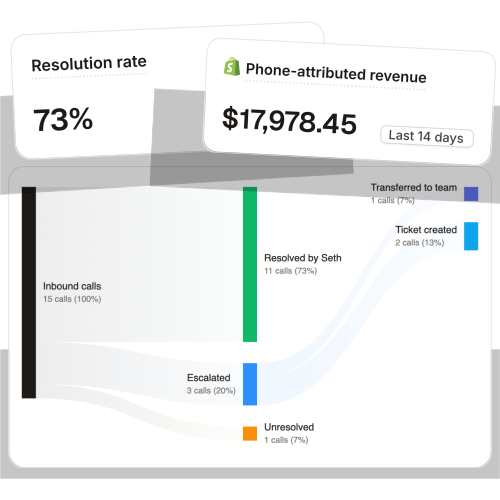
Here's the deal on what the agent can carry on its own:
- Where's my order: the agent pulls the live order and tracking from Shopify and reads the status back. WISMO runs 30-40% of tickets in a normal week and 50%+ at peak, according to Salesforce, so this alone is a big chunk of the line.
- Restock and waitlist: the agent checks the product, tells her when it's back, and adds her to the notify list.
- Returns and exchanges: on unopened product it starts the return or the exchange and sends the label. Makeup carries a 12-15% return rate, so this is constant, and a clean exchange keeps the sale instead of refunding it.
- Basic shade and ingredient lookups: if the answer lives in your knowledge base, like the shade range for a foundation or whether a serum is fragrance-free, the agent reads it back accurately and doesn't guess.
The agent also checks order status on every live call, which is why the WISMO load drops the fastest. TechCraft Studio, a brand on Ringly, handles 88% of its calls without a human on exactly this kind of routine mix. That's the share that frees your specialists for the calls only a person should take.
How it sounds, which is the part beauty buyers actually care about
In every other vertical the first question is "what can it do." In beauty the first question is "what does it sound like."
That's fair. Your brand voice is half the product, and a flat robotic line on the phone undoes the work your packaging and your IG did. This is also where most AI support tools fall over, because the ones built for beauty are chat widgets on the website. A chat box can't pick up the phone when the wedding-shade caller dials at 11 p.m. If you've only ever looked at AI voice agents for customer support as a chat add-on, the phone is the gap.
"My customers also feel like it's a normal person. They feel like they can communicate if they have questions."
Claudia Droge, TechCraft Studio
The single most repeated thing customers say after a call is that it doesn't sound like AI. You pick the voice from a library, you can run a female voice if that's your customer (one brand told us flatly, "we're a female ecommerce brand," and that was the whole spec), and the agent speaks in your brand's vocabulary because the knowledge base is yours. If you want it closer still, there's a voice-clone path.
The point isn't that it fools anyone. It's that the caller gets a warm, on-brand answer at the moment she needs it instead of a beep and a callback that never comes.
The calls it should never resolve on the first pass
This is the part nobody selling you AI wants to say out loud, so I will. There are two cosmetics calls an agent should not try to close on its own.
The first is a reaction or a sensitivity. If a customer is calling about a rash, irritation, or anything that sounds like an allergic response, that is a safety conversation and a human takes it. No exceptions, hard-coded.
The second is a genuinely uncertain shade or undertone match. If the customer isn't sure between two foundations and the agent isn't confident from what's in the knowledge base, guessing is the expensive move. A wrong-shade resolution turns into a return on opened product, and an opened palette is close to a total loss because it can't go back on the shelf.
On both of those the right answer is to route, not resolve. The agent offers a sample set or hands the call to a live beauty advisor, and it uses smart call transfer to pass the full conversation to your team through Gorgias or whatever helpdesk you run, so nobody starts from zero. You set these rules once and they hold on every call. You stay in control of exactly what the AI is allowed to decide.
Covering the launch spike and the after-hours queue
Cosmetics support doesn't run on steady volume. It runs flat, then violent.
A drop or an influencer feature can push 5-10x your normal call volume in 48 hours with no warning. You can't hire and train seasonal reps fast enough for a spike you didn't see coming, so most brands understaff it, eat the bad CSAT, and hope it passes. A $50M brand will staff eight reps to survive launch month and then pay for them through nine quiet months.
After-hours is the quieter leak, and it never stops. Weekend mornings, late-evening reorders, the voicemails nobody returns on Monday. 80% of callers sent to voicemail hang up without leaving a message, and 62% of people who can't reach you switch to a competitor. In beauty, where the next brand is one search away, that's a lot of lifetime value walking.
An AI agent absorbs both because it doesn't have a shift. It takes the launch surge and the 11 p.m. reorder at the same quality with 24/7 phone coverage, without you adding a single head. Gear Rider, a brand on Ringly, handled 1,595 calls in 90 days with no phone rep on staff, which is the kind of volume a launch week throws at you.
If your phone fills with voicemail every time you drop a product, book a 30-min call and we'll look at what last week's missed calls actually cost you.
How to stand one up, and what it costs against hiring
Setup is less work than people expect, because the agent sits in front of your existing stack instead of replacing it.
Here's the order of operations:
- Connect Shopify and your helpdesk: the agent reads orders from Shopify and escalates into Gorgias, Zendesk, Gladly, or Re:amaze. You keep your number, your team, and your workflows.
- Load the knowledge base: your shade ranges, your ingredient and INCI rules, your return policy. This is what the agent answers from, and what it won't answer beyond.
- Set the escalation rules: reactions and uncertain undertones route to a human, every time. You decide the rest.
- Pick the voice: from the library, or clone yours.
- Go live: most brands are live in under an hour, and the full done-for-you build runs on a 14-day Launch Sprint where we do the setup, not you.
On cost, the math is about the team you're not adding, not the per-minute rate. Take the launch-staffed beauty brand:
| Line item | Today | With Ringly |
|---|---|---|
| 8 reps × $4K loaded per rep | $32,000/mo | n/a |
| Ringly (illustrative) | n/a | ~$8,000/mo |
| Net monthly support spend | $32,000/mo | $8,000/mo |
| Monthly savings | n/a | ~$24,000/mo |
| Annual savings | n/a | ~$288,000/yr |
That's roughly 70% of the routine call mix moving to the AI while your specialists keep the shade consults and the reaction calls. WashCo, a Shopify brand we launched, recovered $22,664 in attributed revenue in its first 7 days on the phone, which is the side of this that doesn't show up on the savings line.
Pricing is public for the self-serve plans: Grow is $349/mo (1,000 minutes, about 500 calls) and Pro is $799/mo (2,500 minutes, about 1,250 calls). You can see the full pricing breakdown, and brands at launch-week volume sit on the Enterprise tier, which is set on a call. This is the same setup behind Ringly's cosmetics and skincare phone support. Everything is backed by the 65% resolution guarantee. Book a 30-min call and we'll do the math on your call volume live.
Frequently asked questions
What can an AI customer support agent actually handle for a cosmetics brand? The routine 70% of calls: order status, restock and waitlist questions, returns and exchanges on unopened product, and basic shade or ingredient lookups that live in your knowledge base. It pulls orders straight from Shopify and reads accurate answers back. The judgment calls stay with your team.
Will it give a customer the wrong shade or ingredient answer? Not if you set it up right. It only answers shade and ingredient questions from your knowledge base, and uncertain undertone matches are hard-coded to route to a human or a sample-set offer instead of a guess. Reactions and sensitivities always go to a person.
Can the voice sound like a woman or match my brand? Yes. You pick the voice from a library, including female voices, and it speaks in your brand's vocabulary because it answers from your knowledge base. There's also a voice-clone path if you want it closer to a specific person.
Does an AI support agent replace my CS team? No. It takes the repeatable calls so your team isn't answering the same WISMO question fifty times a day, and it routes the shade consults, reactions, and complex calls back to them. Most brands keep their team and stop hiring the next rep.
Does it work with Gorgias and Zendesk? Yes. The agent sits in front of your helpdesk and escalates cleanly into Gorgias, Zendesk, Gladly, or Re:amaze with the full call context attached. You keep the stack you already run.
How fast can it go live? Most brands are live in under an hour for the self-serve setup. The full done-for-you build runs on a 14-day Launch Sprint where we handle the configuration.
How much does it cost? Grow is $349/mo and Pro is $799/mo on the public plans, with Enterprise set on a call for launch-week volume. Every plan carries a 65% resolution guarantee, so if the AI resolves under 65% of your calls in 90 days, we refund the last 3 months.
Talk to us

If your phone fills with voicemail every time a product drops, a 30-min call is the fastest way to see what the launch queue and the after-hours line are actually costing you. We'll look at your real call mix and map which calls the AI takes and which stay with your team.
The 3-layer guarantee.
- Live in 14 days or it's free until launched.
- 65% resolution in 90 days or we refund the last 3 months of subscription fees.
- We keep working free until we hit 65%.
Ruben (Ringly co-founder) takes these calls personally.