
This post in 30 seconds.
- Beauty calls aren't one thing. They're five, and each one wants a different handler.
- The routine 70% (where's my order, returns, hours, stock) can run without a human. Shade consults and upset customers should not.
- Built for $10M-$100M Shopify beauty brands with a visible phone line and a CS team that drowns every launch.
A foundation shade goes viral on a Tuesday night. By 9am Wednesday your phone queue is five times its normal size, your three reps are still finishing their coffee, and half the callers just want to know if the thing is back in stock. That is a normal week for a beauty brand, and it is the reason the phone is the hardest support channel you own.
I went through the call logs of beauty and skincare brands we run on Ringly and sorted them by what people actually call about. The pattern is consistent enough that you can build a handling plan around it. If you run customer experience at a Shopify beauty brand doing $10M to $100M, you already know the launch-week queue. This is how the brands we work with route it. Book a 30-min call and we'll map your call types live.
The short version: stop treating every call the same. Some of them need your best rep. Most of them don't need a person at all. If you're early on this, you can book a 30-min call and we'll talk through your specific case.
What beauty-brand calls actually are
Most "how to handle phone calls" advice is written for a generic call center. Greet warmly, listen, escalate politely. Fine. None of it tells you what a beauty customer is calling about, which is the part that decides how you staff.
When I sorted the logs, almost everything fell into five buckets:
- Shade, undertone, and match consults. "Will this foundation work for my skin tone." "What's the undertone on the 'Sand' shade." This is the call that often needs a person, because it's a subjective recommendation.
- The launch or influencer surge. A creator posts, a product sells out, and your call volume jumps 5x to 10x in 48 hours. Most of those calls are "is it back in stock" and "where's my order."
- Where's my order. WISMO is 30-40% of support tickets in a normal week and 50% or more at peak, according to Salesforce. For a beauty brand mid-launch it's the single biggest bucket.
- Returns and exchanges. Makeup carries a 12-15% return rate and roughly 30% of beauty returns are shade or color related, per Eightx citing Klarna's beauty data. A lot of those returns start as a phone call.
- Voice and brand fit. Beauty buyers notice tone more than any other vertical. Plenty of them want a female voice, and all of them can tell when they're talking to something that sounds like a script.
Once you see the five types, the staffing question stops being "how many reps" and becomes "which calls actually need one." The honest answer is that the routine four-fifths of that list doesn't.
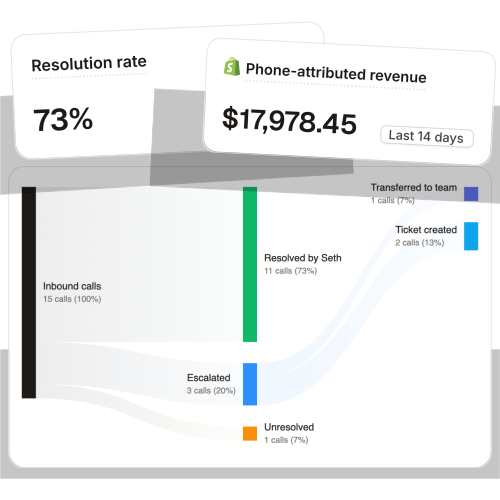
The compliment we hear most from beauty customers after a call is "you don't sound like AI," which matters more here than in any other vertical we serve. Seth resolves up to 90% of inbound calls on its own.
The routing playbook: what a human takes, what AI takes
Here's the deal. The job isn't to answer every call the same way. It's to send each type to the cheapest handler that can actually resolve it, and to free your team for the calls where a human earns their keep.
This is the split that works for the beauty brands we run:
| Call type | Who should handle it | Why |
|---|---|---|
| Shade / undertone consult | Your CS team | Subjective recommendation. A wrong answer becomes a return. |
| Upset customer / reaction complaint | Your CS team | Emotional, brand-risk, needs judgment. |
| Influencer or press inquiry | Your CS team (or marketing) | One-off, relationship-driven. |
| Where's my order | AI | Pure lookup. The AI reads your Shopify order and reads it back. |
| Return or exchange start | AI | Routine workflow. Escalate the edge cases. |
| Hours, stock, restock date | AI | Knowledge-base answer. No judgment needed. |
| Order change / address fix | AI | Structured action against the order. |
The math behind doing this is brutal if you don't. Businesses answer only 37.8% of inbound calls, and 62% of the people who don't get through call a competitor instead, according to a 2026 PCN study. For a beauty brand where a single customer might be a $300-a-year repeat buyer, every dropped WISMO call is a real number walking out the door.
So the routing rule is simple. Anything that needs taste or empathy goes to a person. Everything else gets answered the second it rings. The AI handles the routine load and transfers cleanly to your team when a call needs them, using a smart call transfer rule you set. Your reps stop spending their day reading order numbers out loud and start spending it on shade consults that actually sell product. For the full picture of what a beauty support stack looks like, our cosmetics and skincare guide walks through it.
Handling the launch or influencer spike
The launch spike is where most beauty brands' phone plans fall apart. Beauty LIVE shopping grew 90% in 2025 on TikTok alone, per TikTok's own newsroom, and the brands riding that wave see volume that no human team can absorb on 48 hours' notice. Rare Beauty's blush had a months-long waitlist after a single viral video. A COSRX eye patch hit 12 million views in five days. You cannot hire for that, and you can't predict which Tuesday it lands.
The brands that survive the spike don't staff up for it, they route it. When a drop goes viral, 80% of the new calls are the same two questions: is it back in stock, and where's my order. Both are answers your AI already knows from your knowledge base and your Shopify data.
Here's how it plays out in practice:
- The surge hits the AI first. Stock, restock dates, and order status get answered instantly, 24/7, however many people call at once. No hold music, no voicemail.
- Your humans get the consults. The handful of "which shade should I pick" calls reach a person who isn't buried under 400 WISMO calls.
- Nobody hits a dead line. That matters, because 78% of customers abandon a brand after a single unanswered call, per PCN.
The point of automating the routine spike isn't to remove humans. It's to make sure the one call that needed a human actually got one. Want to see this mapped to your own launch calendar? Book a 30-min call and we'll walk it through.
After-hours and weekend calls
Beauty shoppers don't keep business hours. A lot of the buying decision happens at 9pm after the kids are down, or on a Sunday afternoon scrolling. That's exactly when your reps are off and the call rolls to voicemail.
The problem with voicemail is that it doesn't work. 85% of callers who hit voicemail never leave a message and never call back, according to Eden. So the after-hours queue isn't a backlog you clear on Monday. It's revenue that already left.
"My customers also feel like it's a normal person. They feel like they can communicate if they have questions."
Claudia Droge, TechCraft Studio
An AI phone agent doesn't have an after-hours problem, because it doesn't have hours. It picks up the 11pm "did my order ship" call the same way it picks up the 11am one, pulls the order, and reads it back. Your team walks in Monday to a clean queue instead of 40 voicemails they'll never return. If round-the-clock coverage is the goal, our 24/7 phone support guide covers the setup.
Voice, tone, and not sounding like a bot
Beauty is the one vertical where the voice itself is part of the product. Your brand spends a fortune getting tone right on the site, the packaging, the emails. The phone shouldn't undo all of that.
Two things matter here. First, the voice. Many beauty buyers respond better to a female voice, and you should be able to pick one that fits the brand rather than accept a default. Second, the vocabulary. The agent has to talk about shades, routines, and undertones the way your brand does, which comes from feeding it your real knowledge base instead of generic support scripts.
The bar isn't "does it work," it's "does the customer forget they're talking to AI." When the voice and the vocabulary are right, they do, and the most common thing they say afterward is that it sounded like a real person. That's not a small thing in beauty. It's the difference between a tool you're proud of and one you hide.
The other half is what the AI does with the call. It checks order status against Shopify, answers product questions, starts returns, and hands the call to a human the moment it hits something it shouldn't try to resolve alone. You stay in control of where that line sits.
The mistakes that make beauty calls worse
A few patterns show up over and over when a beauty brand's phone plan isn't working. Most of them are fixable in a week.
- Sending shade consults to voicemail. The one call that actually needs a person is the one most likely to roll to an unmanned line at 7pm. If your routing drops consults, you're losing the highest-intent caller you have.
- Staffing the whole team for the worst week. Carrying eight reps year-round for a launch month that comes four times a year is how beauty CS budgets balloon. The spike is real, but the answer is routing, not permanent headcount.
- Treating WISMO as a rep job. When a person reads order numbers out loud all day, two things happen: the rep burns out, and the consult calls wait behind them. Order lookups are the first thing to take off your team's plate.
- A phone voice that doesn't match the brand. A generic, robotic line on a brand that obsesses over tone everywhere else reads as careless. The voice is part of the experience, so treat it like the rest of the brand.
- No clean handoff rule. If the AI can't transfer a call to a human the moment it needs to, customers get stuck. The whole model depends on a transfer rule that actually works, which our returns and exchanges flow and WISMO handling guide both lean on.
Fix the routing first, the staffing second. Almost every beauty brand we talk to is over-staffed on the routine layer and under-covered on the calls that need a human, which is exactly backwards.
What this costs vs handling it with AI
Let's do the money. Beauty brands don't run a steady CS team, they run hot during launches and quiet between them, which means they tend to over-staff for the worst week and pay for it all year.
Take a $50M beauty brand that staffs 8 reps to survive launch months:
| Line item | Today | With Ringly |
|---|---|---|
| 8 reps × $4K loaded per rep | $32,000/mo | n/a |
| Ringly (illustrative) | n/a | $8,000/mo |
| Net monthly CS spend | $32,000/mo | $8,000/mo |
| Monthly savings | n/a | $24,000/mo |
| Annual savings | n/a | $288,000/yr |
That's a team that's effectively idle nine months of the year, carried so it can handle the launch spike. Route the routine calls to the AI and you absorb the spike without the year-round headcount. The AI resolves up to 90% of calls for $1.99 a call after the first 50, versus the $7 to $16 a human-handled call runs at a typical BPO. WashCo, a Shopify brand we launched, recovered $22,664 in its first 7 days on the phone.
None of this means firing your team. It means your reps spend their time on the consults that move product instead of the order lookups that don't. If you want the numbers run against your actual call volume, book a 30-min call and we'll do the math live. For a deeper look at the in-house-versus-automate tradeoff, see our Shopify Plus customer service breakdown and the cosmetics customer service guide.
Frequently asked questions
Should a beauty brand even have a phone line?
Yes, if your customers are calling. A visible phone number captures the high-intent buyer who wants reassurance before a $60 purchase, and the older or higher-value customer who simply prefers to talk. The question isn't whether to have the line, it's how to handle it without burning a rep on every order lookup.
What calls should always go to a human?
Shade and undertone consults, upset or adverse-reaction calls, and anything press or influencer related. These need taste, empathy, or relationship judgment. Everything routine, order status, returns, hours, stock, can be handled by AI and transferred up only when it gets complicated.
How do I handle the launch-day spike without hiring?
Route it. About 80% of launch-day calls are "is it back in stock" and "where's my order," both of which an AI answers instantly from your knowledge base and Shopify data. That frees your humans for the small number of consults, and nobody hits a dead line.
Can AI do shade matching?
Not well, and you shouldn't ask it to. Shade matching is a subjective recommendation, so the right move is to route those calls to your team. A good AI agent recognizes a consult and transfers it rather than guessing and creating a return.
Will customers be annoyed talking to AI?
Only if it sounds like a bot. When the voice fits the brand and the agent pulls real order data instead of stalling, the most common reaction we hear is that it sounded like a normal person. Beauty buyers are the most tone-sensitive customers there are, and they consistently rate the experience well when it's set up right.
How much does AI phone support cost for a beauty brand?
Ringly is priced on Pay per call: $99 a month for the first 50 conversations, then $1.99 each. Calls run $1.99 each after the first 50 versus $7 to $16 at a human BPO, and there's a 65% resolution guarantee: if Seth resolves under 65% of your calls in a month, that month comes back as credit (after 90 days on Pay per call).
Talk to us

If you run a $10M-$100M Shopify beauty brand and your phone falls apart every launch, a 30-min call is the fastest way to see which of your calls actually need a person and what the rest are costing you.
Our 3 promises.
- Live in under 1 hour. Setup and test calls are free.
- 30-day money back on the $99 plan fee.
- 65% resolution guarantee: if Seth resolves under 65% of your support calls in a month, that month comes back as credit (after 90 days on Pay per call).
Ruben (Ringly co-founder) takes these calls personally.