
This post in 30 seconds.
- A supplement support line is not a generic support line. The agent's hardest job is knowing what it must never say, then handling the routine call anyway.
- The single most underrated call on a supplement line isn't WISMO. It's "is it working yet?", and how the agent answers it decides whether a new subscriber stays.
- Built for founders and Heads of CX at $10M-$100M Shopify supplement brands keeping a paid helpdesk and a phone number nobody picks up after 6 p.m.
A supplement support line gets calls a sneaker store never gets. Someone calls on charge day asking why they got billed again. Someone three weeks into their first bottle calls to ask if it's supposed to be working by now. And someone, eventually, asks if they can take it with their blood-pressure medication, which is the one call the person on the phone is not allowed to answer.
That's the job an AI customer support agent for a supplement store has to do. Not just answer. Know the difference between a call it should resolve and a call it should hand to a human, and never freelance a health claim in between.
If you run a $10M-$100M supplement brand on Shopify, you already know the after-hours pile. Auto-ship charges Tuesday morning, the calls land that evening, and by the time your reps are back online there are nine voicemails and three subscribers who already canceled somewhere else. We've built phone agents for Shopify brands trying to close that gap. See what your line actually gets after 6 p.m. and we'll walk your missed calls with you.
In this post:
How I mapped what this agent has to do
I'm Ruben, co-founder of Ringly. Before writing this, I read the call logs from across the Shopify brands on Ringly, then called a handful of supplement lines myself after 6 p.m. to hear what a customer actually gets. The biggest surprise wasn't WISMO. It was how many people call to ask if the thing is working yet.
Here's how I pulled the agent's real job description apart:
- Read the logs, counted the piles. I went through real transcripts and sorted them into call types, not by what brands assume they get but by what the line actually got.
- Called the lines after hours. I dialed supplement brands at night and logged what happened. Most rolled to voicemail. One let me sit on hold long enough to hang up.
- Split handle from route. For each call type I marked whether a well-built agent should resolve it end to end or pass it to a human, and why.
- Pressure-tested the guardrail. I fed the agent the prompts that get brands in trouble, the "will this cure my..." and "how much should I take for..." questions, to see if it held the line.
- Watched real subscription saves. I listened to calls where someone meant to cancel and walked away keeping the sub, to see what the agent actually said.
I only sell Ringly, so treat the verdicts as a builder's, not a neutral reviewer's. The call-type breakdown below is the part that holds regardless of which agent you put on the phone.
What a supplement support agent does all day
Start with the call mix, because it decides everything else. On a real supplement line, roughly 70-80% of inbound calls are the same handful of questions, asked over and over, by people who'd rather talk than type. Your buyers skew older than a fashion brand's, and older customers call.
Here's what the pile looks like once you sort it:
- Order and auto-ship status (WISMO). Where's my order, why was I charged, did my shipment go out. WISMO runs 30-40% of ecommerce support tickets in a normal week and over 50% at peak (Salesforce). On a supplement line it skews higher, because the monthly charge creates a predictable spike and the WISMO call is the one people make instead of refreshing a tracking email.
- Subscription changes. Cancel, pause, skip a month, change frequency, swap the flavor, update the card on file. This is the second-biggest pile and the one that decides whether the agent pays for itself.
- "Is it working?" New subscriber, week two or three, calling to ask when they'll feel it. More on this one below, because nobody plans for it.
- Product facts. Ingredients, lot number, expiration date, third-party testing, allergen info, capsule size. Answerable from a knowledge base you control.
- Dosage and interactions. How much should I take, can I take it with my medication, is it safe while pregnant. The agent does not answer these. It routes them.
- Returns and refunds. Seal was broken, it upset my stomach, I ordered the wrong one. Handled inside your return policy.
The math on missing those calls is brutal. About 80% of callers routed to voicemail hang up without leaving a message, and 85% never call back (Eden). When only 38% of inbound calls get answered by a live person, 62% of those callers end up reaching for a competitor instead (data via Aira). For a subscription brand, a missed cancel call isn't a lost ticket. It's a lost twelve-month subscriber who churned silently.
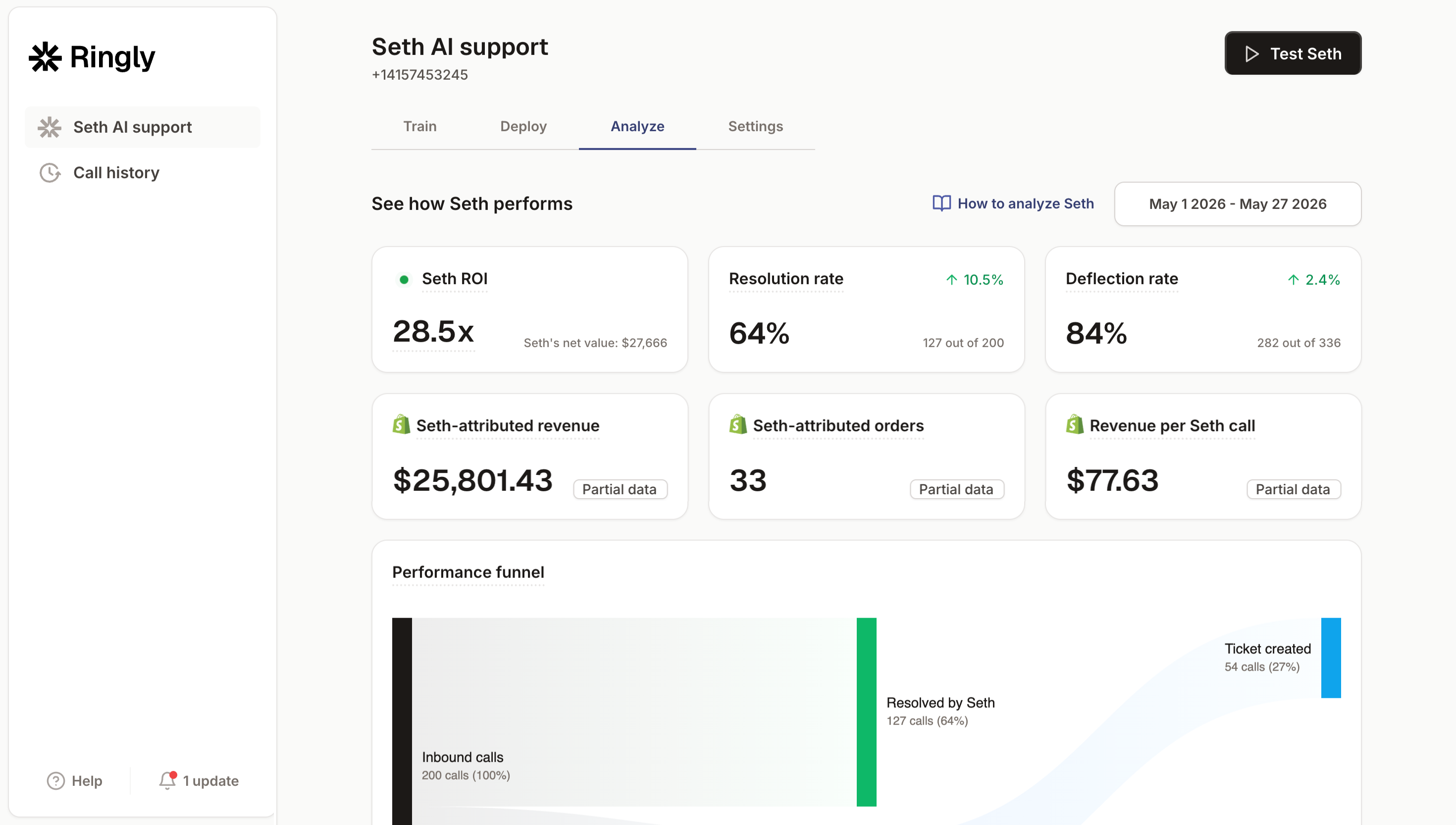
BioLongevity Labs, a supplement brand on Ringly, hits 79% of its calls autonomously. That's the routine pile resolved end to end, leaving the reps the calls that genuinely need a person.
One thing the logs make obvious: the volume isn't flat. It clusters. Charge day spikes WISMO and subscription calls in a single window, usually a Monday or the first of the month, and it hits whether or not your team is staffed for it. Then the rest piles into the evenings and weekends, when older buyers who waited until after dinner to deal with it finally pick up the phone. A line staffed for the daytime average drops a third of its calls in those two windows. That's not a coverage problem you fix by hiring one more rep, because the next hire is idle most of the week and slammed for two hours on charge day. It's the exact shape an agent is built for, since it costs the same at 2 p.m. and 2 a.m.
The anatomy of the agent: know, do, refuse, escalate
People picture an AI support agent as one thing that talks. It's really four things wired together, and a good supplement agent is only as good as its weakest part. Think of it less as a voice and more as a contract: here's what it knows, here's what it can do, here's what it will never say, and here's exactly when it gets a human.
What it knows
This is the knowledge base, and for supplements it's narrower and stricter than most. Products and SKUs. Ingredients and allergens. Lot numbers and expiration dates. Third-party testing and GMP facts. Your shipping and return policy. The brand's own published usage guidance, word for word, so the agent can read it back without inventing anything.
What it does not contain: anything that sounds like medical advice. The KB is curated, not scraped off the web, so the agent answers from your approved language and nothing else.
What it can do
Knowing isn't enough. The calls that matter need the agent to take an action in your systems, the same way a rep clicking through a dashboard would.
- Look up the order in Shopify and read back status, tracking, and charge date.
- Change the subscription in Recharge or Skio: pause, skip, swap, change frequency, or cancel inside your billing rules.
- Start a return or exchange inside your policy.
- Text a tracking link or a form mid-call with an SMS, so the older caller who can't find the email gets it on the phone.
Those last two are the difference between an agent and an answering machine. An agent that can read an order but can't check status or run a custom action just takes a more expensive message.
What it refuses
The guardrail is the whole game in supplements. The agent has a hard-coded list of things it cannot say, and dosage, interactions, and disease claims are at the top. It will not tell someone how much to take, whether it's safe with their medication, or that the product treats, cures, or prevents anything. More on why that matters in the compliance section.
When it escalates
Anything medical, anything angry, anything the KB can't answer cleanly, goes to a human. Not to a voicemail. The agent transfers the call or drops a ticket into the same Gorgias or Zendesk queue your team already works, with the context attached. You decide where the line sits.
One note on subscriptions, since it's the pile that pays. Recharge bought Skio for $105M in April 2026, so the two biggest subscription platforms now sit under one roof (Dealroom). Whichever you run, the agent should change the sub inside the same cancel-flow rules you've already set up, including the save offers. If you've never mapped your subscription cancel logic, do that before you put any agent on the phone, human or not.
The call nobody designs for: "is it working?"
Here's the one that surprised me. A real share of a supplement line is people who aren't lost, aren't canceling, and don't have an order problem. They're new, they're two or three weeks in, and they want to know if they're supposed to feel something yet.
It's a fair question, and the honest answer is "it depends." Collagen takes 4 to 6 weeks for skin hydration, 6 to 8 for visible skin changes, and 3 to 6 months for joints (Momentous). Magnesium, probiotics, ashwagandha all have their own curves. A new subscriber who expected results in week one and got nothing is exactly the person who cancels in week four, right before the product would've started working.
That call is a retention moment disguised as a support call, and most lines treat it like a nuisance. A human rep, under-trained and rushed, either over-promises ("oh you'll feel it any day now") or under-delivers ("I'm not a doctor, sorry"). One creates an FDA problem. The other loses the customer.
A well-built agent handles it cleanly. It reads back the brand's own published usage guidance and the typical timeline the brand itself states, sets a realistic expectation, and reassures without promising an outcome or naming a benefit the brand can't claim. If the caller wants more than the guidance covers, it offers to flag them for a human follow-up. The customer feels heard, the brand stays compliant, and the sub survives week four. That's worth more than the call costs, because a single retained supplement subscriber is $300 to $600 in twelve-month value (Foundry CRO benchmarks).
Keeping it compliant without making it useless
Supplements live under DSHEA, which draws a bright line. You can make structure/function claims ("supports bone health") with the required disclaimer. You cannot make disease claims, the words "treats," "cures," "prevents," or naming a condition, or the FDA treats your product as an unapproved drug (FDA / Congressional Research Service). The most common warning-letter trigger is a disease claim dressed up as a structure/function claim, plus drug-like dosage language.
A human rep can break that rule in a single sentence on a Tuesday afternoon and you'd never know. A configured agent can't. The banned-phrase list is hard-coded. It physically won't tell a caller the product cures their reflux or how many capsules to take for a specific condition. Dosage and interaction questions route to a human or to your licensed source. Allergen and lot-number questions get answered straight from the approved KB, which matters given the FDA finalized new food-allergen guidance in 2025 (Covington).
So the guardrail isn't a limitation. It's the feature. The thing that makes a supplement founder nervous about AI on the phone is the same thing that should make them nervous about a new rep who hasn't been trained yet, except the agent never has a bad day and never improvises. Done right, this is how a supplement brand on Shopify keeps a phone line live without taking on health-claim risk.
"My customers also feel like it's a normal person. They feel like they can communicate if they have questions."
Claudia Droge, TechCraft Studio
That last part matters more for supplements than anywhere, because the older demographic that drives your call volume is the same group most likely to bail the second they think they're talking to a robot.
Build it yourself or buy a done-for-you agent
You have two real paths. Stitch the agent together yourself, or have someone build and run it for you. Both work. They cost very differently in places that don't show up on an invoice.
The DIY path means picking a platform like Vapi or Retell AI, wiring up speech, language, and voice providers yourself, then building the Shopify and Skio actions, the compliance guardrails, and the escalation rules from scratch. The per-minute price looks cheap. Retell lists around $0.07 a minute, but the real cost climbs toward $0.33 once you add the underlying services, and Vapi is bring-your-own-keys, so you're managing a multi-vendor stack (Softcery pricing breakdown).
The part nobody tells you is the tuning. Production builders report rewriting their system prompts hundreds of times across an eight-month run, because the defaults are tuned for demos, not real conversations (RoboRhythms).
| Build it yourself | Done-for-you agent | |
|---|---|---|
| Time to live | 2-4 months, if you have an engineer | About 14 days |
| Who tunes it | Your team, forever | The vendor |
| Compliance guardrails | You build and own them | Built in, maintained |
| When a call goes wrong | Your problem to debug | The vendor fixes it |
There's a second cost to the DIY route that's specific to supplements: the guardrail is the hard part, and it's the part the platforms don't ship for you. Vapi and Retell give you a voice and a way to call an API. They do not give you a compliance layer that knows "treats" is a banned word, that dosage routes to a human, that the usage-guidance answer has to come from your approved copy and nothing the model invented. You build that. And you keep building it, because every time you add a product or change a policy, the guardrail has to keep up. A done-for-you agent owns that maintenance, which on a regulated product is most of the actual work.
If you have a spare engineer who finds voice AI fun, build it. If you have a support line bleeding subscribers tonight, buy it. Most $10M-$100M supplement brands don't have an idle engineer, and the ones who try the DIY route usually end up running a half-tuned agent they're afraid to leave on after hours, which defeats the entire point of putting an agent on after-hours calls.
What it costs vs what you're paying now
Run the numbers against your current team, not against the per-minute price. A typical $30M supplement brand runs a 5-rep CS team plus a couple of part-timers for the weekend subscription rush:
| Line item | Today | With Ringly |
|---|---|---|
| 5 reps × $4K loaded | $20,000/mo | n/a |
| 2 part-time @ $2K | $4,000/mo | n/a |
| Ringly (~$5K/mo) | n/a | $5,000/mo |
| Net monthly CS spend | $24,000/mo | $5,000/mo |
| Monthly savings | n/a | $19,000/mo |
| Annual savings | n/a | $228,000/yr |
That's the 70-80% repeatable pile (auto-ship status, subscription changes, product facts) routed to the agent, while your reps keep the calls that need a human. WashCo, a Shopify brand we launched, recovered $22,664 in its first 7 days on the phone. The savings shape is what carries it, though, not any single revenue number.
Want to see what your own line would do? Book a 30-min call and we'll compare it to your current setup and do the math live on your real call volume.
Going live without ripping out your stack
The fear is always "this is a six-month integration project." It isn't, and it shouldn't be. The agent sits in front of the helpdesk you already run, it doesn't replace it. You keep your phone number, your Gorgias or Zendesk queue, and your Recharge or Skio billing exactly as they are.
A realistic launch runs about two weeks. Week one is the KB and the guardrails: load your products, your policies, your usage guidance, your banned-phrase list. Week two is the live calls and the tuning, with a human reviewing transcripts before anything runs unsupervised after hours. You decide what the agent handles and what it escalates, and you can move that line any day. You can be live in under 1 hour, and Pay per call ships with a 65% resolution guarantee. Supplement brands tend to start by pointing the after-hours and weekend volume at the agent first, then expand once they trust it on the renewal-day spike.
For the deeper vertical context, our supplements industry page and health and wellness page walk through the setup in more detail.
Frequently asked questions
Can an AI support agent change a Recharge or Skio subscription, or just take a message? It changes the subscription inside your existing billing rules, the same as a rep clicking through the dashboard. Pause, skip, swap, change frequency, or cancel, all inside the cancel-flow logic and save offers you've already set up. A message-only agent isn't worth deploying on a subscription brand.
Will it answer dosage or "can I take this with my medication" questions? No, and that's by design. Dosage, drug-interaction, and any condition-specific question routes to a human or your licensed source. The agent is hard-coded to never give medical advice.
How does it handle "is it working / when will I feel results" calls? It reads back your own published usage guidance and typical timeline, sets a realistic expectation, and reassures the caller without promising an outcome or making a health claim. If they want more, it flags them for a human follow-up. Handled well, it's one of the strongest retention moments on the line.
Won't my older customers hate talking to AI? The most repeated compliment we hear is "you don't sound like AI," and the older demographic that drives supplement call volume is exactly who that's built for. The agent can also text a tracking link or form mid-call, which helps callers who can't find the email.
Does it replace Gorgias or my helpdesk? No. It sits in front of your helpdesk and escalates the calls that need a person straight into the same Gorgias or Zendesk queue, with context attached. You keep your stack and your workflows.
How does it stay FDA-compliant and avoid health claims? The guardrail is a hard-coded banned-phrase list, so the agent can't say "treats," "cures," or "prevents," and can't give dosage advice. It answers product and allergen facts from your approved knowledge base only, and routes anything medical to a human.
How much does an AI support agent for a supplement store cost? Pricing starts at $99 a month for the first 50 conversations, then $1.99 each, and a done-for-you build for a $10M-$100M brand is priced by call, typically landing around 20% of what your current CS team costs. For a 5-rep team paying $24K/mo, that's roughly $5K/mo to route 70-80% of the volume.
How fast can it go live? About 14 days. Week one loads your knowledge base and guardrails, week two runs live calls with a human reviewing transcripts. It comes with a 65% resolution guarantee: a month under 65% comes back as credit (after 90 days on Pay per call).
Talk to us

If you run a $10M-$100M Shopify supplement brand and your phone goes to voicemail after 6 p.m., a 30-min call is the fastest way to see what the after-hours and renewal-day spikes are costing you.
Our 3 promises.
- Live in under 1 hour. Setup and test calls are free.
- 30-day money back on the $99 plan fee.
- 65% resolution guarantee: if Seth resolves under 65% of your support calls in a month, that month comes back as credit (after 90 days on Pay per call).
Ruben (Ringly co-founder) takes these calls personally.