
Here is the short version for a pet brand weighing an AI support agent.
- An AI customer support agent answers your phone line around the clock, finds the order in Shopify, handles the autoship change, and hands the hard calls to a human. Phone, not just chat, because that's where your upset 9 p.m. caller actually is.
- TechCraft, a Ringly customer, handles 88% of its calls without a human, and the most common thing its customers say is that the agent doesn't sound like AI.
- Built for founders and CX leads at $10M-$100M Shopify pet brands running a paid helpdesk with a visible phone number.
It's 9 p.m. on a Sunday. A pet parent calls because their dog's prescription food was supposed to arrive Friday and the bowl is empty. Nobody picks up. They leave a voicemail nobody will hear until Tuesday, and somewhere between now and then they reorder from Chewy. That call wasn't a support ticket. It was a retention event, and you lost it because the phone rang into the dark.
If you run a $10M-$100M Shopify pet brand and your support line goes to voicemail after 6 p.m., this is the post where we get specific about what an AI support agent does on a pet call, the one call type it should never touch, and how to tell a real agent from a chatbot in a costume. If you'd rather just see your own missed calls, book a 30-min call and we'll pull your last week of after-hours calls live.
What an AI customer support agent actually is (and why it isn't the chatbot you've seen)
Almost every "AI for pet brands" article you'll find is selling a chatbot. A box on your website that recommends a harness and answers a sizing question before someone buys. That's useful. It is also not the thing that loses you customers.
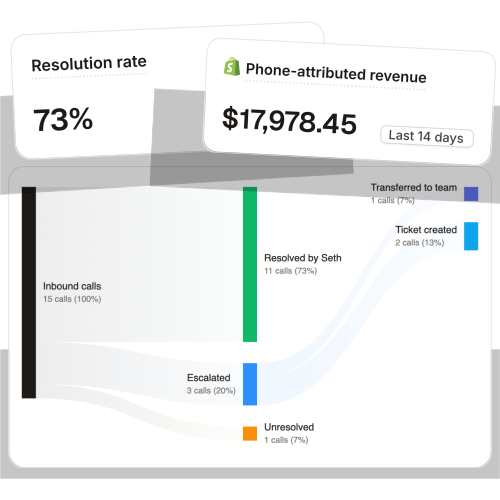
An AI customer support agent, the kind worth paying for, answers your actual phone number. It picks up on the first ring at any hour, pulls the caller's order from Shopify, answers product questions from your knowledge base, makes the autoship change they called about, and transfers anything it shouldn't handle to your team with the full context attached. Ringly is AI phone support for Shopify brands built for exactly this, including a dedicated build for pet brands. Across 50+ active brands the agent resolves up to 90% of inbound calls on its own.
The chatbot catches the curious browser before they buy; the phone agent catches the upset customer who already bought and can't reach you. Those are different jobs, and for a pet brand the second one is where the money lives. A browser who doesn't get a chat reply window-shops elsewhere. A pet parent who can't reach a human about a late prescription shipment churns, and 85% of callers who can't get through never call back, with 62% switching to a competitor, according to PCN's 2026 missed-call study.
Pet ecommerce is big enough that the math matters. The US pet industry hit $158 billion in 2025 and pet ecommerce reached $38.6 billion, up 45.7% since 2020, per the APPA 2025 State of the Industry report. More of those buyers shop online every year, and online buyers call when something goes wrong.
The pet-brand calls an AI agent handles, and the one it shouldn't
I read a stack of real pet-brand call logs to bucket what people actually phone about. It's the same handful of things, over and over, plus a small slice that should always reach a person. Here are the routine calls an AI agent should own.
- Where's my order. WISMO is 30-40% of support tickets in normal periods and over 50% at peak, per Salesforce. For a pet brand selling perishable or prescription food, a late shipment isn't an annoyance, it's an empty bowl tonight. The agent pulls the order from Shopify and gives a real answer, or sends a tracking link by text mid-call. See how Ringly handles order-status lookups and the broader WISMO problem.
- Autoship and subscription changes. This is the one that pays for the whole thing. A subscriber is worth 4-5x a one-time buyer, and a cancel call is a decision about 8 to 18 more orders. The agent can pause, skip the next box, change frequency, or swap the recipe instead of just processing the cancel. Online pet retailers churn around 18% a year and roughly 30% of that traces to poor post-purchase support, per Ringly's pet ecommerce data. Use custom actions to wire the agent into your subscription app.
- Feeding and dosage questions. "How much for a 60-pound dog?" "Can I mix this with kibble?" These get answered straight from your product data through the knowledge base, not from anything the agent makes up.
- Diet transition and allergy questions. "Is this safe for a dog with a chicken allergy?" The agent answers what's on the label and the product page, and stays in its lane. 92% of pet owners say a fast response is very important when they're choosing where to buy, and a careful, instant answer here is a sale you'd otherwise lose to silence.
- Pre-purchase education. Breed and life-stage questions, the "can dogs really eat plant-based?" conversation. Brands like The Farmer's Dog and BarkBox built whole funnels on this kind of guidance. The agent handles the repeatable version so your team isn't explaining the same thing forty times a day.
The one call type the agent should never handle: a grieving pet parent. Sick pet, end-of-life, a recall scare, anything clinical. Chewy became a category legend for sending flowers when a customer's pet died, a moment that earned hundreds of thousands of shares. You do not let software near that. A real agent is built to recognize those calls and get out of the way fast.
What the agent actually sounds like on a pet call
The fastest way to understand the difference between an agent and a chatbot is to listen to one work. Here's a real-shaped autoship call, the kind that runs all weekend.
A customer calls Saturday morning: "Hey, I need to push my next box, we're traveling and the bag will just sit on the porch." The agent pulls her subscription, confirms the dog's name and the recipe, and offers to skip the next delivery or move it out two weeks. She picks two weeks. The agent makes the change, reads back the new date, and texts her a confirmation before she hangs up. No hold music, no "let me transfer you," no Monday-morning callback. That whole call is 90 seconds and it saved a subscriber who, on a worse day, would have just hit cancel.
The skill isn't talking, it's knowing the boundary of what to do and what to escalate. Now flip it. Same Saturday, different caller: "My dog threw up after the new food, is something wrong with the bag?" The agent doesn't diagnose anything. It recognizes the safety trigger, says it's getting a person who can help, and warm-transfers to your team with a note already attached. One call it owns end to end. The other it hands off in seconds. That split is the entire design.
This is also where "you stay in control" stops being a slogan. You write the rules for what the agent says, what it never says, and exactly which words force a human. A pet brand running Gorgias keeps that helpdesk and its workflows. The agent just sits in front of the phone line and feeds the hard calls in with context.
How I evaluated AI support agents for pet brands
I'm Ruben, co-founder of Ringly. Before writing any of this, I called the published support lines of a dozen pet brands after 7 p.m. on a weeknight and timed what happened. Most rolled straight to voicemail. A couple rang out. One had a human, in another time zone, who couldn't see the order. That's the baseline an AI agent is competing against, not some perfect support team.
Then I scored agents against the workflow of a real pet brand, not a feature checklist:
- Shopify order lookup. I connected a test store, placed an order, then called and asked where it was. Did the agent find it and answer, or stall?
- A feeding-safety question. I asked "is this safe for a dog with allergies?" to see whether it answered from product data or improvised something it shouldn't.
- A grief trigger. I said the words a heartbroken customer would say, to confirm the agent escalated to a human instead of trying to comfort me with a script.
- An autoship change. I called to swap a recipe and skip a box, the highest-value routine call a pet brand gets.
- Its own after-hours line. I called each agent the way a customer would, at night, to hear whether it actually picked up and whether it sounded like a person.
The agents that passed all five were the ones built and run for you, not handed to you as software to configure. That distinction matters more than any single feature.
Why the escalation design is the whole game for pet
For most verticals, escalation is a footnote. For pet, it's the feature.
The value of an AI support agent for a pet brand isn't that it handles everything, it's that it handles the routine 90% so a human is free and present for the 10% that actually matter. Grief calls. A sick-pet question. A recall. The agent should detect trigger words ("my dog is sick," "passed away," "vet," "allergic reaction") and do a warm transfer to your team with the call context attached, never attempt to handle them itself. Ringly's smart call transfer is built for exactly this handoff.
"My customers also feel like it's a normal person. They feel like they can communicate if they have questions."
Claudia Droge, TechCraft Studio
There's a structural reason this beats a human-only team, too. Pet food recalls hit three to eight times a year and they come without warning. You can't staff a phone team for a spike you can't predict, but an AI agent absorbs a recall-day call surge without a single new hire and without the queue blowing out. Same logic for the after-hours and weekend volume that a small pet team can never fully cover. 24/7 phone coverage stops being a staffing problem.
What an AI support agent costs a pet brand vs a CS team
Pet brands don't run high steady call volume. They get weekend spikes, recall surges, and emotionally heavy calls. Here's the typical shape.
| Line item | Today | With an AI agent |
|---|---|---|
| 3 weekday reps × $4K loaded | $12,000/mo | n/a |
| 1 weekend rep × $4K loaded | $4,000/mo | n/a |
| AI support agent | n/a | ~$3,000-$5,000/mo |
| Monthly support spend | $16,000/mo | ~$4,000/mo |
| Net monthly savings | n/a | ~$11,000-$12,000/mo |
| Annual savings | n/a | ~$132,000/yr |
That's the routine WISMO, autoship, and feeding calls routed to the agent. The emotional calls still go to your team, who now have time to actually be human on them. TechCraft, a Ringly customer, handles 88% of its calls without a person. Replacing even one burnt-out rep runs $14,113 on average per Insignia's research, so the case rarely comes down to the subscription price.
On a per-call basis the gap is wide: $1.99 a call after the first 50 with the AI agent versus $7-$16 per call through a human BPO, and about $2.70 for an in-house rep. If you want to see your own numbers instead of these, book a 30-min call and we'll do the math on your actual call volume.
The pet objection I hear most is "we only get 20-30 calls a day, is this worth it?" Fair question. But for a pet brand the value isn't volume, it's what each call is worth. One saved autoship is 8-18 more orders. One missed grief call is a Reddit post. Read more on pet retention economics if you want the full picture.
How to choose an AI support agent for your pet brand
A few things separate the agents worth your time from the ones that'll embarrass you.
- Choose phone-first if your customers call. Older and rural pet-owner demographics call more than they chat. If most of your hard moments happen on the phone, a chat-first tool is solving the wrong channel.
- Choose done-for-you over DIY. A pet brand should not be building and tuning prompts. The agents that work are the ones where someone builds it, reviews real calls weekly, and owns the result.
- Make sure escalation is rule-based, not vibes. You want to hard-code the trigger words that force a human handoff. Ask any vendor to show you exactly how a grief call routes.
- Check the integrations you actually run. Shopify is the baseline. Your autoship app and your helpdesk matter too. If you run Gorgias, the agent should sit in front of it and escalate cleanly, not replace it.
- Mind two real setup gotchas. If your order numbers start with a letter, confirm the order-lookup action handles non-numeric prefixes. And know that knowledge bases refresh on a schedule, so live stock counts need a custom action, not the standard KB.
- Get a resolution guarantee in writing. Ringly guarantees 65% resolution: if Seth resolves under 65% of your calls in a month, that month comes back as credit (after 90 days on Pay per call). That's the line that separates a vendor from a partner. If you want the full picture of the AI support phone agent for Shopify and how pricing works, both are worth a look before you call.
The fastest way to judge an agent is to call its demo line yourself and ask it the messy questions your customers ask. If it sounds like a phone tree, walk away. Compare it against your current setup on a call and we'll be honest about where we don't fit.
Frequently asked questions
What's the difference between an AI support agent and a chatbot for a pet brand?
A chatbot answers typed questions on your website, usually before a purchase. An AI support agent answers your phone line, finds orders in Shopify, makes account changes, and escalates to a human. For pet brands, the phone is where the emotional, retention-critical calls land, so the agent is the higher-stakes tool.
Will the AI handle an emotional call, like a sick pet or grief, the right way?
No, and that's by design. A good agent is built to recognize grief and clinical trigger words and warm-transfer the call to your team immediately, with full context. It handles the routine 90% so your humans are free for the calls that need a person.
We only get 20-30 calls a day. Is an AI support agent worth it?
For pet brands, value comes from what each call is worth, not the count. A saved autoship is 8-18 more orders, and a missed after-hours call is a lost customer. If your volume is genuinely tiny, a starter plan makes more sense than an enterprise build, but the after-hours coverage usually pays for itself.
Can it manage autoship and subscription changes?
Yes. Through custom actions the agent can pause, skip the next box, change delivery frequency, or swap the recipe instead of just processing a cancel. That's the single most valuable call type a pet brand gets.
Will customers know they're talking to AI?
Most don't, and the most common thing customers say after a call is that it didn't sound like AI. You stay in control of the voice, the script rules, and what the agent will and won't say.
Does it work with Gorgias, Shopify, and my helpdesk?
Yes. The agent pulls from Shopify and escalates cleanly into Gorgias, Richpanel, Reamaze, or whatever helpdesk you already run. It sits in front of your stack, it doesn't replace it.
How much does it cost, and is there a guarantee?
Pricing is $99 a month for the first 50 conversations, then $1.99 each. Pay per call carries a 65% resolution guarantee: if Seth resolves under 65% of your calls in a month, that month comes back as credit (after 90 days on Pay per call).
Talk to us

If you run a $10M-$100M Shopify pet brand and you're losing calls after-hours, a 30-min call is the fastest way to see what your phone line is leaving on the table. We'll pull your recent missed calls, bucket them the way we did above, and show you which ones an agent would have caught.
Our 3 promises.
- Live in under 1 hour. Setup and test calls are free.
- 30-day money back on the $99 plan fee.
- 65% resolution guarantee: if Seth resolves under 65% of your support calls in a month, that month comes back as credit (after 90 days on Pay per call).
Ruben (Ringly co-founder) takes these calls personally.