
Handling a pet brand's calls is a sorting job, not a staffing one. There are only five kinds of call your line gets, and each one wants a different rule.
- Route the routine 70-90% (where's my order, subscription edits, feeding questions) to 24/7 coverage so nothing rolls to voicemail.
- Hard-route the emotional 10% (grief, illness, recall fear) to a human, every time, on trigger words.
- Built for founders and CX leads at $10M-$100M Shopify pet brands with a visible phone number.
The U.S. pet industry hit $158 billion in 2025 and is projected to clear $165 billion in 2026, with 95 million pet-owning households placing the orders (APPA). Your share of that doesn't arrive as a tidy queue. It arrives as a phone that rings at 8 p.m. on a Saturday with a customer who wants to skip next month's autoship, and then rings again twenty minutes later with someone whose dog just died.
Same line. Two completely different calls. If you're a founder or Head of CX at a Shopify pet brand doing $10M-$100M, you already know the problem isn't how many calls you get. Pet brands don't get the volume a supplement brand does. The problem is that every call carries different stakes, and you're staffing one team to cover all of them.
I read through pet-brand call logs to write this, and the calls sort into five repeatable types. Once you see them, handling the phone stops being a headcount question and becomes a routing question. If your line goes to voicemail after 6 p.m. and all weekend, book a 30-min call and we'll map your call types and where each one should go.
In this post:
Pet calls aren't a volume problem. They're a routing problem
Most advice on pet phone support starts in the wrong place. It tells you to answer faster, or staff longer hours, or outsource to an answering service. That's a volume frame, and volume is rarely the pet brand's real issue.
A pet brand can get thirty calls a day and still have a phone problem, because the stakes per call are higher than the count suggests. Sixty percent of pet owners prefer brands that give them personalized service, and 92% say fast response is "very important" when they pick where to buy (Working Solutions). A pet parent who can't get a person on a subscription question doesn't just churn off the order. They tell other pet parents.
So the right question isn't "how do we answer more calls." It's "which call goes where." Sort the calls by type, give each type a rule, and the phone stops being a thing your team dreads.
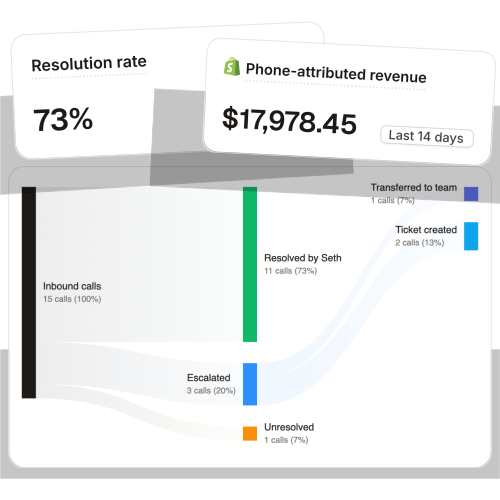
Here's the reframe in one line. The routine calls (order status, subscription edits, feeding questions) don't need a human at all. The hard ones (grief, illness, recall fear) should always get one. The whole job is building the wall between those two groups so neither one leaks into the other.
The five calls every pet brand gets, and the rule for each
When you actually listen to a pet brand's phone line, the calls aren't infinite. They cluster into five types. Here's the map, with who should handle each and the rule that makes it work.
| # | Call type | What it sounds like | Share of volume | Who handles it | The rule |
|---|---|---|---|---|---|
| 1 | Where's my order | "it says delivered but it's not here" | 20-40% | AI, 24/7 | Pull the live Shopify order and tracking, text the link |
| 2 | Subscription edit | "skip next month, swap to the senior food" | high in pet | AI (custom action) | Verify the customer, make the change, confirm by SMS |
| 3 | Product / feeding question | "is this safe for a dog with a chicken allergy" | steady | AI from your KB | Answer from product data only, never give vet advice |
| 4 | Grief / illness / end-of-life | "my dog passed, please cancel" | ~5-10% | Human, always | Hard handoff on trigger words, warm transfer |
| 5 | Recall / safety spike | "is my batch part of the recall" | bursty, 3-8x a year | AI front line, human escalation | Scripted recall answer, escalate the scared callers |
Type 1 is the one nobody argues about. Where's-my-order makes up 20-40% of ecommerce support tickets and pushes past 50% at peak (Salesforce). It's pure lookup. There's no reason a pet parent should wait on hold to hear a tracking number a system can read off in four seconds. Wire it to a live order-status lookup and it handles itself.
Type 2 is where pet is different from every other vertical. Pet diets shift as the animal ages, so subscription swaps run two to three times the rate you'd see at a supplement brand. A "skip this month" call you answer in thirty seconds is a saved subscription. A "skip this month" call that hits voicemail is a cancellation you'll find out about next week.
Type 3 is the feeding question, and it's the one operators worry about most because it can sound medical. It usually isn't. "Is this food safe for a dog with a chicken allergy" is a product-data question, answered from your ingredient list, not a vet question. The rule is simple: answer from the knowledge base, never improvise health advice.
Types 4 and 5 are the ones that need a human in the loop, and they get their own sections below. TechCraft Studio, a brand on Ringly, handles 88% of its calls without a human by sorting them exactly like this, then sending the small emotional slice straight to its team.
How I built this routing map
I co-founded Ringly, and we run AI phone support for Shopify brands, which means I spend a lot of time inside real call logs. The five-type map above didn't come from a whiteboard. It came from reading transcripts.
Here's what I actually did to build it:
- I pulled real pet-brand call transcripts and tagged each call by what the customer was actually trying to do, not by how they opened.
- I counted the clusters. Five types covered nearly every call. The long tail (a wrong number, a wholesale question) was tiny.
- I checked the share per type against where the brand's reps were spending their hours. The mismatch was the whole story: reps spent most of their time on types 1 through 3, which don't need a person.
- I stress-tested the grief handoff. I wrote trigger phrases ("passed away", "put down", "my dog is sick", "emergency") and confirmed the call hands to a human before the AI says anything that could land wrong.
- I cross-checked against the pet-specific risk events (recalls, which hit DTC pet food three to eight times a year) to make sure a sudden spike of worried callers didn't break the routing.
The map is only useful because it's grounded in what pet parents actually call about, not what a support tool's marketing page assumes. If your call mix looks different, the rules still apply, you just reweight the volumes.
The grief and illness calls: the one you cannot automate
This is the call pet brands are right to be scared of. A customer's pet has died, or is dying, and they're calling to cancel an autoship of food the animal will never eat. Get that call wrong and you don't just lose the customer. You get a screenshot.
So the rule is the opposite of what most automation pitches tell you. You don't automate the grief call. You build a wall that catches it before any AI gets near it. On a set of trigger words ("passed", "put to sleep", "my dog is sick", "emergency"), the call routes straight to a human with a warm transfer, no script, no upsell, no "is there anything else."
Chewy is the operator everyone in pet points to here. When a customer's pet dies, Chewy reps cancel the order, refund it, and send flowers. One of those stories collected more than 739,000 likes (Today). That moment is exactly why automation in pet has to be designed around protecting the human calls, not replacing them.
The way to think about it: the routine 90% is the reason your team has time to be fully present on the 10% that matter. When your reps aren't buried in tracking numbers, the grief call gets a person who isn't rushing to clear a queue.
"My customers also feel like it's a normal person. They feel like they can communicate if they have questions."
- Claudia Droge, TechCraft Studio
There's a related call that sounds emotional but isn't, and you have to draw the line cleanly. "Is this food okay for my dog's sensitive stomach" is a product question. "My dog has been vomiting since I switched foods" is a health concern, and the AI's only correct move there is to hand off and never play vet. Recalls work the same way: the AI can read the scripted recall answer (which lots affected, what to do), but a customer who's frightened their dog ate a bad batch gets a person.
After-hours and weekends: where pet calls actually live
Here's the cheapest win most pet brands are sitting on. Pull your call log and look at the timestamps. A large share of the calls (and almost all of the emotional ones) land after 6 p.m. and on weekends, when your team is off.
Older pet parents in particular still reach for the phone, and they don't leave voicemails. They call, hit a recording, and hang up. That's a missed subscription edit, a missed WISMO answer, and sometimes a missed grief call that instead becomes a one-star review about how nobody picked up.
The retention math makes this sharper in pet than almost anywhere. Online pet retailers churn around 18% a year, and roughly 30% of that churn traces back to poor post-purchase support (per our pet-food CX research). The after-hours window is where post-purchase support either happens or doesn't. Closing the nights-and-weekends gap is usually the single highest-return change a pet brand can make to its phone line, because that's exactly when the highest-stakes calls come in.
You don't need a night shift to do it. The routine calls that pile up after hours (order status, subscription edits, feeding questions) are the ones 24/7 phone coverage handles without a human, and the emotional ones get logged and escalated to your team first thing.
If you want to see what your own after-hours line is leaking, book a 30-min call and we'll look at your missed calls together.
The subscription-edit call is your highest-LTV call
Of the five call types, subscription edits are the ones with money directly attached. A pet parent calling to pause, skip, or swap is one phone interaction away from either staying on autoship or canceling.
Treat that call as a retention event, not a chore. When someone calls to "skip next month because we're traveling," the right outcome is a clean skip and a confirmation text, not a hold, not a callback promise, not a voicemail. Every one of those calls you handle fast is, in autoship terms, close to a year of customer retention preserved.
One honest note here, because it matters for how you set this up. Subscription pause, skip, and swap aren't a native button in most AI phone tools, including ours. They run as a custom action wired to your subscription app (Recharge, Skio, Stay, whatever you run). It works well, but it's a setup step, not a checkbox, and any tool that tells you otherwise is glossing over the part that actually takes work. If phone-based order-taking is a big part of your volume, know that we don't take payments over the phone either, we send an SMS payment link instead.
What this costs vs handling it with headcount
Let's put real numbers on it. Pet brands don't run a giant CS team, but they do pay to cover the spread of hours and the weekend spikes.
A typical $20M pet brand runs:
- 3 weekday reps × $4,000 loaded per rep = $12,000/mo
- 1 weekend rep × $4,000 loaded = $4,000/mo
- Total: $16,000/mo, with weekends still understaffed
AI phone support at roughly $3,000-$5,000/mo handles the WISMO, subscription, and feeding-question calls (types 1 through 3) on its own, and hard-routes the emotional calls (types 4 and 5) to your team. Net savings land around $11,000/mo, about $132,000/yr, and your weekend customers stop hitting voicemail.
The honest caveat: if you genuinely take fewer than 500 calls a month, you don't need an enterprise build, and a lighter plan or even keeping it manual may be the right call. The economics turn when the routine volume is enough that a person is spending real hours on calls a system could clear. For most $10M+ pet brands with a visible phone number, it is.
How Ringly handles pet brand calls
Ringly.io is AI phone support for Shopify brands. The phone shouldn't be a tax on your support team, so the AI takes the routine inbound calls and your people handle the calls that actually need them.
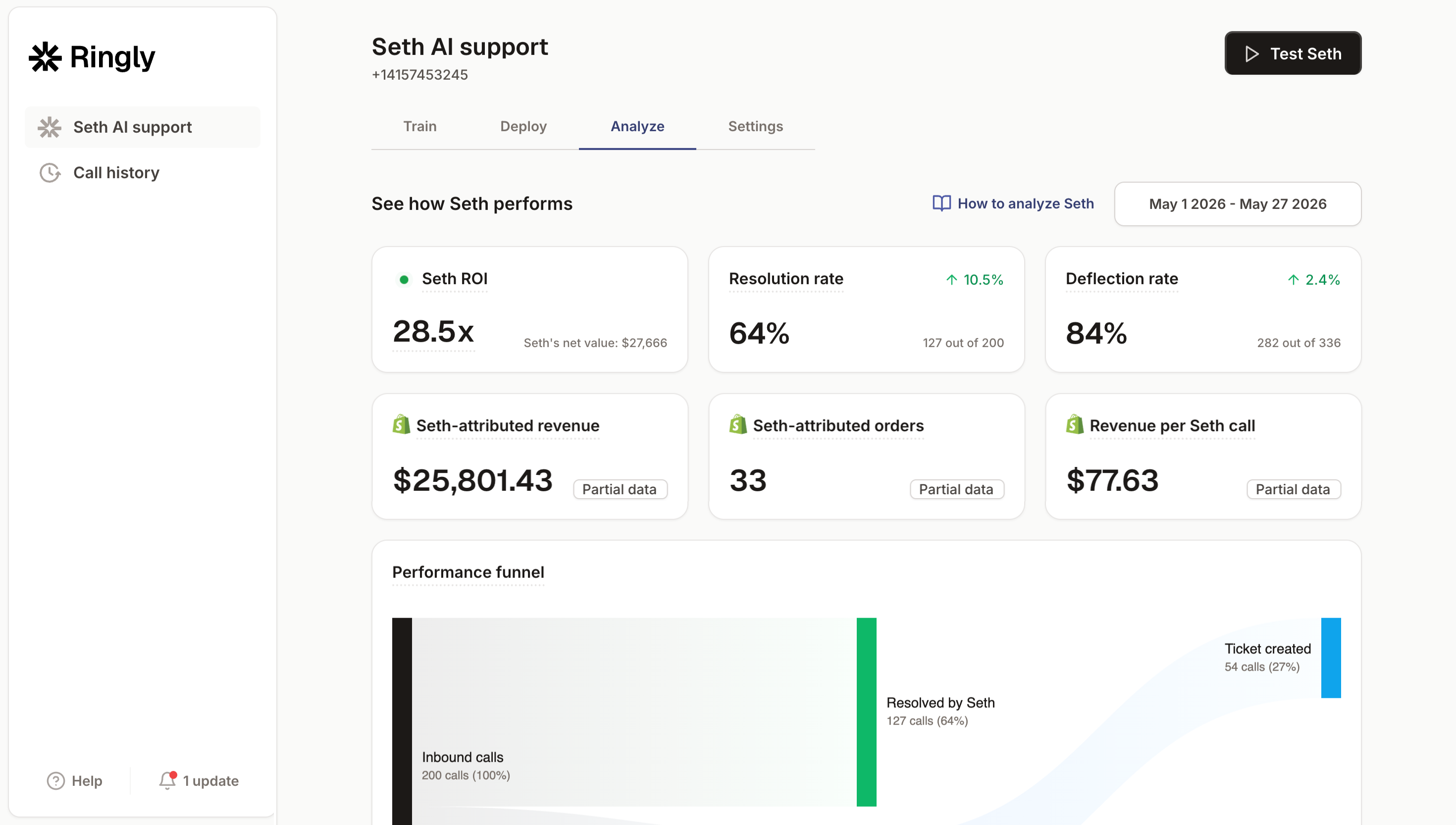
The AI answers inbound calls 24/7. It finds orders in your Shopify store, handles subscription edits as a custom action, answers feeding and product questions from your knowledge base, and cancels orders when a caller asks. It resolves up to 90% of calls autonomously. The grief, illness, and recall-fear calls escalate cleanly to your team, or to Gorgias, Richpanel, Reamaze, or whatever helpdesk you already run.
Pricing: $99 a month for the first 50 conversations, then $1.99 each. Free to try. Live in under an hour. And there's a 65% resolution guarantee: if Seth resolves under 65% of your calls in a month, that month comes back as credit (after 90 days on Pay per call). You can see the full pricing or read how it works on the pets industry page.
If you want the deeper version of this, our guide to customer service for pet brands covers the full channel picture, and pet brand phone support goes deeper on setup.
Frequently asked questions
Should a pet brand automate phone support at all? The routine 70-90% of calls (order status, subscription edits, feeding questions), yes. The emotional calls (grief, illness, recall fear), no, those should always reach a human. The goal isn't to remove people from the phone, it's to free them for the calls that need them.
How do you stop an AI from giving vet advice? With hard rules in the knowledge base. The AI answers product-data questions ("does this food contain chicken") from your ingredient list, and any health-adjacent call ("my dog is vomiting") hands off to a human on trigger words. It's set up to never improvise medical advice.
We only get 20-40 calls a day. Is this worth it? Maybe not, and that's an honest answer. Below roughly 500 calls a month, a lighter plan or manual handling can be fine. The math turns when routine volume is enough that a rep spends real hours on calls a system could clear, which is true for most $10M+ pet brands with a visible phone number.
How are grief or end-of-life calls handled? They route straight to a human. Trigger words ("passed", "put to sleep", "my dog is sick") trigger a warm transfer before the AI handles anything, so a grieving customer always gets a person.
Can it pause, skip, or swap a subscription? Yes, but as a custom action wired to your subscription app (Recharge, Skio, Stay), not a native button. It verifies the customer, makes the change, and confirms by SMS. Worth knowing it's a setup step, not a checkbox.
What happens during a product recall call spike? The AI reads the scripted recall answer (which lots are affected, what to do) so worried callers get an immediate response instead of a busy signal, and it escalates the frightened "did my dog eat a bad batch" calls to your team. That keeps a sudden 3-8x spike from breaking your line.
Does it work with Gorgias or our existing helpdesk? Yes. Calls that need a human escalate cleanly to Gorgias, Richpanel, Reamaze, or whatever you run. You keep your current phone number, helpdesk, and workflows.
How fast can a pet brand get this live? Live in under an hour for the basics. Add your website, docs, and product data and the AI is ready to take order-status and feeding calls. The subscription custom action and grief-handoff rules are part of the setup pass.
Talk to us

If your pet line rolls to voicemail after 6 p.m., that's where your grief calls and your highest-LTV subscription calls both land. A 30-min call is the fastest way to see exactly what your line is leaking and which call types you can route off your team's plate today.
Our 3 promises.
- Live in under 1 hour. Setup and test calls are free.
- 30-day money back on the $99 plan fee.
- 65% resolution guarantee: if Seth resolves under 65% of your support calls in a month, that month comes back as credit (after 90 days on Pay per call).
Ruben (Ringly co-founder) takes these calls personally.