
This post in 30 seconds.
- The "AI support agent" label covers five different jobs: answering, resolving, acting on your backend, routing to a human, and learning from every call. Most tools only do two or three of them well.
- The split that matters most for a Shopify brand is the phone. WISMO alone is up to 50% of inbound calls, and 42% of high-intent post-purchase calls land after 9-to-5.
- Written for founders, COOs, and heads of CX at $10M-$100M Shopify brands who keep a paid helpdesk and a phone number nobody picks up after dinner.
Most of the "AI customer support" content online is about chat. A bubble in the corner of the page that answers a question and routes the rest to a form. That's fine, but it's not where a Shopify brand bleeds money. You bleed it on the phone, where the credit-card-in-hand caller hangs up after 40 seconds of hold music and never comes back.
So when someone asks what AI agents offer for support automation, the useful answer isn't a feature list. It's a map of the five distinct jobs these agents do, how good each one actually is in 2026, and which ones move the number on your P&L.
If you run support at a Shopify brand doing $10M-$100M, the phone is the part of your queue you can't see in your helpdesk dashboard. Those missed calls after-hours don't generate a ticket, so they never get counted. We've launched AI phone agents for 50+ Shopify brands to close exactly that gap. Book a 30-min call and we'll show you what your line is dropping.
The five things AI support agents actually do
Strip away the marketing and every "AI support agent" is doing some combination of five jobs. The reason two tools that both call themselves "AI agents" perform nothing alike is that they're strong on different jobs. Here's the map, with how a modern agent stacks up against the old decision-tree chatbot and a human-only team.
| What it does | Old chatbot | Human-only team | Modern AI agent |
|---|---|---|---|
| Answer (understand intent, pull from KB) | Keyword match, 65-70% accuracy | Best, but slow at peak | Generative, 92% intent accuracy |
| Resolve (close the issue end to end) | Rarely, deflects to a form | Yes | 55-70% on tier-1, autonomously |
| Act (look up an order, trigger a return) | No backend access | Yes | Yes, via API and integrations |
| Route (escalate to the right human, with context) | Dumps to a queue | n/a | Hands over with full transcript |
| Learn (QA, transcripts, resolution data) | None | Manual, patchy | Every call logged and scored |
The 92% intent-understanding number for generative agents (versus 65-70% for keyword bots) comes from Unthread's 2026 accuracy data. That jump in the first row is the whole reason the category got interesting again. The agent finally understands what the customer means, not just which keywords they typed.
A quick honesty note before the deep dive: "deflection" and "resolution" are not the same thing, and the gap between them is where most disappointment lives. More on that below.
How I pressure-tested what these agents really do
I'm Ruben, co-founder of Ringly. We run AI phone support for 50+ Shopify brands, so I evaluate this category constantly, as a buyer and a builder, not a critic.
To write this, I didn't read product pages. I ran the jobs:
- Order lookup. I connected a live Shopify store, pushed a test order through, then called in as the customer and watched whether the agent could find the order, read back the tracking, and offer a return without a human touching it.
- The 11 p.m. test. I called the published support phone line of five DTC brands at 11 p.m. on a Tuesday and logged what answered. Four went to voicemail. One picked up, and it was an AI agent that resolved my fake WISMO question in under two minutes.
- The dashboard data. I pulled resolution numbers from the 50+ brands running on our platform to separate what the agents claim from what they close.
- The hard calls. I ran an angry-customer script and a subscription-cancel request through the agents to see where they break and how cleanly they hand off.
The verdicts below come from running those, not from a spec sheet. Where a job is genuinely hard for AI today, I say so.
Answer: understanding the question and pulling the right answer
This is the job everyone means when they say "chatbot," and it's the one that improved the most. The leap from keyword matching to generative understanding is why a 2026 agent can field "my package says delivered but it's not here" and a 2021 bot couldn't.
The agent listens, figures out the actual intent behind a messy sentence, then retrieves the right answer from your knowledge base or order data. On a phone call that means no menu trees, no "press 1 for shipping." The caller just talks, and a good agent keeps up.
Where it still falls down: a thin or stale knowledge base. The agent is only as good as what you've documented. If your return window lives in a Slack message and not in the KB, the agent will guess, and guessing is how you get the screenshot on Twitter. The fix is unglamorous. Feed it real policies, real product specs, real edge cases. If you want the full picture on how the voice side of customer support works, we wrote that up separately.
Resolve: closing the call without a human in the loop
Answering is the easy half. Resolving is the job that actually saves you payroll, and it's where the honesty gap lives.
Builts AI's 2026 benchmarks put AI-native platforms at 55-70% first-contact resolution, with 65% of tier-1 issues closed without a human. But the same research warns that plenty of deployments deflect 45% of queries while only truly self-serving 14% of them. The difference is whether the agent can finish the job or just punts it to a form with a friendlier face.
"My customers also feel like it's a normal person. They feel like they can communicate if they have questions."
Claudia Droge, TechCraft Studio
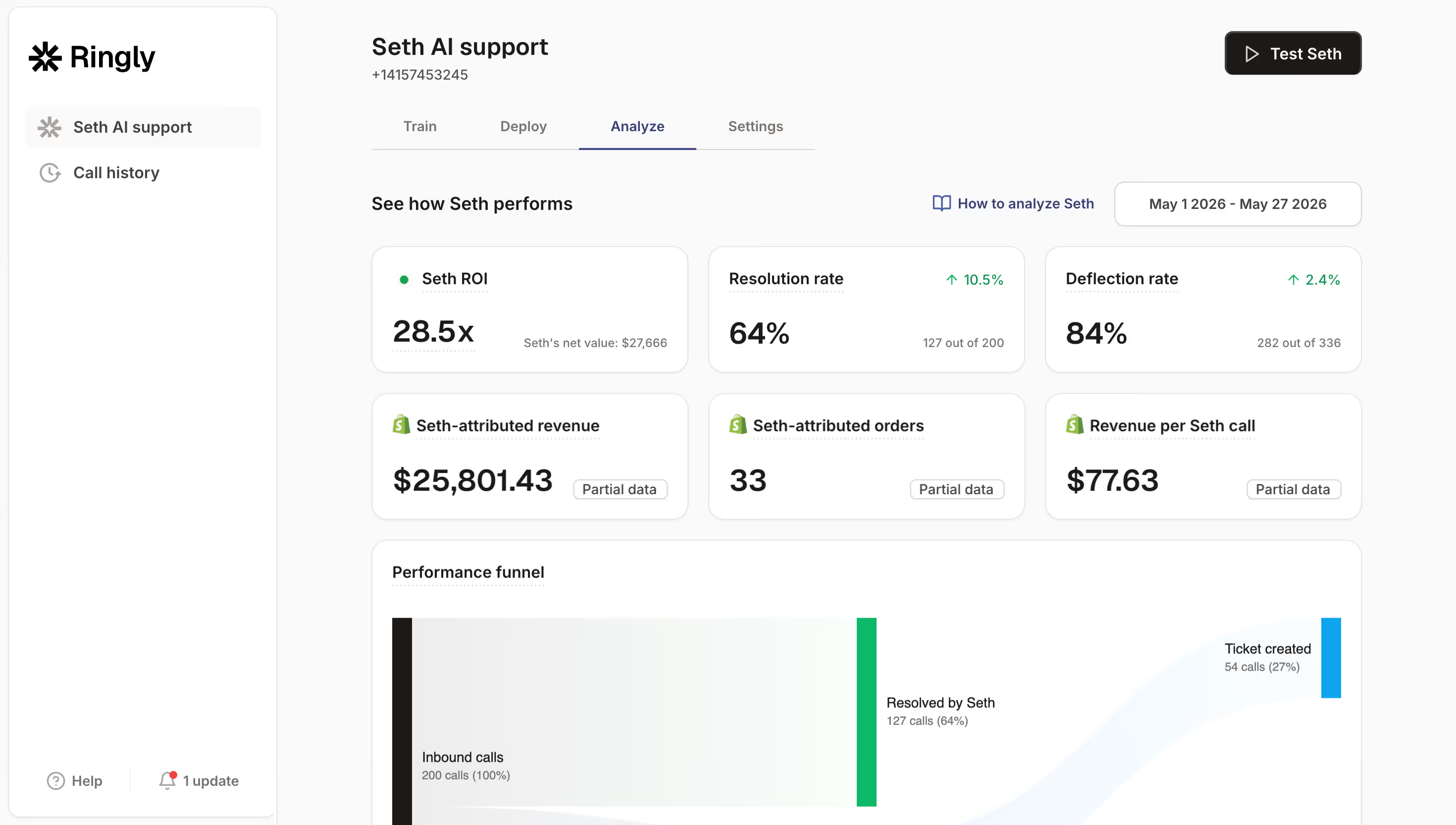
A real resolution rate is the only number worth quoting, because deflection counts the calls you sent away, not the customers you actually helped. Across the brands we run, the AI handles 73% of calls to a real resolution on its own. TechCraft, one of those brands, closes 88% of its calls without a human, and BioLongevity Labs runs at 79% end-to-end. Those are resolutions, not deflections, and the distinction is the whole game.
If your current setup resolves tickets without disappearing the customer into a queue, you're ahead of most. If it doesn't, that's the lever.
Act: taking real actions, and the WISMO wall
This is the line between a chatbot and an agent. A chatbot tells you where your order is. An agent looks it up, reads back the carrier status, and triggers the return label if you want one. It touches your backend systems and changes state.
The single biggest action job in ecommerce is WISMO, "where is my order." Per Salesmate's 2026 data, WISMO runs 20-40% of all tickets and up to 50% of inbound calls. That's the action a good agent should nail cold: pull the order, check live tracking, answer in plain language, and offer the next step. We broke down the WISMO call pattern and how to automate it on Shopify if you want the mechanics.
Beyond WISMO, the action set spans returns, refunds, order edits, and subscription pause-or-skip. The catch is that each action needs a real integration. An agent that "can do returns" in the demo but isn't wired to your Shopify and your returns app will sit there reading policy at the customer instead of solving it.
Here's the part most brands underweight. The phone is where these high-intent action calls cluster, and the phone is where you're losing them. ClearCall's 2026 benchmarks found 42% of high-intent post-purchase calls arrive outside 9-to-5, and 85% of callers who can't reach you never try again. Your helpdesk dashboard can't show you those, because a missed call doesn't open a ticket.
If your phone goes to voicemail after 6 p.m., book a 30-min call and we'll pull your missed-call window so you can see it.
Route: knowing when to hand a human the call
A good agent is judged as much by what it refuses to handle as by what it closes. The brands that get burned by AI support are usually the ones that let the agent fight a call it should have handed off in the first ten seconds.
Clean routing means three things. The agent recognizes the calls it shouldn't take (an emotional call, a legal threat, a one-off the KB doesn't cover). It escalates to the right person, not a generic queue. And it hands over the full transcript so your rep doesn't make the customer repeat themselves.
On the 11 p.m. test, the one brand that answered did this well. When I pushed past its scope, it didn't bluff. It took a callback number and flagged it for the morning. That restraint is a feature, not a failure. An agent that escalates cleanly protects your brand. An agent that bluffs to keep its resolution score up is the one that ends up on social.
This is also the honest answer to the Gorgias and helpdesk crowd: a phone agent isn't there to replace your helpdesk, it sits in front of it and routes the hard calls back to your team with context. We don't pull you off Gorgias or Intercom, we feed them.
Learn: turning every call into data you can act on
The fifth job is the one nobody buys for but everybody needs. Every call gets transcribed, tagged, and scored, so for the first time you can answer the question the founder keeps asking: what's our actual resolution rate, and on which calls?
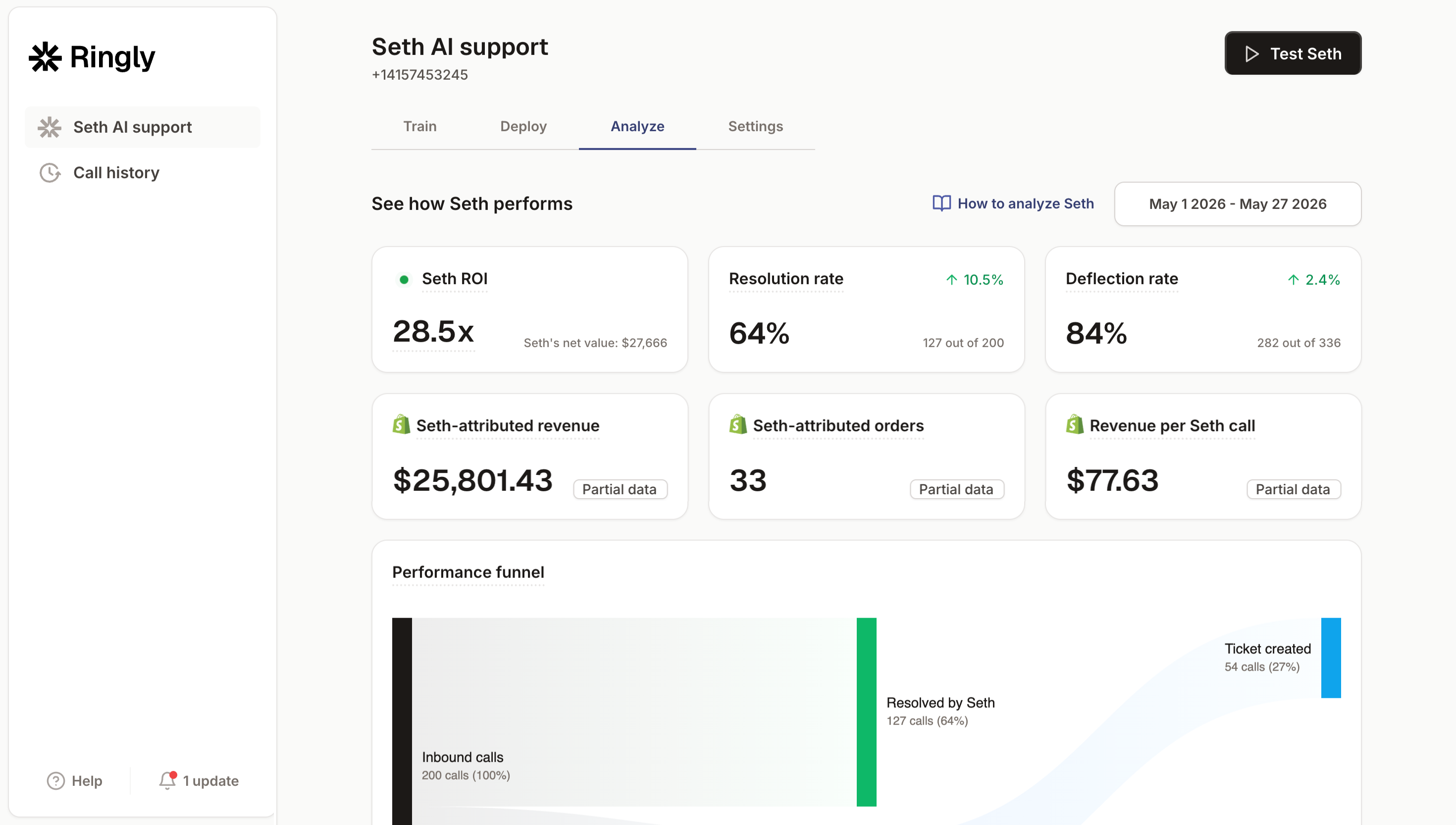
This is where the agent stops being a cost line and starts being an intelligence feed. You see which questions repeat (so you can fix the product page), which calls escalate (so you can train the KB), and which calls drove a sale (so you can attribute revenue to support, not just cost). Gartner notes that improving the customer experience has now overtaken pure automation as the top goal for service leaders, and you can't improve what you can't measure. The learning layer is how the measuring happens.
For a Shopify brand specifically, this is how 24/7 phone coverage stops being a black box. The calls that used to vanish into voicemail now show up as data.
What this costs you today vs with an AI phone agent
Capabilities are abstract until you put them next to payroll. Take a typical $50M Shopify brand running a 6-rep CS team:
| Line item | Today | With an AI phone agent |
|---|---|---|
| 6 reps x $4K loaded per rep | $24,000/mo | n/a |
| AI phone agent (illustrative) | n/a | $5,000/mo |
| Net monthly CS spend | $24,000/mo | $5,000/mo |
| Monthly savings | n/a | $19,000/mo |
| Annual savings | n/a | $228,000/yr |
That's roughly 70% of the repeatable calls (order status, returns, product questions, the same five things over and over) routed to the agent. The other 30%, the genuinely complex calls, still go to your team, who now have time to actually solve them.
The per-call math tells the same story from a different angle. McKinsey's 2026 sample puts an AI resolution at $0.62 versus $7.40 for a human, with voice-AI at $1.18. Across our brands the resolved-call cost runs about $0.42. WashCo, a Shopify brand we launched, recovered $22,664 in its first 7 days on the phone.
Book a 30-min call and we'll run this math on your real team size and call volume, live.
What AI support agents still can't do
Anyone who tells you AI handles everything is selling you the thing that fails in month two. Here's where it still doesn't pencil out, from running this on real stores.
- Truly emotional calls. Grief, a safety issue, a furious customer who needs to feel heard by a person. The agent should recognize these and hand off, not try to win them.
- Subjective fit and feel. "Will this shade match my skin," "does this run small." That's a judgment call a human still owns.
- Real-time inventory. Most setups refresh daily, not live. If your business turns on minute-by-minute stock, flag it early.
- Phone orders end to end. Taking a card number over the phone is a compliance minefield. The clean workaround is an SMS payment link, not the agent reading digits back.
Gartner predicts 20-30% of service agents will be replaced by AI in 2026, but also that half the companies cutting staff will rehire by 2027. The honest read of that is not "AI replaces support." It's "AI absorbs the repeatable 70% so your humans can do the 30% that needs them." A brand that automates the right calls keeps a smaller, happier, better-paid team. If you want the practical version, our integration tips for support automation covers the rollout order.
Frequently asked questions
What's the difference between an AI chatbot and an AI support agent? A chatbot answers questions, usually from a keyword match, and deflects the rest to a form. An AI agent understands intent, retrieves the right answer, and then takes real backend actions like looking up an order or triggering a return. The agent can close the issue. The chatbot mostly hands it off.
What support tasks can AI agents fully automate for a Shopify brand? The repeatable ones: WISMO and order tracking, return and refund requests, product and policy questions, and subscription pause-or-skip. These are 60-80% of most ecommerce volume. The agent handles those autonomously and escalates the rest to your team.
Is deflection the same as resolution? No, and the gap matters. Deflection counts the calls the AI sent away from a human. Resolution counts the customers it actually helped. A tool can post a high deflection number while leaving customers stuck, so ask what share of calls it resolves on its own, not what share it deflects.
Can an AI agent handle phone calls or just chat? Both, but they're different products. Most "AI support" tooling is chat-first. For a Shopify brand the phone is where high-intent, after-hours calls cluster, so a dedicated AI phone agent covers a channel chat tools don't touch.
Will customers know they're talking to AI? Usually they don't mind, and often they can't tell. The most repeated thing customers say after a call on our platform is "you don't sound like AI." The bigger risk isn't that it sounds robotic, it's that it bluffs a call it should have escalated.
How do I know if my brand is ready for this? If you're a Shopify brand doing $10M+ with a visible phone number, a paid helpdesk, and 3-12 reps drowning in repeat calls, you're the fit. If you're under $5M or your support is mostly subjective fit questions, it's early. See our pricing for where the tiers land.
Talk to us

If you run a $10M-$100M Shopify brand and your phone goes quiet after-hours, a 30-min call is the fastest way to see which of these five jobs your current setup is missing, and what that's costing you.
The 3-layer guarantee.
- Live in 14 days or it's free until launched.
- 65% resolution in 90 days or we refund the last 3 months of subscription fees.
- We keep working free until we hit 65%.
Ruben (Ringly co-founder) takes these calls personally.