
Finding the right product can overwhelm online shoppers. When customers face too many options without guidance, they often abandon their purchase entirely.
Guided selling software bridges this gap.
Qonfi has become a popular choice for e-commerce businesses wanting to help customers find the right products through interactive quizzes and recommendations.
But it's not the perfect fit for everyone. Maybe you need something more affordable, or perhaps you want a solution with less setup time.
We've researched and tested the leading Qonfi alternatives to help you find the right guided selling tool for your store.
This comparison covers pricing, features, and use cases so you can make an informed decision.
Editor’s note: Want to hear some sample AI support calls made for your Shopify store?
- Just paste your store URL
- Get sample calls in under 20 seconds (no email required)
- Listen to demo calls for my store
What is guided selling software?
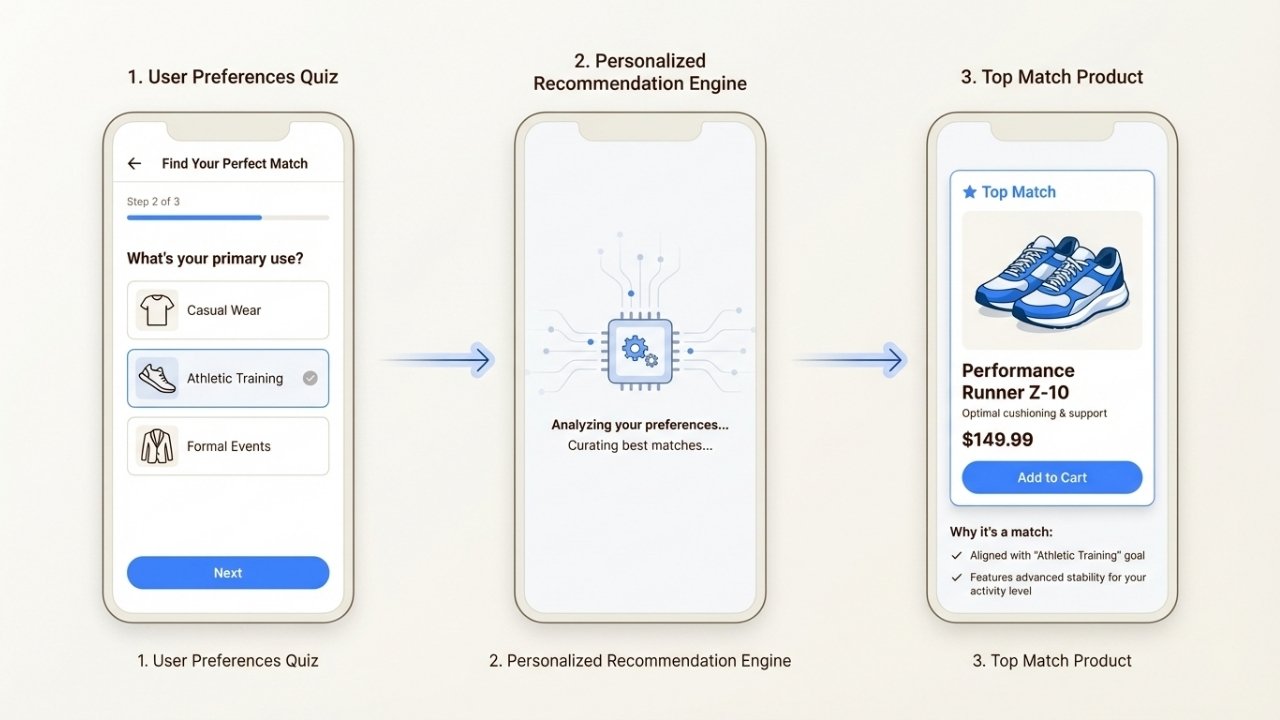
Guided selling software helps online shoppers find the right products by asking them questions about their needs, preferences, and use cases.
Think of it as a digital sales assistant that mimics the experience of talking to a knowledgeable store employee.
Instead of browsing through hundreds of products or trying to decipher technical specifications, customers answer a few simple questions.
The software then recommends products that match their specific requirements.
The benefits are clear: higher conversion rates, reduced return rates, and better customer satisfaction.
When shoppers feel confident about their purchase decision, they're more likely to complete the transaction and less likely to send items back.
Quick comparison: All Qonfi alternatives at a glance
Here's a side-by-side look at the key details for each tool:
| Tool | Starting Price | Best For | Implementation | Free Trial |
|---|---|---|---|---|
| Aiden | $300/month (€285) | Mid-large stores (High-converting UI) | iFrame / One-line JS | Demo on request |
| Outfindo | €99/month | SMBs (Automated data enrichment) | JavaScript snippet | 14 days |
| Zakeke | $29.90/month | Visual 3D & AR customization | JS / Native Apps | 14 days |
| Zoovu | Custom (Annual) | Enterprise (Complex B2B/B2C catalogs) | API / Headless / JS | Demo on request |
| Tweakwise | €350/month | Search & Merchandising power users | JS / API / Hybrid | Yes (Trial available) |
| Simplio3D | $29/month | Budget-friendly 3D configuration | JavaScript / Shopify App | Free tier available |
| Neocom.ai | Custom quote | AI-native "Shop Agent" experiences | No-code integration | Demo / Trial available |
The 7 best Qonfi alternatives
1. Aiden
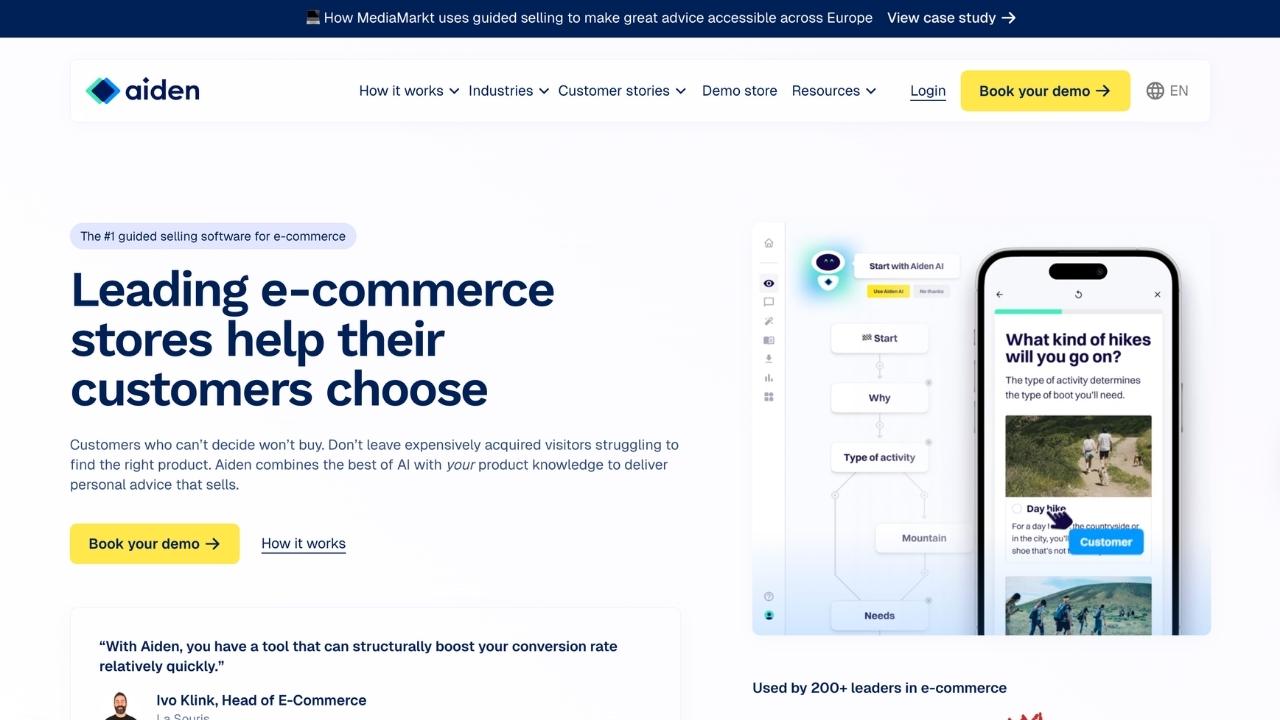
Aiden is a Dutch guided selling platform that has become the most widely used solution in Europe.
Founded by Marja Silvertant, the company grew from a book called "Customers who can't decide, won't buy" into a full-fledged software platform serving major retailers like MediaMarktSaturn.
The platform offers two interaction modes: AI Mode for conversational, adaptive flows and Classic Mode for structured, step-by-step guidance.
This flexibility lets you choose the approach that fits your products and customers best.
Key features include Product Finder for category pages, Product Check for product detail pages, Package Advice for multi-product recommendations, and Profile Enricher for capturing zero-party data.
The platform integrates with Shopify, WooCommerce, Magento, and connects to CDPs like Squeezely and Bloomreach.
Pricing: Aiden no longer displays public pricing, but historical data shows plans starting at €449 per month for the Essential tier (annual contract required).
The Professional plan was previously €799 per month. Source: Aiden
Pros:
- Advanced AI and Classic modes for different use cases
- Strong analytics with Impact Dashboard and GA4 integration
- Extensive European market experience
- 91% completed session rate with 2.5x average conversion increase
Cons:
- Significantly more expensive than competitors (4x Qonfi's price)
- Requires annual contract with no monthly cancellation
- Uses iFrame implementation which can impact SEO
- "Made with Aiden" logo on lower tiers
Best for: Mid to large e-commerce stores with bigger budgets who want advanced features and European market expertise.
2. Outfindo

Outfindo takes a different approach from DIY tools like Qonfi. Instead of requiring you to build your own guidance flows, Outfindo provides ready-made guides based on customer behavior analysis.
The platform uses two proprietary AI agents: Beacon analyzes customer decision-making patterns to create optimal guidance flows, while Diver handles product data management by automatically identifying, gathering, and enriching product information from manufacturers.
This means you simply upload your product feed and Outfindo handles the rest. There's no need to map product properties or create question flows from scratch.
Pricing: Essential plan at €99 per month (200 SKUs, 1 domain), Plus plan at €599 per month (2,000 SKUs, unlimited domains, white-label), and Custom plan for enterprise needs. Source: Outfindo
Pros:
- True plug-and-play deployment with minimal setup
- Automated product data management saves significant time
- Transparent, behavior-based recommendations
- JavaScript implementation (not iFrame) for better SEO
Cons:
- Less customization flexibility compared to DIY tools
- Multi-language support varies by plan
- May not suit businesses wanting full control over question logic
Best for: Businesses wanting quick deployment without technical work or extensive configuration.
3. Zakeke

Zakeke is a visual commerce platform focused on product customization and 3D configuration.
Founded in 2017, the platform now serves over 25,000 active subscribers and has powered more than 70 million personalized products.
Unlike traditional guided selling tools, Zakeke specializes in letting customers customize products visually.
Shoppers can select colors, materials, add text or images, and see their creation in real-time 3D or augmented reality.
The platform includes four main tools: Visual Product Customizer for web-to-print and engraving, 3D Product Configurator for build-to-order products, 3D DAM and AR Viewer for managing 3D assets, and Virtual Try-On for products like eyewear or jewelry.
Pricing: Starter at $68 per month (5 products, 1.9% transaction fee), Grow at $170 per month (25 products, 1.7% fee), Scale at $340 per month (50 products, 1.5% fee), and Enterprise with custom pricing. Source: Zakeke
Pros:
- Most affordable option for visual customization
- Comprehensive 3D and AR capabilities
- Print-ready file automation eliminates manual work
- Integrates with 12+ e-commerce platforms
Cons:
- Transaction fees on every sale (1.5-1.9%)
- Product limits on lower tiers
- Different focus than traditional guided selling (visual vs. advice-based)
Best for: Stores selling customizable products like apparel, home decor, gifts, or any business wanting 3D/AR visualization.
4. Zoovu

Zoovu is an enterprise-grade product discovery platform used by major retailers. The platform combines search functionality, product finders, and chatbots into a comprehensive solution for helping customers find products.
The platform excels at handling complex product catalogs across multiple brands or websites.
You can deploy consistent guided selling experiences across different properties while managing everything from a central dashboard.
Zoovu offers deployment to multiple brands, customer-focused features, and good support from their team.
However, the platform requires technical knowledge to set up and integrate properly.
Pricing: All pricing is custom and requires contacting sales. The platform is positioned as an enterprise solution. Source: Zoovu
Pros:
- Comprehensive platform covering search, finders, and chatbots
- Multi-brand and multi-website deployment
- Strong customer support team
- Scalable for large catalogs
Cons:
- Expensive compared to other providers
- Complex integration process
- Requires technical knowledge to implement
- No public pricing or self-serve option
Best for: Large enterprises with complex product catalogs and technical resources for implementation.
5. Tweakwise

Tweakwise started as a site search and merchandising platform before adding guided selling capabilities.
The platform helps stores optimize search functionality, personalize product lister pages, and stimulate cross-sells and upsells.
The guided selling feature is available as an add-on to the core search platform.
This means you're getting a comprehensive solution that covers multiple aspects of product discovery, not just guided recommendations.
Integration options include JavaScript or API, with extensions available for Magento, Shopware, Shopify, Sana Commerce, and more.
Pricing: Base platform from €395 per month, with guided selling as an additional €375 per month.
Total cost for guided selling functionality starts at €770 per month. Source: Tweakwise
Pros:
- Excellent search functionality as the foundation
- Strong merchandising and personalization features
- Modular approach lets you start with search and add guided selling later
- Good integration ecosystem
Cons:
- Guided selling is an expensive add-on
- Higher total cost than dedicated guided selling tools
- Core strength is search, not product advice
- May be overkill if you only need guided selling
Best for: Stores prioritizing search optimization alongside guidance, or merchants already using Tweakwise for search.
6. Simplio3D
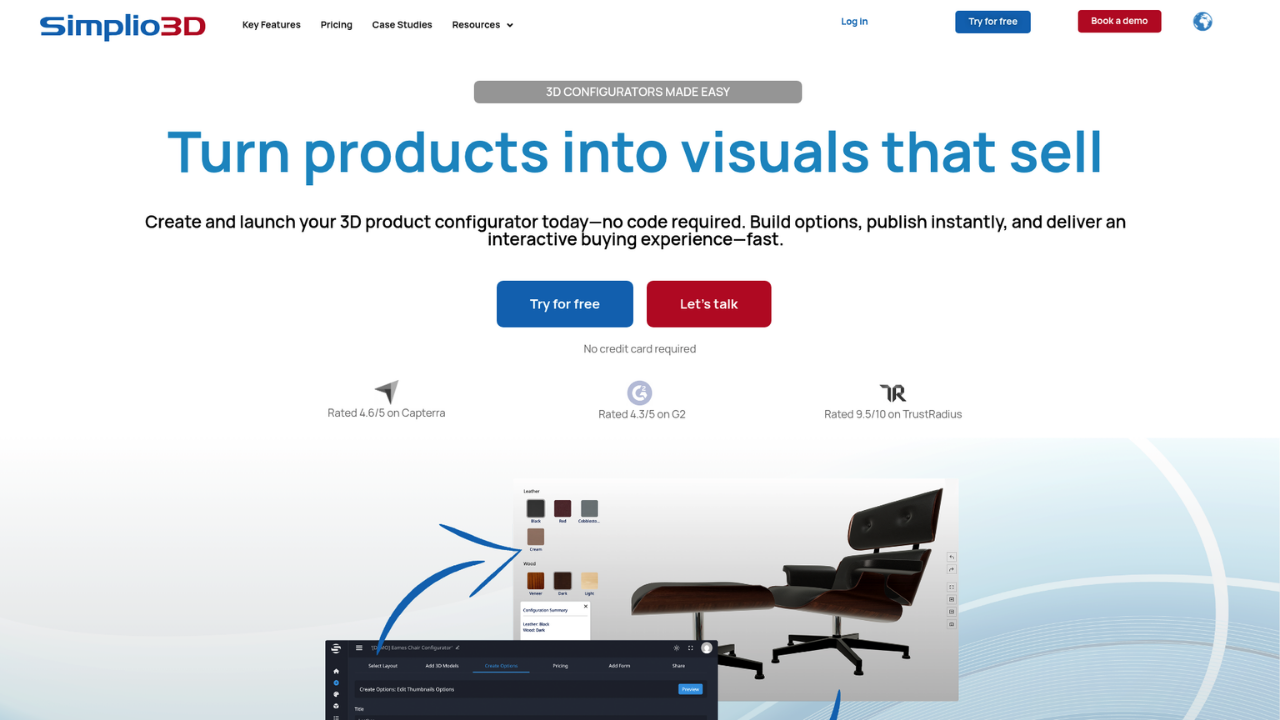
Simplio3D offers an affordable entry point for businesses wanting 3D product configuration. The platform allows customers to customize products visually and see changes in real-time.
The platform allows customers to customize products visually and see changes in real-time.
The no-code approach means you can set up configurators without technical expertise.
The platform handles pricing calculations dynamically as customers make selections, and integrates with popular e-commerce platforms.
While not a traditional guided selling tool, Simplio3D serves a similar purpose for businesses with configurable products.
Customers answer questions through their selections (color, material, components) and see recommended configurations.
Pricing: Starter at $29 per month, Business at $199 per month. Source: Simplio3D
Pros:
- Most affordable 3D configurator option
- No-code setup process
- Real-time pricing calculations
- Good platform integrations
Cons:
- Focused on 3D configuration, not traditional guided selling
- Fewer advanced features than competitors
- Limited to configurable products
Best for: Stores needing 3D product configuration on a budget, particularly for furniture, equipment, or customizable goods.
7. Neocom
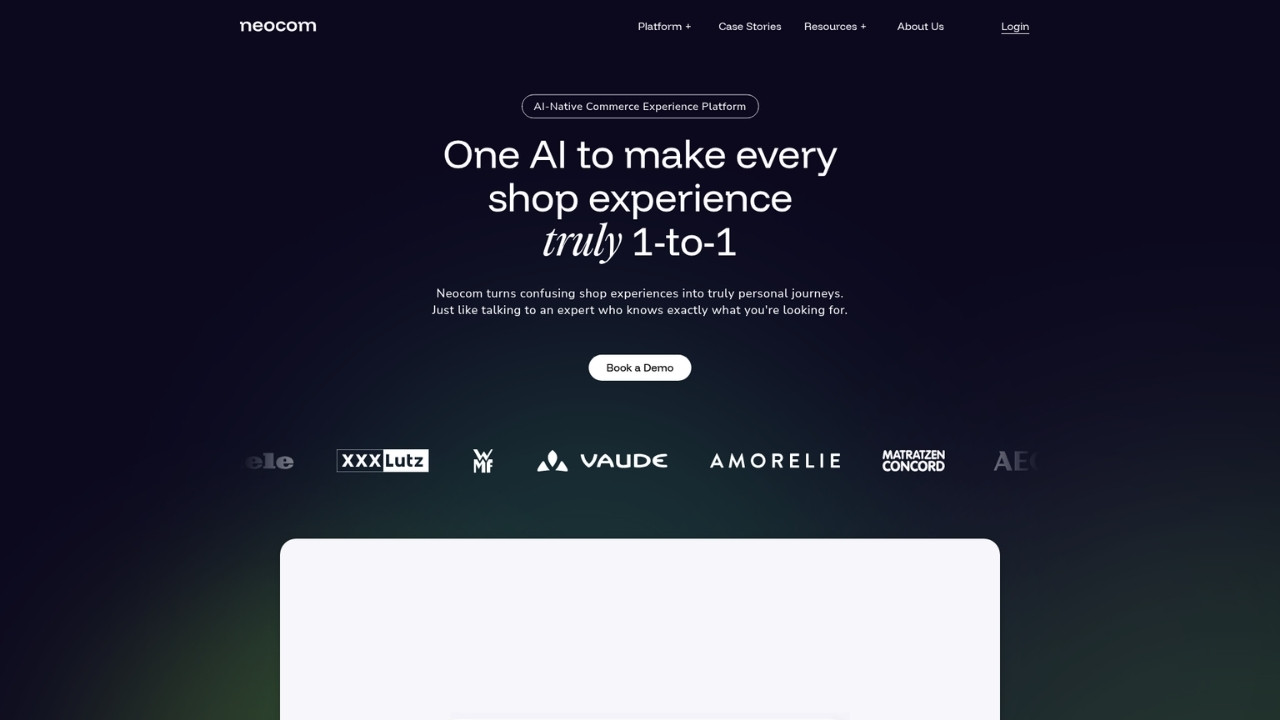
Neocom takes an AI-first approach to product discovery. The platform uses artificial intelligence to create interactive conversations that help customers find the right products while answering their questions automatically.
The system learns from interactions to improve recommendations over time. It can handle product-related questions that would normally require customer service intervention, reducing the load on your support team.
The platform integrates with major e-commerce platforms including Shopify, WooCommerce, and Magento.
Pricing: Custom pricing only, no public rates available. Likely positioned for mid-market to enterprise based on feature set. Source: Neocom
Pros:
- AI-first approach with learning capabilities
- Handles FAQ automatically
- Reduces customer service pressure
- Conversational interface feels natural
Cons:
- No public pricing
- Likely expensive for small stores
- Less transparent than rule-based systems
- May require training period for AI optimization
Best for: Businesses wanting an AI-first approach to product discovery and those looking to reduce customer service load.
How to choose the right guided selling tool
With seven solid options, how do you pick the right one? Here are the key factors to consider:
Budget and pricing model. Look beyond the monthly fee. Some tools charge transaction fees (Zakeke), others require annual contracts (Aiden), and some have custom pricing that may surprise you (Zoovu, Neocom). Calculate the total cost of ownership including setup time and ongoing fees.
Implementation method. Pay attention to how the tool integrates with your site. JavaScript implementations (Qonfi, Outfindo, Zakeke) are generally more SEO-friendly than iFrames (Aiden). Consider your technical resources and whether you need a no-code solution.
Setup complexity. Be realistic about your available time and expertise. DIY tools like Qonfi require significant setup work.
Ready-made solutions like Outfindo get you live faster but offer less customization.
Product type. Match the tool to what you sell. Visual configurators (Zakeke, Simplio3D) work best for customizable physical products.
Advice-based tools (Aiden, Outfindo, Neocom) suit complex product categories where customers need guidance.
Support and documentation. Consider the level of support you need. Enterprise tools typically offer dedicated account managers.
Self-serve tools may rely on documentation and community support.
Which Qonfi alternative should you choose?
The right choice depends on your specific situation:
Choose Aiden if you have the budget for a premium solution and want advanced features with proven European market expertise.
The 2.5x conversion increase and 91% completion rate justify the higher price for many mid to large stores.
Choose Outfindo if you want to get started quickly without technical work. The plug-and-play approach and automated data management save significant time.
Choose Zakeke if you sell customizable products and want the most affordable option with strong 3D and AR capabilities. The print-ready file automation is a major time-saver for made-to-order businesses.
Choose Zoovu if you're an enterprise with complex needs, multiple brands, and technical resources to handle implementation.
Choose Tweakwise if search optimization is a priority alongside guided selling. The combined platform offers good value if you need both capabilities.
Choose Simplio3D if you're on a tight budget but need 3D configuration for your products.
Choose Neocom if you want an AI-first approach and have the budget for a custom solution.
Improve your customer experience beyond product discovery
Guided selling tools help customers find the right products, but what happens when they have questions after purchasing? Ringly.io fills this gap.
the AI, our AI phone support agent, handles inbound customer calls 24/7.
He answers questions about orders, processes returns and exchanges, and escalates complex issues to your team when needed.
With a 73% resolve rate without human intervention, the AI helps you scale support without scaling headcount.
The combination works well: guided selling helps customers choose the right product upfront, reducing returns. The AI handles post-purchase questions, freeing your team to focus on growth. Both tools integrate with Shopify and work together to create a seamless customer experience from discovery to delivery.
Ready to see how AI phone support can complement your guided selling strategy? Start your free trial and see the AI in action.
Frequently Asked Questions
What are the most affordable Qonfi alternatives for small businesses?
For budget-conscious stores, Zakeke at $68 per month and Simplio3D at $29 per month offer the lowest entry points. Outfindo at €99 per month is also competitive if you want a more traditional guided selling approach.
Which Qonfi alternative requires the least technical setup?
Outfindo is the most plug-and-play option, requiring just a product feed upload to get started. The platform handles data management and guidance flow creation automatically.
Do any Qonfi alternatives offer AI-powered recommendations?
Yes, Aiden offers both AI Mode for conversational flows and Classic Mode for structured guidance. Neocom is built entirely around AI for product discovery. Outfindo also uses AI agents for data management and behavior analysis.
Are there Qonfi alternatives that don't use iFrames?
Yes, several alternatives use JavaScript implementation instead of iFrames, including Outfindo, Zakeke, and Tweakwise. JavaScript is generally more SEO-friendly and faster loading.
Which Qonfi alternative is best for stores with customizable products?
Zakeke is the leading choice for customizable products, offering visual customization, 3D configuration, and AR visualization. Simplio3D is a more affordable alternative specifically for 3D configuration.
Can I try these Qonfi alternatives before committing?
Most alternatives offer free trials or demos. Outfindo offers a 30-day free trial. Zakeke has a free trial with no credit card required. Aiden and Zoovu offer demos. Always check the current trial terms on their websites.