

Finding the right product discovery platform can make or break your e-commerce conversion rates.
While Zoovu has built a reputation for enterprise-grade guided selling, many businesses find themselves searching for alternatives due to pricing concerns, integration complexity, or simply wanting a better fit for their specific needs.
Let's look at seven solid options that can help your customers find exactly what they're looking for.
Editor’s note: Want to hear some sample AI support calls made for your Shopify store?
- Just paste your store URL
- Get sample calls in under 20 seconds (no email required)
- Listen to demo calls for my store

What is Zoovu?
Zoovu is an AI-powered product discovery platform that helps e-commerce businesses guide shoppers to the right products through interactive conversations.
Think of it as a digital sales associate that asks questions, understands compatibility requirements, and narrows down options based on customer needs.
The platform excels at handling complex catalogs where product compatibility matters, like camera equipment, power tools, or industrial components.
It uses enriched product data and guided selling flows to ensure customers don't buy the wrong item.
So why look elsewhere? Common reasons include enterprise pricing that scales quickly, technical complexity during implementation, and a learning curve that requires dedicated resources to manage effectively.
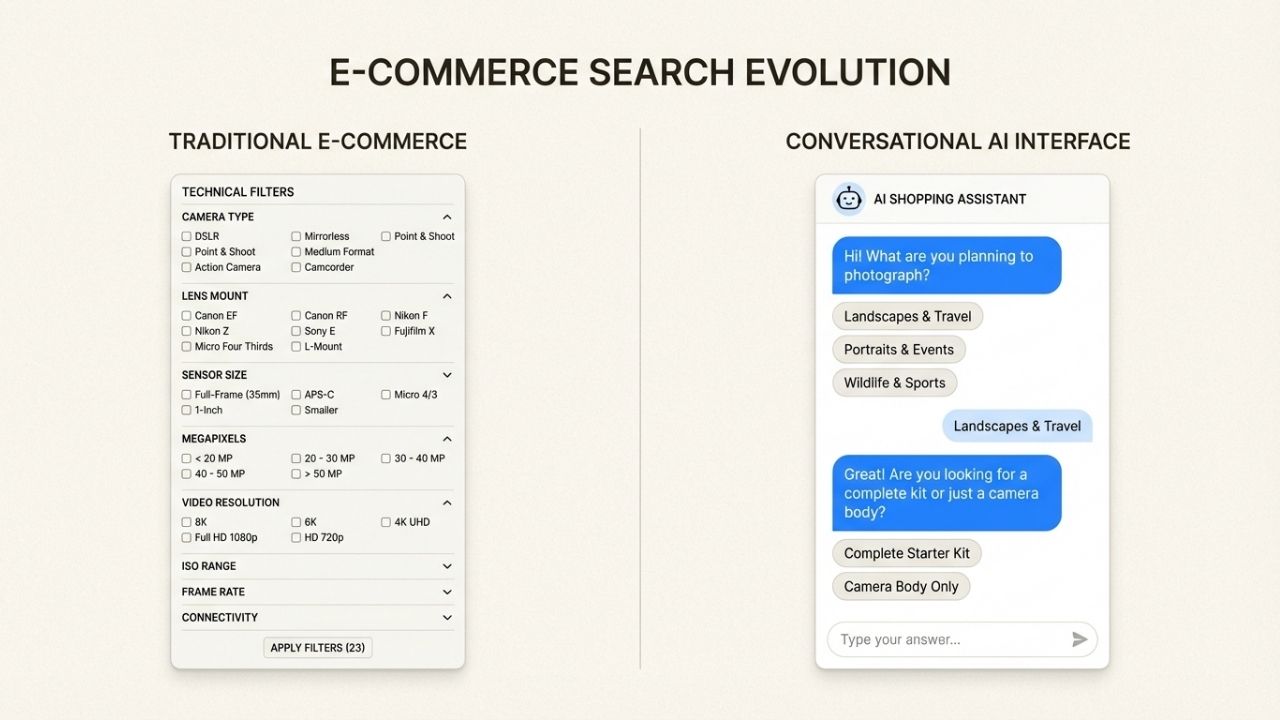
How We Evaluated These Zoovu Alternatives
We looked at platforms across several dimensions that matter to e-commerce teams:
- Ease of use: How quickly can you get a product finder live without engineering resources?
- Integration options: Does it play nicely with Shopify, WooCommerce, Magento, and other major platforms?
- Pricing transparency: Can you understand costs upfront, or is everything "contact sales"?
- AI capabilities: How sophisticated is the recommendation engine?
- E-commerce focus: Is this built specifically for online retail, or is it a generic search tool?
One note: we're including Ringly.io in this list because while it handles a different part of the customer journey (phone support), many businesses evaluating Zoovu are looking at the broader product discovery picture and may benefit from automating phone interactions alongside their digital finders.
Quick Comparison: All 7 Zoovu Alternatives
| Platform | Best For | Pricing Model | Key Differentiator |
|---|---|---|---|
| Aiden | E-commerce guided selling | Custom/Enterprise | 2.5x conversion increase claims |
| Algolia | Developer-led teams | Pay-as-you-go to Enterprise | Speed and customization |
| Constructor.io | Enterprise retailers | Custom | AI-native with transparent reasoning |
| Crobox | Consumer brands | Custom | Psychology-driven insights |
| Luigi's Box | Mid-market e-commerce | Custom (30-day trial) | Highest user ratings |
| Findify | E-commerce personalization | Custom (by catalog size) | Visual merchandising |
| Ringly.io | Phone support automation | $349-$799/month | 73% call resolution rate |
The 7 Best Zoovu Alternatives
1. Aiden
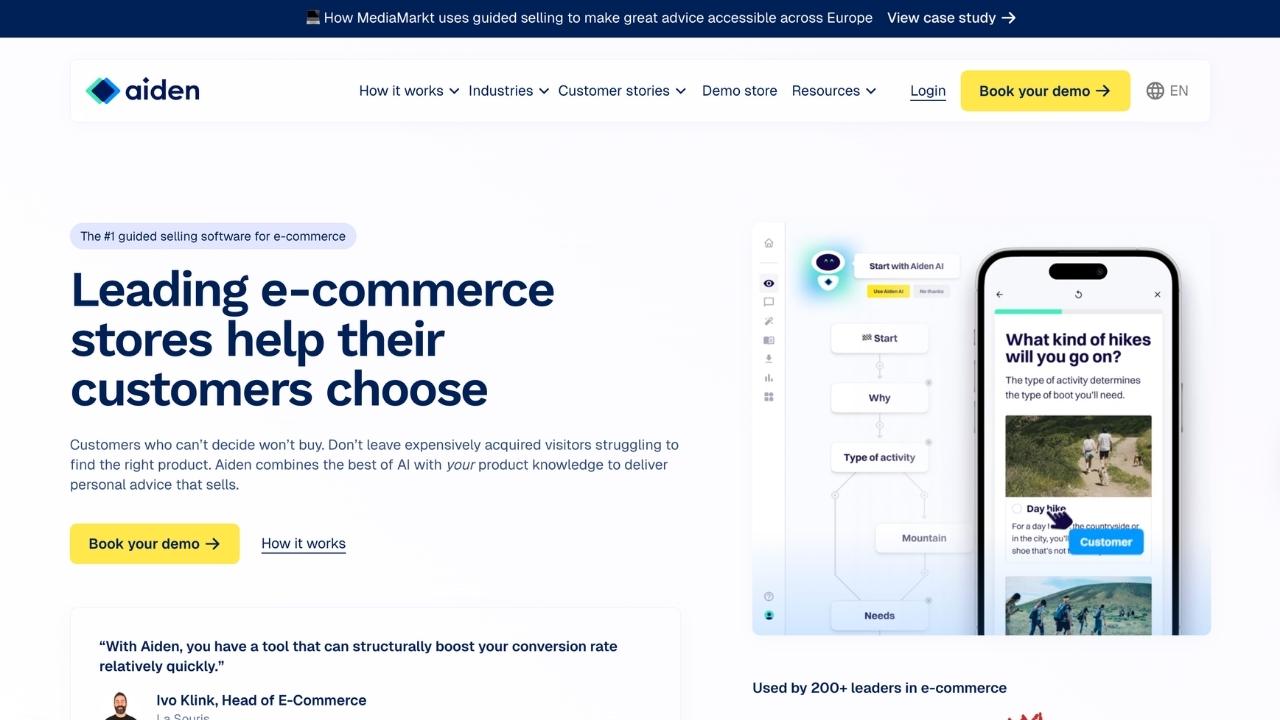
Aiden has positioned itself as the leading guided selling software for e-commerce in Europe, with over 4,000 live product finders powering recommendations across the continent.
The platform offers two distinct interaction modes. AI Mode provides a conversational, adaptive flow that feels more human while keeping merchants in control of the logic.
Classic Mode uses a structured step-by-step approach that's better for visual-heavy categories or technical products where customers need to see specs clearly.
Aiden's feature set includes Product Finders for category pages, Product Checks for PDPs (answering "Does this product suit me?"), Package Advice for cross-category recommendations, and Profile Enricher for capturing zero-party data.
Pros:
- Claims 2.5x average conversion rate increase
- Strong European market presence
- Two interaction modes for different use cases
- Zero-party data collection for marketing automation
Cons:
- Pricing not publicly available (enterprise focus)
- Less suitable for non-commerce use cases
Pricing: Custom/enterprise pricing. Demo required for quotes.
Best for: E-commerce stores selling complex or functional products where customers need guidance to choose correctly.
2. Algolia
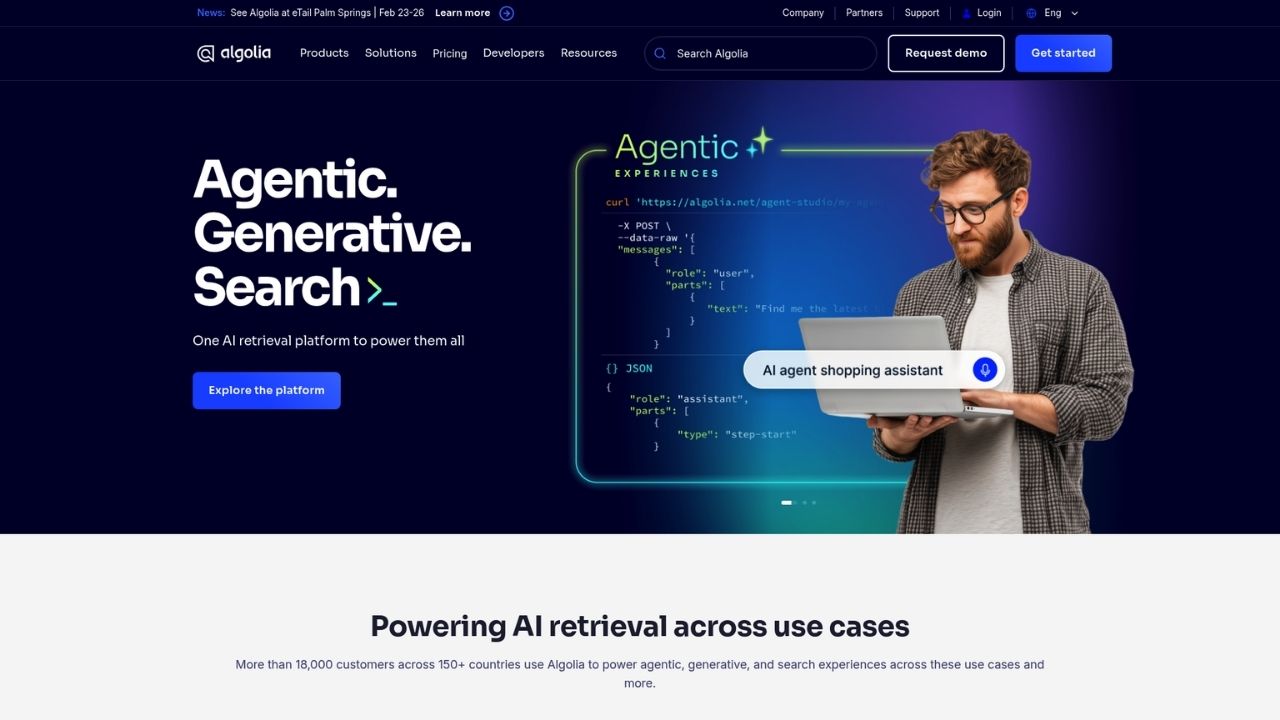
Algolia is the heavyweight in the search infrastructure space, serving 18,000+ customers across 150+ countries and processing over 400 billion requests annually.
If you need maximum flexibility and have technical resources, this is where you look.
The platform goes beyond basic keyword matching with NeuralSearch (combining semantic and keyword search), AI-powered personalization, dynamic re-ranking based on user behavior, and query categorization that predicts which category a search belongs to.
Algolia's pricing starts with a genuinely free Build plan (10K searches/month, 1M records), then moves to pay-as-you-go Grow plans, and finally Elevate for enterprise needs with 99.999% SLA guarantees.
Pros:
- Extremely fast (millisecond response times)
- Highly customizable for complex use cases
- Strong developer ecosystem and documentation
- Recognized Leader in Gartner Magic Quadrant
Cons:
- Requires technical expertise to implement advanced features
- No native guided selling (you build it yourself)
- Costs can scale quickly with high traffic
Pricing: Build (free), Grow (pay-as-you-go from $0.50 per 1K searches), Grow Plus ($1.75 per 1K searches with AI features), Elevate (custom enterprise).
Best for: Teams with developers who need complete control over search behavior and ranking logic.
3. Constructor.io
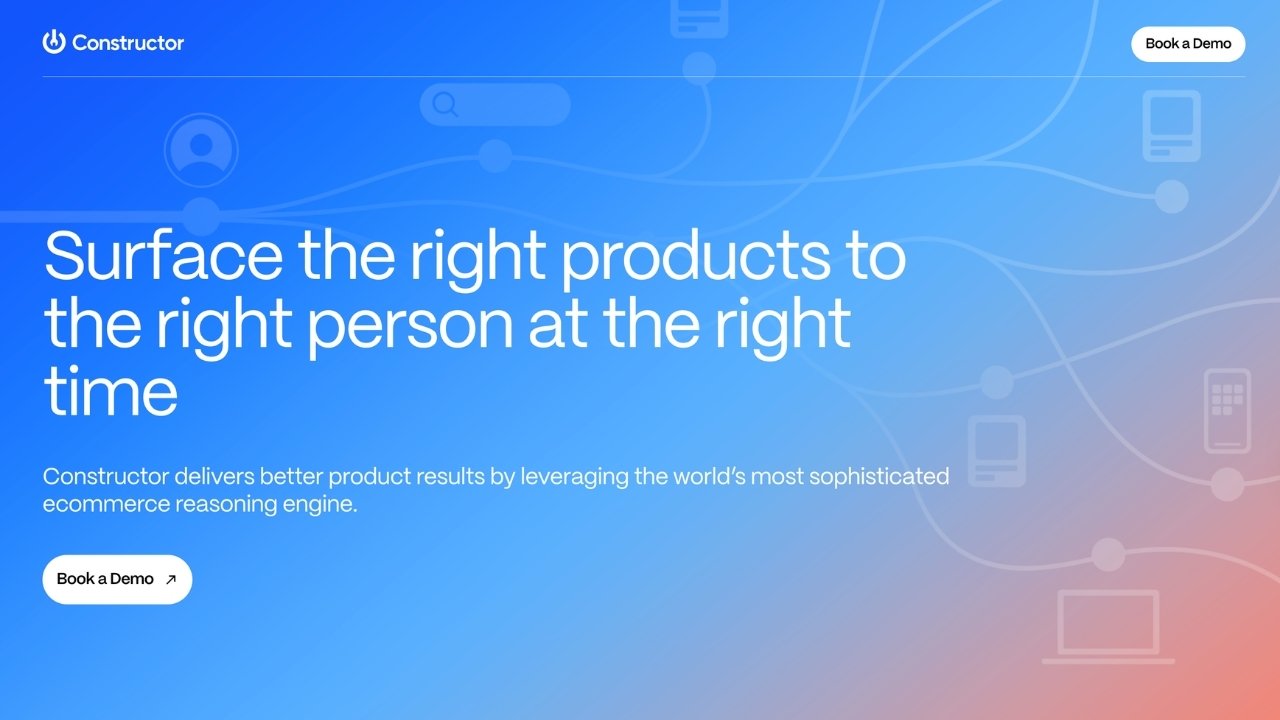
Constructor positions itself as the AI-native alternative built specifically for ecommerce KPIs.
The platform doesn't just rank products, it reasons about shopper intent using behavioral, contextual, and catalog data.
The product suite covers search, browse, recommendations, collections (themed landing pages), quizzes for guided selling, and even retail media.
One standout feature is Attribute Enrichment, which uses AI to fill in missing product attributes from your catalog data.
Constructor offers a "Proof Schedule" (a 2-4 week complimentary analysis) that shows exactly how much revenue lift you can expect before committing.
They claim 98.5% client retention over three years.
Pros:
- AI-native architecture (not retrofitted)
- "Glassbox" AI explains its reasoning
- Quick implementation (8 weeks or less)
- Strong enterprise support and white-glove onboarding
Cons:
- Enterprise pricing (no self-serve option)
- Requires clean data feeds for best results
Pricing: Custom enterprise pricing. Proof Schedule available for ROI validation.
Best for: Enterprise retailers with large catalogs who want AI-powered discovery without black-box opacity.
4. Crobox
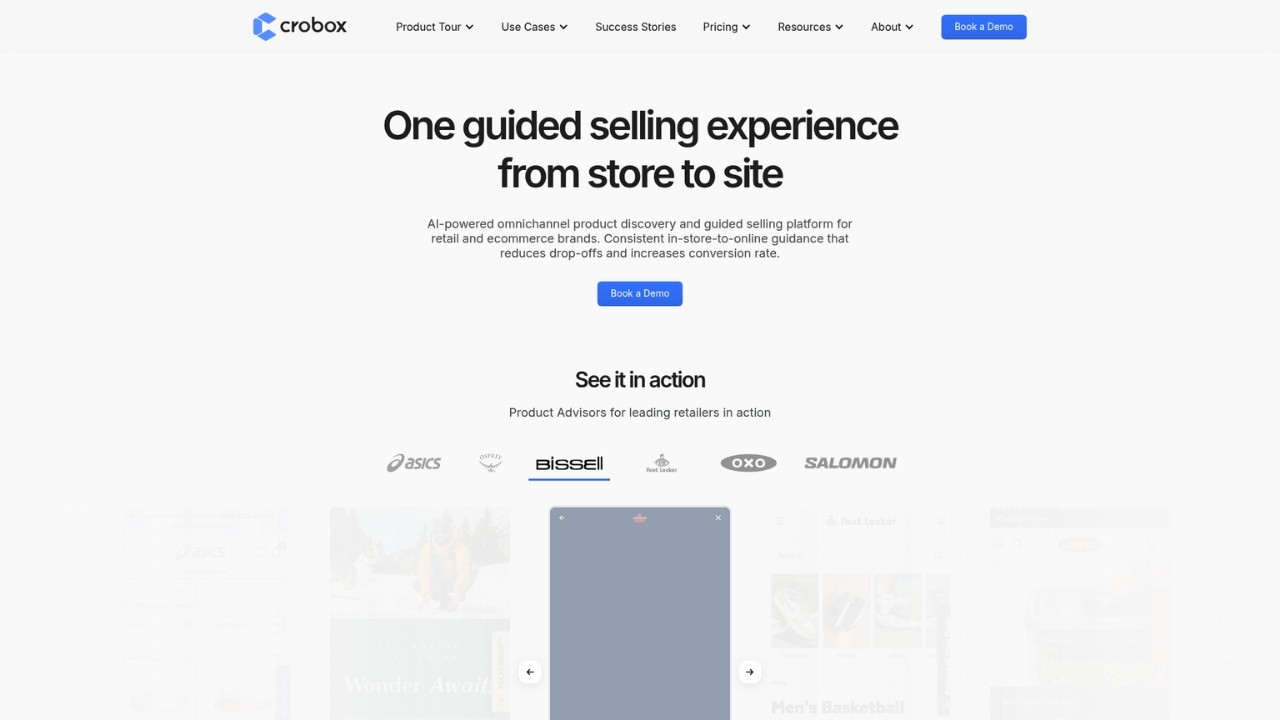
Crobox takes a different approach, combining product discovery with behavioral psychology.
The platform is designed to feel like an in-store associate who understands not just what customers want, but why they want it.
The guided selling experience follows a three-step journey: activation (getting attention), conversation (understanding needs), and personalization (delivering recommendations).
Crobox claims +15% conversion rate uplift and +12% average order value increases on average.
Customer results are impressive: ASICS saw +56% conversion uplift with a 16x ROI, Love Stories achieved 604% conversion uplift, and Ekster delivered 41.5x ROI with their Wallet Finder.
Pros:
- Psychology-driven approach to recommendations
- Strong visual customization and brand alignment
- Fast deployment (less than a day claimed)
- Proven ROI across fashion and lifestyle brands
Cons:
- Less suited for compatibility-heavy technical catalogs
- No public pricing
Pricing: Custom pricing based on implementation scope.
Best for: Consumer brands, fashion, and lifestyle products where purchase decisions are preference-driven rather than compatibility-driven.
5. Luigi's Box

Luigi's Box boasts the highest ratings on G2 and Gartner (4.8/5) among search and discovery solutions, with 4,000+ online businesses trusting the platform including major names like Under Armour, Škoda, Nespresso, and Notino.
The product suite includes AI-Powered Search with autocomplete and typo correction, Recommender for upsells and cross-sells, Product Listing for optimized category pages, Shopping Assistant (a newer AI-driven conversational feature), and comprehensive Analytics.
What sets Luigi's Box apart is the implementation flexibility. You can choose self-integration with no-code options or opt for custom integration with their team's assistance. They offer a 30-day free trial to test before committing.
Pros:
- Highest user ratings in the category
- Easy implementation with no-code options
- Low maintenance (no ongoing dev work required)
- Strong European presence and support
Cons:
- Some advanced features only available with custom integration
- Shopping Assistant still relatively new
Pricing: Self-integration (custom pricing after 30-day trial) or Custom Integration (enterprise pricing with full support).
Best for: Mid-market e-commerce businesses wanting a balance of power and ease-of-use.
6. Findify
Findify focuses on personalized search and recommendations with strong visual merchandising capabilities.
While we couldn't access detailed current pricing or feature lists during research (the site returned errors), the platform is known for its merchandising studio that lets teams visually arrange and promote products.
The platform typically appeals to e-commerce stores that want plug-and-play personalization without heavy technical lifting.
Pricing is generally based on catalog size and traffic volume.
Pros:
- Strong merchandising tools
- Easy integration for most e-commerce platforms
- Good for teams wanting visual control over recommendations
Cons:
- Limited guided selling capabilities compared to dedicated solutions
- Less information publicly available
Pricing: Custom pricing based on catalog size and traffic.
Best for: E-commerce stores prioritizing visual merchandising and easy-to-manage personalization.
7. Ringly.io

Ringly.io serves a different but complementary role in the product discovery ecosystem.
While the other tools on this list help customers find products on your website, Ringly.io's "the AI" AI agent handles the phone calls that come after (or instead of) digital browsing.
For e-commerce businesses, this matters because some customers still prefer calling, especially for high-consideration purchases or when they have specific questions.
The AI handles inbound calls 24/7, looks up orders, processes returns and exchanges, and only escalates to humans when necessary.
The platform integrates natively with Shopify and resolves approximately 73% of calls without human intervention.
Setup takes about three minutes, and the AI supports 30 languages.
Pros:
- quick setup with no technical skills required
- 73% call resolution rate without human intervention
- Transparent pricing (no "contact sales" for basic tiers)
- 40-language support for global stores
Cons:
- Phone-focused (doesn't replace website product finders)
- Shopify-centric (best fit for that ecosystem)
Pricing: Start ($349/mo for 1,000 minutes), Grow ($349/mo for 1,000 minutes), Enterprise: custom pricing for 5,000+ minutes). Overage at $0.19/minute.
Best for: Shopify stores with phone support needs that want to automate repetitive calls while maintaining customer satisfaction.
Try Ringly.io free for 14 days
Choosing the Right Zoovu Alternative for Your Business
The best choice depends on your specific situation:
For compatibility-heavy catalogs (camera equipment, industrial parts, technical gear): Aiden or Constructor.io offer the strongest guided selling logic.
For developer-led teams who want total control: Algolia provides the most flexibility, though you'll build more yourself.
For consumer brands where psychology and brand experience matter: Crobox's behavioral approach fits well.
For mid-market efficiency: Luigi's Box hits the sweet spot of capability and ease-of-use.
For phone support automation: Ringly.io complements any of the above by handling the calls that slip through the cracks.
One factor many businesses overlook is migration complexity. Moving from Zoovu means exporting your product data, rebuilding your recommendation logic, and retraining your team. Budget 4-8 weeks for a full transition, depending on catalog complexity.
Final Recommendations
If you need a direct Zoovu replacement with similar guided selling capabilities, start with Aiden or Constructor.io.
Both offer the conversational product discovery experience customers expect.
If search performance is your primary concern, Algolia or Luigi's Box provide more robust technical foundations.
And if you're looking to reduce support costs across channels, combining a digital product finder with Ringly.io's phone automation covers both bases.
Most platforms offer free trials or demos. Take advantage of them.
The best product discovery tool is the one your team actually uses and your customers actually engage with.
Frequently Asked Questions
What are the best free Zoovu alternatives?
Among the options reviewed, Algolia offers a genuinely free Build plan with 10,000 searches per month and 1 million records. Luigi's Box provides a 30-day free trial. Most other platforms require custom pricing discussions. Keep in mind that 'free' tiers typically have usage limits that growing e-commerce stores will outgrow quickly.
How long does it take to migrate from Zoovu to an alternative platform?
Most businesses should budget 4-8 weeks for a complete migration. This includes exporting product data, rebuilding recommendation logic, configuring integrations, and training your team. Constructor.io claims 8 weeks or less for implementation. Simpler platforms like Aiden or Luigi's Box can be faster, especially if you use their no-code options.
Which Zoovu alternative is best for Shopify stores?
For Shopify specifically, Aiden offers strong native integration with guided selling focused on e-commerce. Ringly.io is purpose-built for Shopify phone support. Algolia and Luigi's Box both have solid Shopify integrations as well. The best choice depends on whether you need guided selling (Aiden), search optimization (Algolia/Luigi's), or phone automation (Ringly.io).
Do these Zoovu alternatives work for B2B e-commerce?
Yes, though suitability varies. Algolia and Constructor.io both have dedicated B2B e-commerce solutions with features like contract pricing and account-based catalogs. Aiden can work for B2B if your products require guided configuration. For B2B with complex phone inquiries, Ringly.io can handle order lookups and routine questions while escalating complex contract discussions to your sales team.
Can I use multiple product discovery tools together?
Absolutely. Many businesses use Algolia for site search, Aiden or Crobox for guided selling on category pages, and Ringly.io for phone support. The key is ensuring they integrate with your e-commerce platform without creating conflicting recommendations. Most modern platforms offer API-first architectures that make this integration manageable.
What should I budget for a Zoovu alternative?
Pricing varies dramatically. Entry-level options like Algolia's Grow plan might start around $50-100/month for smaller catalogs. Mid-market solutions like Luigi's Box typically range from a few hundred to several thousand monthly. Enterprise platforms like Constructor.io or Zoovu itself often start at $5,000+ monthly. Ringly.io offers the most transparent pricing starting at $349/month for phone support.
How do I measure ROI when switching from Zoovu?
Track these metrics before and after migration: conversion rate from product finder interactions, average order value for users who engage with recommendations, return rate (should decrease with better matching), time-to-purchase, and customer satisfaction scores. Constructor.io offers a 'Proof Schedule' that projects these metrics before you commit. Most platforms provide analytics dashboards to track performance post-implementation.