

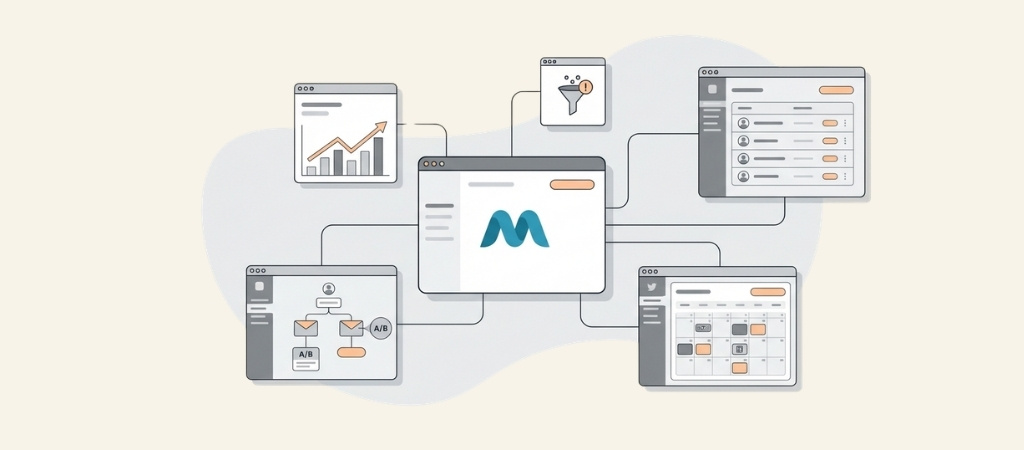
Maropost is a solid marketing automation platform, but at $251 per month, it's not the right fit for every business.
Whether you're looking for more affordable options, different features, or easier setup, there are plenty of alternatives worth considering.
We researched and tested the top platforms to help you find the best Maropost alternative for your needs. Here's what we found.
Editor’s note: Want to hear some sample AI support calls made for your Shopify store?
- Just paste your store URL
- Get sample calls in under 20 seconds (no email required)
- Listen to demo calls for my store
What is Maropost and who uses it?
Maropost is a marketing automation and commerce platform that combines email marketing, SMS, social media, and analytics into one system.
It's designed for mid-market to enterprise e-commerce brands that need advanced automation and high-volume sending capabilities.
Key features include cross-channel campaigns, eRFM analytics for customer segmentation, dynamic landing pages, and AI-powered product recommendations.
The platform claims a 98% email deliverability rate and offers dedicated deliverability support across all plans.
The main barrier for many businesses is the price. Starting at $251 per month with usage-based pricing, Maropost targets established e-commerce brands with substantial marketing budgets.
If you're a smaller business or just starting with automation, that price point can be hard to justify.
Top Maropost alternatives at a glance
Here's a quick comparison of all seven platforms we'll cover:
| Platform | Starting Price | Free Tier | Best For | Key Differentiator |
|---|---|---|---|---|
| Klaviyo | $0 | Yes (250 contacts) | E-commerce lifecycle marketing | Predictive analytics and strong free tier |
| HubSpot | $0 | Yes (1,000 contacts) | B2B and integrated CRM | All-in-one marketing, sales, and service platform |
| ActiveCampaign | $15/mo | No | Marketing + sales automation | 950+ pre-built automation recipes |
| Mailchimp | $0 | Yes (500 contacts) | Beginners and small businesses | User-friendly with extensive template library |
| Omnisend | $0 | Yes (250 contacts) | Multi-channel e-commerce | Email + SMS + web push notifications |
| Brevo | $0 | Yes (300 emails/day) | Budget-conscious businesses | CRM included on all plans |
| Drip | $39/mo | No | E-commerce retention | Revenue-focused reporting and attribution |
The 7 best Maropost alternatives for 2026
1. Klaviyo

Klaviyo is an AI-powered email and SMS platform built specifically for B2C businesses.
It stores customer data and uses it to deliver personalized experiences across multiple channels.
Key features:
- Predictive analytics for churn and customer lifetime value
- Advanced segmentation based on purchase behavior
- Email and SMS campaigns
- Customer Hub (self-service portal for order tracking)
- AI-powered subject line generator
- Revenue attribution for campaigns
Pricing:
- Free: Up to 250 contacts, 500 emails/month, 150 SMS credits
- Paid: Scales based on contact count
Pros:
- Strong free tier with full feature access
- Deep e-commerce integrations with Shopify, WooCommerce, and BigCommerce
- Predictive analytics help identify at-risk customers
- Customer Hub reduces support tickets with self-service options
Cons:
- Pricing scales quickly as your list grows
- Steeper learning curve than simpler tools
- Email support limited to first 60 days on free plan
Best for: E-commerce brands focused on repeat purchases and lifecycle marketing.
The predictive analytics make it especially valuable for businesses wanting to understand customer behavior patterns.
Source: Klaviyo pricing
2. HubSpot Marketing Hub
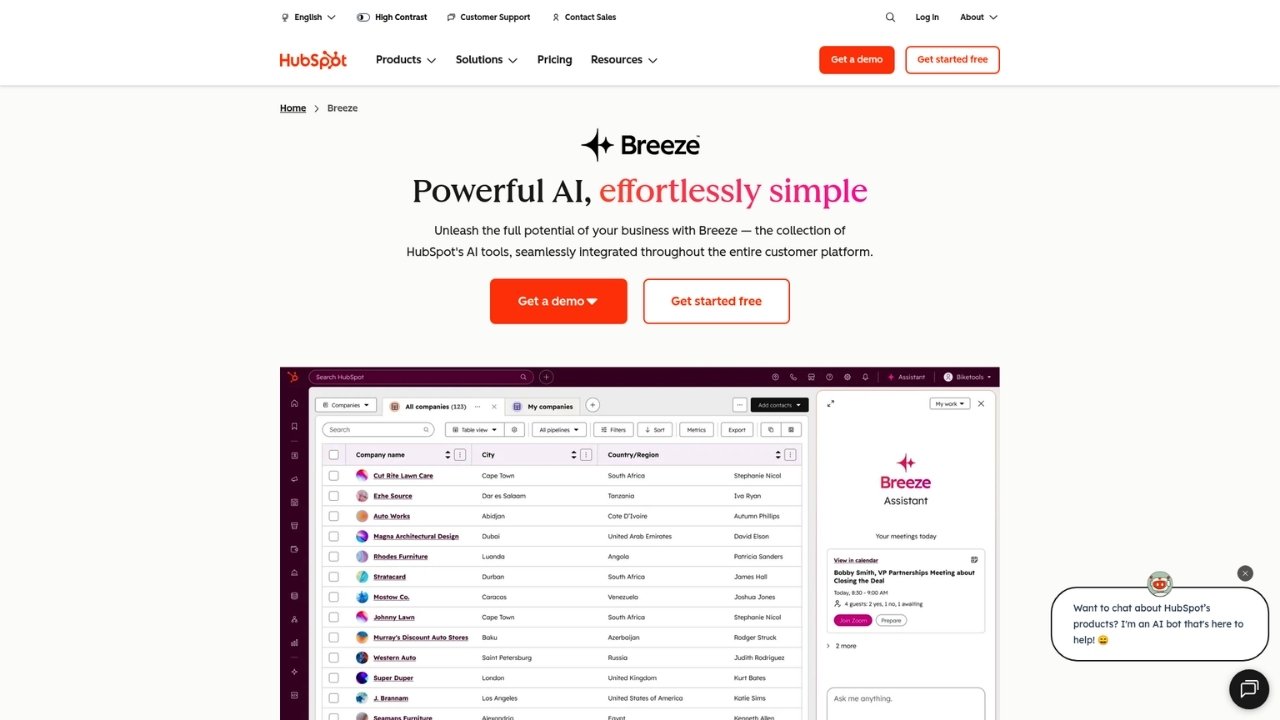
HubSpot offers an all-in-one platform that combines marketing automation with CRM, sales tools, and customer service.
It's designed for businesses that want everything in one place rather than juggling multiple tools.
Key features:
- Email marketing and automation
- Landing pages and forms
- Live chat and conversational bots
- Social media management
- Lead scoring (Professional and up)
- Multi-touch revenue attribution (Enterprise)
- 1,500+ app integrations
Pricing:
- Free: 1,000 marketing contacts, 2 users, HubSpot branding
- Starter: $9/month per seat (annual billing)
- Professional: $800/month (includes $3,000 onboarding fee)
- Enterprise: $3,600/month (includes $7,000 onboarding fee)
Pros:
- Generous free tier includes CRM and marketing tools
- Unified platform reduces tool switching
- Extensive educational resources and community
- AI-powered features like Breeze Customer Agent
Cons:
- Advanced features require expensive tiers
- Onboarding fees add significant upfront costs
- Can become complex as you add more hubs
Best for: B2B companies and businesses wanting integrated CRM and marketing. The free tier works well for small businesses, but costs escalate quickly at higher tiers.
Source: HubSpot marketing pricing
3. ActiveCampaign
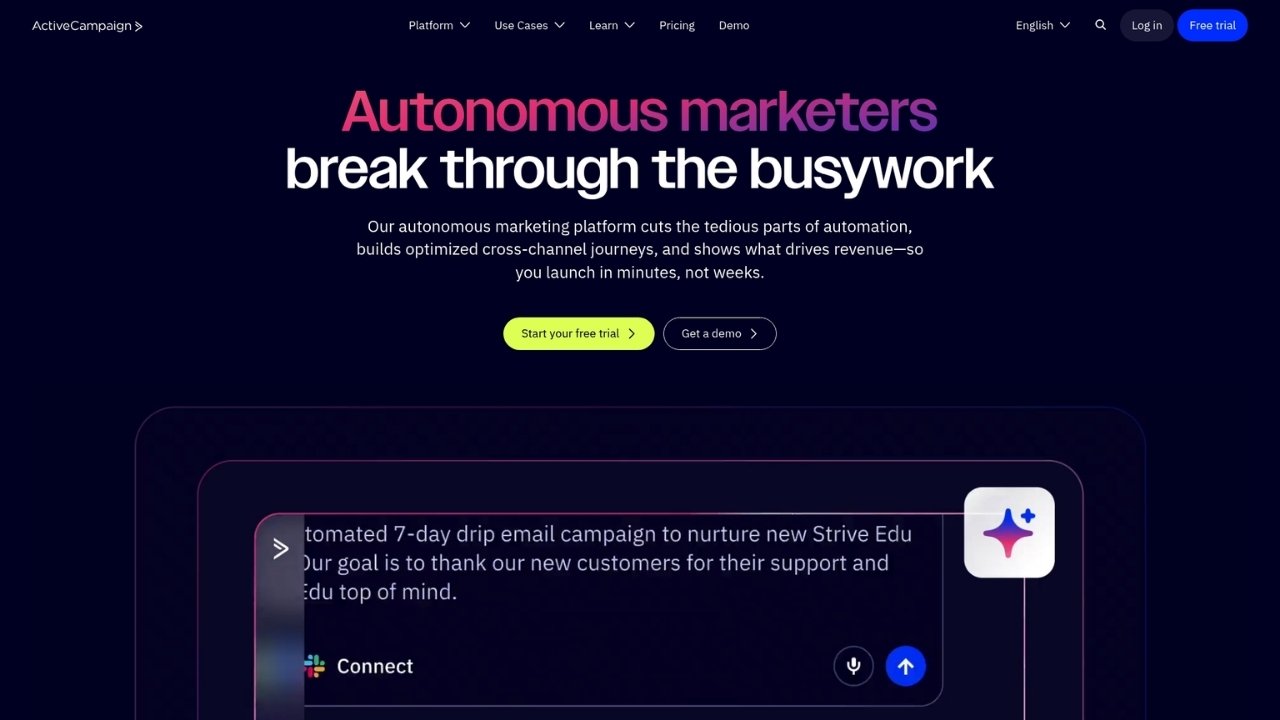
ActiveCampaign focuses on marketing automation with built-in CRM capabilities.
It offers a 30-day money-back guarantee and emphasizes "autonomous marketing" with AI-powered features.
Key features:
- 950+ pre-built automation recipes
- Email, SMS, and WhatsApp campaigns
- Landing pages and forms
- Lead scoring and deal tracking
- Site and link tracking
- Attribution and conversion tracking
- 1,000+ integrations
Pricing (1,000 contacts):
- Starter: $15/month (5 actions per automation, 1 user)
- Plus: $49/month (unlimited automation actions, 1 user)
- Pro: $79/month (advanced segmentation, 3 users)
- Enterprise: $145/month (premium segmentation, dedicated account team, 5 users)
Pros:
- Extensive library of automation templates
- 30-day money-back guarantee
- Flexible add-ons for SMS and enhanced CRM
- AI-powered automation builder
Cons:
- No free tier available
- Can be complex for beginners
- Some advanced features require add-ons
Best for: Small to mid-sized businesses wanting marketing and sales automation with room to grow. The tiered pricing lets you start small and upgrade as needed.
Source: ActiveCampaign pricing
4. Mailchimp
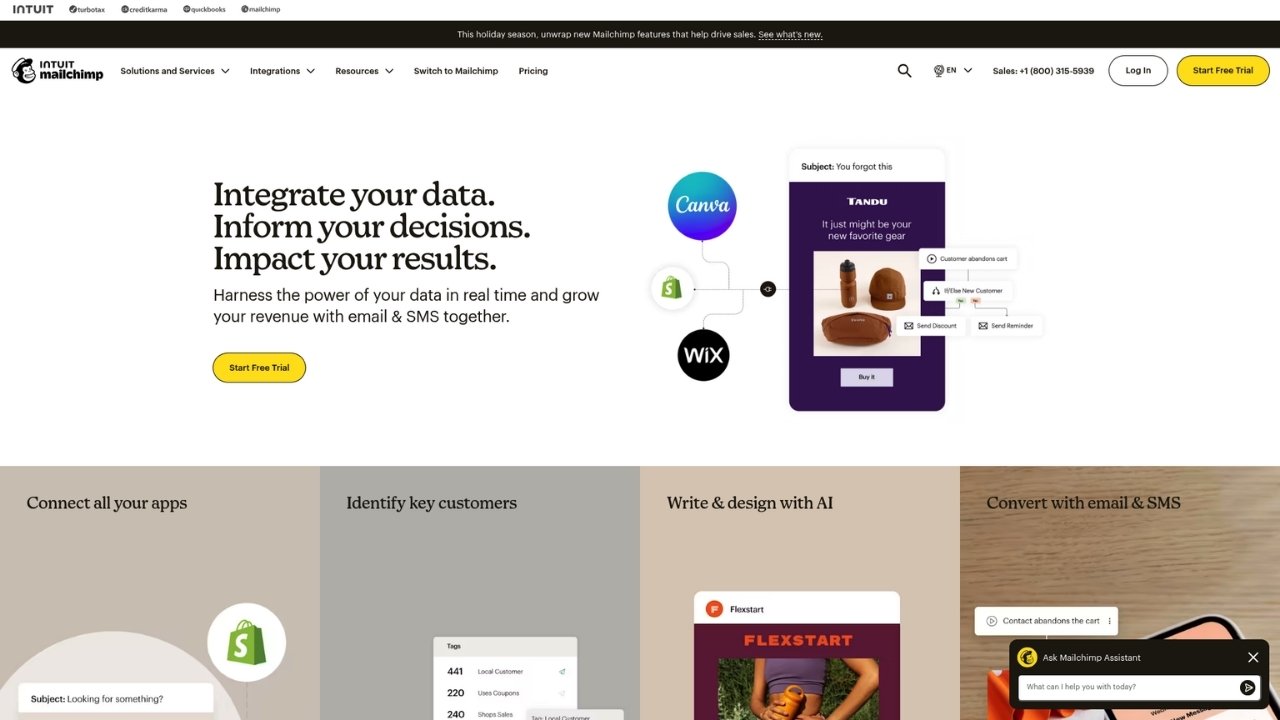
Mailchimp is one of the most recognized names in email marketing.
It's known for its user-friendly interface and extensive template library, making it a popular choice for beginners.
Key features:
- Email campaigns and newsletters
- Marketing automation
- Landing pages and forms
- Audience management
- A/B testing (paid plans)
- Behavioral targeting (Standard+)
- 100+ pre-designed templates
Pricing:
- Free: 500 contacts, 1,000 sends/month, Mailchimp branding
- Essentials: $13/month (500 contacts, 5,000 sends)
- Standard: $20/month (500 contacts, 6,000 sends, advanced automations)
- Premium: $350/month (10,000 contacts, 150,000 sends)
Pros:
- Easy to use with intuitive drag-and-drop builder
- Generous free tier for small lists
- All-in-one platform includes email, SMS, and social media
- Extensive template library
Cons:
- Deliverability rates vary (82-95% according to independent research)
- Pricing jumps significantly as contacts grow
- Limited automation on lower tiers
- Customer support quality varies by plan
Best for: Small businesses and beginners starting with email marketing. The user-friendly interface makes it easy to get started, though you may outgrow it as your needs become more sophisticated.
Source: Mailchimp
5. Omnisend
.jpeg)
Omnisend is built specifically for e-commerce businesses.
Unlike most email platforms, it includes web push notifications alongside email and SMS, giving you three channels to reach customers.
Key features:
- Email marketing with 250+ templates
- SMS marketing (global coverage)
- Web push notifications
- Pre-built e-commerce workflows
- Automation splits and A/B testing
- Unlimited segmentation (all plans)
- Popups, signup forms, and landing pages
- Product recommendations
- Facebook and Google audience sync
Pricing (500 contacts):
- Free: 250 contacts, 500 emails/month, 500 web push, 60 SMS
- Standard: $16/month (6,000 emails, unlimited web push, 60 SMS)
- Pro: $59/month (unlimited emails, bonus SMS credits equal to plan price)
Pros:
- All features included on every plan
- Web push notifications (unique among competitors)
- Built specifically for online stores
- 24/7 support available on all plans including free
- Free migration and onboarding specialist for paid plans
Cons:
- Less suited for non-e-commerce businesses
- SMS costs add up quickly beyond included credits
- Free plan limited to 250 contacts
Best for: Small to mid-sized e-commerce brands wanting multi-channel marketing.
The combination of email, SMS, and push notifications helps you reach customers wherever they are.
Source: Omnisend pricing
6. Brevo
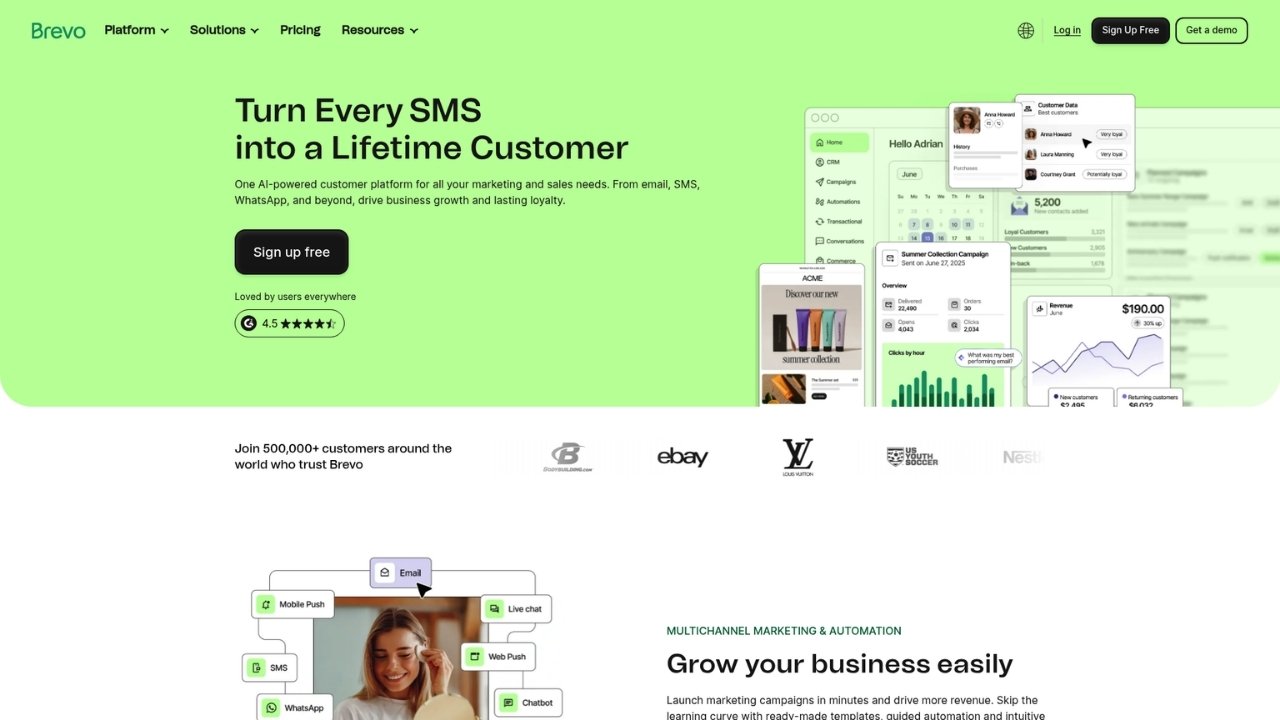
Brevo (formerly Sendinblue) offers email marketing, SMS, CRM, and automation at a lower price point than most competitors.
It's a good option for budget-conscious businesses that still want multi-channel capabilities.
Key features:
- Email marketing campaigns
- SMS marketing
- Marketing automation
- CRM (included on all plans)
- Transactional emails
- Landing pages
- A/B testing (Business plan+)
- AI send time optimization
- WhatsApp campaigns
- Push notifications
Pricing:
- Free: 300 emails/day, Brevo branding
- Starter: $9/month (5,000 emails, no Brevo logo)
- Business: $16/month (20,000 emails, marketing automation, A/B testing)
- Enterprise: Custom pricing (dedicated IP, SSO, tailored onboarding)
Pros:
- CRM included on all plans at no extra cost
- Transactional emails available on all plans
- Affordable entry point
- No daily sending limits on paid plans
- 500,000+ customers worldwide
Cons:
- Template builder less intuitive than some competitors
- Advanced automation requires higher tiers
- Free plan limited by daily sends rather than monthly
Best for: Budget-conscious businesses wanting multi-channel capabilities with integrated CRM. It's particularly good if you need transactional emails alongside marketing campaigns.
Source: Brevo pricing
7. Drip
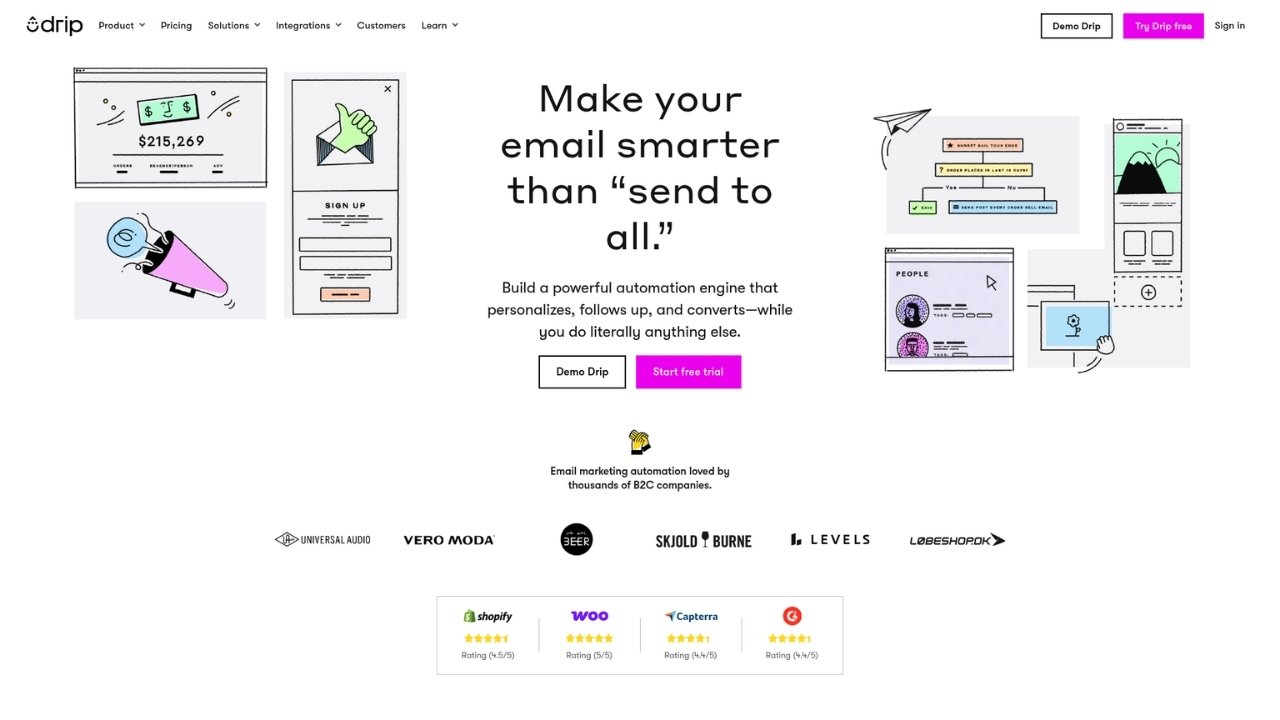
Drip is an e-commerce CRM focused on helping online retailers build customer relationships and drive repeat purchases. It emphasizes revenue attribution and reporting to show the direct impact of your marketing.
Key features:
- Email marketing automation
- Dynamic customer segmentation
- Onsite campaigns (popups, forms)
- Revenue attribution and reporting
- A/B testing
- Pre-built playbooks (welcome series, abandoned cart)
- 90+ integrations
- Smart A/B testing
Pricing:
- Starting at $39/month for up to 2,500 contacts
- Unlimited email sends on all plans
- 14-day free trial (no credit card required)
Pros:
- Built specifically for e-commerce
- Strong revenue tracking and attribution
- Highly rated customer support team
- Free migration included
- Personalized onboarding
Cons:
- No free tier available
- Less feature-rich than full marketing suites
- Pricing starts higher than some competitors
Best for: E-commerce stores focused on customer retention and repeat purchases. The revenue-focused reporting makes it valuable if you want to understand exactly how much money your campaigns generate.
Source: Drip pricing
How to choose the right Maropost alternative
With so many options, how do you pick the right one? Here are the key factors to consider.
Your business size and budget: Small businesses with limited budgets should start with free tiers from Klaviyo, HubSpot, Mailchimp, or Omnisend. As you grow, you can upgrade to paid plans. If you have a larger budget and need advanced features, ActiveCampaign or Drip might be better fits.
E-commerce vs B2B focus: E-commerce brands should prioritize Klaviyo, Omnisend, or Drip. These platforms offer deep integrations with Shopify, WooCommerce, and BigCommerce. B2B companies will get more value from HubSpot or ActiveCampaign, which offer stronger CRM and lead scoring capabilities.
Integration needs: Check which platforms integrate natively with your existing tools. All seven platforms offer Shopify integration, but support for other platforms varies. HubSpot leads with 1,500+ integrations, while smaller platforms like Drip offer 90+.
Support and deliverability: Consider access to deliverability experts and support quality. Maropost offers dedicated deliverability support, which is rare. Among alternatives, Omnisend offers 24/7 support on all plans, while others limit premium support to higher tiers.
Multi-channel requirements: If you need more than email, look at Omnisend (email + SMS + push), Brevo (email + SMS + WhatsApp), or ActiveCampaign (email + SMS + WhatsApp). These platforms let you reach customers across multiple channels from one interface.
Why phone support matters alongside email marketing
Email marketing is powerful, but it's just one piece of customer support.
Modern customers expect to reach you through whatever channel they prefer, including phone.
While these email marketing platforms help you communicate proactively, you also need a way to handle inbound phone calls. That's where Ringly.io comes in.
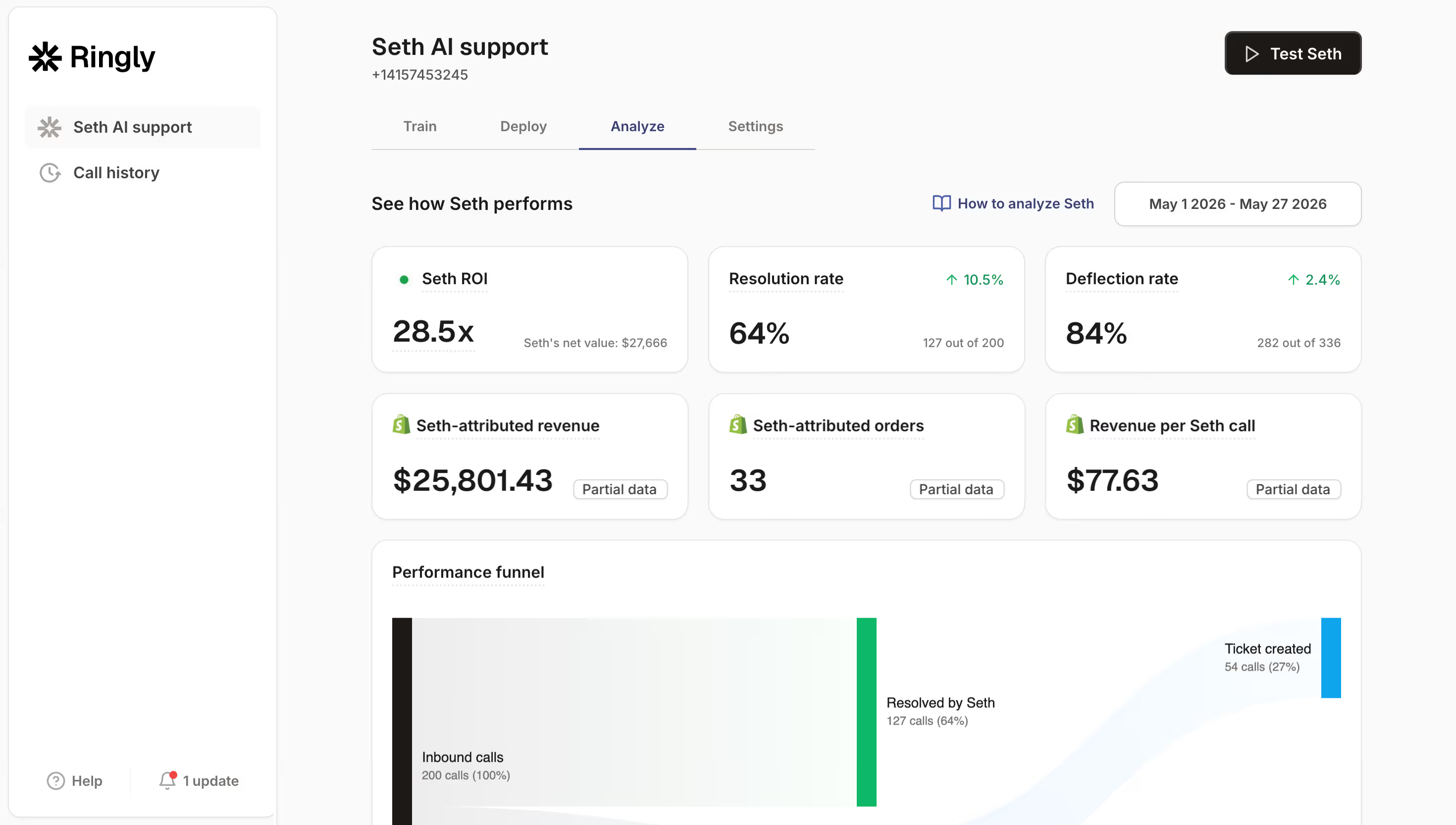
Ringly.io provides AI-powered phone support that complements your email marketing efforts.
the AI, their AI phone representative, handles inbound calls 24/7, answers questions, looks up orders, processes returns, and escalates to your team only when necessary. It resolves around 73% of calls without human intervention.
The platform integrates with Shopify and supports 30 languages, making it accessible for global e-commerce stores.
Pricing starts at $349 per month for 250 call minutes, with a 14-day free trial available.
Combining a strong email marketing platform with AI phone support gives you complete coverage across the channels your customers actually use.
Frequently Asked Questions
What are the best free Maropost alternatives?
Klaviyo, HubSpot, Mailchimp, Omnisend, and Brevo all offer free tiers. Klaviyo gives you 250 contacts and 500 emails per month. HubSpot offers 1,000 contacts and 2,000 email sends. Mailchimp provides 500 contacts and 1,000 sends. Omnisend includes 250 contacts, 500 emails, and web push notifications. Brevo allows 300 emails per day.
Which Maropost alternative is best for Shopify stores?
Klaviyo, Omnisend, and Drip are all excellent choices for Shopify stores. Klaviyo offers deep integration and predictive analytics. Omnisend provides multi-channel capabilities including web push notifications. Drip focuses on revenue attribution and customer retention. All three offer native Shopify integrations with one-click setup.
How does Maropost pricing compare to alternatives?
Maropost starts at $251 per month, which is significantly higher than most alternatives. ActiveCampaign starts at $15 per month. Drip starts at $39 per month. HubSpot, Klaviyo, Mailchimp, Omnisend, and Brevo all offer free tiers. Even paid plans from these alternatives typically cost less than Maropost's entry point.
What Maropost alternative has the best deliverability rates?
Maropost claims a 98% deliverability rate. Among alternatives, ActiveCampaign and Omnisend are known for strong deliverability. Mailchimp has reported deliverability rates of 82-95% according to independent research. Most platforms offer deliverability monitoring and support, though dedicated deliverability teams are typically reserved for higher-tier plans.
Can I migrate from Maropost to these alternatives easily?
Most platforms offer migration support. Omnisend provides free migration with a dedicated specialist for paid plans. Drip includes free migration and personalized onboarding. ActiveCampaign offers free migration and onboarding support. Klaviyo and HubSpot have extensive documentation and support teams to help with transitions.
Which Maropost alternative offers the best automation features?
ActiveCampaign leads with 950+ pre-built automation recipes and an AI-powered automation builder. HubSpot offers robust automation at Professional and Enterprise tiers. Klaviyo provides strong e-commerce automation with predictive analytics. Omnisend includes pre-built e-commerce workflows on all plans. The best choice depends on your specific automation needs and technical comfort level.
Are there Maropost alternatives that include CRM functionality?
Yes, several alternatives include CRM features. HubSpot offers a full CRM on all plans, including the free tier. Brevo includes CRM functionality on all plans at no extra cost. ActiveCampaign has built-in CRM capabilities with lead scoring and deal tracking. Drip functions as an e-commerce CRM with customer profiles and revenue tracking.