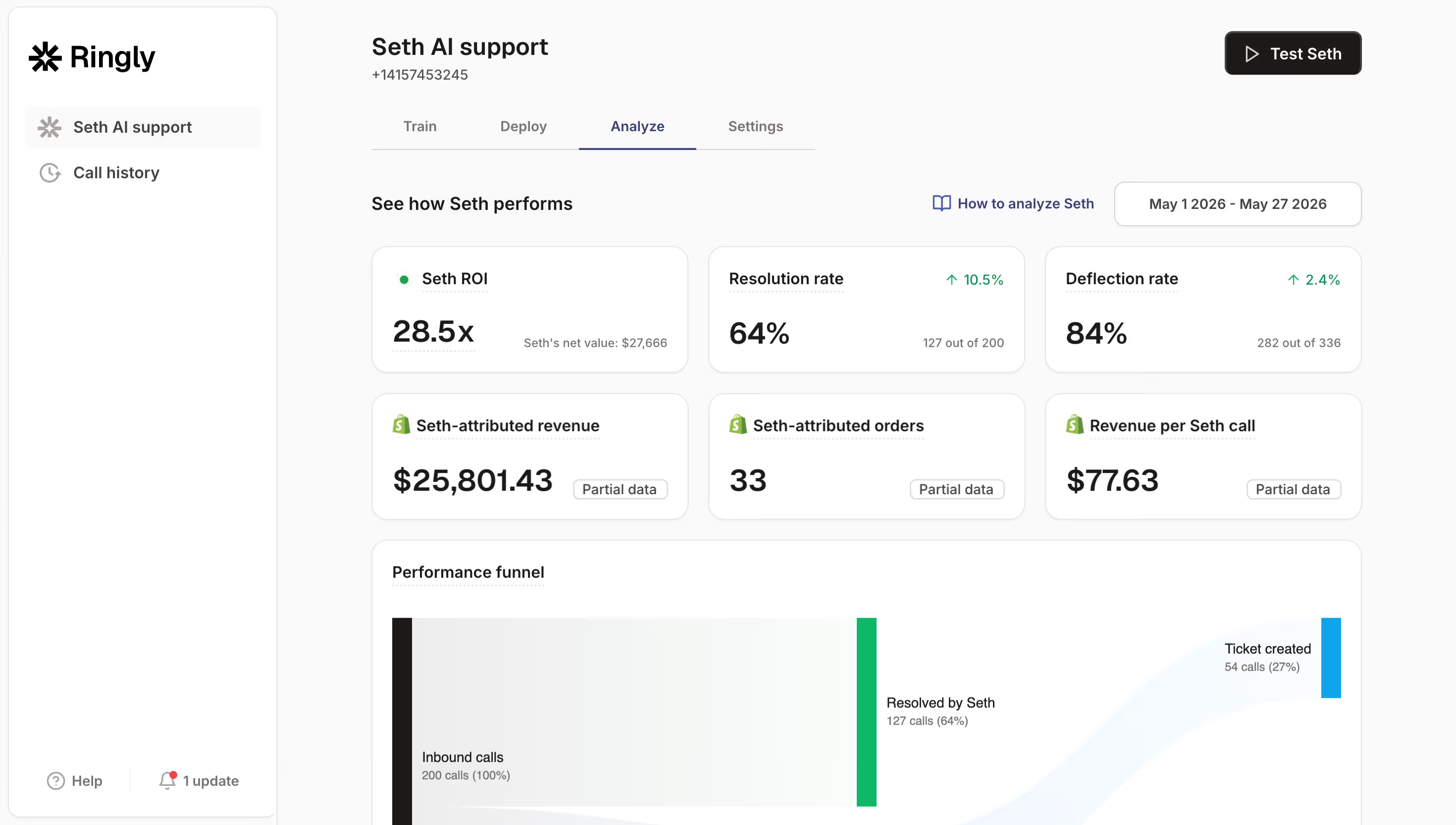


Finding the right products online shouldn't feel like solving a puzzle. That's the promise of guided selling platforms like Neocom.
They help customers navigate complex catalogs through interactive conversations, leading to better purchase decisions and fewer returns.
But Neocom isn't the only player in this space.
Whether you're looking for clearer pricing, better integrations, or different features, there are solid alternatives worth considering.
This guide breaks down six of the best Neocom alternatives for e-commerce businesses in 2026.
Each one takes a slightly different approach to guided selling, so you can find the fit that makes sense for your store.
Editor’s note: Want to hear some sample AI support calls made for your Shopify store?
- Just paste your store URL
- Get sample calls in under 20 seconds (no email required)
- Listen to demo calls for my store
What is Neocom?
Neocom is an AI-powered guided selling platform designed for e-commerce stores.
It creates interactive product finders that ask customers questions about their needs, then recommends the most suitable products from your catalog.
The platform aims to replicate the in-store expert experience online.
Instead of browsing through endless filters, customers answer a few targeted questions and get personalized recommendations.

Neocom users appreciate the easy setup, pre-made conversation templates, and analytics dashboard.
However, some businesses look for alternatives due to unclear enterprise pricing, limited integrations with certain store platforms, and restricted language support.
Why consider Neocom alternatives?
There are a few common reasons e-commerce teams start exploring other options:
Pricing transparency: Neocom doesn't publish pricing publicly, which can make budgeting difficult for growing businesses.
Integration gaps: Some store platforms and third-party tools aren't fully supported.
Language limitations: Not all languages are available, which can be a blocker for international expansion.
Feature depth: Depending on your product complexity, you might need more advanced configuration or recommendation logic.
The good news is that the guided selling market has matured significantly. Several platforms now offer compelling alternatives with different strengths.
Top 6 Neocom alternatives compared
Before diving into each option, here's a quick overview of how they stack up:
| Platform | Starting Price | Best For | Key Differentiator |
|---|---|---|---|
| Aiden | Custom quote | Growing online stores | 91% completion rates, 2.5x conversions |
| Zoovu | Custom quote | Enterprise B2C/B2B | Omni-channel, semantic search |
| Crobox | $999/month | D2C brands, enterprises | Psychology + AI, strong ROI |
| Outfindo | Custom quote | Complex product catalogs | Automated product data enrichment |
| Excentos | Custom quote | B2B, technical products | German engineering, complex configurators |
| Octane AI | $50/month | Shopify merchants | Shopify-native, 42% email opt-in rate |
Let's look at each one in detail.
1. Aiden
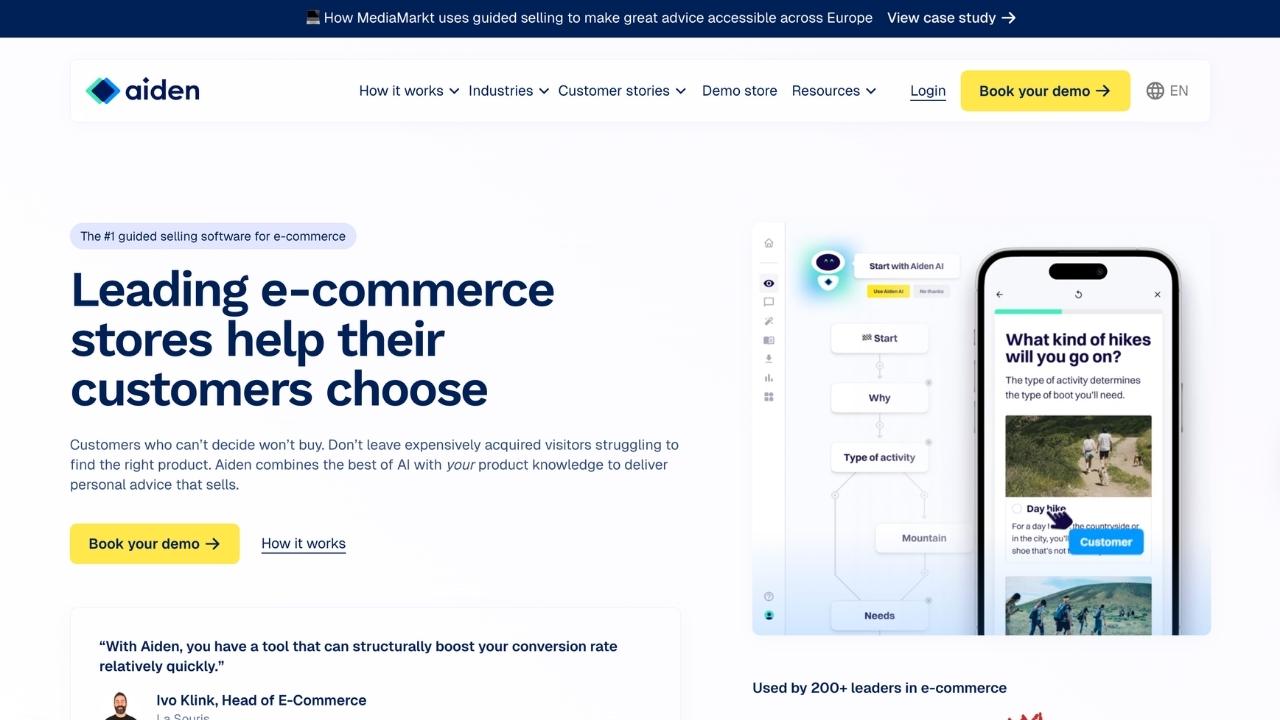
Aiden is a guided selling platform founded in the Netherlands that's become particularly popular among European e-commerce stores.
The platform was born from the book "Customers who can't decide, won't buy" and focuses on helping online stores sell complex and functional products.
Key features:
- AI Mode: Conversational, adaptive flows that feel human while keeping merchants in control
- Classic Mode: Structured, step-by-step flows for clarity and visual impact
- Product Finder: Helps shoppers understand which product is right for them
- Product Check: Validates if a specific product fits customer needs on PDPs
- Package Advice: Recommends complementary product combinations
- Impact Dashboard: Deep analytics with GA4 integration
Performance metrics:
Aiden reports impressive numbers: 91% completed sessions, 2.5x average conversion rate increases, and product finders that can be built and launched in a single day. They've served over 2.5 million customers.
Pricing:
Pricing is custom and requires booking a demo. No public pricing tiers are available.
Pros:
- Strong conversion rate improvements
- Two interaction modes (AI and Classic)
- Integrates with all major e-commerce platforms
- Quick setup and deployment
Cons:
- Pricing not transparent
- Primarily focused on European market
- May be overkill for simple product catalogs
Best for: Growing online stores wanting to improve conversions through better product advice, particularly in European markets.
2. Zoovu

Zoovu is an AI search and product discovery platform founded in 2010 and based in Boston. It serves enterprise B2C and B2B companies with a comprehensive suite of discovery tools.
Key features:
- AI Search: Interprets natural language and buyer intent, delivering dynamic results
- Guided Selling: Ask-the-expert flows that mimic human guidance
- Visual Configurator: Dynamic configuration for complex products
- Product Bundling: Smart recommendations for accessories and add-ons
- AI Shopping Assistants: Chat-based discovery powered by GenAI
- Data Enrichment: Connects to ERP, PIM, and CRM systems
Performance metrics:
Zoovu publishes impressive case study results: Microsoft saw 25% growth in conversion performance, Canon achieved 53% lift in conversion rate, and Einhell reduced search abandonment by 35%.
The platform processes product data on 57 million SKUs daily.
Pricing:
Enterprise-focused with custom pricing. No public pricing information available.
Pros:
- Strong semantic search capabilities
- Omni-channel deployment (web, mobile, in-store, voice)
- Robust data enrichment
- Proven enterprise results
Cons:
- Enterprise pricing (likely high)
- Complex setup for smaller businesses
- May be more than smaller stores need
Best for: Enterprise B2C and B2B companies needing sophisticated omni-channel product discovery across multiple touchpoints.
3. Crobox
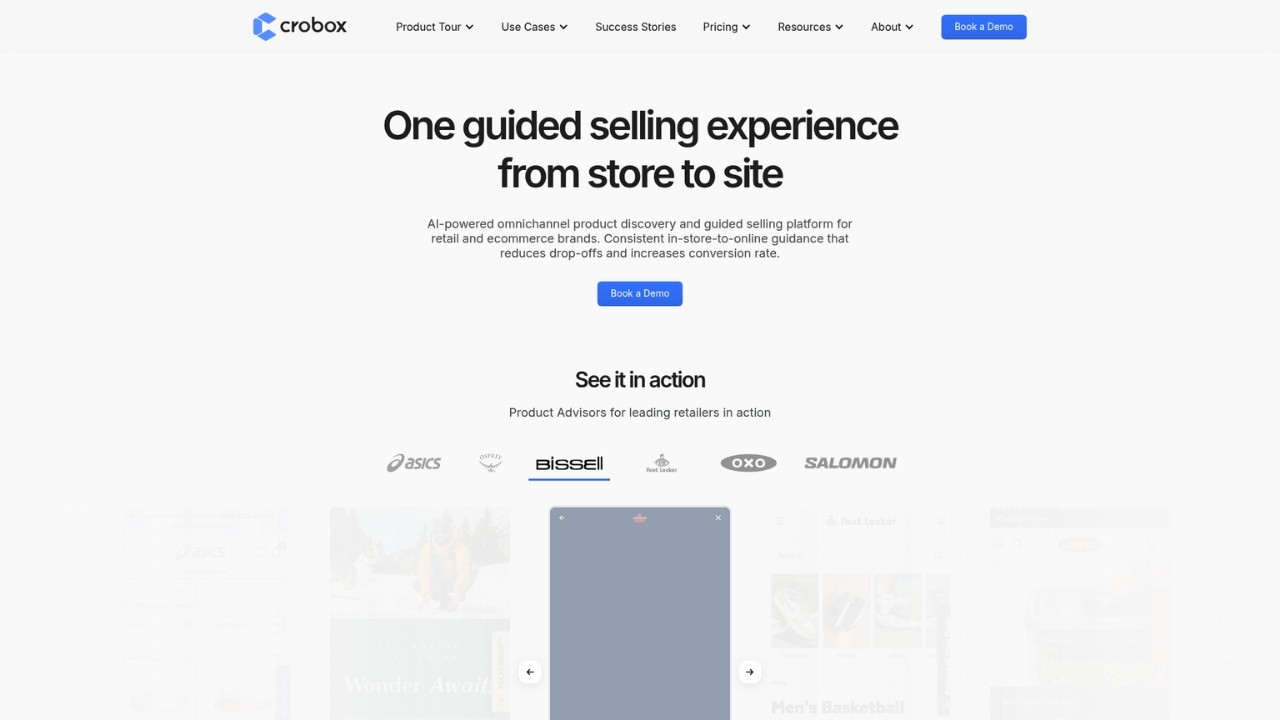
Crobox is an Amsterdam-based product discovery platform founded in 2014.
It differentiates itself by combining behavioral psychology with AI to create more persuasive guided selling experiences.
Key features:
- Product Advisors: Digital advisors that guide shoppers to the right products
- Behavioral Psychology: Insights-driven approach to understanding customers
- Real-Time Behavior Tracking: Monitors shopper behavior as they navigate
- Dynamic Product Messaging: Personalized messaging based on behavior
- A/B Testing: Test different advisor experiences
- On-Brand Experience: Fully customizable design
Performance metrics:
Crobox reports strong ROI across case studies: ASICS achieved 56% conversion uplift, LoveStories saw 604% conversion rate increase and 15% AOV uplift, and Ekster achieved 41.5x ROI. Average results include 12% conversion rate uplift and 3.5x ROI.
Pricing:
Starting at $999/month based on third-party sources, though official pricing requires contact.
Pros:
- Psychology-backed recommendation engine
- Strong ROI and case study results
- GDPR-compliant zero-party data collection
- Integrates with 99% of e-commerce platforms
Cons:
- Higher starting price point
- May be complex for simple use cases
- Enterprise-focused feature set
Best for: E-commerce businesses, consumer goods companies, and D2C brands wanting psychology-driven recommendations with measurable ROI.
4. Outfindo

Outfindo is a newer entrant founded in 2020 in the Czech Republic. The platform focuses on automating product data enrichment while providing guided selling experiences.
Key features:
- Beacon AI: Analyzes customer behavior patterns across product categories
- Diver AI: Autonomous manufacturer data gathering with AI enhancement
- Automated Product Data: Real-time product spec enrichment from manufacturers
- Guided Customer Journey: AI-optimized guidance flows
- Seamless Setup: Upload product feed and AI aligns products with customer needs
Key differentiators:
Outfindo's standout feature is automated product data management. Instead of manually maintaining product specs, their AI gathers and enhances data directly from manufacturers. This means product descriptions stay current without ongoing manual work.
Pricing:
Custom pricing with a 30-day free trial available.
Pros:
- Automated product data enrichment
- Minimal ongoing maintenance
- Quick setup (minutes, not days)
- AI-driven customer insights
Cons:
- Less flexible than some competitors
- Newer player with shorter track record
- Fewer public case studies
Best for: E-commerce sites with complex product categories that want to minimize manual data management while providing guided experiences.
5. Excentos
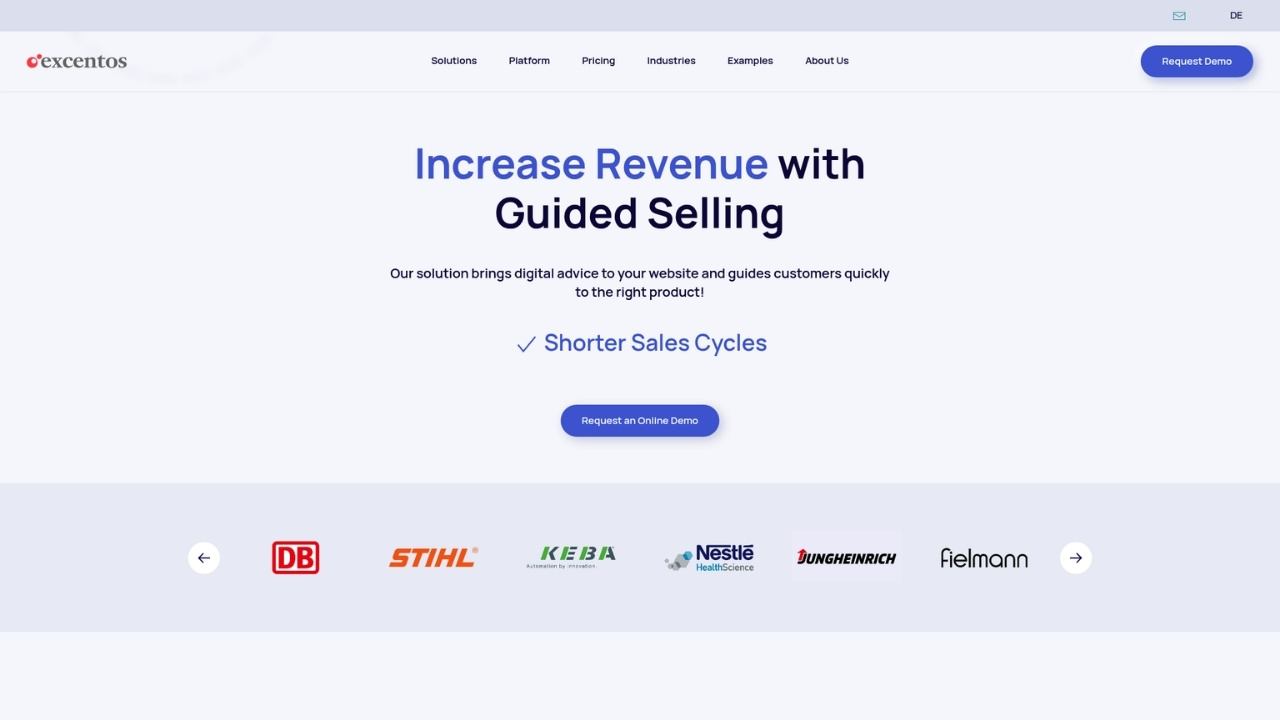
Excentos is a German guided selling solution with a strong focus on B2B and technical product categories.
The platform emphasizes complex configurators and sales enablement tools.
Key features:
- Product Finder: Guide customers to the right product
- Product Configurator: Handle complex product configurations with dependency logic
- Sales Enablement: Interactive sales playbooks for sales teams
- AI-Assistant: Create digital advisors with AI tools
- No-Code Platform: Self-service advisor building
- Performance Tracking: Analytics to measure advisor performance
Key benefits:
Excentos excels at handling complex product logic and configurations.
Their platform can manage dependencies, price calculations, and shopping cart integration for technical products.
Pricing:
Custom pricing requires demo request.
Pros:
- Strong in technical/industrial sectors
- Handles complex product logic
- German engineering and hosting
- Sales team enablement features
Cons:
- Steeper learning curve
- Enterprise-focused
- Less suited for simple D2C use cases
Best for: Technical products, B2B e-commerce, complex configurators, and companies needing German/EU data hosting compliance.
6. Octane AI
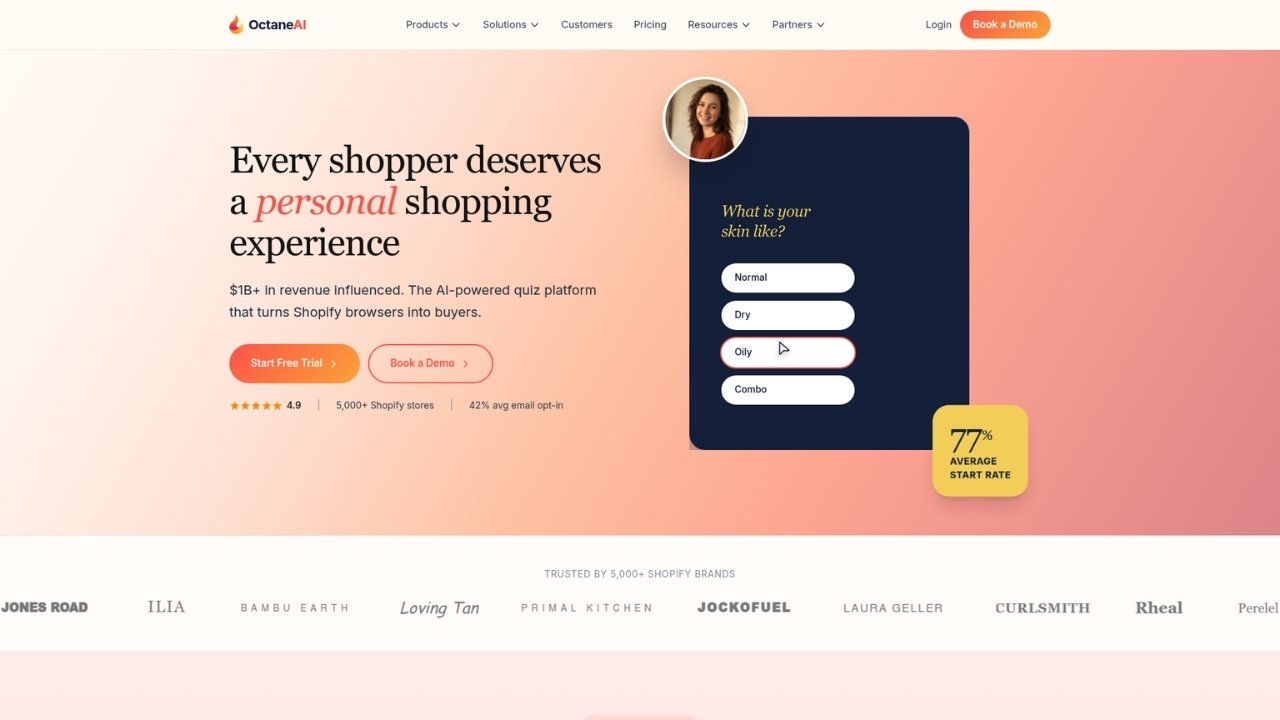
Octane AI is the leading product quiz platform built specifically for Shopify. With over 5,000 Shopify brands using the platform, it's become the go-to solution for merchants wanting zero-party data collection.
Key features:
- AI-Powered Quizzes: Personalized product recommendation quizzes
- CORE-1 AI Engine: Proprietary AI that learns from every interaction
- Smart Products: AI picks perfect products in real-time
- Smart Copy: Personalized results page copy
- Image Analysis: Photo-based shade matching
- Pop-ups & Widgets: Capture emails and engage visitors
Performance metrics:
Octane AI reports $1B+ in revenue influenced across merchants. Key stats: 77% quiz start rate (vs 45% industry average), 42% average email opt-in rate, and 2.5x higher AOV for quiz users. Jones Road Beauty generated $100M in revenue using Octane AI quizzes.
Pricing:
| Plan | Monthly Price | Credits | Key Features |
|---|---|---|---|
| Basic | $50 | 400 | 2 quizzes, pop-ups, Klaviyo & Shopify sync |
| Plus | $200 | 2,200 | Unlimited quizzes, A/B testing, custom branding |
| Enterprise | $500+ | 7,250+ | Dedicated Account Manager, strategy calls |
1 credit = 1 quiz engagement. AI features use additional credits. 14-day free trial available.
Pros:
- Shopify-native integration
- Transparent, affordable pricing
- Strong email marketing integrations
- Quick setup with no coding
Cons:
- Limited to Shopify (no WooCommerce, BigCommerce, etc.)
- Less suitable for complex B2B product logic
- Credit system can be confusing
Best for: Shopify merchants wanting zero-party data collection, especially in beauty, skincare, fashion, and supplements verticals.
Feature comparison table
Here's a more detailed side-by-side comparison:
| Feature | Aiden | Zoovu | Crobox | Outfindo | Excentos | Octane AI |
|---|---|---|---|---|---|---|
| Starting Price | Custom (approx. $300/mo) | Custom quote | $999/mo (€1,000) | €99/mo | Custom quote | $50/mo |
| Free Trial | Demo / Request | Demo / Request | 30 days | 30 days | Demo / Request | 14 days |
| AI Recommendations | Yes (AI Mode) | Yes | Yes (Beacon AI) | Yes | Yes | Yes (Smart Products) |
| Visual Configurator | No | Yes (2D/3D & CPQ) | No | No | Yes | No |
| Data Enrichment | Limited | Yes (Semantic AI) | Yes (Diver AI) | Yes (Automated) | Manual / DIY | No |
| Platform Focus | General eCommerce | Enterprise B2C/B2B | D2C Enterprise | Mid-market / Catalog | B2B Technical | Shopify Native |
| B2B Features | Limited | Strong (BOM/CPQ) | Limited | Medium | Strong (Technical) | No |
| A/B Testing | Yes | Yes | Yes | Limited | Yes | Yes (Plus Plan) |
| Setup Complexity | Low-Medium | High | Medium-High | Low (Automated) | Medium-High | Low (Code-free) |
How to choose the right guided selling platform
With six solid options, how do you pick the right one? Here are the key factors to consider:
Your e-commerce platform: If you're on Shopify, Octane AI is the obvious choice. For other platforms, Aiden, Zoovu, and Crobox offer broader compatibility.
Product complexity: Technical products with many configurations need Excentos or Zoovu. Simple product catalogs can work with any option.
Budget: Octane AI has the most transparent and affordable entry point. Crobox starts at $999/month. The others require custom quotes.
Technical resources: Aiden, Outfindo, and Octane AI are designed for low technical overhead. Zoovu and Excentos may require more implementation effort.
Data needs: If you struggle with product data management, Outfindo's automated enrichment is unique. For zero-party data collection, Octane AI and Crobox excel.
Geographic focus: European businesses might prefer Aiden or Excentos. US-based enterprises often lean toward Zoovu.
Reducing support calls with better product guidance
Here's something that doesn't get discussed enough: good guided selling doesn't just increase conversions. It reduces customer support volume.
When customers find the right product upfront, they have fewer questions after purchase. They know what they're getting. They understand the features. They're confident in their choice.
This means fewer "will this fit?" calls, fewer "is this compatible with...?" emails, and fewer returns due to mismatched expectations.
Of course, some customers will still prefer to call. That's where having a solid phone support strategy helps. If you're dealing with post-purchase questions, returns, or order tracking calls, an AI phone agent like the AI agent from Ringly.io can handle the repetitive stuff while your team focuses on complex issues.
Start improving your e-commerce conversions today
The right guided selling platform depends on your specific situation. There's no universal "best" option.
If you want affordable, Shopify-native quizzes with strong email integration, go with Octane AI.
If you need enterprise-grade omni-channel discovery, Zoovu is worth the investment. For psychology-driven recommendations with proven ROI, Crobox delivers.
For automated product data management, Outfindo is unique. For complex B2B configurators, Excentos has the depth.
And for European markets wanting quick deployment, Aiden is solid.
The key is matching the platform to your catalog complexity, technical resources, and budget. Most offer demos or trials, so you can test before committing.
Whatever you choose, the goal is the same: help customers find the right products with confidence. When you do that, conversions go up and returns go down.
That's worth the investment.
Frequently Asked Questions
Which Neocom alternatives offer the best value for small businesses?
For small businesses, Octane AI offers the most transparent pricing starting at $50/month with a 14-day free trial. If you're not on Shopify, you'll need to look at custom-priced options like Aiden or Outfindo, which can still be affordable depending on your catalog size.
Do any Neocom alternatives work with platforms other than Shopify?
Yes, Aiden, Zoovu, Crobox, Outfindo, and Excentos all support multiple e-commerce platforms. Only Octane AI is Shopify-exclusive. If you're on WooCommerce, BigCommerce, Magento, or a custom platform, the other five options are better fits.
What's the difference between guided selling and product filters?
Product filters let customers narrow down options based on specs they've already decided on. Guided selling asks questions to help customers figure out what they actually need. Filters work when customers know what they're looking for. Guided selling helps when they don't.
How long does it typically take to implement a guided selling solution?
Implementation time varies by platform and complexity. Octane AI and Aiden can be live in hours or days. Zoovu and Excentos typically take weeks for enterprise implementations. Outfindo claims setup in minutes due to automated data handling.
Can guided selling platforms integrate with my existing email marketing tools?
Most platforms integrate with major email marketing tools. Octane AI has native Klaviyo integration. Aiden connects to ESPs and CDPs. Zoovu and Crobox offer broader marketing platform integrations. Always verify specific integrations during your demo.
Do I need technical expertise to set up these Neocom alternatives?
Most modern guided selling platforms are designed for non-technical users. Octane AI, Aiden, and Outfindo emphasize no-code setup. Zoovu and Excentos may require technical resources for complex implementations. All platforms offer support and documentation to help with setup.