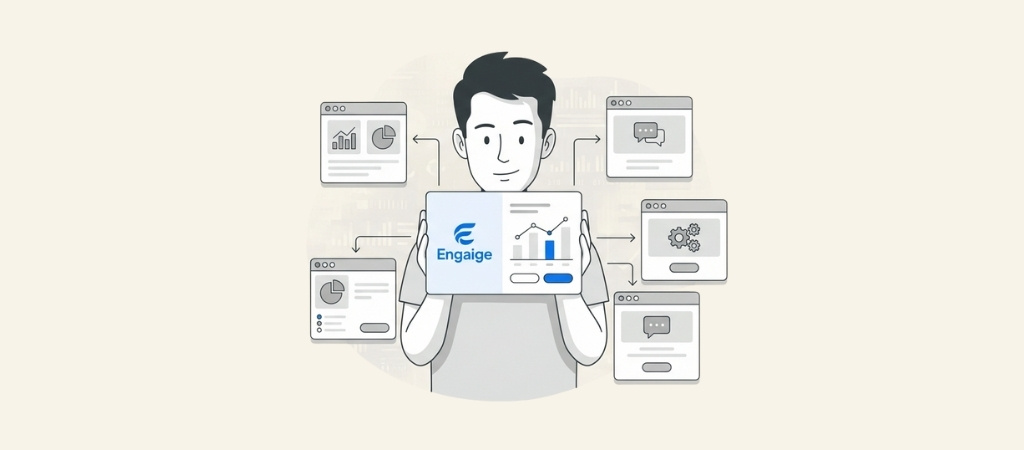
Engaige positions itself as an enterprise AI customer support platform.
At $10,000 per month, it's priced for Fortune 500 companies with complex needs and deep pockets. For most businesses, that's simply not realistic.
The good news? You don't need Engaige's budget to get powerful AI customer support.
Several alternatives offer comparable (and sometimes better) AI capabilities at a fraction of the cost. Some start at $15 per month. Others are free to try.
This guide breaks down 7 Engaige alternatives that actually deliver on their AI promises.
We'll look at real pricing, specific AI features, and who each tool works best for.
Editor’s note: Want to hear some sample AI support calls made for your Shopify store?
- Just paste your store URL
- Get sample calls in under 20 seconds (no email required)
- Listen to demo calls for my store
What is Engaige?
Engaige is an AI-powered customer support platform focused on enterprise clients.
It offers AI agents that handle customer conversations across channels, automated ticket routing, and integration with existing help desk systems.
The platform targets companies with high support volumes that want to reduce human agent workload through automation.
Its AI can handle routine inquiries, escalate complex issues to humans, and learn from interactions to improve over time.
The challenge for most businesses is the price tag. At $10,000 per month according to Capterra, Engaige requires serious commitment.
That pricing puts it out of reach for SMBs and even many mid-market companies.
How we evaluated these Engaige alternatives
We looked at each tool through a practical lens. Here's what mattered:
- AI capabilities - Can it actually resolve conversations, or just deflect them? How accurate is the AI?
- Pricing transparency - Do they publish prices, or hide behind "contact sales"?
- Ease of setup - How long from signup to working AI? Hours, days, or months?
- Integration ecosystem - Does it work with your existing tools?
- Customer reviews - What do real users say on G2, Capterra, and Trustpilot?
Every tool on this list offers a free trial. You can test them with your actual data before committing.
Engaige alternatives at a glance
| Tool | Starting Price | AI Focus | Best For | Rating |
|---|---|---|---|---|
| Intercom | $29/seat + $0.99/resolution | Advanced AI agent | Mid-market wanting best AI | 4.5/5 |
| Zendesk | $19/agent (Support), $55/agent (Suite) | Enterprise AI suite | Large enterprises | 4.6/5 |
| Tidio | $0 (Free), $24.17/mo | SMB AI chatbot | Ecommerce, small businesses | 4.7/5 |
| Forethought | Custom pricing | AI-native platform | AI automation priority | 4.5/5 |
| LiveAgent | $15/agent | Basic AI assistance | Budget-conscious teams | 4.7/5 |
| Gladly | Custom pricing | LTV-focused AI | Retail/ecommerce brands | 4.8/5 |
| Help Scout | $0 (Free), $25/user | Simple AI tools | Growing teams | 4.7/5 |
1. Intercom
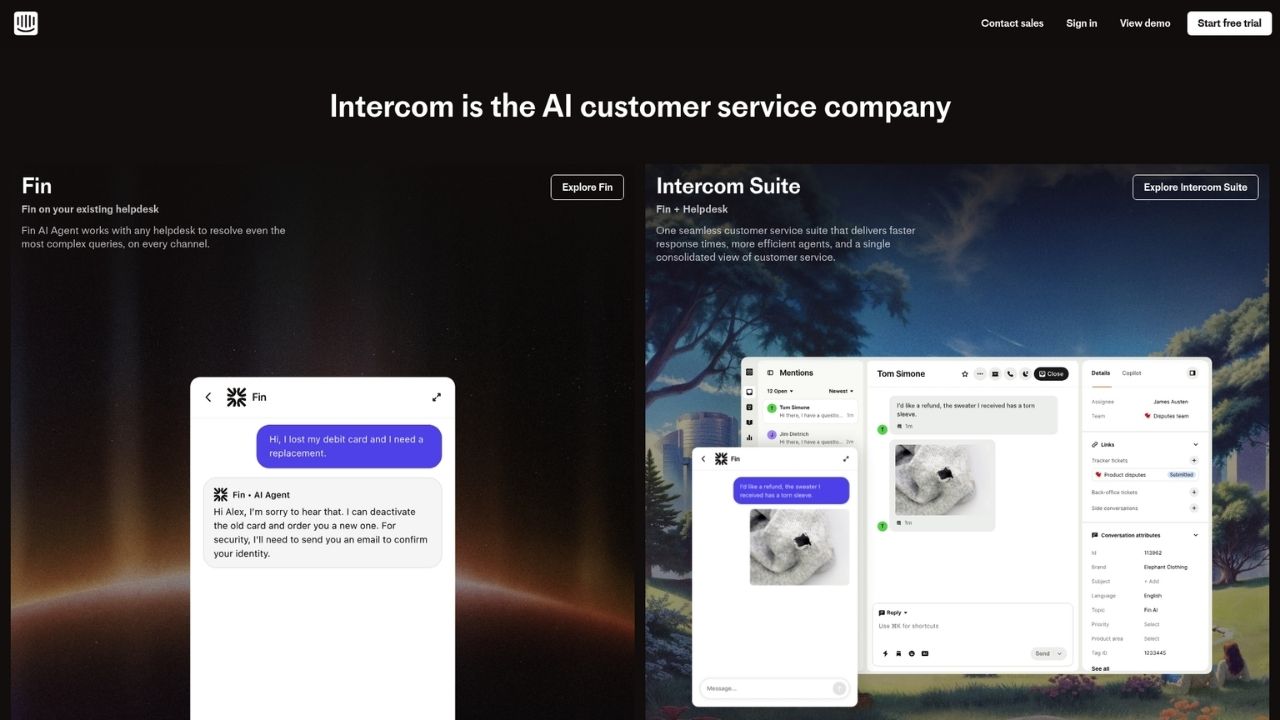
Intercom has repositioned itself as "the AI customer service company" with Fin, their flagship AI Agent. It's the most advanced AI on this list.
AI capabilities:
Fin AI Agent resolves complex queries across all channels (voice, email, chat, social).
It uses a patented 6-step process: refine query, retrieve content, rerank, generate response, validate accuracy, optimize.
Intercom claims a 73% resolution rate in head-to-head tests against competitors.
The AI works with your existing help desk too. If you're already on Zendesk or Salesforce, you can add Fin without switching platforms.
Pricing:
| Plan | Price | Key Features |
|---|---|---|
| Essential | $29/seat/mo | Fin AI ($0.99/resolution), Messenger, Help Center |
| Advanced | $85/seat/mo | Multiple Inboxes, Workflows automation |
| Expert | $132/seat/mo | SSO, HIPAA, SLAs, 50 free Lite seats |
Best for: Mid-market companies wanting the most advanced AI without building custom solutions.
Pros:
- Industry-leading AI resolution rates
- Works with existing help desks (Zendesk, Salesforce)
- Resolution-based pricing (pay for results, not attempts)
- Extensive integration ecosystem
Cons:
- Gets expensive at scale ($0.99 per resolution adds up)
- Seat pricing on top of resolution costs
- Learning curve for advanced features
2. Zendesk

Zendesk is the established market leader, now heavily investing in AI. If you need proven reliability at enterprise scale, this is your tool.
AI capabilities:
Zendesk AI Agents handle automated resolution across channels.
The platform includes generative replies, intelligent triage for automatic ticket categorization, and Copilot for real-time agent assistance.
You get 5-15 automated resolutions per agent per month included, depending on your plan. Additional resolutions cost $1.50 committed or $2.00 pay-as-you-go.
Pricing:
Best for: Enterprises needing proven reliability, extensive integrations, and advanced security.
Pros:
- Mature platform with 1000+ integrations
- Enterprise-grade security and compliance
- Scales to massive volumes (Uber, Siemens use it)
- Complete suite in one platform
Cons:
- Complex pricing with many add-ons
- AI features cost extra
- Steeper learning curve than newer tools
3. Tidio

Tidio focuses on SMBs and ecommerce stores. It's affordable, easy to set up, and includes a capable AI agent called Lyro.
AI capabilities:
Lyro AI Agent solves up to 67% of customer problems automatically.
It learns from your support content to generate personalized responses. Unlike rule-based chatbots, Lyro understands intent and context. It includes human handoff for complex issues and supports multiple languages.
Pricing:
| Plan | Price | Key Features |
|---|---|---|
| Free | $0 | 50 conversations, 100 Flow visitors, 3 agents |
| Starter | $24.17/mo | 100 billable conversations, 50 Lyro conversations |
| Growth | From $49.17/mo | 250+ conversations, advanced analytics |
| Plus | From $749/mo | Custom limits, departments, OpenAPI |
| Premium | Custom | 3,000+ Lyro conversations, guaranteed 50% resolution |
Best for: Small to mid-sized businesses, especially ecommerce stores on Shopify or WooCommerce.
Pros:
- Free tier to get started
- Strong ecommerce integrations
- Affordable AI compared to competitors
- Visual Flow builder for automation
Cons:
- Less advanced AI than Intercom or Forethought
- Plus plan jumps significantly in price
- Limited enterprise features
4. Forethought
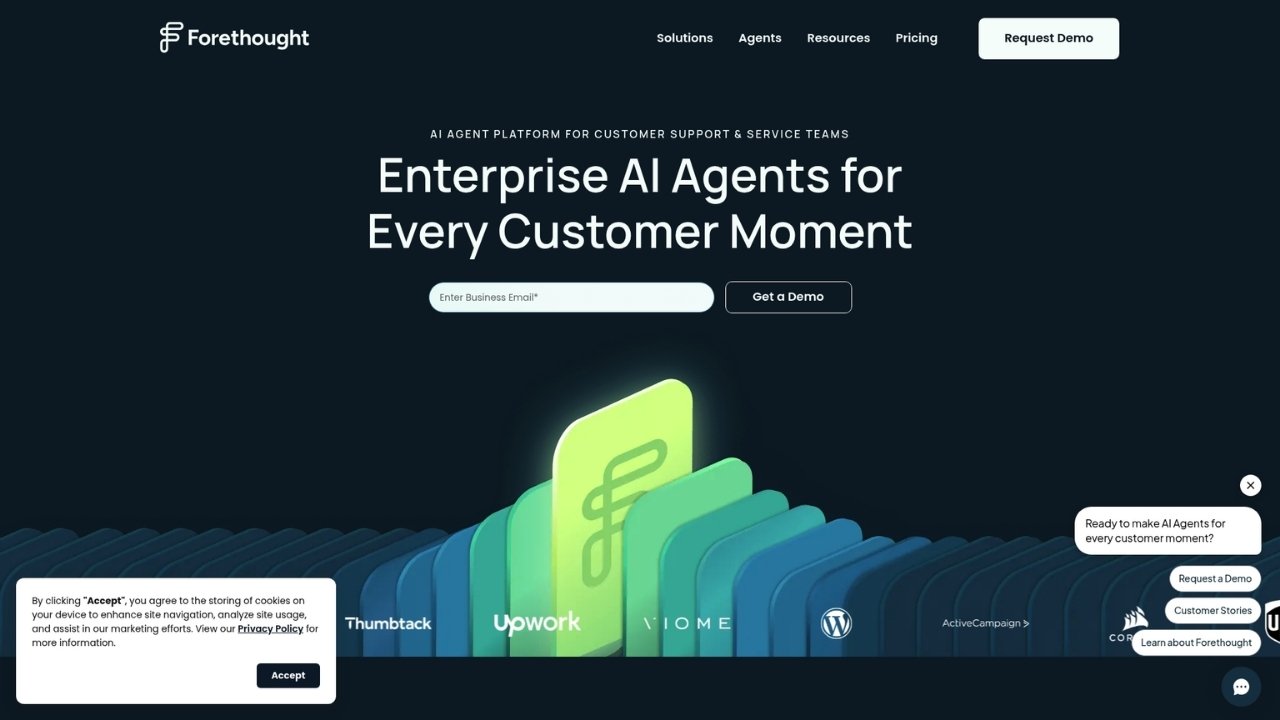
Forethought is AI-native, built from the ground up for customer support automation. It's newer than Zendesk but purpose-built for AI.
AI capabilities:
The platform includes Solve (AI agent for ticket resolution), Triage (AI-powered routing), Assist (AI copilot for agents), and Discover (AI insights). Autoflows enable no-code workflow automation.
The AI can take custom actions in external systems, not just respond to messages.
Pricing:
All plans require custom quotes. Pricing is outcome-based (platform access + committed usage based on deflection volume).
| Plan | Key Features |
|---|---|
| Basic | AI agent for chat, Autoflows, insights dashboard |
| Professional | Omnichannel AI, multiple brands, multilingual |
| Enterprise | API access, knowledge gap detection, advanced security |
Best for: Companies where AI automation is the top priority and budget allows for custom solutions.
Pros:
- AI-native architecture (not retrofitted)
- Outcome-based pricing
- Purpose-built for support (not general platform)
- Fast implementation (days, not months)
Cons:
- No transparent pricing
- Less mature ecosystem
- Smaller customer base
5. LiveAgent
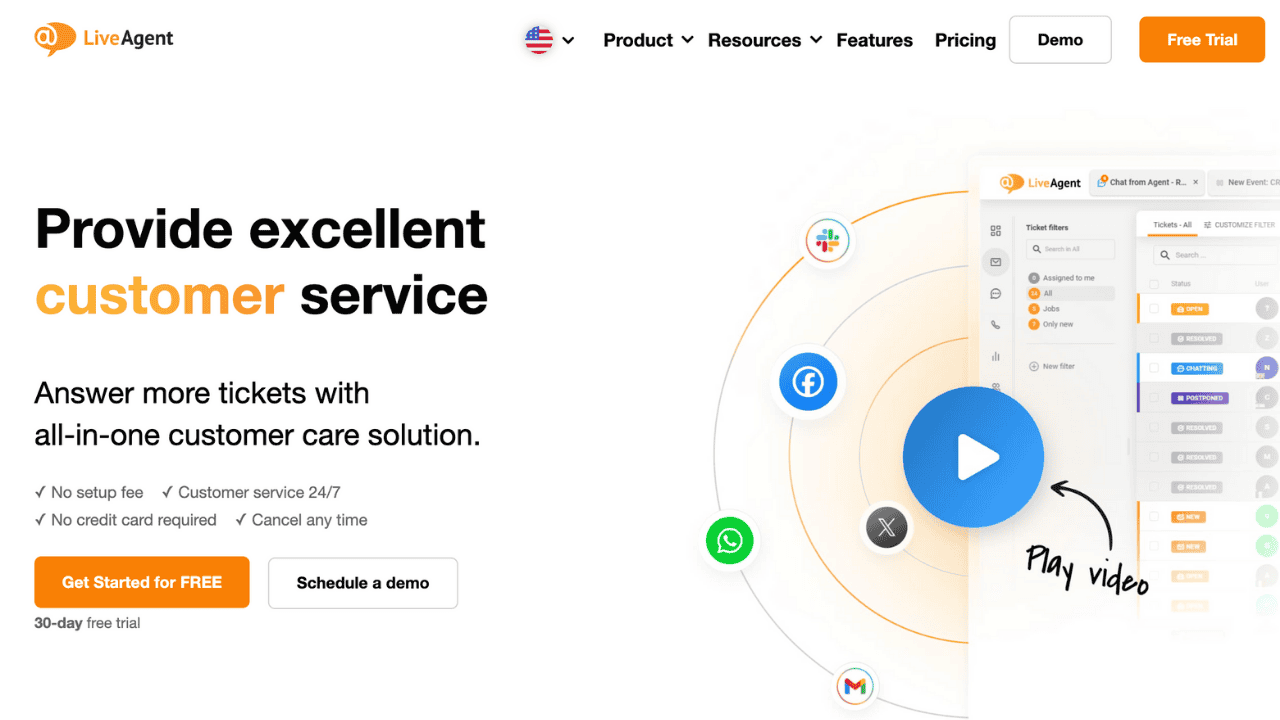
LiveAgent offers the best value on this list. It includes ticketing, live chat, call center, and basic AI at a fraction of competitor prices.
AI capabilities:
AI Answer Assistant enhances responses using ChatGPT.
AI Chatbot answers simple questions and transfers complex ones to human agents. Both features are included in all paid plans.
Pricing:
| Plan | Annual | Monthly | Key Features |
|---|---|---|---|
| Small Business | $15/agent | $19/agent | Ticketing, chat, knowledge base, AI features |
| Medium Business | $29/agent | $35/agent | + Call center, IVR, proactive chat, SLA |
| Large Business | $49/agent | $59/agent | + Social channels (FB, IG, Twitter, WhatsApp) |
| Enterprise | $69/agent | $85/agent | + Dedicated account manager, priority support |
Best for: Budget-conscious teams needing comprehensive features without premium pricing.
Pros:
- Best value pricing
- All-in-one included (call center, social, chat)
- 30-day free trial, no credit card
- Transparent pricing
Cons:
- AI less sophisticated than premium competitors
- Interface can feel dated
- Smaller integration ecosystem
6. Gladly
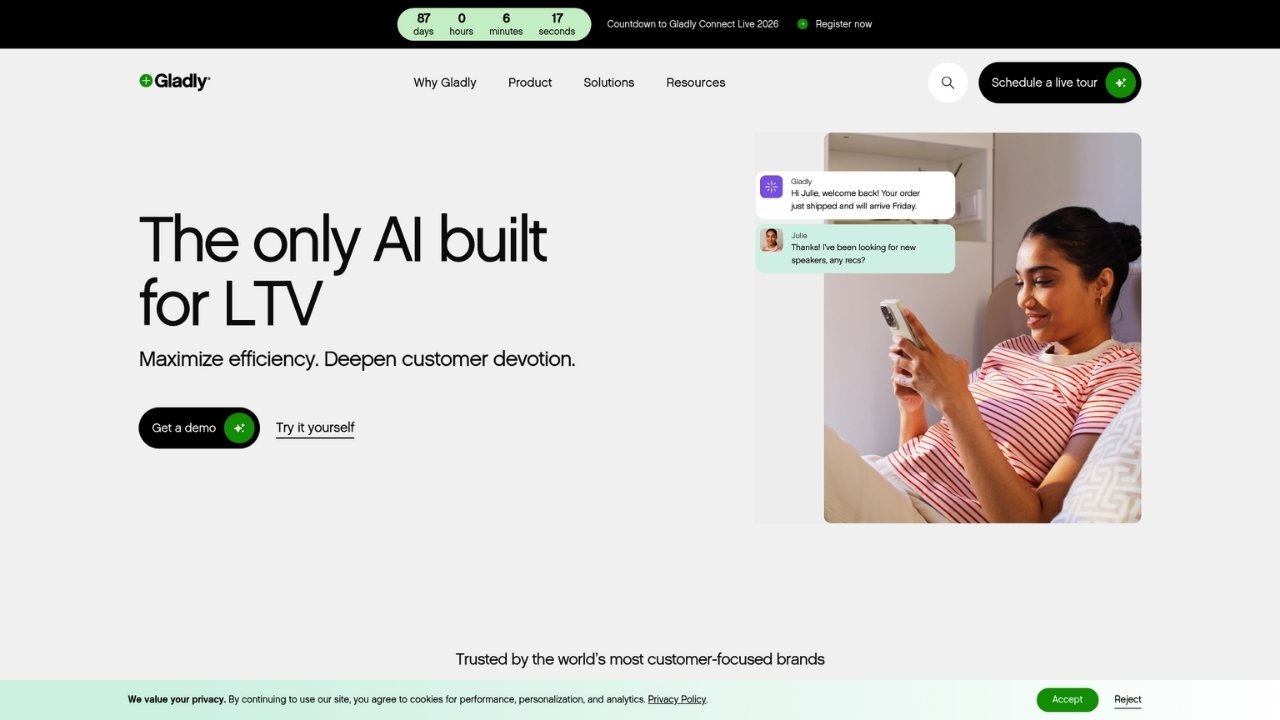
Gladly takes a different approach. It treats customers as people, not tickets. Used by Nordstrom, Crate & Barrel, and Allbirds.
AI capabilities:
Gladly AI resolves conversations or works alongside human agents.
The platform carries customer history across all channels, so every interaction has context. You write Guides in plain English to teach the AI your brand voice and when to escalate to humans.
Pricing:
All plans require contacting sales for custom quotes.
Best for: Retail and ecommerce brands focused on customer lifetime value over cost-cutting.
Pros:
- Conversation-based (no tickets)
- Built to increase LTV, not just cut costs
- Deep retail/ecommerce expertise
- Fast setup
Customer results:
- $510M+ saved with Gladly
- 240M+ conversations powered by AI
- 65% increase in CSAT
- 120% increase in revenue per call
Cons:
- No transparent pricing
- Different paradigm requires change management
- Primarily focused on retail
7. Help Scout

Help Scout is built for growing teams who want simplicity. It feels like email but with powerful support features.
AI capabilities:
AI Assist helps expand, shorten, edit, or translate text. AI Drafts creates replies based on past conversations and help content. s
AI Summarize condenses long conversations into bullet points. AI Answers (add-on at $0.75/resolution) provides an AI chatbot using your knowledge base.
Pricing:
| Plan | Annual | Monthly | Key Features |
|---|---|---|---|
| Free | $0 | $0 | Up to 5 users, 1 Inbox, 100 contacts/mo |
| Standard | $20/user | $25/user | Up to 25 users, 2 Inboxes, AI Inbox assistant |
| Plus | $40/user | $45/user | Up to 50 users, unlimited AI Drafts, Salesforce/Jira/HubSpot |
| Pro | $65/user | $75/user | Unlimited users, SSO, HIPAA, dedicated onboarding |
AI Answers add-on: $0.75 per resolution.
Best for: Small teams wanting simplicity without sacrificing AI capabilities.
Pros:
- Simple, email-like interface
- Transparent pricing
- Free tier available
- Customer-focused design
Cons:
- Fewer advanced features
- Limited omnichannel (no native phone/SMS)
- AI less advanced than Intercom/Forethought
AI capabilities compared: What actually works?
Not all AI is created equal. Here's how these tools compare on what matters.
Automated resolution rates:
| Tool | Claimed Resolution Rate | Notes |
|---|---|---|
| Intercom Fin | 73% | Head-to-head test winner |
| Tidio Lyro | 67% | Guaranteed 50% on Premium plan |
| Forethought | Varies | Outcome-based pricing |
| Zendesk AI | Varies | 5-15 included per agent/month |
| Others | Not specified | Basic AI assistance |
Training requirements:
- Intercom: Under 1 hour setup on existing help desk
- Zendesk: Moderate setup, works better with existing knowledge base
- Tidio: FAQ scraper auto-imports content
- Forethought: Claims days not months
- Gladly: Write Guides in plain English
- LiveAgent/Help Scout: Minimal setup for basic AI features
Human handoff:
All tools offer human escalation, but quality varies. Intercom and Gladly get praise for seamless transitions. Tidio and Help Scout make it easy but less sophisticated.
Pricing reality check: What you'll actually pay
Engaige at $10,000/month sets a high bar. Here's how the alternatives stack up for a team of 10 agents handling 1,000 AI-resolved conversations monthly.
| Tool | Monthly Cost (10 agents, 1,000 AI resolutions) |
|---|---|
| LiveAgent Small Business | $150 |
| Tidio Growth + Lyro | ~$300-400 |
| Help Scout Plus + AI Answers | $450 + $750 = $1,200 |
| Intercom Essential | $290 + $990 = $1,280 |
| Zendesk Suite Team | $550 + ~$1,500 = $2,050 |
| Forethought | Custom (likely $2,000+) |
| Gladly | Custom (likely $3,000+) |
Hidden costs to watch for:
- Per-resolution pricing (Intercom, Help Scout) adds up fast at volume
- Add-ons (Zendesk Copilot at $50/agent, advanced AI) inflate base prices
- Implementation fees for enterprise plans
- Integration costs for custom connections
Scaling costs:
Most tools charge per agent or per resolution. As your team grows, costs scale linearly. LiveAgent and Tidio offer the most predictable pricing. Intercom and Help Scout can surprise you if AI resolution volume spikes.
Which Engaige alternative should you choose?
Here's the straightforward breakdown.
Choose Intercom if: You want the most advanced AI and have the budget. Fin's 73% resolution rate is industry-leading. Just watch those per-resolution costs.
Choose Zendesk if: You need enterprise reliability and extensive integrations. It's the safe choice for large organizations.
Choose Tidio if: You're a smaller business or ecommerce store. The free tier lets you start without commitment, and Lyro handles most common questions well.
Choose Forethought if: AI automation is your absolute top priority. It's purpose-built for this, though you'll need to talk to sales.
Choose LiveAgent if: Budget matters most. At $15/agent, it's the best value while still including AI features.
Choose Gladly if: You're in retail or ecommerce and care about customer lifetime value. The conversation-based approach treats customers like people.
Choose Help Scout if: You want simplicity above all else. It feels like email but with AI assistance when you need it.
Getting started with AI-powered customer support
Switching from Engaige (or starting fresh) doesn't have to be painful. Here's how to approach it.
Start with free trials. Every tool on this list offers one. Test with your actual support data, not demo content. See how the AI handles your real customer questions.
Migration is usually straightforward. Most platforms offer import tools from Engaige, Zendesk, and other major help desks. Your ticket history and knowledge base can transfer over.
Implementation timeline:
- Week 1: Trial 2-3 tools with your data
- Week 2: Choose and purchase
- Week 3: Migrate data and configure
- Week 4: Train team and go live
What to expect in your first 30 days:
AI won't be perfect immediately. It needs to learn from your specific customers and products. Most tools show improvement within the first few weeks as the AI processes more interactions.
Start with AI handling simple, common questions. Gradually expand its scope as confidence grows. Keep humans handling complex or sensitive issues.
Ready to switch from Engaige? Explore how Ringly.io can help you build AI phone agents that integrate with your new support platform.
Frequently Asked Questions
What are the best Engaige alternatives for small businesses?
Tidio and Help Scout are the best options for small businesses. Both offer free tiers to get started. Tidio works especially well for ecommerce stores with its Shopify integration. Help Scout is ideal if you want a simple, email-like experience.
Which Engaige alternative has the best AI capabilities?
Intercom's Fin AI Agent leads in resolution rates at 73%. Forethought is also strong as an AI-native platform built specifically for automation. For most use cases, Tidio's Lyro at 67% resolution offers the best balance of capability and affordability.
Are there any free Engaige alternatives?
Yes. Tidio offers a free plan with 50 conversations and 100 Flow visitors. Help Scout's free plan includes up to 5 users and 1 Inbox. Both let you test AI features before committing to paid plans.
How do Engaige alternatives compare on pricing?
Engaige alternatives range from $15-69 per agent per month, with AI features often costing extra. LiveAgent starts at $15/agent. Intercom and Zendesk run $55-132 per seat. Most are significantly cheaper than Engaige's $10,000/month.
Can I use Engaige alternatives with my existing help desk?
Some work standalone, others integrate. Intercom's Fin can work with Zendesk, Salesforce, or other help desks. Forethought also integrates with existing systems. Most others (Tidio, Help Scout, LiveAgent) are complete replacements.
What should I look for when choosing an Engaige alternative?
Focus on resolution rate (how often AI actually solves problems), pricing model (per seat vs per resolution), ease of setup, and integration with your existing tools. Always test with a free trial using your real data before committing.
Also read: