


It costs $44,886 a year to hire just one support agent, and most of their day is wasted on the same three questions.
You are working hard to grow your brand, but your team is just dealing with basic tracking calls.
You know that if you don't find a better way to scale, your best people will burn out and your profits will sink.
This guide will go over how to write an eCommerce customer service job description that attracts top talent.
First, we will look at the key parts of a great job post.
Then, we will show you how to build a team that uses both humans and automation to grow faster.
Editor’s note: Want to hear some sample AI support calls made for your Shopify store?
- Just paste your store URL
- Hear sample calls for your store (no email required)
- Listen to demo AI calls for my store
What does an ecommerce customer service representative do?
Think of an e-commerce customer service representative as the main point of contact for your online brand.
They are responsible for making sure every customer has a smooth and positive experience, from the moment they land on your site to when they unbox their order.
Their main job is to answer customer questions and resolve issues quickly and kindly across channels like phone, email, and chat.
To do this well, they need to know your products inside and out, understand your e-commerce platform (like Shopify), and be comfortable with any customer service software you use. Their work has a direct impact on customer satisfaction and helps keep people coming back.
Key components of a standout ecommerce customer service job description
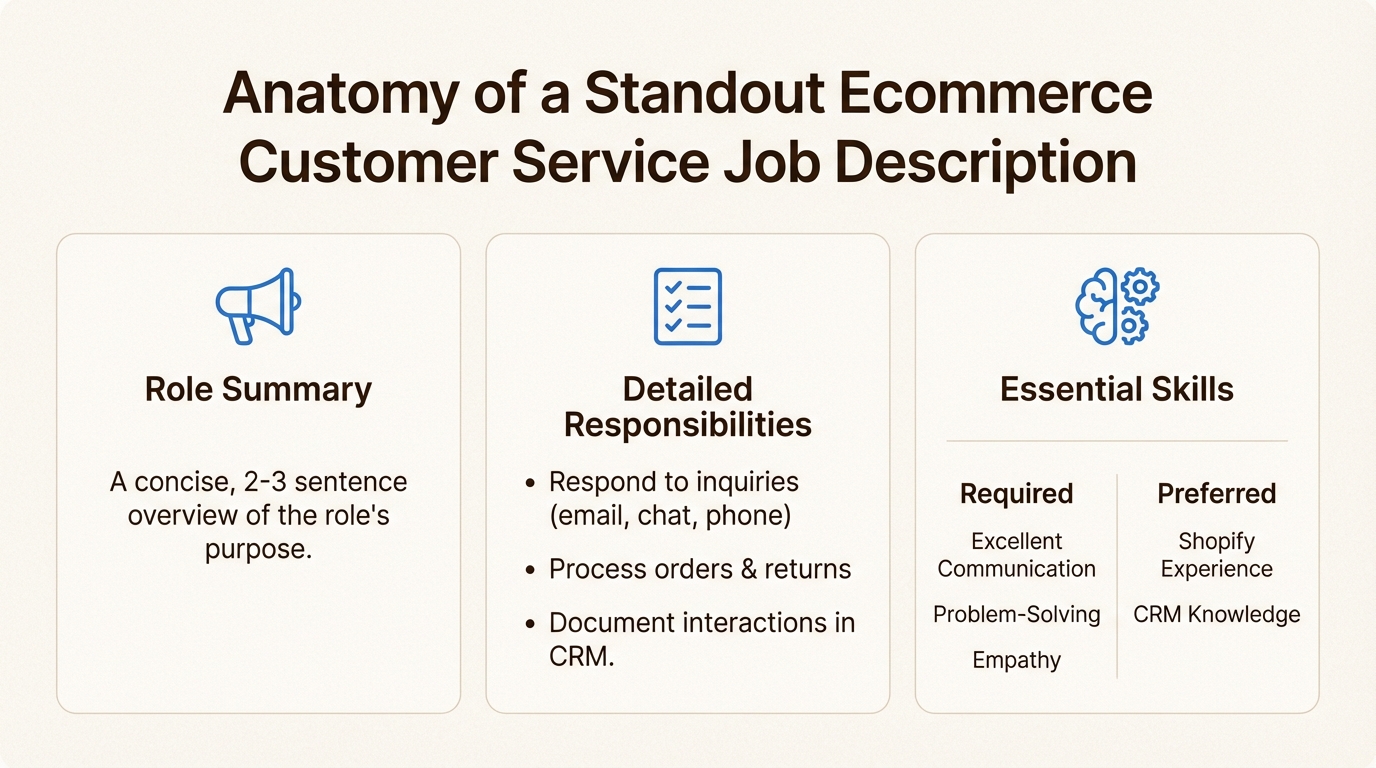
A great job description does more than just list tasks. It attracts the right candidates by setting clear expectations and giving them a feel for your company culture. Let's break down the essential sections.
Role summary
Start with a clear, concise summary of two or three sentences that outlines the purpose of the role. This is your chance to make a good first impression.
For example: "We're looking for an empathetic E-commerce Customer Service Representative to be the friendly voice of our brand. In this role, you'll make sure every customer feels heard, valued, and supported throughout their shopping journey."
Detailed responsibilities
This is where you get specific about the day-to-day tasks. Vague descriptions can lead to mismatched expectations, so be clear about what the job actually involves.
A good list of responsibilities might include:
- Responding to customer inquiries via email, chat, and phone about orders, shipping, returns, and product information.
- Processing orders, returns, and exchanges accurately within the e-commerce platform.
- Documenting all customer interactions and transactions in a CRM or ticketing system.
- Working with other teams, like logistics and billing, to resolve customer issues.
- Noticing patterns in customer feedback to help improve products and processes.
Essential skills
To attract a wider pool of talent, it’s helpful to split this section into "Required" and "Preferred" categories.
This helps candidates see where they stand and encourages those with strong potential to apply, even if they don't meet every single requirement.
Key skills usually include excellent written and verbal communication, strong problem-solving abilities, empathy, and attention to detail. It's also important to list any required experience with specific e-commerce platforms like Shopify or CRM systems.
Common challenges in e-commerce customer support
So you've written the perfect job description and hired a fantastic team. The problem is, even the best support teams run into roadblocks as an e-commerce business grows.
Here are a few common pain points:
- Scaling Costs: As order volume increases, so does the need for support. Hiring more agents is expensive, with the average salary for a representative around $44,886 per year.
- 24/7 Availability: Your customers shop at all hours, but providing round-the-clock human support is a huge operational and financial challenge for most businesses.
- Repetitive Inquiries: A large number of support queries are simple and repetitive, like "Where is my order?" These calls can lead to agent burnout and take time away from more complex issues. For many stores, an AI can handle up to 90% of these calls automatically.
- Training and Consistency: Getting every agent to provide the same on-brand answers every time takes a lot of training and ongoing management.
This reflects the reality of a growing e-commerce business. The volume and expectations can often challenge a purely manual approach.

Introducing the AI-powered team member
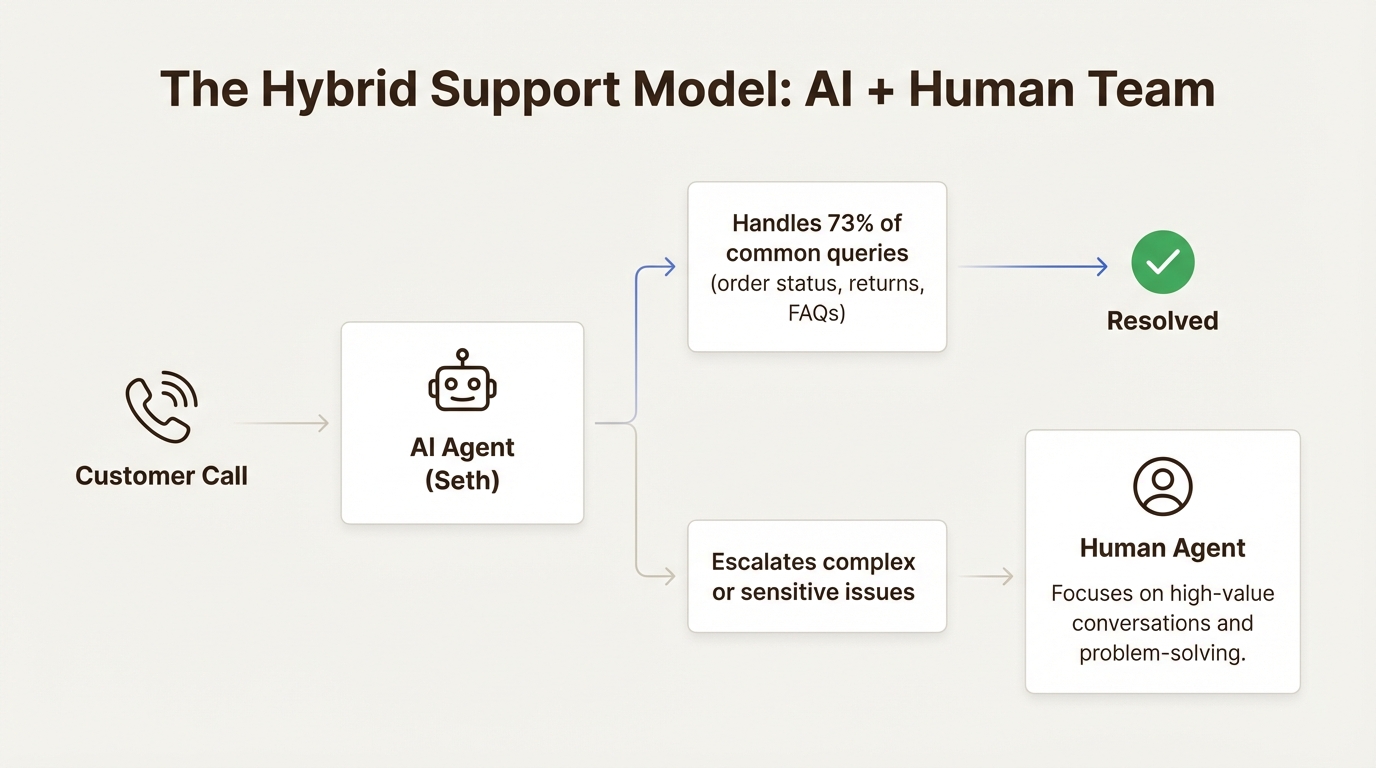
This is where an AI phone support representative comes in. Instead of thinking of it as a replacement, think of it as a specialized new team member designed to handle high-volume, repetitive tasks. This frees up your human agents to focus on the high-value work they do best.
For example, Ringly.io offers an AI agent named Seth that can be set up in under 1 hour. It’s designed to work alongside a human team.
The AI agent's role
To make it clearer, let’s frame the AI’s capabilities just like a job description. This helps show the exact role it plays on your team.
Responsibilities:
- Answer every single inbound customer call, 24/7, without missing one.
- Instantly look up order status and tracking information by integrating directly with Shopify.
- Process returns and exchanges automatically based on your store's policies.
- Answer frequently asked questions by referencing your website and knowledge base documents.
- Seamlessly escalate complex or sensitive calls to the human support team based on rules you set.
Key "skills" for this role include multilingual support in 30 languages, perfect recall of company policies, and tireless availability.
How AI complements your human team
An AI agent and a human team can work effectively together. The AI handles the majority of common, straightforward calls, which immediately reduces the queue and stress for your human agents.
They're no longer bogged down by answering "Where is my order?" fifty times a day.
This allows your team to dedicate their time and energy to building genuine customer relationships and solving tricky problems. Plus, tools like Ringly.io provide detailed call analytics and transcripts.
These insights help you identify common call trends, which you can use to train both your AI and your human agents more effectively.
Comparing the cost: Human agent vs. AI agent
It’s also helpful to look at a direct comparison of the investment. While both a human representative and an AI agent bring a lot of value, their cost structures are designed for very different purposes.
| Feature | Full-Time Human Agent | Ringly.io AI Agent (Seth) |
|---|---|---|
| Annual Cost | ~$45,000/year (average US salary) | $99/mo for the first 50 conversations, then $1.99 per conversation |
| Availability | ~40 hours/week | 168 hours/week (24/7) |
| Call Capacity | One call at a time | 15+ concurrent calls |
| Training Time | Weeks to months | 3 minutes to set up |
| Languages | Typically 1-2 | 40 out-of-the-box |
Ringly prices per conversation. The pricing page has the details. It also comes with a unique guarantee: If Seth resolves under 65% of calls in a month, that month comes back as credit (after 90 days on Pay per call).
For a deeper dive into the expectations and responsibilities of roles in this field, watching a detailed overview can be incredibly helpful.
The video below breaks down the core functions of an e-commerce professional, providing valuable context for anyone looking to hire or be hired for a customer service position.
This video breaks down the core functions of an e-commerce professional, providing valuable context for anyone looking to hire or be hired for a customer service position.
Building your modern support team
A strong ecommerce customer service job description is essential for hiring great people who can represent your brand with care.
But in today's market, the most effective way to scale support is with a hybrid model.
This model empowers your human agents by automating repetitive tasks that often lead to burnout. By combining the empathy of a great human team with the efficiency of an AI agent like the AI, e-commerce brands can deliver exceptional service that scales with their growth.
Ready to see how an AI agent can transform your phone support?
Give your customers 24/7 help and free up your team. You can try Ringly for free today, and it comes with a 30-day money back guarantee.
Frequently Asked Questions
What are the most important skills to list in an ecommerce customer service job description?
You should focus on a mix of soft and hard skills. Key skills include excellent written and verbal communication, problem-solving, empathy, and attention to detail. It's also wise to list any required experience with e-commerce platforms like Shopify or specific CRM software.
How can I make my ecommerce customer service job description stand out to attract better candidates?
To make your job description more appealing, go beyond a simple list of tasks. Briefly describe your company culture and explain how the role contributes to the company's mission. A clear, friendly tone helps attract candidates who are a good fit for your brand.
Should I include salary information in my ecommerce customer service job description?
Yes, it's generally a good idea. Including a salary range can attract more qualified applicants and saves everyone time by ensuring candidates' expectations align with what you're offering from the start.
What common mistakes should I avoid when writing an ecommerce customer service job description?
A common mistake is being too vague about daily responsibilities, which can lead to mismatched expectations. Another is creating a long list of "required" skills that might discourage great candidates. It's better to split skills into "required" and "preferred" categories.
How does using an AI agent affect the ecommerce customer service job description for my human team?
Using an AI agent shifts the focus of the human role. Your job description can highlight more complex problem-solving, customer relationship-building, and handling escalated issues, since the AI will manage most of the repetitive questions about order status or returns.