

Customer inquiries do not respect business hours. They pile up at 2 AM, during your busiest sale, and in the middle of family dinner. Customer service outsourcing companies exist to take that load off your plate, typically cutting support operating costs by 40-60% while covering you around the clock.
Phone support that pays for itself. Ringly answers your store's calls and resolves at least 65% of them, backed by a guarantee. Book a call to see it run on your store.
This guide ranks the 8 best customer service outsourcing companies for 2026, with real pricing, languages, compliance, and honest pros and cons for each. It covers 24/7 outsourcing, third party customer service for high-volume brands, how to keep your support tickets under control, and how to outsource customer service for a small business without losing quality. If you run a Shopify store and phone support is the part eating your margins, the top pick is built specifically for you.
The short answer: For Shopify and e-commerce brands, Ringly.io is the strongest pick. It is a done-for-you AI phone agent that resolves around 73% of inbound calls on its own, speaks 40+ languages, and only charges you once it resolves at least 65% of your calls. For large global enterprises that need thousands of human agents, Teleperformance remains the scale leader. For budget-conscious teams that want human agents, HelpSquad has the lowest entry price.

What is customer service outsourcing?
Customer service outsourcing means hiring a third party to handle your customer interactions instead of staffing them in-house. That can cover phone calls, email, live chat, social media replies, and back-office work like order processing and returns.
The model comes in several flavors:
- BPOs (Business Process Outsourcers) run full-scale contact centers with hundreds or thousands of agents
- Onshore providers operate in your home country for cultural alignment and easy communication
- Nearshore teams work in neighboring countries or regions with similar time zones
- Offshore providers operate in distant locations like the Philippines or India for cost savings
- GigCX platforms tap into networks of on-demand agents for flexibility
- AI phone agents resolve calls automatically and only loop in a human when the call needs one
Most businesses outsource for 24/7 coverage, access to specialized skills, handling seasonal spikes, or freeing up internal teams to focus on growth instead of the ticket queue.
How to choose a customer service outsourcing company
The right partner comes down to more than price. Here is what actually matters, roughly in the order it should weigh into your decision:
Volume and channel requirements (highest weight). Do you need phone support, or is email and chat enough? Are you handling 100 tickets a month or 100,000? Some providers specialize in high-volume call centers, others in digital channels, and AI agents in phone.
Resolution rate and quality. A cheap agent who escalates everything costs you more than a slightly pricier one who closes the ticket. Ask for first-contact resolution and CSAT numbers, not just headcount.
Language and timezone coverage. If your customers are global, you need multilingual support. If they are mostly US-based, you might prioritize American accents and business-hours coverage.
Industry expertise and compliance. Healthcare needs HIPAA. E-commerce needs PCI-DSS for payment security. Make sure your provider has experience in your category and the certifications to match.
Pricing model alignment. Hourly rates suit unpredictable volume. Per-ticket pricing aligns cost with demand. Dedicated teams make sense for consistent high volume. Outcome-based pricing (you pay when it resolves) shifts the risk onto the vendor.
Technology integration. Your partner should plug into your existing CRM, help desk, and store without forcing you to rebuild your stack.
Customer service outsourcing companies comparison
| Company | Starting Price | Best For | Languages | Key Strength |
|---|---|---|---|---|
| Ringly.io | Outcome-based (you pay when it resolves) | Shopify and e-commerce phone support | 40+ | AI agent resolves ~73% of calls, pay only past 65% resolution |
| Teleperformance | Custom (enterprise) | Fortune 500, global operations | 650+ | Massive scale, 50 years experience |
| Hugo Inc | ~$11/hour | Growth-focused startups | 60+ | College-educated agents, 30-day trial |
| Influx | Custom | Flexible, seasonal scaling | Multiple | Month-to-month contracts |
| HelpSquad | $8/hour or $185/month | Budget-conscious SMBs | Limited | Most affordable entry point |
| SupportYourApp | Custom | Tech, SaaS, compliance-heavy | 60+ | ISO 27001, PCI DSS certified |
| ShyftOff | Custom (25-55% savings) | US companies needing flexibility | English | GigCX model, pay for productive time only |
| EverHelp | Custom (per ticket or agent) | AI + human hybrid needs | 30+ | Flexible pricing models |

1. Ringly.io
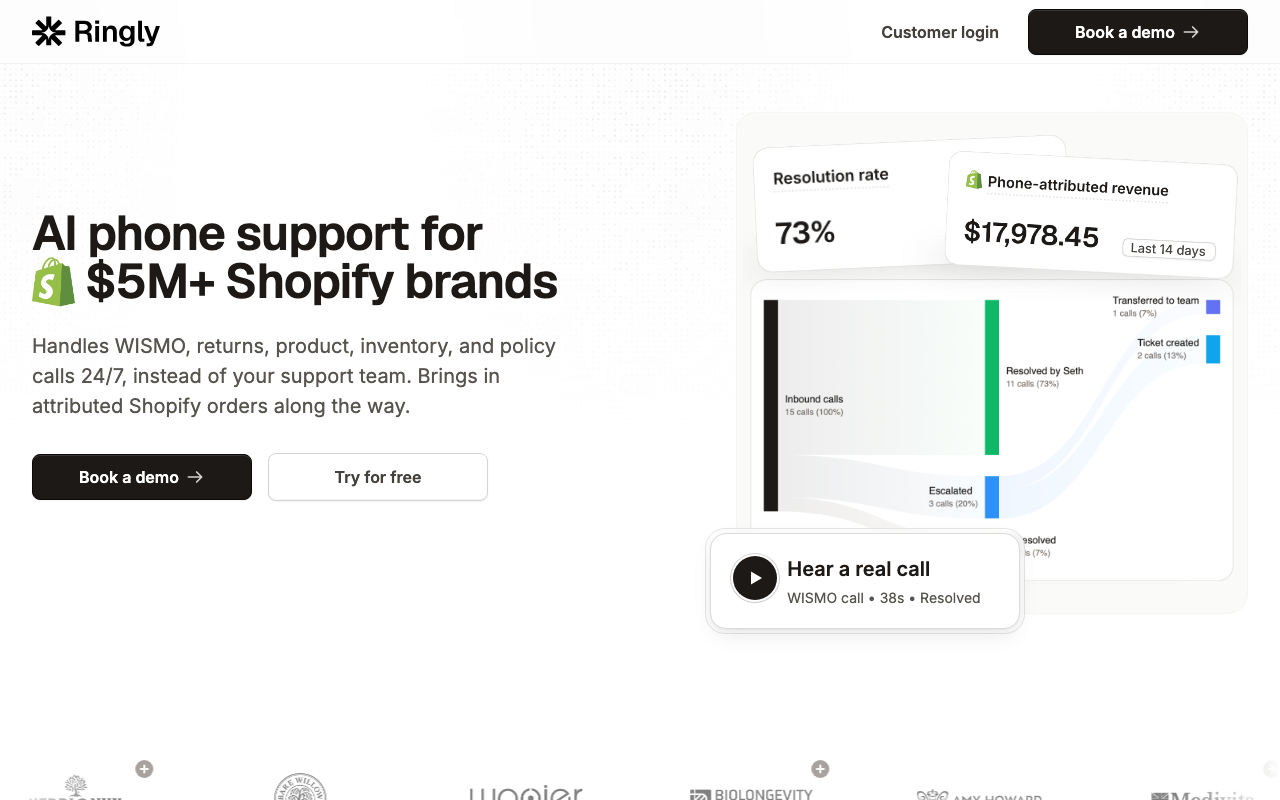
Ringly.io is a done-for-you AI phone agent built specifically for Shopify stores. Instead of staffing a team of human agents at $2,000+ per agent each month, you get an AI agent that picks up every call, 24/7, and resolves around 73% of them without a human touch. When a call genuinely needs a person, it hands off to your team.
It is the only option on this list where the AI handles order tracking, returns, exchanges, and FAQs by reading directly from your store, and it does it across 40+ languages. One store recovered $22k in orders that would otherwise have been lost to missed and abandoned calls.
What sets it apart is who carries the risk. Most outsourcers bill you per hour or per agent whether or not the work gets done. Ringly runs on a Resolution Promise: you only start paying once the agent resolves at least 65% of your calls. Setup is done for you, and most stores go live within 14 days.
Key strengths:
- Done-for-you setup, live in 14 days
- Resolves ~73% of inbound calls autonomously
- Resolution Promise: you only pay once it resolves at least 65% of your calls
- Speaks 40+ languages
- Trusted by 50+ Shopify brands
- Handles unlimited simultaneous calls with no hold queue
- Reads order and customer data straight from Shopify
Considerations:
- Focused on phone support for e-commerce, not a general-purpose human BPO
- Best fit for Shopify and DTC brands rather than enterprise call centers staffing hundreds of seats
Pricing: Outcome-based. Setup is done for you and you only pay once the agent resolves at least 65% of your calls. Final quote is set on the call based on your call volume.
Best for: Shopify and e-commerce brands where missed and repetitive phone calls are eating margin, and who want the vendor to carry the risk on whether it actually works.
2. Teleperformance

Teleperformance is the largest BPO on this list by a wide margin. With nearly 50 years in business, a physical presence in 165+ countries, and 86% of the Forbes Top 100 as clients, they operate at a scale few can match.
Their offering spans everything from traditional customer service to AI-powered solutions through their TP.ai platform. They support 650+ languages and dialects, which makes them a natural fit for truly global enterprises.
Key strengths:
- Unmatched global presence and language coverage
- Deep vertical expertise across automotive, banking, healthcare, retail, and technology
- Long-term client relationships (top 100 clients average 14 years)
- Human plus AI approach with proprietary technology
Considerations:
- Enterprise-focused, not suited for small businesses
- Requires custom pricing consultations
- Complex contracts compared to agile alternatives
Pricing: Custom enterprise pricing (contact sales)
Best for: Large enterprises with global operations needing comprehensive, long-term outsourcing partnerships.
3. Hugo Inc

Hugo positions itself as the premium choice for fast-growing digital brands. They have been recognized as the fastest-growing BPO company in 2023 and 2024 by Clutch, and their workforce consists entirely of college graduates with 3+ years of professional experience.
Their service covers the full omnichannel spectrum including phone, email, chat, social media, and in-app messaging. What sets them apart is their commitment to dedicated teams that work exclusively for your brand, never shared across clients.
Key strengths:
- 100% dedicated teams (no shared agents)
- 98% employee retention rate
- Month-to-month contracts with 24-hour scaling notice
- 30-day risk-free trial
- ISO 27001, SOC 2, HIPAA, and GDPR compliant
Considerations:
- Premium pricing may not fit ultra-low budgets
- Minimum team sizes apply
Pricing: From approximately $11/hour per agent, with month-to-month contracts and no setup fees.
Best for: Growth-focused startups and mid-market companies that prioritize quality and brand alignment over rock-bottom pricing.
4. Influx

Influx has built their reputation on flexibility. Their month-to-month pricing model means you are not locked into long-term contracts, and they can deploy teams in as little as one week.
They provide Level 1 and Level 2 support with dedicated team leads, and their client list includes brands like Dolby, ClassPass, and YAZIO. Case studies show strong results, with one client cutting first response time to a fraction of what it was during a period of rapid growth.
Key strengths:
- No long-term contracts required
- Rapid deployment (1 week possible)
- Brand-aligned agent training
- 94%+ CSAT scores reported by clients
- Nearshore teams for reliable coverage
Considerations:
- Custom pricing may be premium for very small businesses
- Less transparent pricing than some competitors
Pricing: Custom pricing based on volume and requirements (contact for quote)
Best for: Brands needing flexibility, seasonal scaling, or those who want to avoid long-term BPO commitments.
5. HelpSquad

HelpSquad offers the most accessible entry point on this list. Their virtual assistants and receptionists start at just $8 per hour, which puts professional customer support within reach of businesses that might otherwise struggle to afford it.
They offer three distinct live chat plans ranging from $185 to $600 per month, plus a pay-per-lead option where you only pay when they deliver qualified leads from your website.
Key strengths:
- Most affordable pricing ($8/hour entry point)
- Live chat specific pricing tiers
- Pay-per-lead option for risk-averse businesses
- HIPAA compliant for healthcare use cases
- 14-day free trial available
Considerations:
- Limited language support compared to global providers
- Smaller scale than enterprise BPOs
Pricing:
- Virtual assistants: $8/hour
- Virtual receptionists: $8/hour
- Live chat plans: $185-$600/month
- Pay-per-lead: From $5 per lead
Best for: Small to mid-sized businesses on a budget, healthcare providers needing HIPAA compliance, or companies focused primarily on live chat support.
6. SupportYourApp

With 15+ years in business and a client list that includes Calm, MacPaw, and Mastercard, SupportYourApp has established itself as a security-focused provider for tech companies. They are ISO/IEC 27001:2022 certified and PCI DSS Level 1 compliant.
Their AI solutions can automate up to 80% of routine inquiries, and they offer support in 60+ languages across all major channels. Their pricing tiers range from Essential (0.5-4 agents) to Enterprise (100+ agents).
Key strengths:
- Strong security credentials and compliance
- 60+ languages supported
- AI-powered automation capabilities
- Omnichannel coverage
- Proven track record with tech and SaaS companies
Considerations:
- Pricing requires consultation (not transparent)
- May not fit smaller budgets
Pricing: Custom pricing based on plan tier and requirements
Best for: Tech companies, SaaS businesses, and any organization where security compliance and data protection are non-negotiable.
7. ShyftOff

ShyftOff operates on a GigCX model, using a network of 200,000+ on-demand agents rather than traditional employees. Their workforce delivery platform uses AI to match the right agents to your needs in real time.
The key differentiator is their pricing model: you only pay for productive time (when agents are actually with customers, in queue, or doing after-call work). No paying for idle time or shrinkage.
Key strengths:
- 25-55% cost savings versus traditional BPOs
- Highly flexible scaling (3-5x surge capacity)
- 99% reliability rate
- 4.8/5 average quality rating
- PCI-DSS, HIPAA, SOC II, HITRUST, GDPR compliant
Considerations:
- US market focus only
- GigCX model may not suit all company cultures
Pricing: Custom pricing, billed only for productive hours (contact for quote)
Best for: US-based companies needing maximum flexibility, seasonal businesses with dramatic volume swings, or those looking to optimize costs without sacrificing quality.
8. EverHelp

EverHelp offers flexible pricing models that let you choose between per-ticket or per-agent billing. They have won multiple awards including the 2026 Stevie Award for sales and customer service.
Their three service tiers (Shared Team, Dedicated Team, and Talent Only) let you match the service level to your existing infrastructure. They support 30+ languages and maintain an average 28-day time-to-hire.
Key strengths:
- Flexible pricing (per ticket or per agent)
- 1,000+ support agents in their network
- AI integration available
- Fast 4-week launch timeline
- Strong client testimonials (Grubhub, Airtable)
Considerations:
- Less brand recognition than major BPOs
- No public pricing (all plans require contact)
Pricing: Custom pricing based on chosen model (Shared, Dedicated, or Talent Only)
Best for: Companies wanting flexible pricing models, businesses with established support infrastructure, or those seeking an AI plus human hybrid approach.
Human BPO vs AI phone agent: which makes sense for you?
The biggest shift in customer service outsourcing for 2026 is that AI is no longer just a feature bolted onto a human BPO. For phone support in particular, an AI agent can now resolve the bulk of routine calls on its own, which changes the math.
A human BPO bills you per agent or per hour regardless of how many tickets actually close. You also carry the management overhead: hiring cycles, training, ramp time, attrition, and quality monitoring. That is the right trade when calls are complex, highly regulated, or need a human relationship.
An AI phone agent flips the model. There is no headcount to manage, it handles unlimited calls at once with no hold queue, and the better ones tie price to outcomes so you pay for resolved calls rather than seats. For high-volume, repetitive e-commerce calls (where is my order, can I return this, change my address), that is usually the cheaper and faster path. The practical answer for many brands is both: an AI agent for the routine majority, a small human team for the complex tail.
Key takeaways: choosing your outsourcing partner
The right customer service outsourcing company depends entirely on your situation:
- E-commerce phone automation → Ringly.io resolves the majority of calls with an AI agent and only charges once it clears 65% resolution
- Enterprise with global operations → Teleperformance offers unmatched scale and language coverage
- Growth-focused digital brands → Hugo Inc or Influx provide flexibility and quality
- Budget-conscious SMBs → HelpSquad delivers professional support at the most accessible price point
- Compliance-heavy industries → SupportYourApp brings the certifications and security credentials
- Flexible US staffing → ShyftOff's GigCX model offers strong agility
- AI plus human hybrid → EverHelp provides flexible pricing and AI integration
Start with a clear read on your volume, channels, and budget, then request trials or pilots from 2-3 providers that match your criteria. Most reputable companies offer some form of trial, which lets you test the fit before committing long-term.
Frequently Asked Questions
What is the best customer service outsourcing company?
It depends on what you need. For Shopify and e-commerce brands where phone support is the pain, Ringly.io is the strongest pick because its AI agent resolves around 73% of calls on its own and you only pay once it clears 65% resolution. For large global enterprises staffing hundreds of human agents, Teleperformance leads on scale. For the lowest entry price with human agents, HelpSquad starts at $8/hour.
How much do customer service outsourcing companies typically charge?
Pricing varies widely by model and location. Hourly rates range from $7-$15 for offshore teams to $25-$35+ for onshore US agents. Per-agent monthly costs typically fall between $2,000-$3,500. Some providers like HelpSquad offer entry points as low as $8/hour or $185/month for live chat. AI phone agents like Ringly.io use outcome-based pricing instead, where you only pay once the agent resolves at least 65% of your calls.
What is the largest customer service outsourcing company?
Teleperformance is currently the largest BPO by headcount and global presence, with hundreds of thousands of employees across 165+ countries and 86% of the Forbes Top 100 as clients.
How quickly can I get started with a customer service outsourcing company?
Deployment timelines range from 1 week (Influx) to 4-6 weeks (traditional enterprise BPOs). AI-powered options like Ringly.io are done-for-you and most stores go live within 14 days, since there are no agents to hire and train.
Are there customer service outsourcing companies for small businesses?
Yes. HelpSquad specializes in SMBs with affordable entry points. Hugo Inc and Influx also work with smaller companies, though they typically have minimum team sizes. For small e-commerce stores specifically, an AI phone agent like Ringly.io is often more cost-effective because there is no per-agent cost.
Can customer service outsourcing companies handle technical support?
Many can, but capabilities vary. SupportYourApp and Hugo Inc specifically highlight technical support. When evaluating providers, ask about their experience with your product category and whether they offer tiered support (Level 1 for basic issues, Level 2 for complex technical problems).