
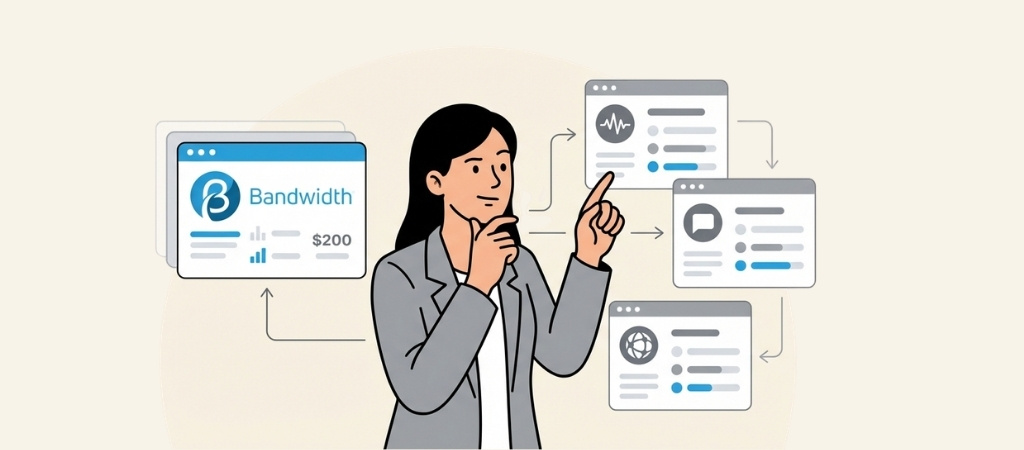
The strongest Bandwidth alternatives for voice and SMS are Telnyx, Twilio, and Plivo, which offer flexible CPaaS APIs with usage-based pricing. Ringly.io fits a narrower need: it is a done-for-you AI phone agent for Shopify and DTC stores that answers inbound support calls 24/7 and escalates the rest, billed by usage minutes.
Finding the right communications platform can make or break your customer experience.
While Bandwidth has been a staple in the CPaaS market for years, many businesses are discovering that its enterprise-focused model doesn't fit their needs.
Research shows that opaque pricing, complex contracts, and inconsistent support are the main drivers pushing companies to explore other options.
This guide compares 6 top Bandwidth alternatives that offer better flexibility, transparent pricing, and faster setup times.
Whether you're building AI phone agents, automating SMS notifications, or scaling customer support, these options deserve your consideration.
Editor’s note: Want to hear some sample AI support calls made for your Shopify store?
- Just paste your store URL
- Hear sample calls for your store (no email required)
- Listen to demo calls for my store

What are the best Bandwidth alternatives in 2026?
Bandwidth is a cloud communications platform that provides voice, messaging, and 911 access APIs for businesses. The company owns large portions of its underlying network, including PSTN interconnects and E911 routing infrastructure. This ownership gives Bandwidth advantages in domestic reliability and regulatory compliance.
The platform works well for large enterprises with steady, high-volume traffic. Companies that value stability and have the resources to navigate complex contracts often find Bandwidth works for them.
However, Bandwidth's model creates barriers for smaller or fast-moving teams. Minimum monthly commitments typically fall between $2,500 and $10,000 depending on traffic mix. Approval cycles for STIR/SHAKEN, toll-free verification, and messaging compliance often stretch 3-8 weeks. Support follows an enterprise-first model, so teams without large spend don't get SLA-level handling.
Why Consider Bandwidth Alternatives?
Several factors are pushing businesses to evaluate other options:
Pricing transparency. Wholesale rates shift with destination mix, routing paths, and concurrency peaks. This unpredictability makes budgeting tough for SaaS platforms, seasonal call centers, and early-stage products.
Setup speed. Many alternatives offer activation within hours, not weeks. When you're launching a new product or running a time-sensitive campaign, waiting 3-8 weeks for approvals isn't an option.
Global coverage. Bandwidth leans heavily toward the United States. If your customers are international, you'll want providers with broader geographic reach.
Support accessibility. Smaller businesses often struggle with tiered ticket queues and can't easily reach engineers who can diagnose route-level failures.
The alternatives below address these gaps while maintaining the reliability you need for customer communications.
Bandwidth Alternatives Comparison
| Provider | Voice (make) | Voice (receive) | SMS | Min Commit | Countries | Free Trial |
|---|---|---|---|---|---|---|
| Telnyx | Custom | Custom | Volume-based | None | 30+ | Yes |
| Twilio | $0.014/min | $0.0085/min | $0.0083/msg | None | 180+ | Yes |
| Plivo | $0.0055/min | $0.0030/min | $0.0077/msg | None* | 190+ | Yes |
| Vonage | $0.01446/min | Varies | $0.00809/msg | None | 50+ | Yes |
| Sinch | Varies | Varies | Varies | None | 25 (voice) | Yes |
| Infobip | Varies | Varies | Varies | None** | 200+ | Yes |
*Plivo Professional limited to $2,500/month usage. **Infobip has minimum commitment fees in some regions for specific channels.
1. Telnyx
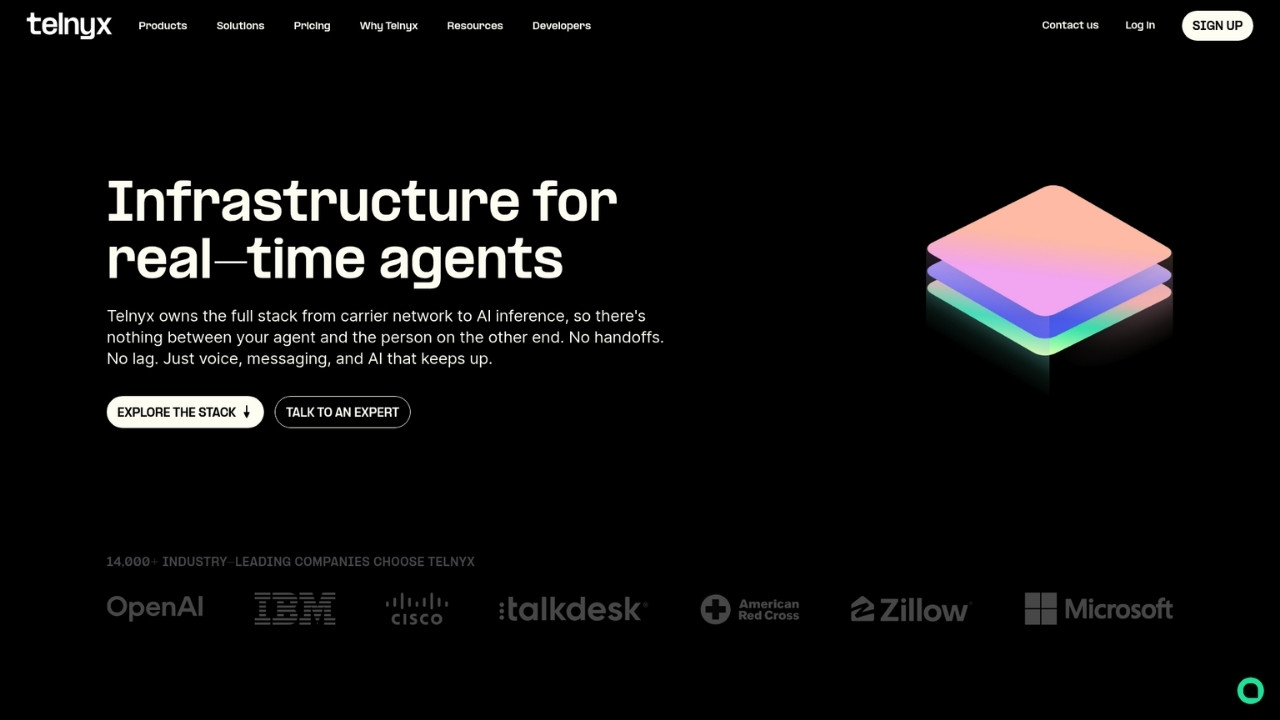
Telnyx operates a private global network with bare-metal fiber and direct peering across regions. Unlike competitors that abstract over other providers' foundations, Telnyx owns the full telephony stack from carrier network to AI inference.
The platform positions itself as "agent-native," meaning it was built specifically for Voice AI agents rather than retrofitted from traditional CPaaS products. This shows in their sub-500ms end-to-end latency and co-located edge PoPs with GPUs for processing voice data.
Key strengths:
- Private MPLS-like backbone for consistent low latency
- No minimum commitments with pay-as-you-go pricing
- 40+ languages supported with real-time multilingual transcription
- 24/7 free in-house support via chat or call
- ISO 27001, SOC 2, GDPR, and PCI DSS compliant
Best for: Technical teams that want infrastructure control, AI/ML companies building voice agents, and organizations that need low-latency communications.
Considerations: Advanced features require telecom expertise to fully leverage. If you just need basic SMS, this might be more platform than you need.
2. Twilio

Twilio is the market leader in cloud communications, serving over 335,000 companies including Spotify, Reddit, Instacart, and Atlassian. The platform combines communications APIs with AI and first-party data, making it a comprehensive customer engagement solution.
The company was named a Leader in the 2025 Gartner Magic Quadrant for CPaaS. Their 99.95% uptime SLA with automated failover gives enterprises the reliability they need.
Key strengths:
- Most mature ecosystem with extensive documentation
- SDKs in Python, C#, PHP, Ruby, Java, and JavaScript
- Comprehensive channel support: SMS, MMS, RCS, WhatsApp, Voice, Email, Video
- Elastic SIP trunking at competitive rates
- No credit card required for free trial
Pricing highlights:
- SMS: $0.0083/message
- Voice (receive): $0.0085/min
- Voice (make): $0.014/min
- WhatsApp: $0.005/message
Best for: Developer-heavy teams that want speed of iteration, companies that need comprehensive customer engagement platforms, and organizations scaling globally.
Considerations: Pricing carries a 20-40% markup over wholesale rates. Cost volatility at high volumes can surprise teams that aren't monitoring usage closely.
3. Plivo
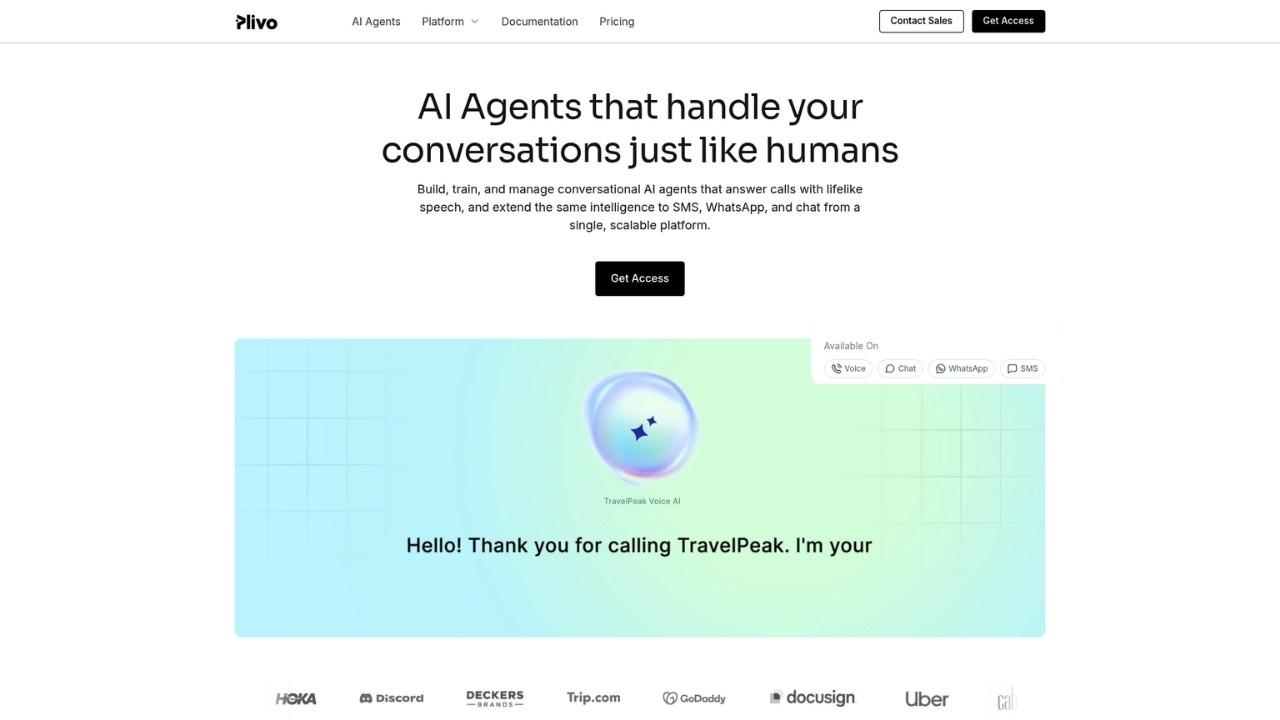
Plivo is an AI-first communications platform recognized as the #1 Leader in Gartner Peer Insights Customers' Choice for Global CPaaS 2023. The platform processes over 1 billion conversations annually with 99.99% uptime.
What sets Plivo apart is its focus on autonomous AI agents. Their Vibe Agent Builder lets you create conversational AI agents across Voice, Chat, SMS, and WhatsApp without writing code. The platform includes built-in telephony, so you don't need third-party providers.
Key strengths:
- AI agent builder with no-code interface
- Competitive voice rates: $0.0055/min to make calls, $0.0030/min to receive
- Voice AI agents at $0.045/min
- Direct integrations with Shopify, Calendly, and Zendesk
- Easy migration path from Bandwidth with familiar API structures
Pricing structure:
- Professional: Start free, pay as you go, limited to $2,500/month usage
- Enterprise: From $1,000/month with custom pricing and volume discounts
Best for: Cost-conscious businesses, companies building AI-powered customer service, and teams that want quick deployment without heavy engineering resources.
Considerations: Smaller ecosystem than Twilio means fewer third-party integrations and community resources.
4. Vonage
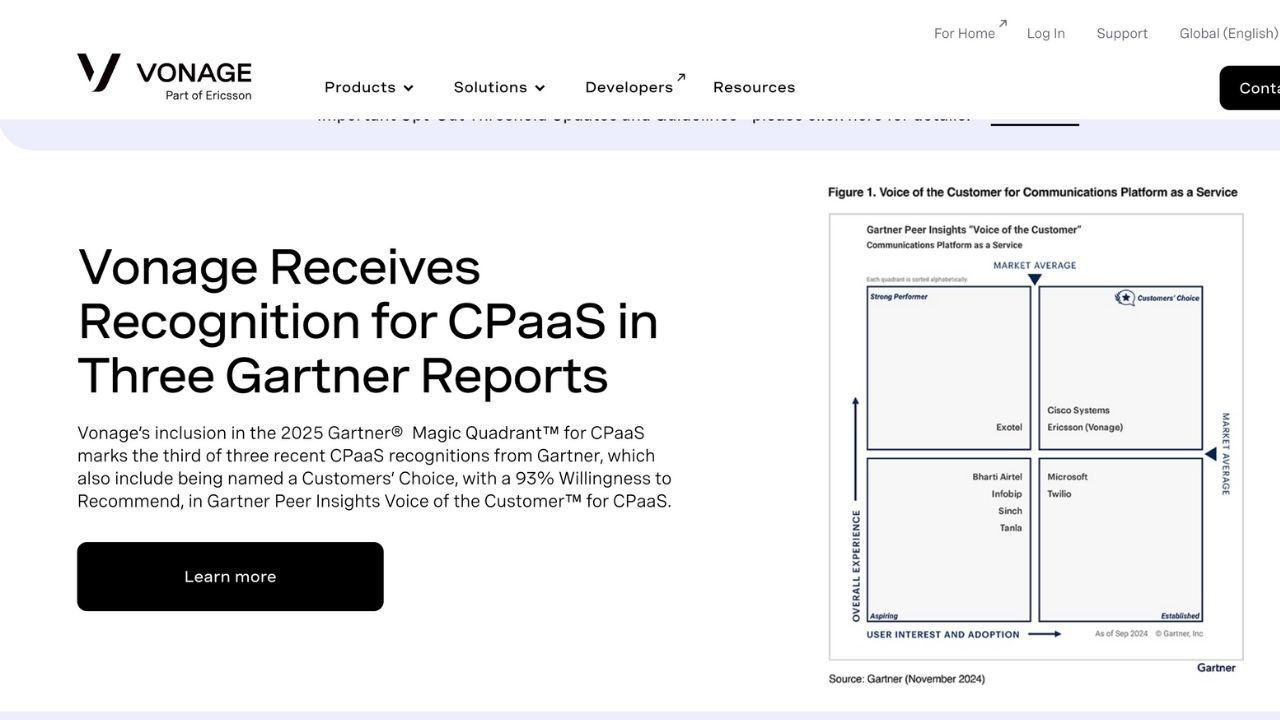
Vonage provides enterprise-grade communications APIs with a focus on comprehensive solutions. The platform offers true per-second billing globally, which can lead to significant savings for high-volume operations.
The company's Video API and In-App Voice capabilities are particularly strong, making it a good choice for businesses that need to keep conversations within branded applications.
Key strengths:
- True per-second Voice API billing across the globe
- Patented Verify API for 2FA with pay-only-for-success pricing
- Elastic SIP trunking eliminates expensive pre-provisioning
- Strong video capabilities with broadcasting and recording
- In-App Messaging for branded chat experiences
Pricing highlights:
- SMS: $0.00809/message
- Voice (PSTN): $0.01446/minute
- Video: $0.0041/minute
- Verify: $0.05720 per successful verification
Best for: Enterprises that need comprehensive communications stacks, companies that require video capabilities, and organizations that want per-second billing precision.
Considerations: Complex pricing structure with multiple products. Enterprise sales process can slow down evaluation for smaller teams.
5. Sinch
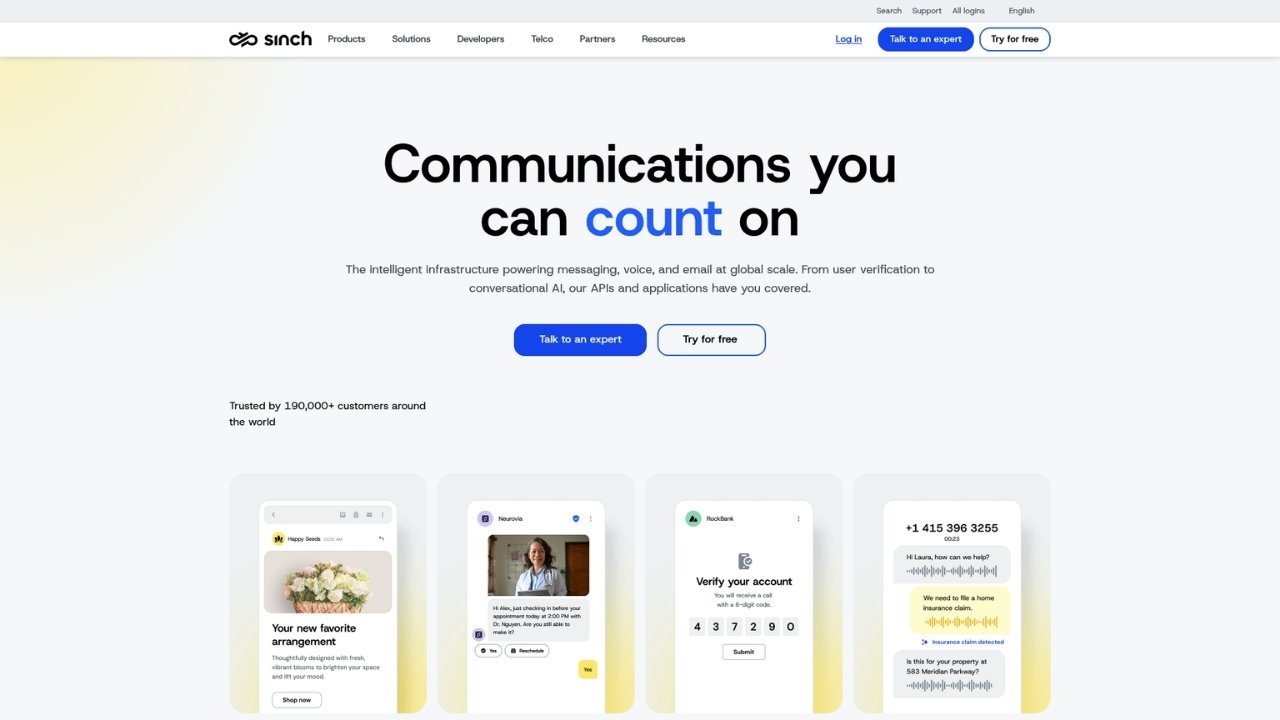
Sinch is a global messaging leader with strong presence in APAC and European markets. The platform offers transparent pay-as-you-go pricing with automatic volume discounts as you scale.
While Sinch provides voice services, their strength lies in messaging. The company offers excellent SMS delivery rates worldwide and supports RCS for richer messaging experiences.
Key strengths:
- Global SMS with high delivery rates
- Strong APAC and European coverage
- Transparent pricing with no hidden fees
- WhatsApp Business API support
- Volume discounts applied automatically
Best for: Global messaging-heavy use cases, APAC-focused businesses, and companies that need high SMS delivery rates with transparent pricing.
Considerations: Voice coverage limited to 25 countries versus Bandwidth's 65+. Multiple portals from acquisitions can create a fragmented experience.
6. Infobip
Infobip is an omnichannel communications platform offering SMS, Email, Viber, WhatsApp, Voice, and more across 200+ countries. The company holds a 4.6/5 rating on Gartner and maintains strong presence in European markets.
The platform provides both pay-as-you-go channel access and monthly subscription plans for complete communication hubs. Their conversational modules include Moments for marketing automation, Answers for chatbot building, and Conversations for contact center management.
Key strengths:
- True omnichannel: SMS, Email, Voice, WhatsApp, Viber, RCS
- Conversational modules for marketing and support
- 200+ countries and territories covered
- Flexible pricing: both pay-as-you-go and subscription options
- Strong European infrastructure
Pricing structure:
- Moments: From €49/month for marketing automation
- Answers: From €99/month for chatbot builder
- Conversations: €39/seat/month for contact center
- Channel usage billed separately based on volume
Best for: Businesses that want unified communications platforms, European companies, and organizations that need omnichannel capabilities with marketing automation.
Considerations: Enterprise-focused pricing can be complex. Minimum commitment fees apply in some regions for specific channels like Viber.
How to Choose the Right Bandwidth Alternative
Selecting the right provider depends on your specific needs:
For quick setup and AI focus: Plivo or Telnyx offer the fastest paths to production, especially if you're building AI-powered experiences.
For developer-heavy teams: Twilio provides the most mature ecosystem, extensive documentation, and broadest channel support.
For global messaging: Sinch or Infobip excel at SMS delivery worldwide with strong international presence.
For enterprise communications: Vonage offers comprehensive solutions with video capabilities and per-second billing.
Budget considerations: Plivo offers the most competitive voice rates. Twilio provides predictable pricing but at a premium. Telnyx and Sinch offer volume discounts that reward growth.
Getting Started with AI Phone Support
If you're specifically looking to automate phone support for your business, there's another option worth considering. At Ringly.io, Ringly.io offers an AI phone support agent designed for e-commerce businesses.
The AI handles inbound calls 24/7, answering questions, looking up orders, processing returns, and escalating to your team only when necessary. Unlike building your own solution on top of CPaaS APIs, the AI works out of the box with deep Shopify integration.
Our platform resolves up to 90% of calls without human intervention. Most stores go live within an hour, not weeks, and you can try it for free.
If you're evaluating Bandwidth alternatives because you need better phone support, try Ringly for free and see how AI-native phone support compares to traditional CPaaS solutions.
Frequently Asked Questions
Which Bandwidth alternative offers the best pricing for small businesses?
Plivo offers the most competitive rates for voice calls at $0.0055/min to make and $0.0030/min to receive, with no minimum commitments on their Professional plan. For SMS-heavy use cases, Twilio and Plivo have similar rates around $0.008 per message.
Can I migrate my existing Bandwidth phone numbers to these alternatives?
Yes, all major Bandwidth alternatives support number porting. Plivo specifically mentions easy migration from Bandwidth with familiar API structures. Telnyx and Twilio also offer streamlined porting processes.
Which alternative is best for building AI voice agents?
Telnyx positions itself as the only 'agent-native' platform with sub-500ms latency and co-located GPUs. Plivo offers a no-code Vibe Agent Builder specifically for AI agents. Twilio provides ConversationRelay at $0.07/min for integrating voice AI.
Do these alternatives offer better global coverage than Bandwidth?
Yes. While Bandwidth covers 65+ countries, Infobip reaches 200+ countries, Plivo covers 190+, and Twilio serves 180+ countries. Sinch and Telnyx have stronger presence in APAC and Europe respectively.
Which Bandwidth alternative has the fastest setup time?
Plivo and Telnyx both offer setup within hours. This compares favorably to Bandwidth's 3-8 week approval cycles for compliance and verification.
Are there any free trials available?
Yes, all six alternatives offer free trials. Twilio and Vonage don't require credit cards to start. Plivo, Telnyx, Sinch, and Infobip also provide trial access with free credits for testing.