


The CPaaS market is booming. Projected to hit $72.4 billion by 2035, cloud communications have become essential infrastructure for modern businesses.
Yet many teams that started with Plivo find themselves hitting walls as they scale.
I spent the last few weeks testing the leading Plivo alternatives to see which ones actually deliver.
The issues with Plivo are well-documented: support tickets that go unanswered for days, no formal uptime SLA, and surprise bills for messages that never reached their destination.
When your business depends on reliable communications, these aren't minor inconveniences. They're dealbreakers.
This guide breaks down 7 Plivo alternatives that solve these problems.
Each one was evaluated on pricing transparency, reliability, support quality, and feature breadth.
Whether you're looking to cut costs, improve delivery rates, or get better support, there's an option here that fits.
Editor’s note: Want to hear some sample AI support calls made for your Shopify store?
- Just paste your store URL
- Hear sample calls for your store (no email required)
- Listen to demo calls for my store

What is Plivo and why consider alternatives?
Plivo launched in 2011 as a straightforward API for SMS and voice. It's built a solid reputation for simplicity and global reach, with connections to carriers in nearly 200 countries. For small teams getting started with programmatic communications, it works well enough.
The pay-as-you-go model keeps initial costs low. You can rent local phone numbers internationally, send SMS messages, and handle basic voice calls without committing to contracts. The REST API is clean and the documentation gets you up and running quickly.
But the cracks start showing as you grow. Here's what drives teams to look elsewhere:
- Support gaps: Non-enterprise customers report long delays and unresponsive tickets
- No SLA: There's no formal uptime guarantee, which creates uncertainty for mission-critical operations
- Compliance burden: US A2P/10DLC registration sits entirely on your shoulders
- Hidden costs: Users report paying for undelivered messages and dealing with faulty SMS templates that split messages unexpectedly
If you're running light workloads and don't need real-time support, Plivo might still work. But if communications are central to your business, you need something more robust.
How I evaluated these Plivo alternatives
Every provider on this list was tested against the same criteria:
- Pricing transparency: Clear per-message rates without hidden fees
- Reliability: Uptime SLAs and delivery rate guarantees
- Support quality: Response times and availability (24/7 vs business hours)
- Feature breadth: SMS, voice, WhatsApp, and other channels
- Ease of integration: API quality, documentation, and SDK availability
- Global coverage: International reach and local number availability
I also looked at real user feedback from G2, Gartner, and Reddit to catch issues that don't show up in marketing materials.
Quick comparison: Plivo alternatives at a glance
| Provider | Best For | US SMS Rate | Key Strength |
|---|---|---|---|
| Twilio | Multi-channel dev teams | $0.0083 | Broadest ecosystem |
| Telnyx | Cost-conscious developers | $0.0025 | Lowest rates, network control |
| Bird | Omnichannel engagement | $0.0075 | Multi-channel flows |
| Vonage | UC + API hybrid needs | $0.00809 | Unified communications |
| Bandwidth | High-volume US voice | $0.004 | Carrier-grade infrastructure |
| Messente | Global SMS/WA/Viber | Varies by country | 98% delivery rates |
| Sinch | Enterprise messaging | Custom | Scale and verification |
1. Twilio

Twilio is the 800-pound gorilla of CPaaS. Founded in 2008, they've built the most comprehensive communications platform on the market. When developers think of SMS or voice APIs, Twilio is usually the first name that comes to mind.
Their feature set is unmatched. You get SMS, MMS, RCS, voice calling, WhatsApp Business API, video, email through SendGrid, and even a full contact center platform called Twilio Flex. The documentation is excellent, with sample code in dozens of languages and a massive developer community.
Pricing sits at a premium. US SMS messages cost $0.0083 to send or receive. Voice calls run $0.014 per minute outbound and $0.0085 inbound. Those rates aren't the highest on the market, but they're far from the lowest. Twilio makes up for it with reliability: they offer a 99.95% uptime SLA with automated failover.
The ecosystem is Twilio's real moat. Need to verify phone numbers? There's Lookup. Building two-factor auth? Verify API handles it. Want AI-powered voice interactions? ConversationRelay integrates voice AI into your stack. Almost any communications use case has a pre-built solution.
Pros
- Broadest API ecosystem in the industry
- Excellent documentation and community support
- 99.95% uptime SLA
- Multi-region redundancy
- SOC 2, GDPR, HIPAA compliance
Cons
- Premium pricing compared to alternatives
- Complex pricing with many add-ons
- Limited free support (paid plans available)
- Can be overwhelming for simple use cases
Verdict: Twilio is the safe choice if you need comprehensive communications capabilities and have the budget. It's overkill for basic SMS needs, but hard to beat for complex multi-channel applications.
2. Telnyx
Telnyx positions itself as the developer-friendly alternative to Twilio, and the pricing backs that up. At $0.0025-$0.004 per SMS segment, they're roughly half the cost of Twilio for messaging.
The company operates its own private global IP network. That might sound like technical fluff, but it matters for reliability and cost. By not relying on third-party carriers, Telnyx can offer lower rates and troubleshoot issues at a deeper level.
Support is a standout feature. Every customer gets free 24/7 access to in-house engineers via chat or phone. No ticketing queues, no "contact sales for help." This directly addresses one of the biggest complaints about Plivo.
The feature set covers the essentials: messaging (SMS, MMS, WhatsApp), voice API, SIP trunking, number lookup, verify API, fax, and even IoT SIM connectivity. The Mission Control portal is clean and well-designed, though the platform remains developer-centric.
Pros
- Lowest SMS rates among major providers
- Free 24/7 in-house support
- Owns and operates private network
- Real-time analytics and detailed reporting
- Strong developer community (Slack channel)
Cons
- Developer-focused (not no-code friendly)
- Number porting can be slow
- Coarse access controls in portal
- Smaller ecosystem than Twilio
Verdict: If you're technical and want Twilio-like capabilities at half the price, Telnyx is the obvious choice. The support quality alone makes it worth considering over Plivo.
3. Bird
Bird (formerly MessageBird) rebranded in 2024 with a focus on AI-native customer engagement. While they still offer the core messaging APIs, they've expanded into CRM-style tools for marketing, sales, and support teams.
The platform spans SMS, WhatsApp, email, push notifications, and RCS. A visual flow builder lets non-developers create automation workflows. The CDP (Customer Data Platform) unifies customer data across channels.
Pricing for US SMS starts at $0.0075 per segment, competitive with Twilio. WhatsApp messages run $0.005 plus vendor fees. The pay-as-you-go model has no commitments, though higher volume users can get custom pricing.
Bird works best for teams that need omnichannel engagement rather than simple API access. If you want to coordinate campaigns across SMS, WhatsApp, and email without juggling multiple vendors, Bird handles it in one platform.
Pros
- All-in-one platform with CRM capabilities
- Visual workflow builder for non-developers
- Strong European presence
- AI-native features
- Omnichannel orchestration
Cons
- Post-rebrand reviews have been mixed
- Enterprise-focused pricing at scale
- Complex feature set may be overkill for simple needs
- Smaller developer community than Twilio
Verdict: Choose Bird if you need sophisticated customer engagement workflows and want a visual interface for building them. Skip it if you just need a simple SMS API.
4. Vonage
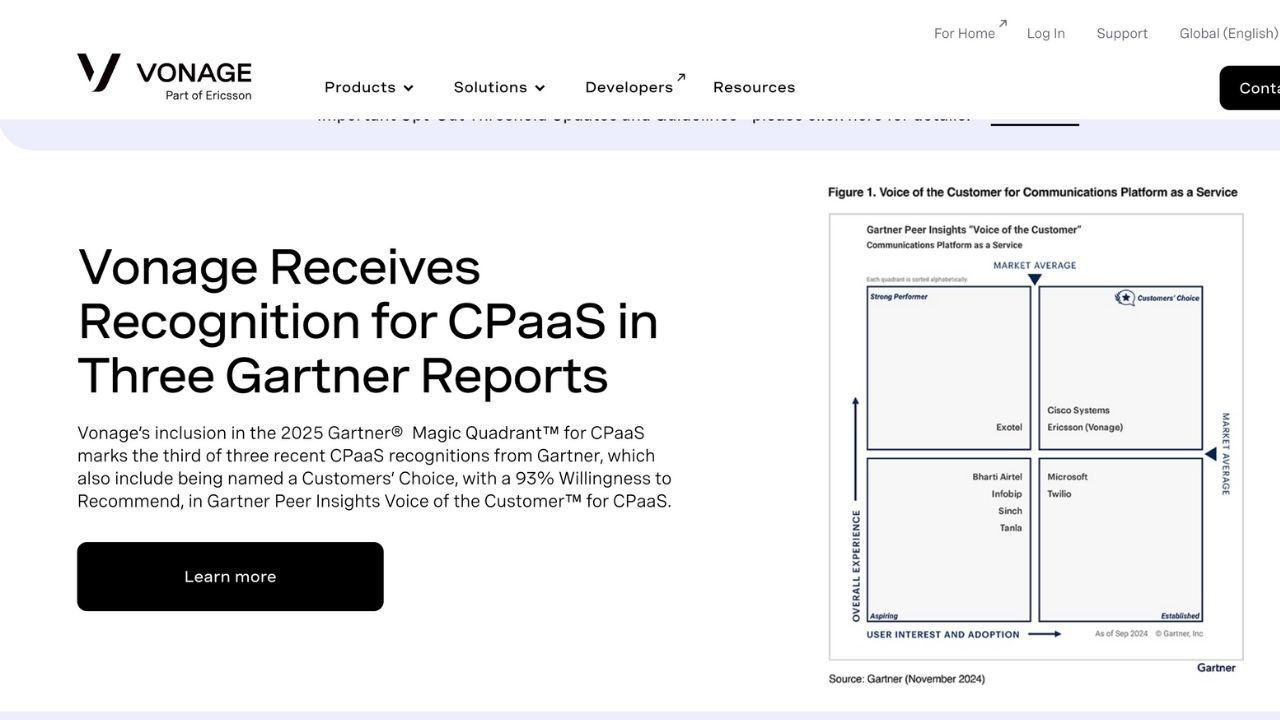
Vonage (formerly Nexmo, now owned by Ericsson) offers a hybrid approach: unified communications, contact center tools, and APIs under one roof. This makes them unique among CPaaS providers.
Their API pricing starts at $0.00809 per SMS message and $0.01446 per minute for voice calls. The Messages API, which handles multi-channel delivery, starts at $0.00121 per message. True per-second billing for voice means you only pay for what you use.
What sets Vonage apart is the human touch. Every customer gets access to an account manager. When you need help, you talk to a person who knows your setup, not a ticketing queue. A Gartner reviewer put it well: "In a world of AI, I still love having a human to actually discuss things with."
The unified communications angle matters if you need both APIs and traditional phone systems. You can run your entire communications stack through Vonage instead of stitching together multiple vendors.
Pros
- Human account managers for all customers
- True per-second voice billing
- Unified communications + APIs in one platform
- Strong global carrier relationships
- Comprehensive feature set
Cons
- Enterprise-focused packaging
- Complex pricing structure
- Premium pricing tier
- Can feel heavy for simple API needs
Verdict: Vonage fits teams that want the full communications stack without managing multiple vendors. If you need both programmable APIs and traditional UC features, they're worth the premium.
5. Bandwidth
Bandwidth is the carrier-grade option on this list. Founded in 1999, they own and operate their own nationwide all-IP voice network. That infrastructure ownership translates to reliability and cost savings at scale.
Messaging pricing starts at $0.004 per SMS for US 10DLC numbers. Short codes run $0.008 and toll-free $0.007. Voice calls cost $0.0100 per minute outbound and $0.0055 inbound. These rates beat most competitors for high-volume usage.
The network ownership enables features others can't match. E911 integration is native, critical for telehealth, VoIP apps, and any regulated industry. Carrier-grade call routing provides insights into quality that API-only platforms lack.
Support comes in tiers. The free "Signature" support includes 24/7 access to experts. Premium support starts at $3,000 per month with faster response times. Premium Plus at $7,500 adds a dedicated Customer Success Manager.
Pros
- Owns and operates network infrastructure
- Direct-to-carrier pricing
- Native E911 support
- Carrier-grade SLAs
- Signature support included free
Cons
- US-centric (limited global coverage)
- Minimum commitments for enterprise features
- Developer-heavy setup
- Complex for beginners
Verdict: Bandwidth is the choice for US-focused enterprises with high-volume needs and regulatory requirements. If you need E911 or run mission-critical voice services, their infrastructure is hard to beat.
6. Messente
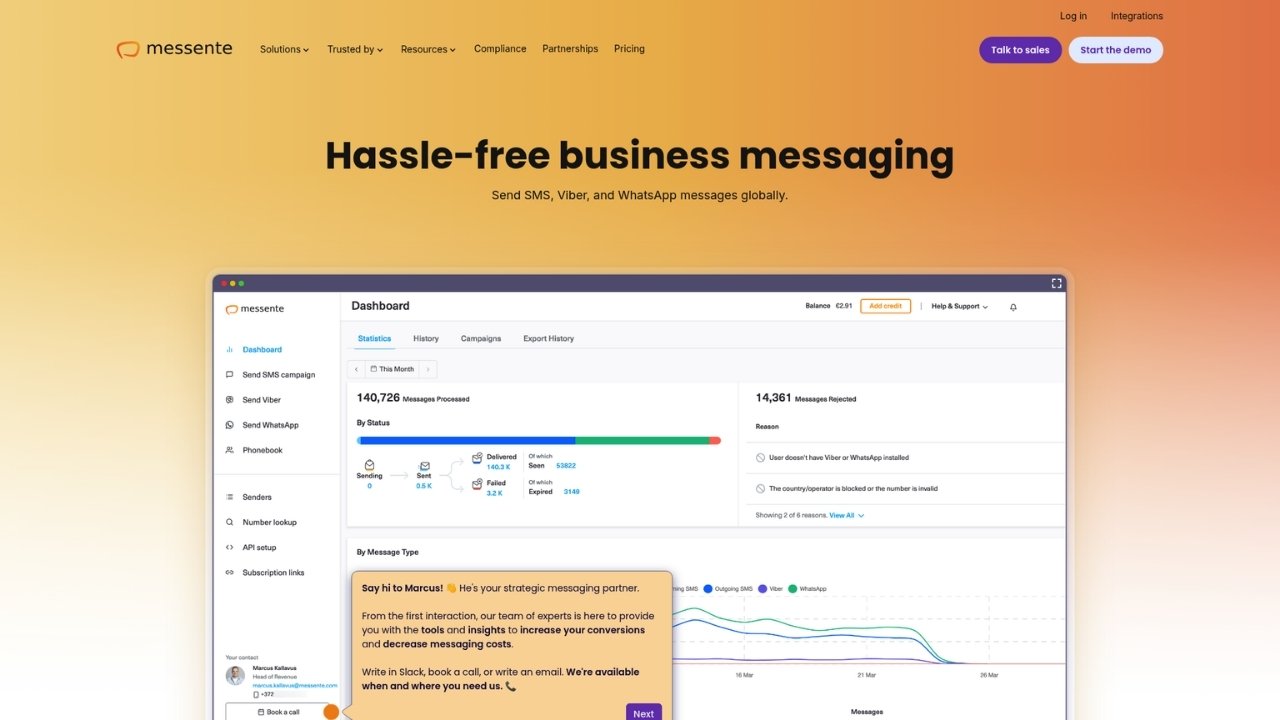
Messente is the messaging specialist on this list. Founded in 2013 and based in Estonia, they focus exclusively on SMS and OTT messaging (WhatsApp, Viber) with a strong emphasis on delivery reliability.
Their claim to fame is a 98% average delivery rate globally. They achieve this through adaptive routing that finds the fastest, most reliable path for each message. Direct connections with hundreds of carriers worldwide help avoid the grey routes that plague cheaper providers.
Pricing is flexible. SMS rates vary by country but start from €0.001 per message. WhatsApp and Viber pricing depends on carrier fees. They offer both pay-as-you-go (€500 minimum monthly) and commitment plans with better support.
Support is personal. Every account gets human support with a 60-minute response time target. Professional and Enterprise plans add dedicated account managers and private Slack channels for real-time help.
Pros
- 98% delivery rate globally
- Only pay for delivered messages with fallback
- Personal support with fast response times
- Strong EU compliance (GDPR, DORA, ISO 27001)
- 12+ years specializing in business messaging
Cons
- No voice features
- Web-only interface (no mobile app)
- Limited pre-built integrations
- Minimum spend requirements
Verdict: If your use case is pure messaging (SMS, WhatsApp, Viber) and delivery rates matter more than voice capabilities, Messente is the specialist choice. Their support quality directly addresses Plivo's biggest weakness.
7. Sinch
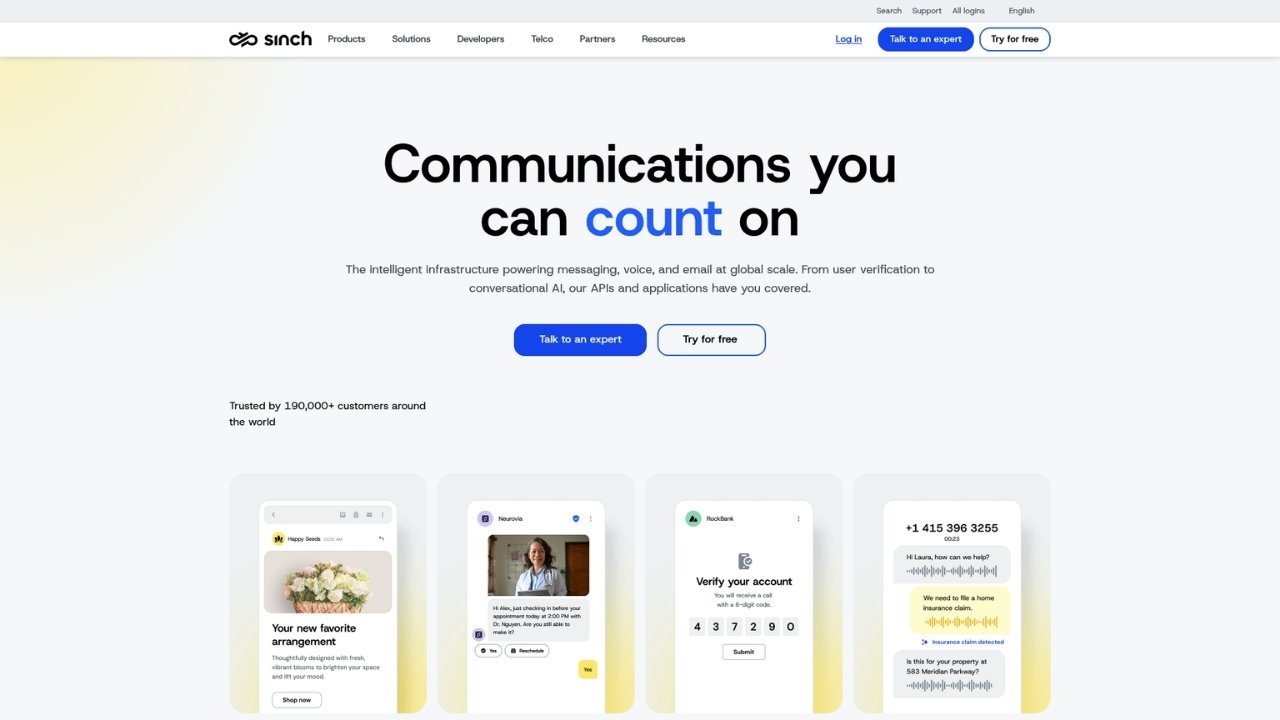
Sinch is the enterprise heavyweight. Founded in Sweden in 2008, they serve massive-scale messaging and verification needs for some of the world's largest companies.
Their product portfolio is extensive: Conversation API for multi-channel messaging, SMS API, Verification API for 2FA, Voice API, Email through Mailgun and Mailjet, and even a full contact center solution (Contact Pro). They also offer telco-grade infrastructure for operators.
Pricing is custom and volume-based, which tells you something about their target market. This isn't a sign-up-with-a-credit-card platform. It's built for enterprises sending millions of messages monthly.
The "Super Network" connects to carriers globally with deep ties that ensure delivery even at massive scale. Their verification products are particularly strong, handling 2FA and account security for financial platforms and large retailers.
Pros
- Massive scale capabilities
- Deep carrier relationships globally
- Strong in verification and 2FA
- Comprehensive product portfolio
- 5G messaging readiness
Cons
- Enterprise-focused (heavyweight for small teams)
- Custom pricing (not transparent)
- Complex product portfolio
- Requires significant volume to justify costs
Verdict: Sinch is for large enterprises with massive A2P messaging needs and verification workloads. If you're not sending millions of messages monthly, it's probably overkill.
How to choose the right Plivo alternative
The best choice depends on your primary pain point and use case:
Best overall value: Telnyx offers Twilio-like capabilities at roughly half the price, with better support.
Most comprehensive: Twilio has the broadest feature set and ecosystem, if you can afford the premium.
Best for omnichannel: Bird handles SMS, WhatsApp, email, and push in one platform with visual workflow tools.
Best for UC integration: Vonage combines APIs with unified communications for teams that want everything under one vendor.
Best for US carrier-grade: Bandwidth owns their network and offers E911, making them ideal for regulated US environments.
Best for global SMS: Messente's 98% delivery rate and adaptive routing make them the messaging specialist.
Best for enterprise scale: Sinch handles massive volume and verification needs that smaller platforms can't touch.
Migration tips for moving off Plivo
Switching providers doesn't have to be painful. Here's how to do it without breaking your communications:
- Inventory everything: Document all numbers, API endpoints, webhooks, and integrations before you start. You'd be surprised how many dependencies hide in legacy code.
- Run parallel testing: Set up your new provider alongside Plivo. Send a percentage of traffic to the new platform and compare delivery rates, latency, and error rates.
- Plan number porting: If you're bringing existing numbers, start the porting process early. Timelines vary by country and can take weeks.
- Keep Plivo as fallback: During the transition, maintain Plivo as a backup. Dual-homed SIP trunks or API fallbacks give you safety if something goes wrong.
- Test compliance flows: If you handle 2FA or sensitive messages, verify that your new provider handles these correctly before cutting over fully.
Which Plivo alternative will you choose?
Plivo served a purpose for many teams getting started with programmatic communications. But as your business grows, you need a platform that grows with you without the support headaches and hidden costs.
Telnyx offers the best balance of price, features, and support for most technical teams. Twilio remains the safe enterprise choice if budget isn't the primary constraint. And if messaging delivery is your top priority, Messente's specialization pays dividends.
Start with free trials from your top two picks. Run real traffic through both, compare the results, and make the switch. Your customers (and your support team) will thank you.
If phone support is part of your communications strategy, consider how Ringly.io can complement your SMS and messaging setup with AI-powered phone agents that handle customer calls 24/7.
Frequently Asked Questions
Is Telnyx really cheaper than Twilio for the same features?
Yes, Telnyx typically costs 40-60% less than Twilio for comparable SMS and voice capabilities. Their US SMS rates are $0.0025-$0.004 vs Twilio's $0.0083. The trade-off is a smaller ecosystem and fewer pre-built integrations.
Do any of these Plivo alternatives offer better support?
Telnyx and Messente both offer significantly better support than Plivo. Telnyx provides free 24/7 in-house engineering support via chat and phone. Messente guarantees 60-minute response times and assigns dedicated account managers. Vonage also provides human account managers for all customers.
Which Plivo alternative is best for small businesses?
For small businesses, Telnyx offers the best combination of low cost and good support. Bird is also worth considering if you need a visual interface and don't have developers on staff. Avoid Bandwidth and Sinch unless you have high volume needs.
Can I keep my existing phone numbers when switching from Plivo?
Yes, all the providers on this list support number porting. The process varies by country and provider. Telnyx users report some frustrations with porting speed, while others like Bandwidth and Twilio handle it smoothly. Start the process early and maintain Plivo as a fallback during transition.
Which alternative works best for international SMS?
Messente specializes in global messaging with a 98% delivery rate and adaptive routing. Twilio and Sinch also have strong international coverage. Check each provider's pricing for your specific target countries, as rates vary significantly by destination.
Do these alternatives handle WhatsApp Business API?
Yes, Twilio, Telnyx, Bird, Vonage, and Sinch all support WhatsApp Business API. Messente offers WhatsApp and Viber through their omnichannel API. Pricing varies, with most charging per-message fees plus Meta's conversation-based pricing.