

The best Sinch alternatives are Twilio, Telnyx, and Infobip, each offering messaging and voice APIs with different pricing and reach. If what you really need is your inbound Shopify support phone line answered, Ringly.io is the focused option: an AI agent that handles support calls 24/7, billed by usage.
Sinch is one of the bigger names in cloud communications, but it is not the right fit for everyone.
If you are dealing with complex pricing, slow support responses, or a platform that feels built only for developers, you are probably looking for alternatives.
We have researched and compared seven solid Sinch alternatives that cover different needs.
Whether you want lower SMS rates, better support, or a platform that does not require a computer science degree to set up, one of these should work for you.
Editor’s note: Want to hear some sample AI support calls made for your Shopify store?
- Just paste your store URL
- Hear sample calls for your store (no email required)
- Listen to demo calls for my store
What are the best Sinch alternatives in 2026?
Sinch is a CPaaS (Communications Platform as a Service) provider based in Stockholm. They handle SMS, voice, email, and WhatsApp APIs for businesses that need to communicate with customers at scale. With over 4,000 employees and operations in 60-plus countries, they are certainly not small.
But size does not always mean the best fit. Here is why businesses start searching for Sinch alternatives:
- Pricing transparency: Users often mention that Sinch's pricing structure is hard to forecast, with unexpected costs popping up
- Support quality: Slow or inconsistent support responses are a common complaint
- Developer-heavy platform: Non-technical users sometimes struggle with the interface and setup process
- Fragmented experience: Multiple portals from various acquisitions can make navigation confusing
If any of these sound familiar, it might be time to explore what else is out there.
How we evaluated these Sinch alternatives
To keep this comparison fair and useful, we looked at each platform across the same criteria:
- Pricing transparency: Clear, published rates without hidden fees
- Ease of use: How quickly can you get started and manage campaigns?
- Channel support: SMS, voice, WhatsApp, email, and other messaging channels
- Global reach: Coverage for international messaging and calling
- Customer support: Availability and quality of help when you need it
- User ratings: G2 scores and real user feedback
Now let us dive into the seven best Sinch alternatives for 2026.
Quick comparison: all seven alternatives at a glance
| Provider | SMS Rate (US) | Voice Rate (US) | G2 Rating | Best For |
|---|---|---|---|---|
| Twilio | $0.0075/message | From $0.013/min | 4.4-4.5 | Developers, scale |
| Telnyx | $0.0025/message | From $0.002/min | 4.7-4.8 | Cost-conscious teams |
| Bandwidth | $0.004/message | From $0.0055/min | 4.5 | Enterprise compliance |
| Infobip | Varies by country | Varies by country | 4.4 | Global omnichannel |
| Plivo | $0.0077/message | From $0.0055/min | 4.5 | AI-powered engagement |
| Vonage | Custom pricing | Custom pricing | 4.2 | Unified communications |
| MessageBird | $0.0075/message | Varies by country | 4.1 | Marketing teams |
The 7 best Sinch alternatives
1. Twilio

Twilio is the dominant player in the CPaaS space. Founded in 2008 and headquartered in San Francisco, they have built a massive ecosystem around their communication APIs.
Key features:
- SMS, MMS, voice, WhatsApp, email, and video APIs
- Extensive SDKs for C#, Java, Node.js, PHP, Python, Ruby, and Go
- Twilio Studio for visual workflow building
- Twilio Flex, a cloud contact center platform
- Serverless Functions for running code without infrastructure
Pricing:
Twilio uses a pay-as-you-go model. SMS starts at $0.0075 per message, while voice calls start at $0.013 per minute. They offer a free trial with credits to test the platform.
Pros:
- Massive developer community and extensive documentation
- Comprehensive feature set covering virtually every communication need
- Proven at scale with enterprise customers
Cons:
- Expensive at high volumes compared to alternatives like Telnyx
- Developer-first approach means a steeper learning curve for non-technical users
Best for: Development teams building custom communication workflows who need a platform that can scale with them.
2. Telnyx
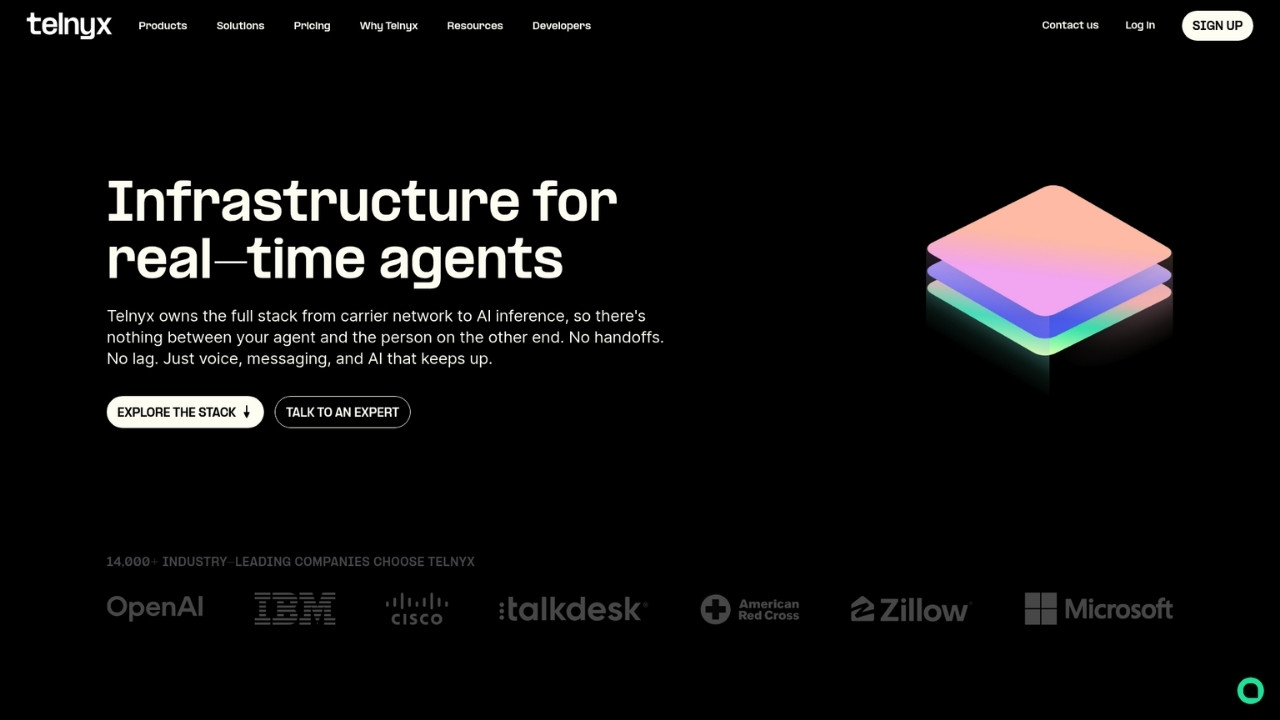
Telnyx is a Chicago-based CPaaS provider that has built its own carrier-grade global network. They focus heavily on developer experience and transparent pricing.
Key features:
- SMS, MMS, voice, and WhatsApp APIs
- Real-time analytics and reporting dashboard
- Global carrier network with local presence in major markets
- 24/7 in-house engineering support
- Mission Control Portal for easy management
Pricing:
Telnyx offers some of the lowest rates in the industry. SMS starts at $0.0025 per message, and voice calls start at $0.002 per minute. They use usage-based pricing with volume discounts as you scale.
Pros:
- Most affordable rates among major CPaaS providers
- Transparent pricing with no hidden fees
- Excellent documentation and developer resources
- Highest G2 rating (4.7-4.8) in this comparison
Cons:
- Requires technical knowledge to implement effectively
- Per-minute billing for calls can add up for high-volume users
Best for: Cost-conscious developers and businesses with telecom-heavy use cases who want carrier-grade quality without the enterprise price tag.
3. Bandwidth
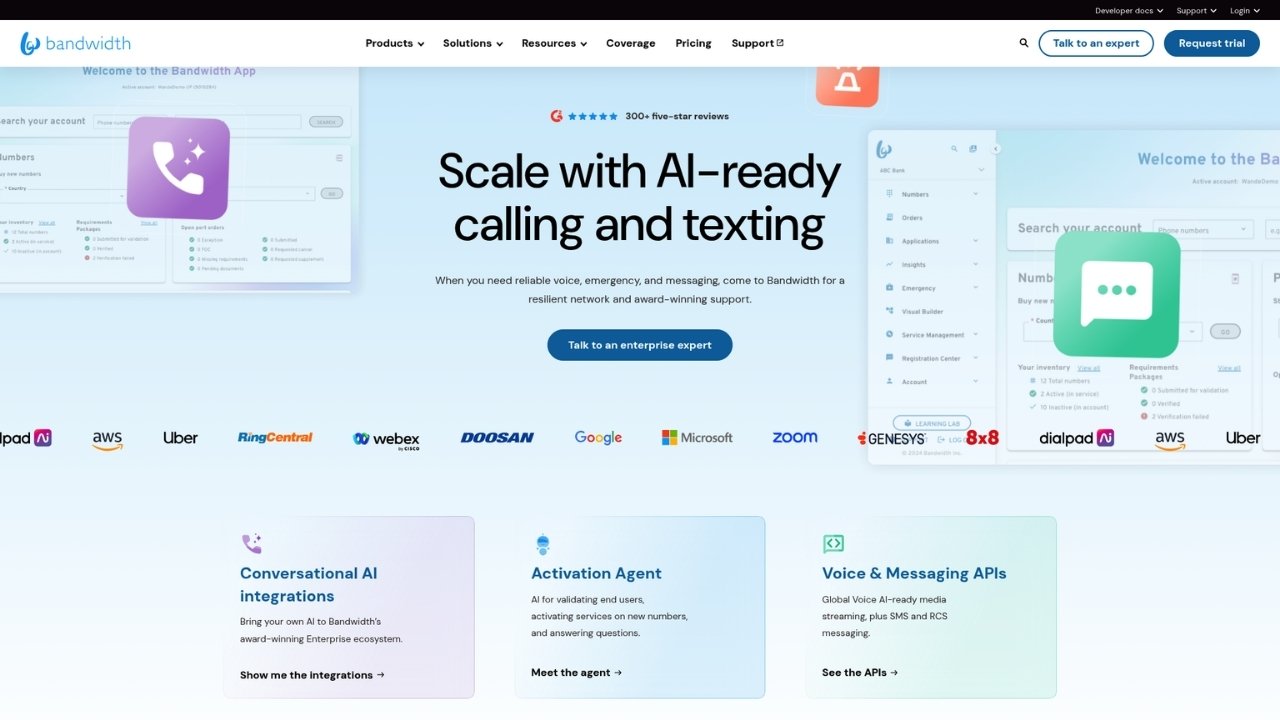
Bandwidth is unique among CPaaS providers because they own and operate their own network. Based in Raleigh, North Carolina, they provide direct-to-carrier services without intermediaries.
Key features:
- Direct-to-carrier SMS and voice APIs
- 911 emergency services integration
- Global reach across 65-plus countries
- Full PSTN replacement in 38 countries
- BYOC integrations with Microsoft Teams, Webex, Zoom, Genesys, Five9, and Google Voice
Pricing:
Bandwidth offers volume-based pricing. SMS on 10DLC numbers costs $0.004 per message. Voice calls are $0.0100 per minute for outbound local and $0.0055 per minute for inbound local calls in the US.
Support packages range from free Signature support to Premium Plus at $7,500 per month with a dedicated Customer Success Manager.
Pros:
- Owned and operated network means better reliability and control
- 97% plus CSAT score since Q3 2021
- Strong compliance support for regulated industries
- No intermediaries means clearer accountability
Cons:
- Enterprise-focused with less accessibility for small businesses
- Custom pricing for larger deployments requires talking to sales
Best for: Regulated industries and enterprises that need carrier-level control, compliance, and reliability.
4. Infobip
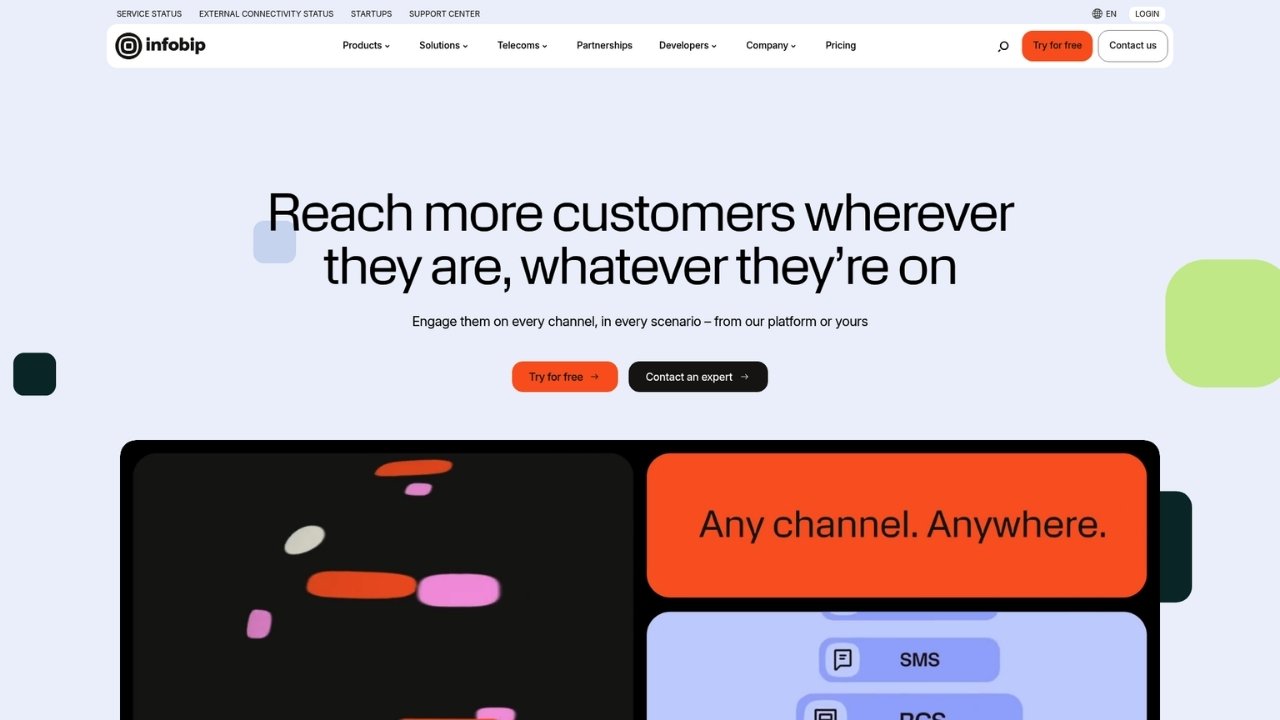
Infobip is a global cloud communications platform headquartered in Croatia. They position themselves as an omnichannel engagement platform for enterprises.
Key features:
- Omnichannel messaging: SMS, WhatsApp, RCS, email, voice, Viber, Messenger, Telegram
- Moments: Customer engagement and marketing automation platform
- Conversations: Cloud contact center solution
- Answers: Chatbot building platform with AI capabilities
- People: Customer data platform for unified profiles
Pricing:
Infobip uses a hybrid pricing model. Their conversational modules start at €49 per month for Moments (marketing automation), €99 per month for Answers (chatbots), and €39 per seat per month for Conversations (contact center). Communication channels are pay-as-you-go with country-specific rates.
Pros:
- Higher ease-of-use ratings than Sinch
- Strong global carrier connectivity
- Comprehensive omnichannel capabilities in one platform
- Better support scores compared to Sinch
Cons:
- Custom pricing for enterprise features requires contacting sales
- Some reviews mention reliability concerns
Best for: Enterprises needing global omnichannel messaging at scale with integrated marketing automation and customer engagement tools.
5. Plivo
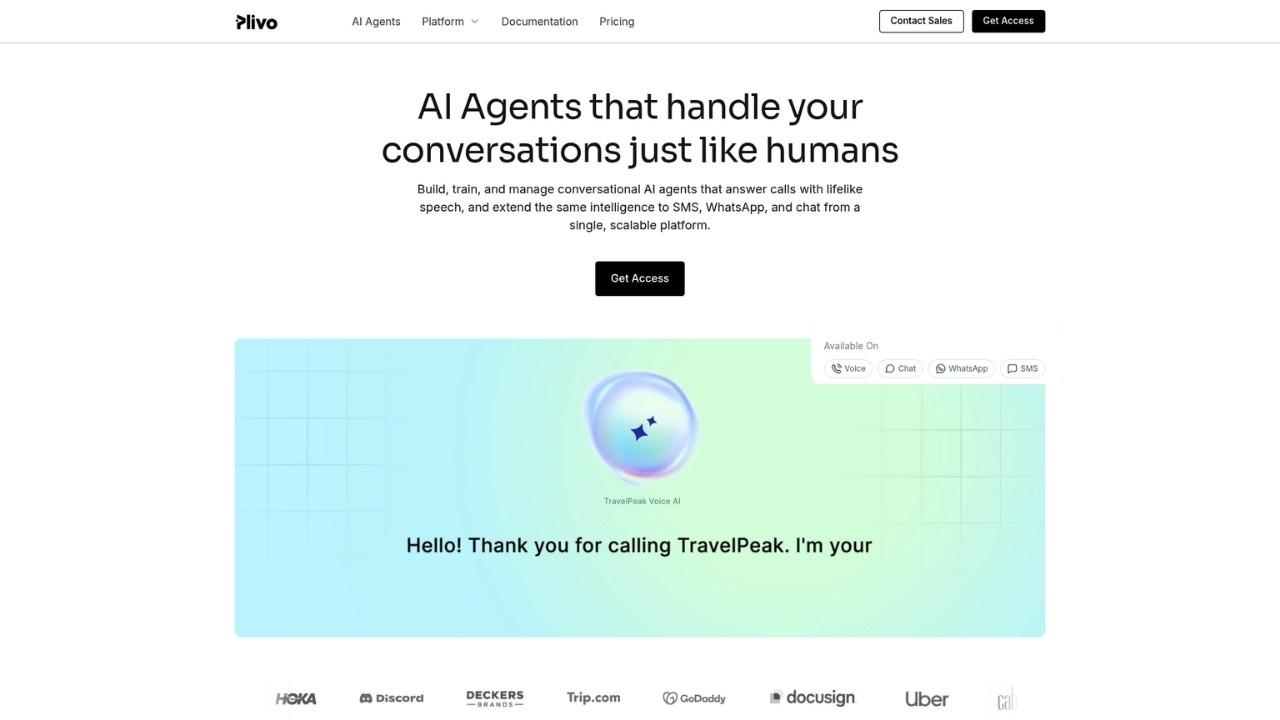
Plivo, founded in 2011 and based in Austin, Texas, has evolved from a traditional CPaaS provider into an AI-first customer engagement platform.
Key features:
- AI Agents for voice, SMS, WhatsApp, and chat
- Vibe Agent: No-code AI agent builder that sets up flows automatically
- Built-in telephony and phone number provisioning
- Multimodal AI that generates and processes audio, images, and text
- Integrations with Shopify, Calendly, Zendesk, and more
Pricing:
Plivo offers a free start with pay-as-you-go pricing. Their Professional plan includes voice starting at $0.00550 per minute outbound, SMS at $0.00770 per message, and AI Voice Agents at $0.045 per minute. Enterprise plans start at $1,000 per month with custom pricing and volume discounts.
Pros:
- AI-first approach with no-code setup
- 99.99% platform uptime guarantee
- HIPAA, GDPR, SOC 2, and PCI DSS compliant
- Strong focus on voice quality and human-like AI interactions
Cons:
- AI features may be overkill for simple SMS use cases
- Limited to $2,500 monthly usage on the free tier
Best for: Businesses wanting AI-powered customer engagement with simple setup and no coding required. Great for companies looking to automate phone support.
6. Vonage
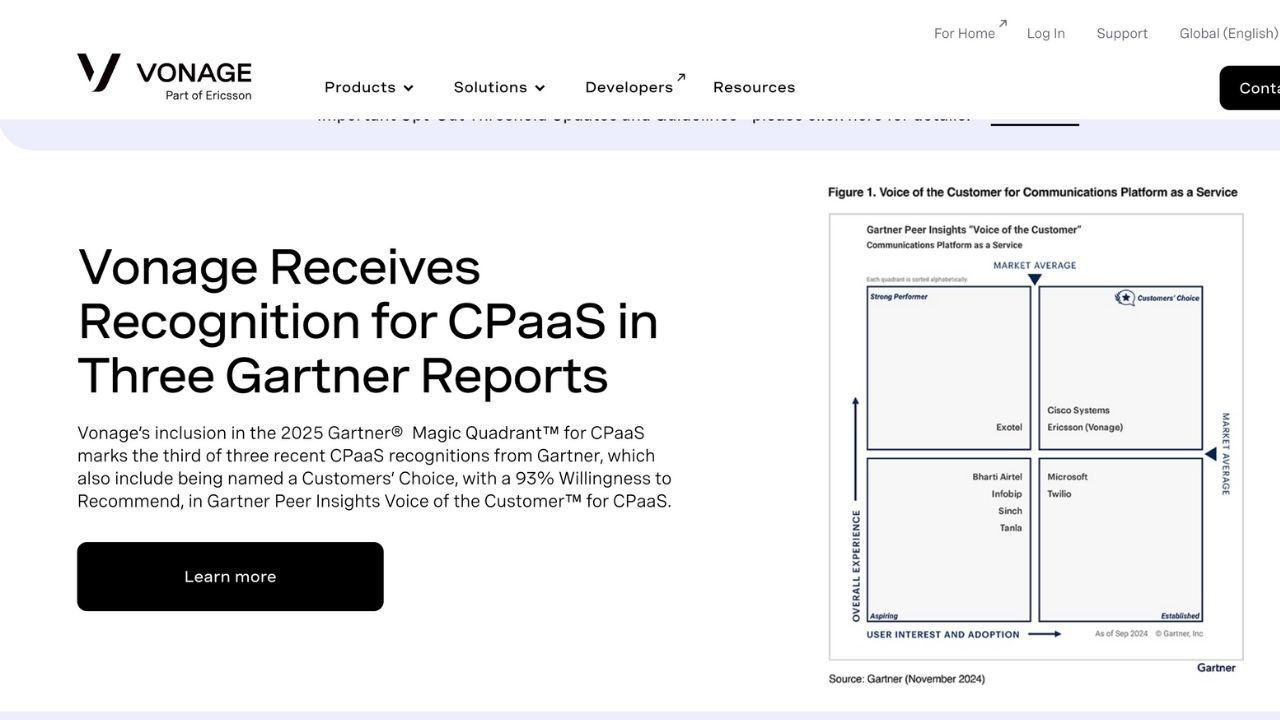
Vonage, formerly known for consumer VoIP services, has transformed into a comprehensive business communications provider after acquiring Nexmo. They are now part of Ericsson.
Key features:
- Communications APIs: Voice, SMS, video, and WhatsApp
- Unified Communications: Business phone, video conferencing, and team messaging
- Contact Centers: Cloud-based with CRM integration and AI capabilities
- Network APIs: Developer-friendly access to network capabilities
- Vonage AI for customer engagement automation
Pricing:
Vonage primarily uses custom and quote-based pricing. Their Communications APIs are pay-as-you-go, while Unified Communications and Contact Center solutions require contacting sales for specific rates.
Pros:
- Broad enterprise portfolio covering multiple communication needs
- Strong voice and video capabilities
- Omnichannel support across messaging, voice, and video
- 100,000 plus businesses worldwide use Vonage
Cons:
- Expensive compared to alternatives
- Slow customer support according to some reviews
- Complex cancellation process
- Lower G2 rating (4.2) than most alternatives
Best for: Enterprises wanting unified communications and CPaaS capabilities in one platform with a single vendor relationship.
7. MessageBird (Bird)
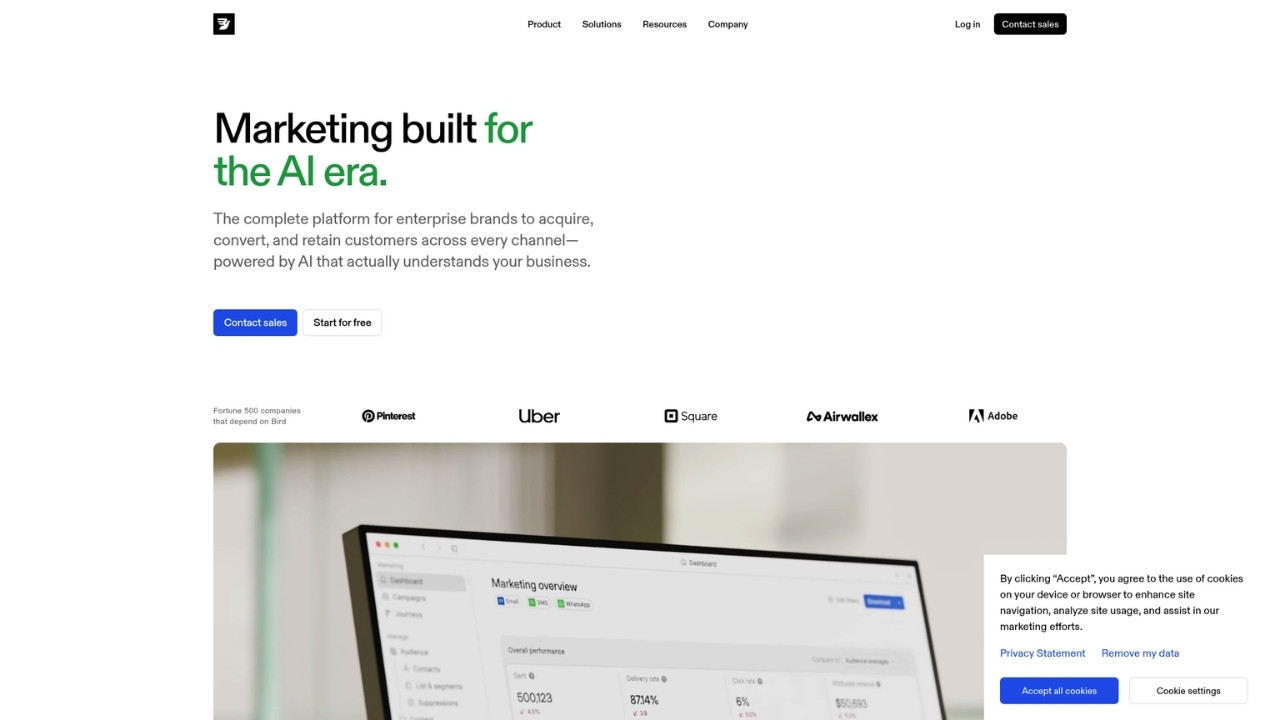
Bird, formerly MessageBird, is an Amsterdam-based omnichannel platform that has rebranded to focus on AI-native customer engagement.
Key features:
- Unified CRM for marketing, sales, and payments
- Channels: SMS, WhatsApp, Email, RCS, Push notifications, Voice
- Full automation suite with visual workflow builder
- Customer Data Platform (CDP) for unified profiles
- Integrations with major e-commerce and CRM platforms
Pricing:
Bird offers three tiers. Pay As You Go has no commitments with email starting at $1.50 per 1,000 messages and SMS at country-specific rates. Monthly Targeted Contacts bundles start from 50,000 contacts. Enterprise plans include custom volume pricing, SSO, and dedicated support.
Pros:
- Easy-to-navigate UI compared to developer-heavy platforms
- Quick setup process
- Multiple channels unified in one platform
- Strong focus on marketing automation
Cons:
- More expensive than alternatives for high volumes
- Lower G2 rating (4.1) than competitors
- Rebranding may cause some confusion about the platform's direction
Best for: Marketing teams wanting omnichannel campaign management with unified customer data and straightforward campaign creation tools.
Choosing the right Sinch alternative for your business
With seven solid options, how do you pick the right one? Here is a simple framework based on your primary use case:
For developers and technical teams:Telnyx or Twilio are your best bets. Telnyx wins on price and transparency. Twilio wins on ecosystem size and documentation depth.
For enterprises needing compliance:Bandwidth is the clear choice. Their owned network, 97% plus CSAT score, and strong compliance support make them ideal for regulated industries.
For global omnichannel messaging:Infobip or MessageBird work well. Infobip has stronger enterprise features. MessageBird is easier for marketing teams to use.
For cost-sensitive use cases:Telnyx offers the lowest SMS and voice rates. Plivo is competitive for AI-powered engagement.
For unified communications:Vonage covers the broadest range of communication needs in one platform, though at a premium price.
For AI-powered phone support:If you are specifically looking to automate phone support rather than build custom API workflows, there are specialized solutions worth considering. At Ringly.io, we focus specifically on AI phone agents for e-commerce businesses. Our AI agent The AI handles inbound calls, answers questions, looks up orders, and processes returns automatically. It is a different approach from traditional CPaaS platforms, more focused on out-of-the-box automation than API building blocks.
Key takeaways: finding your best Sinch alternative
The right Sinch alternative depends on what you actually need. Here is the short version:
- Choose Telnyx for the best rates and transparent pricing
- Choose Twilio for the largest developer ecosystem
- Choose Bandwidth for enterprise compliance and carrier control
- Choose Infobip for global omnichannel at scale
- Choose Plivo for AI-first customer engagement
- Choose Vonage for unified communications across your business
- Choose MessageBird for marketing-focused omnichannel campaigns
Most of these platforms offer free trials or starter credits. Test two or three that fit your use case before committing. The best platform is the one that your team can actually use and that fits your budget at scale.
Looking for AI phone support instead? If you run a Shopify store and want to automate phone support without building API workflows, try Ringly.io for free. Our AI agent The AI handles calls, order lookups, and returns automatically.
Frequently Asked Questions
Which Sinch alternative offers the lowest SMS pricing?
Telnyx offers the lowest SMS rates among major CPaaS providers at $0.0025 per message for outbound SMS in the US. This is significantly lower than Twilio's $0.0075 and Sinch's typical rates.
Are there any Sinch alternatives that do not require developers to set up?
Yes. MessageBird and Infobip both offer more user-friendly interfaces designed for marketing teams rather than developers. Plivo also provides a no-code AI agent builder called Vibe Agent that sets up flows automatically based on your description.
Which alternative is best for global messaging across multiple countries?
Infobip and Telnyx both excel at global messaging. Infobip has a strong presence with 40 plus data centers worldwide, while Telnyx offers competitive international rates and local number provisioning in many countries.
Can I switch from Sinch without losing my phone numbers?
In most cases, yes. Phone numbers can typically be ported between carriers. Bandwidth, Telnyx, and Twilio all support number porting. Check with your new provider about the porting process, which usually takes a few business days.
Which Sinch alternative has the best customer support?
According to G2 ratings and user reviews, Telnyx (4.7-4.8 rating) and Bandwidth (97% plus CSAT score) consistently receive the highest marks for customer support quality and responsiveness.
Is there a Sinch alternative specifically for AI phone agents?
While Plivo offers AI agents as part of their platform, if you are specifically looking for AI phone support for e-commerce, specialized solutions like Ringly.io focus entirely on AI phone agents that handle customer calls, order lookups, and returns without requiring any technical setup.