

A customer calling about a $4,200 engagement ring at 9pm on a Sunday doesn't leave you a voicemail. She calls the next brand in the SERP. By Monday morning, when you're listening to the message and dialing back, that ring is somebody else's revenue.
That's the math problem every Shopify jewelry brand runs into eventually. Your AOV sits somewhere between $300 and $5,000. Your team is online 40-50 hours a week. Your customers shop 168. The gap costs you real money, and not the kind you'll recover with a "sorry we missed you" email.
This guide covers the six real options for automated phone support for a jewelry store, with pricing, the actual jewelry-specific call mix, and where AI works (and where it doesn't). No fluff. By the end you'll know which setup fits your brand.
Editor's note. If you run a Shopify jewelry brand at $10M-$100M with a paid helpdesk and a visible phone line, the Sunday-evening engagement-ring call going to voicemail is the line item costing you the most. Book a 30-min call and we'll run the missed-call math on your store live.
Why phone support is different for jewelry brands
Jewelry doesn't behave like the rest of e-commerce. Three things make the phone channel disproportionately important here.
The AOV is much higher. A typical Shopify jewelry brand sits between $300 and $5,000 per order. Fashion jewelry (Catbird, Ana Luisa, Mejuri demi-fine) lands around $150-$400. Solid-gold fine jewelry (Aurate, Stone & Strand, Mejuri's gold line) clears $400-$1,500. Bridal and engagement specialists (Brilliant Earth, Frank Darling) average $1,500-$5,000 and up. According to Invoca's 2024 buyer expectations report, 60% of consumers prefer to call for purchases over $500. Jewelry sits right on top of that threshold.
The buying journey is consultative. People don't just add an engagement ring to cart and check out. They want to talk through metal options, gemstone provenance, sizing, engraving, delivery timing, and ring-box presentation. These are 15-45 minute conversations, and they happen on the phone.
Most purchases are gifts. Industry research from Edahn Golan and NRF holiday data puts the gift share at 40-60% of fine jewelry purchases. That drives a unique support pain pattern: gift-receipt-not-shown returns, surprise delivery coordination, last-minute engraving changes, and "is this a real ruby" verification calls from the recipient.
And there's a brand-perception piece nobody talks about enough. A bad voice on your line tanks luxury equity. A customer about to drop $3,000 doesn't want a 2005-era phone tree. The voice has to feel calm and consultative, not transactional.
The result: jewelry calls cluster in evenings and weekends (peak shopping hours for considered purchases), the team has to be available, and the cost of missing a call is brutal.
The actual call mix at a Shopify jewelry brand
Here's what the inbound call mix actually looks like for a $5M-$25M Shopify jewelry brand. This is synthesized from operator interviews and what we see across Ringly's jewelry and luxury customers.
| Call type | Share of calls | AI-resolvable? |
|---|---|---|
| Order status / shipping anxiety (high AOV = high stakes) | 28% | Yes, with Shopify integration |
| Ring sizing questions (sizers, conversion charts) | 14% | Yes, with knowledge base |
| Returns and exchanges (incl. gift-receipt-not-shown) | 12% | Mostly yes, edge cases escalate |
| Custom / engagement-ring consultation requests | 11% | No, escalate to human stylist |
| Engraving / personalization changes | 10% | Yes, with order modification |
| Repair / resize / clean-and-polish logistics | 9% | Partial, quote standard, escalate complex |
| Product questions (gemstone, metal, care) | 8% | Yes, with knowledge base |
| Warranty and authenticity claims | 5% | Partial, verify policy, escalate disputes |
| Wholesale / press inquiries | 3% | Escalate to founder |
Roughly 65-75% of calls are AI-resolvable with a Shopify-connected agent and a decent knowledge base. The remaining 25-35% (custom design, complex repair, disputes, wholesale) need to be routed to a human. The AI's job there is to qualify the lead, capture the right info, and transfer cleanly.
The two buckets that surprise most jewelry founders are sizing and engraving. They feel like things customers should self-serve via the sizing guide page or the order-confirmation email. But the data is consistent: about a quarter of all support contacts at fine jewelry brands are sizing or personalization questions. People don't trust their printed-paper ring sizer when they're spending $1,800. They want a person.
The engagement-ring inquiry is the one you do NOT want the AI handling end to end. Those are 45-60 minute consultative sales conversations that often convert to your highest-value orders. Route them to a human stylist or your own phone, no exceptions.
What a missed call actually costs a jewelry brand
Most "missed call cost" data points are blended across industries. The blended number is around $1,200 per missed business call (BIA Advisory Services). For jewelry, you can roughly multiply that by your AOV multiplier vs the average B2C purchase.
Concrete example: a brand with a $1,200 AOV that misses a Sunday-evening engagement-ring caller doesn't lose $1,200. They lose the engagement ring sale (maybe $3,500), the eventual wedding band order (another $800), the bridesmaid gifts the bride sends three friends, and the lifetime-value tail. That single missed call can be $5,000-$8,000 in actual lost LTV.
And the inverse matters too. According to the Salesforce State of the Connected Customer 2024, 89% of consumers are more likely to make another purchase after a positive support experience. Picking up the phone at 9pm and answering a sizing question is not just saving one sale. It's recruiting a repeat customer.
The math also lines up with where the industry is heading. A 2025 Gartner CX report found that AI is now resolving more than 50% of contact-center interactions at retail brands that have deployed it, at roughly one-tenth the per-interaction cost of a human agent. For jewelry, that means the routine 70% of calls (status, sizing, returns, repairs) can move to AI without losing quality, freeing your in-house team for the engagement and custom conversations that actually need them.
This is why ecommerce phone support matters even more in jewelry than in supplements or apparel. A missed call in supplements means a customer reorders her gummies somewhere else. A missed call in jewelry means losing a wedding.
6 ways to automate phone support for a jewelry store
Here's the honest landscape, ranked by how well each option fits a Shopify jewelry brand.
1. AI phone agents built for Shopify (Ringly.io)
Best for: Shopify jewelry brands at $1M-$50M revenue that want phone support live without hiring a night-and-weekend team.
Ringly.io is AI phone support for Shopify brands. The AI answers inbound calls 24/7, finds orders in your Shopify store, processes returns and exchanges, answers product questions from your knowledge base, and rescues abandoned carts with outbound follow-up. Across 50+ brands, the AI resolves 73% of calls autonomously at roughly $0.42 per resolved call. For jewelry specifically, that resolution-rate ceiling translates to "the AI handles sizing, status, returns, repairs, and product questions, and routes engagement and custom design straight to you."
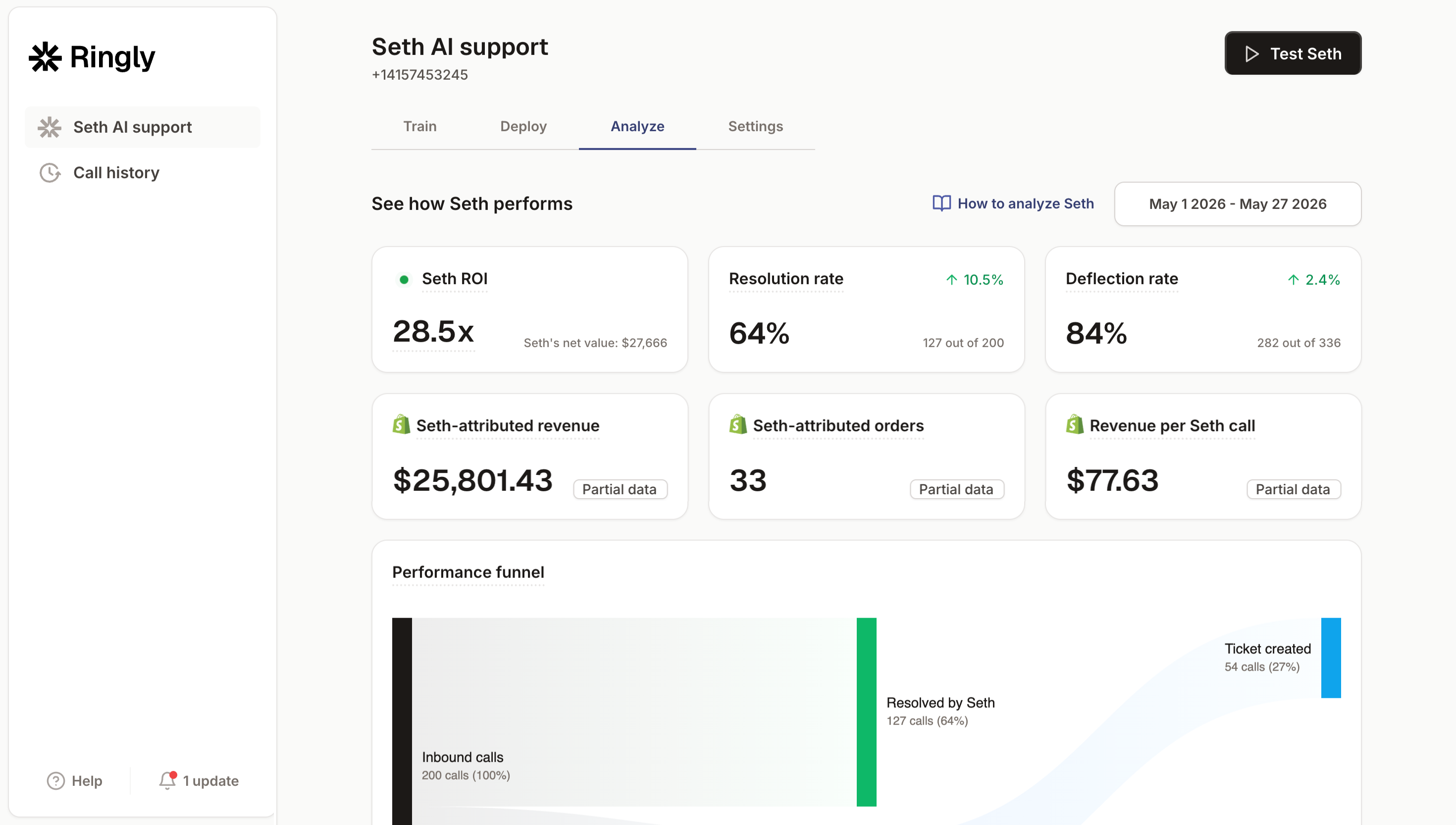
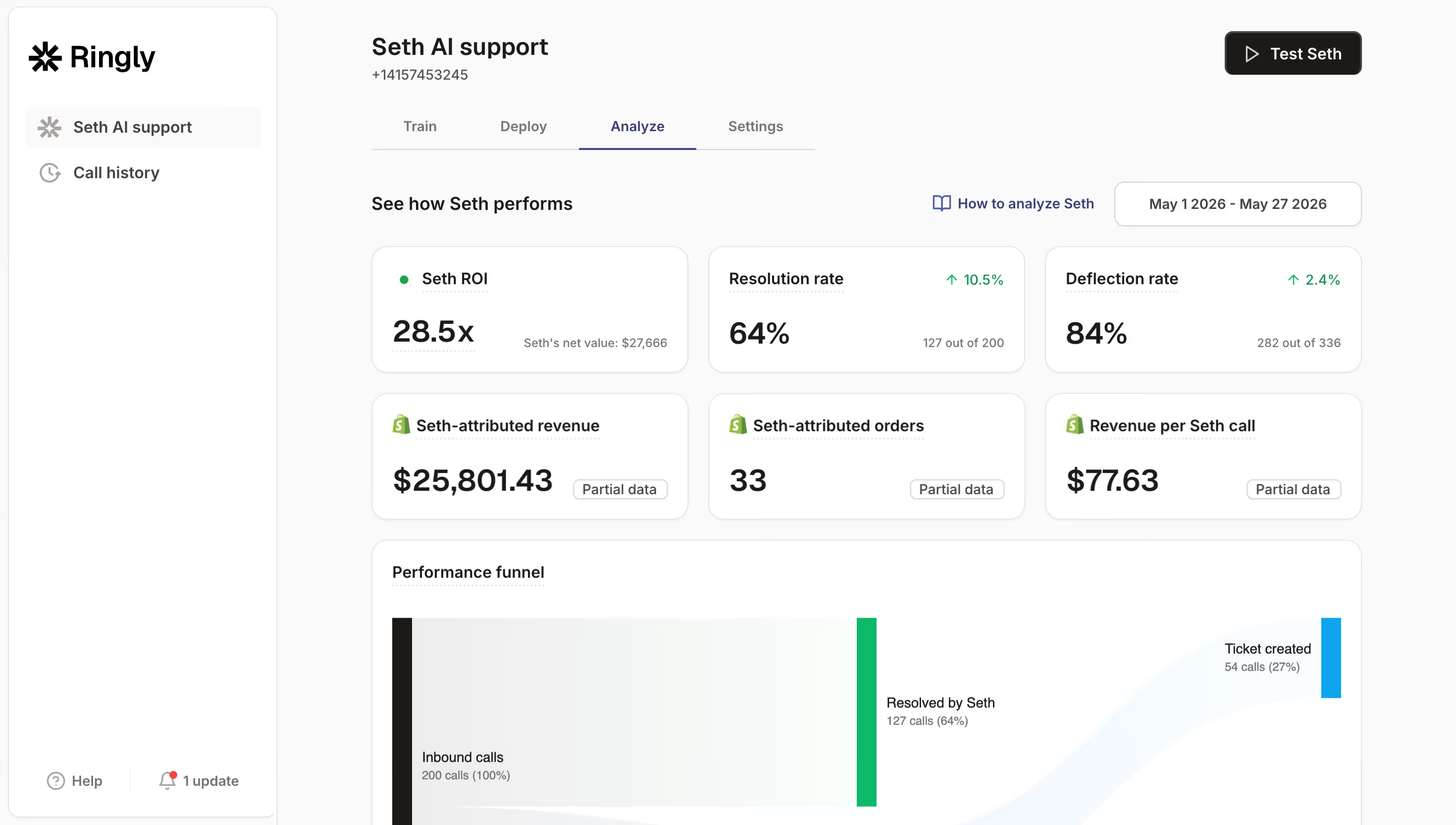
WashCo, a Shopify brand we launched, generated $22,664 in attributed revenue in its first 7 days post-launch. 271 calls handled, 85% deflection, 66% resolution, $0.91 per call vs $2.70 human-handled. WashCo is industrial cleaning, not DTC jewelry. Treat the $22,664 as proof on AI phone resolution itself, not vertical match.
Pricing
| Plan | Price | Minutes included | Best for |
|---|---|---|---|
| Grow | $349/mo | 1,000 (~500 calls) | Boutique brands under $1M revenue |
| Pro | $799/mo | 2,500 (~1,250 calls) | Growing brands $1M-$10M |
| Enterprise | Custom | 5,000+ | Fine jewelry brands $10M+ |
14-day free trial on Pro. 65% resolution guarantee: if the AI resolves under 65% of your calls in 90 days, Ringly refunds the last three months. See Ringly.io pricing for current details.
What works
- Native Shopify integration: pulls order data, processes returns, checks inventory and shipping status without dev work. The AI can say "your platinum solitaire shipped Friday, expected delivery Tuesday" instead of "let me transfer you."
- 40 languages: handles international engagement customers without staffing a multilingual team.
- Smart escalation: route engagement consults, custom design briefs, and wholesale to your owner phone or stylist queue while everything else gets resolved on the call. See smart AI call transfer.
- Knowledge-base aware: feed in your sizing guide, return policy, repair pricing, gemstone care, and warranty terms. The AI quotes from your actual policies, not made-up answers. See knowledge base feature.
- 65% resolution guarantee: if it doesn't hit, you get the last three months back. Lowest-risk way to test AI for a luxury brand.
- Voice quality is calm and consultative, not call-center pacing. Important for the $3,000 conversation.
What doesn't
- Not the right tool for 45-minute engagement consults. Those should always escalate to a human. The AI does a great job qualifying and transferring, but it's not pretending to be a stylist.
- You need a real knowledge base to get the resolution rate. If your sizing guide and return policy aren't documented, you'll do that work in week one.
Why it ranks #1
It's the only option in this list that's purpose-built for Shopify and offers a guarantee. For a jewelry brand, the combination of Shopify-native order lookup, calm voice, and smart escalation is the difference between "AI augments my team" and "AI sounds cheap."
2. AI chatbots (Shopify Inbox, Tidio, Gorgias)
Best for: Covering text channels (live chat, Messenger, email auto-reply), not phone.
Chatbots are the most common e-commerce automation. Shopify Inbox is free and comes with every Shopify plan. It handles basic auto-replies and captures contact info during off-hours. Tidio adds AI chat through its Lyro feature ($39/mo on top of base) and scores 4.7/5 across 1,600+ G2 reviews. Gorgias is a full helpdesk with AI Automate for text channels, starting around $10/mo and landing at $360/mo for most growing brands (4.6/5 G2 across 500+ reviews).
Pricing
- Shopify Inbox: free
- Tidio: free plan + $39/mo Lyro AI add-on
- Gorgias: $10/mo Starter, $360/mo Pro typical
What works
- Cheap to deploy for the text-channel coverage you already need
- Strong AI for repetitive text questions like shipping FAQ, sizing chart links, return policy lookup
- Integrates with your Shopify catalog to recommend products in chat
What doesn't
- Doesn't handle phone calls at all. A jewelry customer calling at 9pm gets nothing.
- Older or higher-AOV customers strongly prefer phone for considered purchases, especially anything over $500.
Why it ranks second
The best stack for a jewelry brand combines a chatbot for text and a phone AI for calls. They cover different channels, not the same one.
3. Hybrid AI + human answering services (Smith.ai, Ruby)
Best for: Brands that want a human voice answering calls but can't justify in-house staffing.
Smith.ai and Ruby Receptionists are virtual receptionist services that blend AI screening with human agents. Smith.ai pricing starts at $255/mo for 30 calls (Starter) and scales to $1,200+/mo for 600 calls. Smith.ai scores 4.5/5 across 200+ G2 reviews.
Pricing
- Smith.ai: $255-$1,200+/mo depending on call volume
- Ruby Receptionists: $235-$1,200+/mo
What works
- Real humans answer, good for brand perception in pure luxury
- No technical lift to set up
- Bilingual options available
What doesn't
- Not Shopify-native. Order lookup happens via Zapier or webhooks, slower and clunkier than a native integration.
- Per-call pricing climbs fast. At $4-$8 per call, a busy holiday weekend can blow your budget.
- The receptionists are generalists, not jewelry specialists. They'll book appointments and take messages, but they won't quote your return policy or check inventory accurately.
- No engagement-consult capability. They're answering, not selling.
Why it ranks third
Better than nothing, but you're paying premium prices for a generalist human voice that still can't do most of what an AI with Shopify integration does. Useful as a stopgap, not a destination.
4. DIY voice-AI builders (Synthflow, Vapi, Bland AI)
Best for: Brands with in-house developer resources that want full control.
Synthflow, Vapi, and Bland AI are voice-AI builder platforms. Usage-based pricing, typically $0.07-$0.15 per minute. They're powerful, but they hand you the components and expect you to assemble them.
Pricing
- Synthflow: from $29/mo + per-minute usage
- Vapi: pure usage-based, ~$0.07/min
- Bland AI: ~$0.09/min, custom pricing for higher volumes
What works
- Maximum flexibility if you have a dev team
- Lower per-minute cost at scale than packaged products
- Can build any conversational flow you want
What doesn't
- No Shopify integration out of the box. You're writing API calls.
- No knowledge-base ingestion built for you. You build it.
- No call routing UI built for you. You build it.
- Voice quality and prompt tuning is on you. Most DIY builds sound bot-ish in week one and need months of iteration.
Why it ranks fourth
Great for an agency building a custom voice app. Wrong tool for a jewelry brand that just wants the phone answered tonight.
5. Outsourced human BPO teams
Best for: Brands that need overnight human coverage and have the margin to absorb $2K-$5K/mo.
Companies like TaskUs, SupportYourApp, and SellerSmile provide outsourced support agents. Cost runs $1,800-$5,500/mo for nights and weekends coverage, depending on volume and language requirements.
Pricing
| Coverage | Monthly cost |
|---|---|
| Part-time VA (20 hrs/week) | $600-$1,400 |
| Dedicated agent (nearshore) | $1,800-$3,500 |
| Full BPO night/weekend coverage | $3,000-$5,500 |
What works
- Real humans who can handle the engagement-ring inquiry properly with training
- Scales with seasonality if you negotiate flex hours
What doesn't
- Training overhead is real. Three to six weeks before an agent knows your collection.
- Quality varies wildly by provider and by individual agent.
- Turnover. You'll retrain.
- Expensive at the right coverage level. For a $1M-$5M brand, $4K/mo in outsourced support is brutal margin pressure.
Why it ranks fifth
The smarter play in most cases: AI handles the 70% routine, outsourced human handles the 30% complex. Cost typically drops by 60% vs human-only.
6. Do nothing + voicemail-to-text
Best for: Brands so early-stage that even $349/mo is a stretch.
You set up a Google Voice number or Shopify number, route to voicemail after hours, and call back in the morning. Free, except for the cost of the missed calls.
Why it ranks last
This is the default state, and it's the most expensive option once your AOV crosses $300. If you're shipping fine jewelry and using voicemail as your "after-hours strategy," you're funding your competitors.
Cost comparison across all options
Here's the apples-to-apples view for a brand fielding roughly 400 calls a month.
| Solution | Monthly cost | 24/7 coverage | Shopify-native | Brand voice fit |
|---|---|---|---|---|
| Ringly.io (Grow) | $349 | Yes | Yes | High |
| Ringly.io (Pro) | $799 | Yes | Yes | High |
| Shopify Inbox + voicemail | $0 | Partial (text only) | Yes (text) | Low (no phone) |
| Tidio + Lyro | $70-100 | Partial (text only) | Yes (text) | Low (no phone) |
| Gorgias Pro | $360 | Partial (text-heavy) | Yes | Medium (no real phone) |
| Smith.ai (200 calls) | $600-900 | Yes | No | High but generic |
| Synthflow / Vapi DIY | $250-500 + dev | Yes if built | Build it | Depends on build |
| Outsourced BPO (nights) | $3,000-5,500 | Yes | No | High |
The cost-effective sweet spot for a $1M-$10M jewelry brand is Ringly Pro ($799) handling all calls + Gorgias or Tidio handling text channels. You're under $1,200/mo for full coverage with real AI behind it.
How to choose the right setup for your jewelry brand
Choose Ringly.io if:
- You're on Shopify
- Your AOV is over $200 and you want to keep phone support live without hiring
- You're losing calls after hours or on weekends and you can feel it in the LTV math
- You want a guarantee, not a "trust us" pitch
Choose Smith.ai or Ruby if:
- You absolutely require a human voice for brand reasons
- Your call volume is low enough that per-call pricing makes sense
- You don't need order-lookup or knowledge-base depth
Choose DIY voice-AI (Synthflow, Vapi, Bland) if:
- You have an in-house developer and want full control
- You're an agency building bespoke flows for multiple clients
- You're comfortable with months of prompt tuning before launch
Choose outsourced BPO if:
- Your engagement and custom design call mix is unusually high (over 25%)
- You have the margin to absorb $3K-$5K/mo
- You want a human-first brand experience and AI augmentation isn't a fit
Choose "do nothing" if:
- You're pre-revenue and $349/mo genuinely isn't on the table
- Just know you're funding the next brand in the SERP
For three reference scenarios:
- Boutique under $1M revenue: Ringly Grow ($349) + Shopify Inbox (free) + a clean FAQ page. Done for under $400/mo.
- Growing brand $1M-$10M: Ringly Pro ($799) + Gorgias Pro ($360) for text. About $1,160/mo total, covers all channels.
- Fine jewelry $10M+: Ringly Enterprise + Gorgias + 2-3 in-house stylists for engagement consults. AI handles the 70%, humans own the high-touch sales.
Implementation: getting AI phone support live in a week
Here's the realistic timeline for a Shopify jewelry brand. Most teams ship it in 5-7 working days.
- Day 1: Pick the solution. Connect Shopify (5 minutes, OAuth).
- Day 2: Upload your knowledge base. Sizing guide, return policy, repair pricing, shipping FAQs, gemstone care, warranty terms. Plan 60-90 minutes.
- Day 3: Configure escalation routing. Engagement-ring inquiries go to owner phone. Custom design goes to stylist queue. Press goes to founder email. Wholesale goes to wholesale@.
- Day 4: Test with 15 mock calls covering each call type. Gift return without receipt. Sizing question. Repair quote. Engagement inquiry. Custom design. Order status. Each one should either resolve or transfer cleanly.
- Day 5: Set business hours and after-hours behavior. Add your new AI number to your contact page, Google Business profile, and order confirmation email. See check order status feature.
- Day 6: Soft launch. Route 50% of calls to AI, 50% to existing flow.
- Day 7: Full launch. Monitor first 50 live calls, fill any knowledge gaps the AI flags.
This is the same playbook we walk every new Ringly jewelry customer through. By week two, the AI is handling roughly 70% of inbound calls and your team is sleeping on weekends again.
The call makes sense if you're feeling this
The call makes sense if:
- You're a Shopify (or Shopify Plus) brand doing $10M-$100M
- You run a paid helpdesk (Gorgias, Zendesk, Gladly, Re:amaze, or Intercom)
- You have a visible phone number on your store
- Your CS team is 3-12 people, and the Sunday-evening high-AOV calls keep going to voicemail
What happens on the call.
- We pull your last 7 days of missed calls live, on the call. No homework for you.
- We show you the recovered revenue at typical resolution rates for high-AOV jewelry call mix.
- You decide if it's worth a deeper conversation. No deck, no follow-up sequence.
If that's you, book a 30-min call and we'll run the numbers on your actual call volume.
FAQ
Can AI handle a custom engagement ring inquiry?
You don't want it to. Engagement consults are 45-60 minute consultative sales conversations that convert your highest-value orders. The AI should qualify the lead, capture the budget range and timeline, and transfer cleanly to a human stylist. Ringly's smart escalation lets you route these straight to your owner phone or a dedicated stylist queue.
How does AI handle a gift return without a gift receipt?
Most modern AI phone agents can look up the order in Shopify by name, email, or shipping address. From there, they apply your return policy (within window, original condition, etc.) and initiate the return in Shopify. Edge cases like "the giver doesn't want them to know" or refund-to-different-card requests escalate to a human.
What's the average call volume for a Shopify jewelry brand?
It varies by AOV and marketing channel, but a rough benchmark: brands at $1M-$5M revenue typically field 150-400 inbound calls per month. Brands at $5M-$25M see 400-1,200. Engagement-ring specialists see proportionally more (higher consideration, more pre-purchase questions). Holiday season can spike 3-4x baseline.
Will an AI voice damage my brand's luxury perception?
The 2024-2026 voice models are nearly indistinguishable from a calm human in blind A/B tests when configured well. The risk isn't the voice itself, it's the persona. Generic call-center pacing and pushy upsell scripts hurt luxury brands. A calm, consultative voice with your brand's name and tone does not.
How does AI handle a ring resize or repair request?
For standard requests (resize within plus or minus 2 sizes, basic polish, prong tightening) the AI quotes from your repair pricing knowledge base, captures the order info, and emails the customer a shipping label. For complex or non-standard requests (stone replacement, custom modification) it escalates to your repair coordinator.
How much does automated phone support for a jewelry store cost?
For a $1M-$10M jewelry brand, the sweet spot is roughly $350-$800/mo for AI phone coverage plus $40-$360/mo for text channels. Outsourced human alternatives run $2,000-$5,500/mo for comparable coverage. DIY voice-AI platforms can be cheaper per minute but require dev work. See voice AI pricing for the broader comparison.
Does AI phone support integrate with my helpdesk (Gorgias / Re:amaze)?
Yes. The AI handles the call and resolves what it can. Anything that needs a human (or anything you want logged) creates a ticket in your existing helpdesk via email or webhook. You don't have to switch helpdesks or change your team's workflow.
Talk to us
Jewelry brands lose more per missed call than any other Shopify vertical. The AOV math, the consultative buying journey, and the gift-purchase concentration all stack against you when the phone goes unanswered.
If you run a $10M-$100M Shopify jewelry brand and you're losing engagement and high-AOV calls after-hours, a 30-min call is the fastest way to see what you're leaving on the table.
The 3-layer guarantee.
- Live in 14 days or it's free until launched.
- 65% resolution in 90 days or we refund the last 3 months of subscription fees.
- We keep working free until we hit 65%.
Ruben (Ringly co-founder) takes these calls personally.