


TeamSupport has been a staple in the B2B help desk space for years, but many users report it is starting to show its age.
If you're dealing with sluggish performance, limited customization options, or pricing that doesn't match the value you're getting, you're not alone.
Many teams are actively searching for TeamSupport alternatives that better fit their needs.
The customer support software market has evolved dramatically.
Whether you're running a small ecommerce store or managing enterprise-level support operations, there's likely a better option out there for you.
Editor’s note: Want to hear some sample AI support calls made for your Shopify store?
- Just paste your store URL
- Hear sample calls for your store (no email required)
- Listen to demo calls for my store
Let's break down the seven best TeamSupport alternatives worth considering this year.
How we evaluated these TeamSupport alternatives
We focused on solutions that directly address the pain points TeamSupport users commonly report: slow interfaces, rigid workflows, and pricing that scales poorly. Our criteria included pricing transparency, ease of use, feature depth, integration capabilities, and how well each tool fits specific use cases.
Every alternative on this list offers something TeamSupport doesn't, whether that's modern AI features, better ecommerce integration, or simply a more intuitive user experience.
TeamSupport alternatives at a glance
| Tool | Starting Price | Free Trial | Best For | Key Differentiator |
|---|---|---|---|---|
| Zendesk | $19/agent/month | 14 days | Large enterprises | Most comprehensive feature set |
| Freshdesk | $0 (free tier) | 14 days | Budget-conscious teams | Generous 14-day free trial |
| LiveAgent | $15/agent/month | 30 days | SMBs seeking value | All-in-one pricing includes phone |
| Gorgias | $10/month | 7 days | Ecommerce stores | Ticket-based pricing, unlimited agents |
| Zoho Desk | ~$14/agent/month | 15 days | Zoho ecosystem users | Deep Zoho integration |
| HappyFox | $21/agent/month | Demo required | SMBs needing automation | Strong self-service portal |
| Ringly.io | From $99 a month (50 conversations included) | Free to try | Phone-heavy ecommerce | AI phone agent automation |
The 7 best TeamSupport alternatives
1. Zendesk

Zendesk is the enterprise leader for a reason. With over 100,000 businesses using the platform (including Uber, Siemens, and Lush), it's built to handle complex support operations at scale.
The platform offers true omnichannel support covering email, live chat, phone, and social messaging. What sets Zendesk apart is the depth of its features: skills-based routing, IVR phone trees, advanced analytics, and a marketplace with over 1,000 integrations. The AI agents (included in Suite plans) can handle routine inquiries automatically, freeing up your team for complex issues.
If you need the most comprehensive feature set and have the budget to match, Zendesk delivers.
| Plan | Annual Price | Key Features |
|---|---|---|
| Support Team | $19/agent/month | Email ticketing, social support, basic automations |
| Suite Team | $55/agent/month | AI agents, messaging, live chat, phone, 1 help center |
| Suite Professional | $115/agent/month | Copilot tools, 5 help centers, custom reporting, CSAT surveys |
| Suite Enterprise | $169/agent/month | 300 help centers, sandbox, custom roles, audit logs |
Pros:
- Extensive integrations via Marketplace
- Enterprise-grade features and security
- Phone support included on all Suite plans
- Robust reporting and analytics
Cons:
- Expensive compared to competitors
- Complex setup and steep learning curve
- Many advanced features require higher-tier plans
2. Freshdesk

Freshdesk strikes a solid balance between features and affordability. Part of the Freshworks ecosystem, it serves over 74,000 businesses including Pearson and Bridgestone.
The 14-day free trial is genuinely useful: up to 2 agents for 6 months with basic ticketing and a knowledge base. As you grow, the paid plans add Freddy AI (Freshdesk's AI assistant), custom portals, and advanced reporting. The interface is clean and intuitive, making onboarding new team members relatively painless.
| Plan | Annual Price | Key Features |
|---|---|---|
| Free | $0 | Up to 2 agents for 6 months, basic ticketing, knowledge base |
| Growth | $15/agent/month | Ticketing, customer portal, reports, Freddy AI (500 sessions) |
| Pro | $49/agent/month | Custom portals, custom objects, advanced ticketing, custom reporting |
| Enterprise | $79/agent/month | Audit logs, approval workflows, skills-based assignments |
Pros:
- Generous free plan for small teams
- Intuitive, modern interface
- Strong automation capabilities
- Good mobile apps
Cons:
- Advanced features require higher tiers
- Pricing can get complex with add-ons
- AI sessions beyond the included limit cost extra ($49 per 100 sessions)
3. LiveAgent
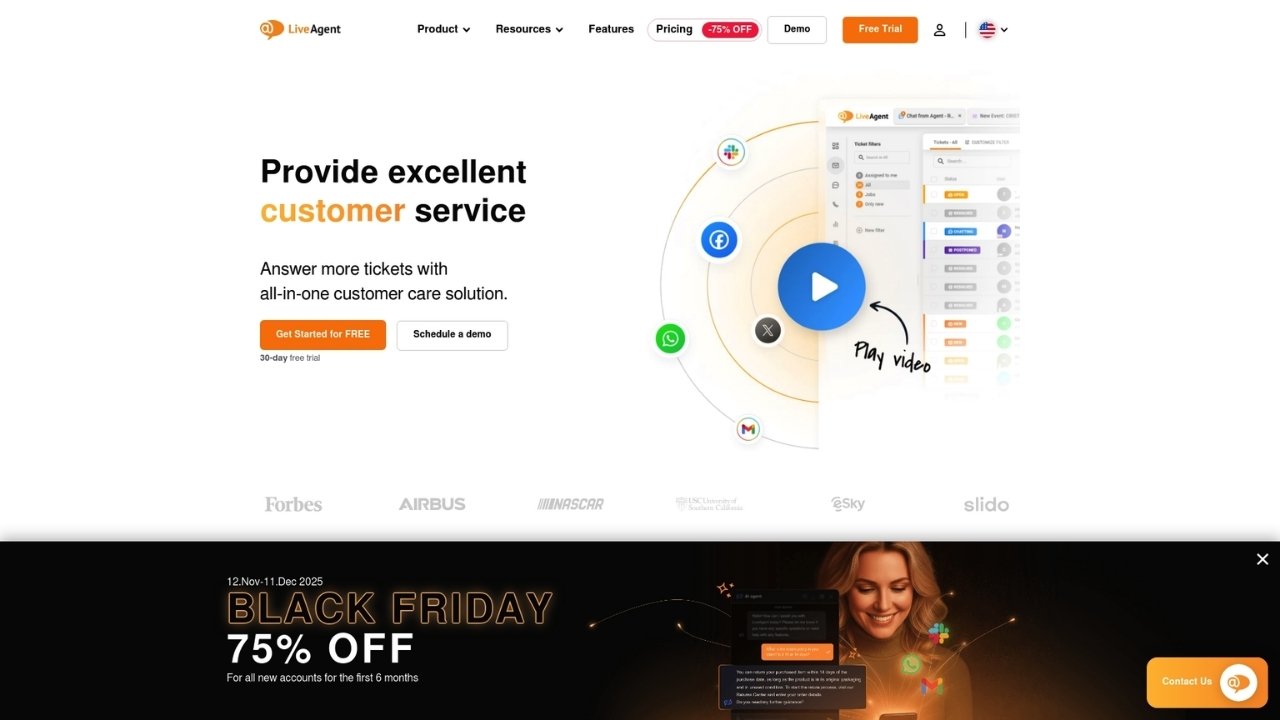
LiveAgent has earned its reputation as a value leader. Founded in 2004, the platform serves companies like Forbes, Airbus, and NASCAR with an all-in-one approach that includes email, chat, phone, and social channels.
What makes LiveAgent stand out is the pricing transparency. Unlike competitors that nickel-and-dime you for phone support or social channels, LiveAgent includes these in straightforward per-seat pricing. The 30-day free trial (no credit card required) gives you plenty of time to evaluate.
| Plan | Annual Price | Key Features |
|---|---|---|
| Small Business | $15/agent/month | Ticketing, live chat, knowledge base, basic integrations |
| Medium Business | $29/agent/month | Call center & IVR, time rules, reports, proactive chat |
| Large Business | $49/agent/month | SSO, custom roles, social channels |
| Enterprise | $69/agent/month | Dedicated account manager, priority support |
Pros:
- Affordable entry point
- Phone and social included (not add-ons)
- 24/7 customer support
- 200+ integrations
Cons:
- Interface can feel dated compared to newer tools
- Some advanced features require Scale plan
- Social channel add-ons on lower tiers cost extra
4. Gorgias

If you run an ecommerce store, Gorgias deserves serious consideration. Built specifically for online retailers, it integrates deeply with Shopify, BigCommerce, Magento, and WooCommerce.
The ticket-based pricing model works well for growing teams. Instead of paying per agent, you pay based on ticket volume with unlimited users on most plans. This means you can have your entire team access the platform without worrying about seat costs adding up.
Gorgias shines at ecommerce-specific workflows: processing refunds, checking order status, and handling returns directly within the help desk. The AI Agent can automate responses to common questions like "where's my order?"
| Plan | Monthly Price | Annual Price | Tickets/Month | AI Interactions |
|---|---|---|---|---|
| Starter | $10 | N/A | 50 | Pay per use ($1.00 each) |
| Basic | $60 | $50/month | 300 | 60 included |
| Pro | $360 | $300/month | 2,000 | 600 included |
| Advanced | $900 | $750/month | 5,000 | 2,500 included |
Pros:
- Built specifically for ecommerce workflows
- Ticket-based pricing with unlimited agents
- Process refunds and check orders without leaving the platform
- 150+ integrations including Klaviyo and Recharge
Cons:
- Not ideal for non-retail businesses
- Ticket limits on all plans (overage fees apply)
- AI Agent costs extra on Grow plan
5. Zoho Desk

Zoho Desk makes the most sense if you're already invested in the Zoho ecosystem. As part of Zoho's suite of business applications, it integrates seamlessly with Zoho CRM, Zoho Books, and other tools.
The platform offers solid value with a free tier for up to 3 agents and affordable paid plans. Zia, Zoho's AI assistant, provides ticket analysis and can suggest responses based on your knowledge base.
| Plan | Price | Key Features |
|---|---|---|
| Free | $0 | Up to 3 agents, basic ticketing |
| Standard | ~$14/agent/month | Ticket management, knowledge base, basic automations |
| Professional | ~$23/agent/month | Multi-department, advanced reporting, Zia AI |
| Enterprise | ~$40/agent/month | Advanced AI, custom functions, data administration |
Pros:
- Affordable pricing
- Deep integration with Zoho suite
- AI-powered insights via Zia
- Free tier available
Cons:
- Limited third-party integrations compared to leaders
- UI less polished than competitors
- Smaller app ecosystem
6. HappyFox

HappyFox positions itself as the middle ground between simple help desks and complex enterprise solutions. Founded in 2011, it focuses on SMBs with a clean interface and strong automation capabilities.
The self-service portal is a standout feature, with SEO optimization built in to help customers find answers through search engines. Smart rules and canned actions (macros) help agents handle repetitive tasks efficiently.
| Plan | Annual Price | Agents | Key Features |
|---|---|---|---|
| Basic | $21/agent/month | Up to 5 | Unlimited tickets, SLA, knowledge base, SSO |
| Team | $39/agent/month | Unlimited | Multi-brand, custom email, custom roles, 24/5 support |
| Pro | $89/agent/month | Unlimited | Asset management, task management, scheduled tickets, 24/7 support |
| Enterprise PRO | Custom | Unlimited | Agent scripting, 2TB storage, advanced audit logs |
Pros:
- Easy setup and onboarding
- Strong knowledge base with SEO optimization
- Good automation for the price
- 100+ integrations
Cons:
- Grow plan limited to 5 agents
- No 14-day free trial (demo required)
- Some advanced features only in Enterprise
7. Ringly.io

Ringly.io takes a different approach from traditional ticketing systems. Instead of managing support tickets, it automates phone calls entirely using an AI agent named the AI.
Here's how it works: the AI answers your business phone 24/7, handles order lookups, processes returns and exchanges, answers FAQs, and only escalates to your human team when necessary. The AI resolves up to 90% of calls without human intervention.
For ecommerce stores dealing with high call volumes, this can be transformative. You get 24/7 phone coverage without hiring additional staff or managing complex phone trees.
| Plan | Price | Included | Key Features |
|---|---|---|---|
| Pay per call | $99 a month | 50 conversations, then $1.99 each | Seth on your support line 24/7; spam, hang-ups and wrong numbers are free |
Pros:
- AI resolves up to 90% of calls autonomously
- True 24/7 availability
- Deep Shopify integration
- 30 languages supported
- Billing only starts after proven results (65% resolution rate)
Cons:
- Voice-focused (not a full ticketing replacement)
- Ecommerce-centric
- Higher starting price than some alternatives
Which TeamSupport alternative should you choose?
The right choice depends on your specific situation:
For large enterprises: Zendesk offers the most comprehensive feature set and can handle complex, multi-channel operations at scale. Just be prepared for the price tag and implementation complexity.
For budget-conscious SMBs: LiveAgent delivers excellent value with transparent pricing that includes phone support. HappyFox is also worth considering if you need strong self-service capabilities.
For ecommerce stores: Gorgias is the clear winner for ticket-based help desks with deep store integration. If phone support is a major channel, Ringly.io offers a unique AI-powered approach that can dramatically reduce your support workload.
For Zoho users: If you're already using Zoho CRM or other Zoho products, Zoho Desk provides seamless integration that other tools can't match.
For free option seekers: Freshdesk offers the most generous free tier that's actually usable for real support operations.
Making the switch from TeamSupport
Migrating help desk platforms doesn't have to be painful. Plan for the following when migrating:
- Data export: Most platforms offer migration tools or services to transfer your tickets, contacts, and knowledge base articles
- Team training: Schedule training sessions before go-live. Most tools offer documentation and video tutorials
- Parallel running: Consider running both systems for a week or two to ensure nothing falls through the cracks
- Custom field mapping: Take time to map your existing custom fields to the new platform properly
Start improving your customer support today
The best TeamSupport alternative for your team depends on your size, budget, and which support channels matter most to you. Enterprise teams will find Zendesk's depth hard to beat. Ecommerce stores should seriously evaluate Gorgias or Ringly.io. Budget-conscious SMBs have excellent options in LiveAgent and Freshdesk.
Whatever you choose, the tools available today offer capabilities that simply didn't exist when TeamSupport was built. Modern AI features, better integrations, and more intuitive interfaces mean your team can spend less time fighting software and more time helping customers.
If phone support is a pain point for your business, consider how Ringly.io could transform your operations. With the AI handling routine calls 24/7, your team can focus on the complex issues that actually require human expertise. Try Ringly.io for free and see what AI phone support can do for your store.
Frequently Asked Questions
What are the best TeamSupport alternatives for small businesses?
For small businesses, LiveAgent and Freshdesk offer the best value. LiveAgent starts at $15/agent/month with phone support included, while Freshdesk has a genuinely useful free tier for up to 2 agents.
Which TeamSupport alternatives work best for ecommerce stores?
Gorgias is built specifically for ecommerce with deep Shopify integration and ticket-based pricing. For stores with high call volumes, Ringly.io offers AI phone automation that can resolve up to 90% of calls without human intervention.
Are there any free TeamSupport alternatives worth using?
Yes. Freshdesk offers a free plan for up to 2 agents for 6 months with basic ticketing and knowledge base features. Zoho Desk also has a 14-day free trial for up to 3 agents.
How do TeamSupport alternatives compare on pricing?
Entry-level pricing ranges from free (Freshdesk, Zoho Desk) to $19/agent/month (Zendesk, Freshdesk paid plans). Most use per-seat pricing, though Gorgias uses ticket-based pricing and Ringly.io uses usage-based pricing (per minute).
What should I look for when evaluating TeamSupport alternatives?
Focus on: (1) which channels you need (email, chat, phone, social), (2) integration with your existing tools, (3) pricing model that fits your team size, (4) ease of use for agents, and (5) AI/automation capabilities that can reduce manual work.
Can I migrate my existing TeamSupport data to a new platform?
Most TeamSupport alternatives offer migration tools or services to transfer tickets, contacts, and knowledge base articles. Plan for some manual cleanup of custom fields and workflows during the transition.