


Speed Commerce has been around since 1982, making it one of the older names in third-party logistics.
But age doesn't always equal the right fit. Maybe you're looking for more transparent pricing, better technology, or a partner that specializes in your specific product type.
The good news? The 3PL landscape has exploded with options.
Whether you're shipping subscription boxes, heavy equipment, or anything in between, there's a fulfillment partner built for your needs.
This guide breaks down 7 Speed Commerce alternatives worth considering.
Each one brings something different to the table, from global networks to hands-on flexibility.
One thing to keep in mind: while these companies handle the physical fulfillment, you'll still need a system for customer communication.
Ringly.io offers AI phone agents that integrate with any 3PL to handle "where's my order" calls automatically. But more on that later.
Editor’s note: Want to hear some sample AI support calls made for your Shopify store?
- Just paste your store URL
- Get sample calls in under 20 seconds (no email required)
- Listen to demo calls for my store
What to look for in a Speed Commerce alternative
Before diving into specific providers, let's talk about how to evaluate them. Not every 3PL is right for every business.
Pricing transparency matters more than you might think. Some providers publish rates upfront.
Others require you to sit through a sales call just to get a ballpark figure. If you prefer knowing costs before engaging, this is a key differentiator.
Warehouse network directly impacts shipping speed and cost.
More locations mean you can distribute inventory closer to customers. But more isn't always better if those locations don't align with your customer base.
Technology and integrations can make or break your workflow. A slick dashboard means nothing if it doesn't connect to your Shopify store or Amazon account.
Check their integration list before getting excited about features.
Specialization is often overlooked. A provider optimized for apparel might struggle with electronics.
One built for heavy goods could be overkill for lightweight supplements.
Watch out for these red flags:
- Long-term contracts with heavy cancellation fees
- Opaque pricing with lots of "additional charges"
- Poor reviews mentioning inventory shrinkage or accuracy issues
- No trial period or way to test the service
- Pushy sales teams that won't answer direct questions
At-a-glance comparison
Here's a quick reference to help you identify which providers deserve a closer look:
| Provider | Best For | Pricing Model | Warehouse Locations | Key Strength |
|---|---|---|---|---|
| ShipBob | Fast-scaling DTC brands | Custom quote (~$275 min) | 60+ global | 2-day shipping, international reach |
| Amazon FBA | Amazon-first sellers | Per-unit + storage fees | Hundreds globally | Prime eligibility |
| Red Stag Fulfillment | Heavy/bulky products | Custom quote | 2 US locations | 99.99% accuracy guarantee |
| ShipMonk | Subscription/startup brands | Custom quote (~$250 min) | 12 US facilities | SFP support, low minimums |
| Saltbox | Small hands-on businesses | Membership-based | 12 US locations | Coworking + fulfillment hybrid |
| The Fulfillment Lab | Marketing-focused brands | $0.95-$2.50 pick rate | 14 global facilities | No storage fees, customization |
| Cart.com | Integrated commerce needs | Custom quote | 14 US warehouses | All-in-one platform |
Now let's dive into each option.
1. ShipBob
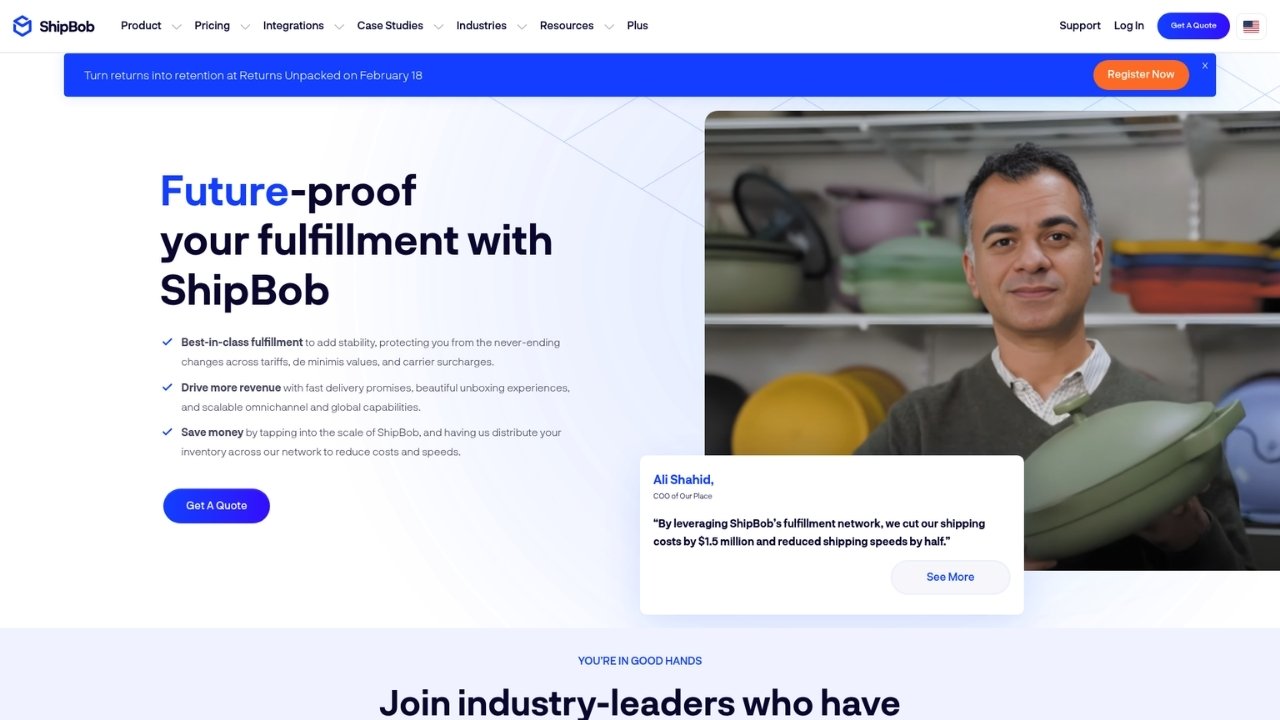
ShipBob has become the default choice for many fast-growing DTC brands, and for good reason.
With 60+ fulfillment centers across North America, Europe, and Asia, they offer genuine global reach that few competitors can match.
The company emphasizes speed. Their network enables 2-day shipping to 95% of the continental US, which has become table stakes for competing with Amazon.
They claim a 99.97% accuracy rate and 99.6% on-time shipping within SLA.
Key features:
- Real-time inventory tracking across all locations
- 50+ integrations including Shopify, NetSuite, Klaviyo, and Amazon
- Custom packaging and branded unboxing experiences
- B2B fulfillment with EDI compliance
- International shipping to 250+ destinations
- Proprietary WMS available for merchants with their own warehouses
Pricing: ShipBob requires a custom quote, with monthly minimums typically starting around $275.
Their software is free for customers, and standard packaging (brown boxes, poly mailers) is included. Custom branded packaging and kitting cost extra.
What works well: The scale advantages are real. One customer, Our Place, reported cutting shipping costs by $1.5 million and reducing delivery times by half after switching to ShipBob.
The Inventory Placement Program can reduce fulfillment costs by over $2 per order compared to single-location fulfillment.
Limitations: Monthly minimums exclude very small sellers. The pricing isn't transparent, you need to engage sales to understand costs.
Some users report that while the technology is good, it can feel less customizable than a full WMS for complex enterprise needs.
Verdict: ShipBob is a solid choice if you're scaling fast, need international reach, and can meet their minimums.
The global network and reliability make them a safe bet for growth-stage brands.
2. Fulfillment by Amazon (FBA)
Let's address the elephant in the room. If you sell on Amazon, FBA is almost impossible to ignore.
The Prime badge alone can increase conversion rates significantly, and Amazon's logistics network is unmatched in scale.
FBA handles everything: storage, picking, packing, shipping, customer service, and returns. Y
ou send inventory to their fulfillment centers, and they take care of the rest.
According to Amazon, FBA shipping costs 70% less per unit than comparable premium options from major carriers.
Key features:
- Prime eligibility for Amazon orders
- Multi-channel fulfillment for non-Amazon sales
- Global network of hundreds of fulfillment centers
- FBA Dashboard for inventory forecasting
- Automated replenishment recommendations
- New Seller Incentives ($100 off shipments, $200 fulfillment credit)
Pricing: FBA uses a complex fee structure. You'll pay:
| Fee Type | Cost |
|---|---|
| Professional selling plan | $39.99/month |
| Small standard fulfillment (2 oz) | $3.06 |
| Large standard fulfillment (1 lb) | $4.99 |
| Storage (Jan-Sep, standard) | $0.78/cubic foot |
| Storage (Oct-Dec, standard) | $2.40/cubic foot |
| Referral fees | 8-45% depending on category |
Additional fees apply for aged inventory, returns processing, and inbound placement services.
What works well: The Prime badge is powerful. Access to 200+ million Prime members is hard to replicate.
The trust factor of Amazon's brand also reduces customer hesitation at checkout.
Limitations: The fee structure is complex and can be hard to predict. Multi-channel fulfillment exists but is less flexible than pure 3PLs.
You lose branding control (Amazon-branded boxes). Long-term storage fees punish slow-moving inventory.
Verdict: If Amazon represents the majority of your sales, FBA is probably your best bet.
For multi-channel sellers, consider using FBA for Amazon orders and a different 3PL for other channels.
3. Red Stag Fulfillment

Red Stag occupies a unique position in the market.
They're highly selective about who they work with, focusing almost exclusively on heavy, bulky, or high-value items. If your products are bigger than a shoebox or heavier than 10 pounds, they're worth a serious look.
The company backs its service with four guarantees: dock-to-stock in 2 business days, zero shrinkage (they won't lose or damage your inventory), 99.99% pick and pack accuracy, and on-time shipments.
Key features:
- Specialized handling for items 10+ lbs or larger than shoebox size
- White-glove service for high-value goods
- Same-day shipping available
- Secure facilities with enhanced protection
- Kitting and subscription box assembly
- Amazon FBA prep services
Pricing: Red Stag requires a custom quote. They don't publish rates, and their pricing page actually returns a 404.
You'll need to contact sales for pricing based on your specific product dimensions, weight, and volume.
What works well: The accuracy guarantee is industry-leading. Most 3PLs won't put their money where their mouth is like Red Stag does.
Their specialization means they have the right equipment and expertise for products that generalist 3PLs struggle with.
Limitations: They're very selective. If you sell small, lightweight items, they probably won't take your business.
They only have two warehouse locations (Knoxville, TN and Salt Lake City, UT), which limits geographic distribution compared to larger networks.
Verdict: If you sell heavy, bulky, or high-value products, Red Stag should be at the top of your list.
Their specialization and guarantees justify potentially higher costs for the right products.
4. ShipMonk
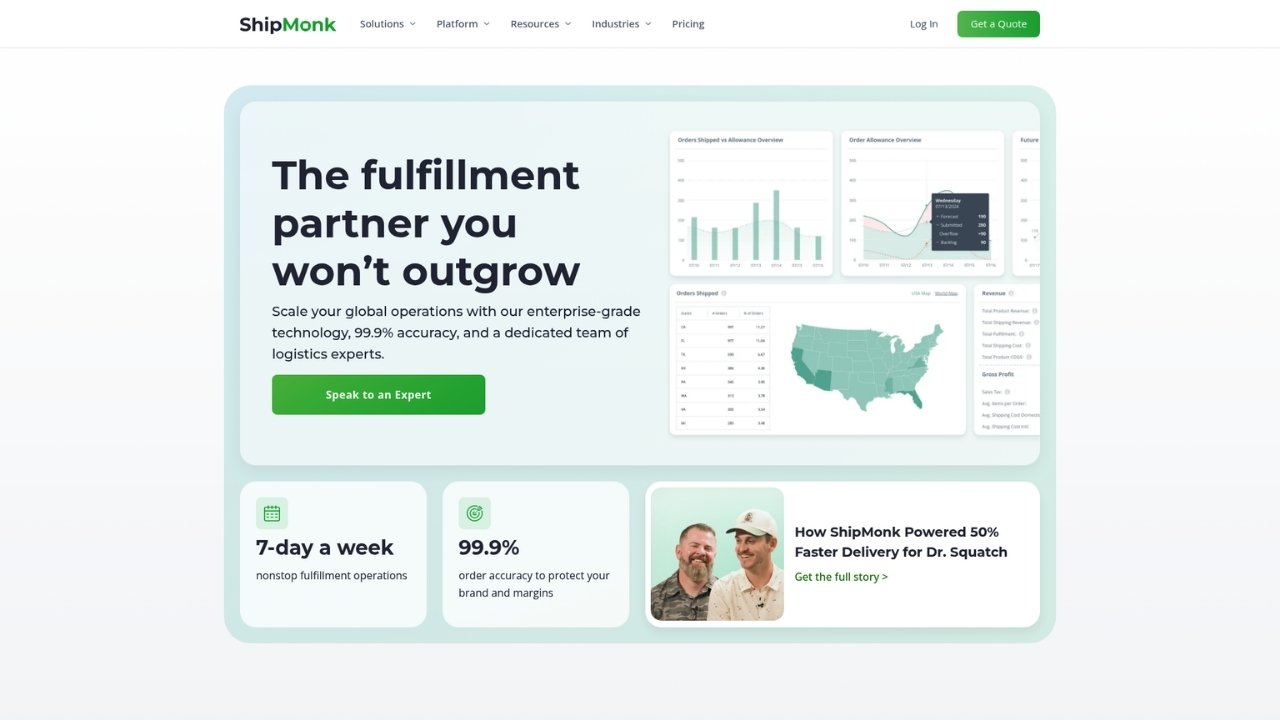
ShipMonk positions itself as the tech-forward choice for subscription boxes and growing startups.
With a 99.9% accuracy rate and a Virtual Carrier Network that automatically selects the best shipping option for each order, they compete aggressively on technology.
The company has built a strong reputation in the subscription box space, with specialized kitting and packaging capabilities.
They also support Seller-Fulfilled Prime (SFP), which is valuable for brands wanting Prime eligibility without committing fully to FBA.
Key features:
- Virtual Carrier Network for optimal shipping rates
- Subscription box specialization
- Seller-Fulfilled Prime support
- 100+ integrations including Etsy, Groupon, and major platforms
- Returns management and inspection
- Freight management services
- Real-time inventory and order tracking
Pricing: ShipMonk uses custom quotes with lower minimums than some competitors, typically around $250/month.
Like most 3PLs, they don't publish specific rates online.
What works well: The technology stack is impressive. The Virtual Carrier Network can save significant money on shipping by automatically optimizing carrier selection.
Their subscription box expertise means they understand the unique challenges of kitting and assembly.
Limitations: As a newer player compared to ShipBob or FBA, they have less track record.
Some users report that while the technology is excellent, the service can feel less polished at enterprise scale. They have fewer warehouse locations than ShipBob.
Verdict: ShipMonk is ideal for subscription businesses, startups, and brands wanting SFP capabilities.
The lower minimums make them accessible to smaller sellers who might not qualify for ShipBob.
5. Saltbox

Saltbox offers something genuinely different: a hybrid of coworking space and micro-fulfillment warehouse.
If you're the type of founder who wants to work alongside your inventory, this is your only real option.
With 12 locations across the US, Saltbox provides flexible warehouse space with month-to-month terms.
No long-term contracts, no massive minimums, and the ability to scale up or down as needed.
Key features:
- Flexible micro-fulfillment warehouse space
- Adjacent coworking facilities
- On-demand fulfillment services
- Month-to-month agreements (no long-term contracts)
- Community of entrepreneurs and small business owners
- Additional business services (photography, notary, etc.)
Pricing: Saltbox uses a membership-based model. Their pricing page was unavailable during research, but they emphasize transparent pricing without hidden fees. Contact them for current rates.
What works well: The flexibility is unmatched. Being able to walk into your warehouse, check inventory, and work from the adjacent office space is valuable for hands-on founders.
The community aspect provides networking opportunities with other entrepreneurs.
Limitations: There's a cap around 20,000 orders per month, so high-volume sellers will outgrow Saltbox.
It's US-only with no international locations. The model requires more owner involvement than traditional 3PLs, which could be a pro or con depending on your style.
Verdict: Saltbox is perfect for small businesses and early-stage startups that want flexibility and hands-on involvement. If you're not ready to fully outsource fulfillment, this is a great middle ground.
6. The Fulfillment Lab
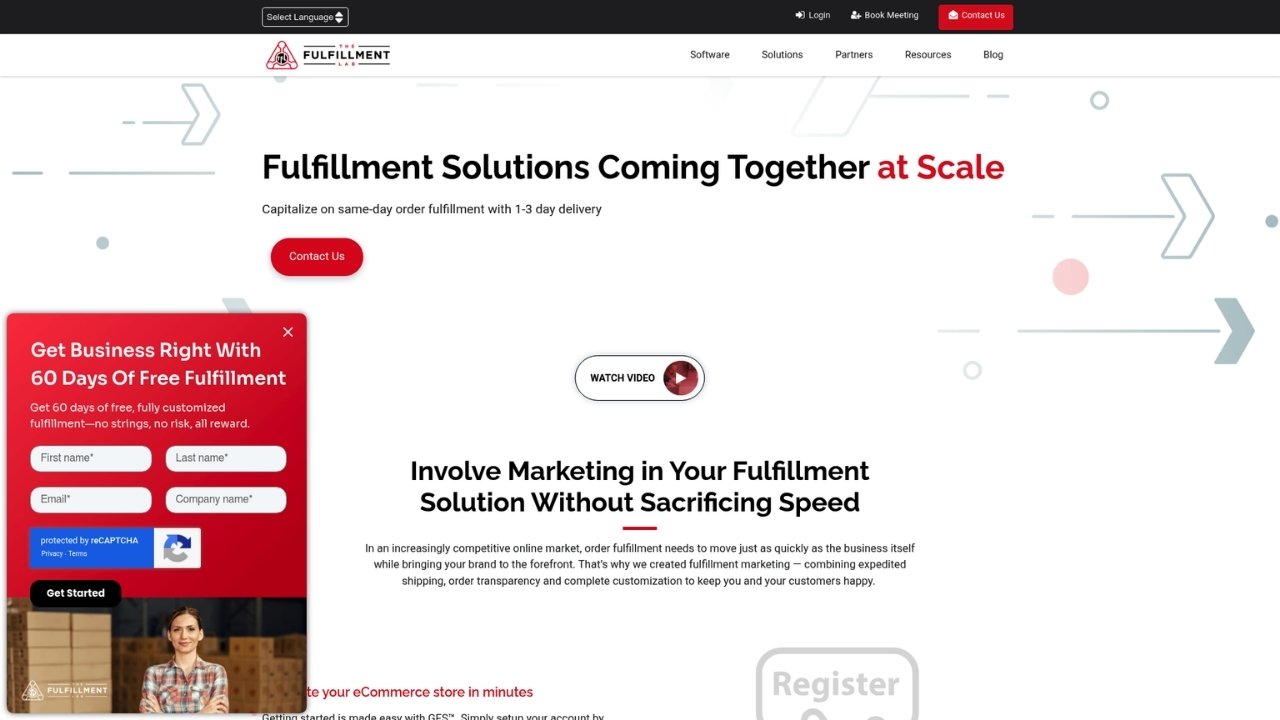
The Fulfillment Lab (TFL) has carved out a niche with "fulfillment marketing," the idea that your packaging and unboxing experience is a marketing opportunity.
With 14 facilities worldwide and a proprietary software platform, they offer a compelling package for brands that care about presentation.
One standout feature: they don't charge receiving or storage fees.
You only pay when something ships, which removes a significant barrier to entry for smaller sellers.
Key features:
- Fulfillment marketing with customized packaging and inserts
- 14 global fulfillment facilities
- Proprietary GFS™ (Global Fulfillment System) platform
- Dynamic integrations with major e-commerce platforms
- No receiving or storage fees
- Same-day order processing
- 60 days free fulfillment promotion for new customers
Pricing: TFL offers more transparency than most. Their pricing calculator shows sample rates:
| Service | Rate |
|---|---|
| Primary pick (first item) | $0.95 - $2.50 |
| Secondary pick (additional items) | $0.10 - $0.25 |
| Returns processing | $0.76 - $1.26 |
| Inserts | $0.10 |
What works well: The no-storage-fee model is genuinely different and lowers the barrier to trying their service.
The focus on customization and marketing through fulfillment is valuable for brands investing in unboxing experiences. The 60-day free trial reduces risk for new customers.
Limitations: They're less well-known than ShipBob or FBA, which might give some brands pause. The technology platform is newer and less proven than established competitors.
Verdict: TFL is ideal for brands wanting custom packaging without massive minimums, international sellers needing global reach, and anyone wanting to test fulfillment without upfront storage costs.
7. Cart.com
Cart.com takes a different approach than pure 3PLs. They offer a unified commerce platform that combines fulfillment with growth marketing, marketplace services, and customer engagement.
If you're looking for an all-in-one solution rather than just a warehouse, Cart.com is worth exploring.
With 8.5 million square feet of fulfillment space across 14 warehouses and 70+ million orders processed annually, they have the scale to support significant volume.
Key features:
- Omnichannel fulfillment (D2C and B2B)
- Proprietary Constellation OMS/WMS platform
- Growth marketing services (paid media, SEO, email, SMS)
- Marketplace management (Amazon, Walmart)
- Customer engagement and support services
- 360 Managed Commerce (end-to-end outsourcing)
- Merchant financing options
Pricing: Cart.com requires custom quotes. They don't publish specific rates, and pricing varies significantly based on which services you use.
What works well: The integrated approach can simplify operations for brands that want one partner handling multiple functions.
The financing options are unique and valuable for growing businesses. The analytics and reporting capabilities are strong.
Limitations: Less specialized in pure fulfillment compared to dedicated 3PLs. There's potential for platform lock-in if you use multiple services.
The broad offering might be overwhelming if you just need straightforward fulfillment.
Verdict: Cart.com is best for brands wanting an integrated e-commerce + fulfillment solution, mid-market companies needing comprehensive services, and businesses that could benefit from merchant financing alongside logistics.
How to choose the right Speed Commerce alternative
With seven solid options, how do you decide? Here's a simple framework based on your business stage and needs.
Just starting out or low volume: Consider ShipMonk or Saltbox. ShipMonk has lower minimums than ShipBob and excellent technology.
Saltbox offers maximum flexibility if you want hands-on involvement.
Amazon is your primary channel: FBA is probably your best bet. The Prime badge and Amazon's logistics network are hard to beat for Amazon-specific sales.
Selling heavy or bulky products: Red Stag Fulfillment is the clear choice. Their specialization and guarantees are built specifically for products that generalist 3PLs struggle with.
Scaling fast with international ambitions: ShipBob or The Fulfillment Lab. ShipBob has the larger network, but TFL's no-storage-fee model makes them worth considering.
Questions to ask during sales calls:
- What's your accuracy rate, and do you guarantee it?
- Can I see your integration list before committing?
- What happens if you lose or damage my inventory?
- Are there any fees beyond pick/pack/ship and storage?
- Can I tour a facility before signing?
Red flags to watch for:
- Reluctance to provide references from similar businesses
- Pushy sales tactics or pressure to sign quickly
- No trial period or pilot program option
- Poor online reviews mentioning inventory issues
- Unclear or evasive answers about pricing
Pairing your 3PL with AI customer support
Here's something most 3PLs won't tell you: fulfillment is only half the customer experience battle. Once that package ships, your customers will have questions.
"Where's my order?" "Can I change the shipping address?" "My package hasn't arrived."
These calls and emails eat up hours of your team's time.
This is where Ringly.io fits in. Our AI phone agents integrate with any 3PL setup to handle routine customer inquiries automatically.
We're seeing 70-73% resolution rates without human intervention for common questions like order status and returns.
The integration works seamlessly. When a customer calls asking about their order, our AI pulls real-time data from your 3PL and provides instant answers.
No more "let me check on that and call you back."
For businesses processing thousands of orders monthly, this can mean reclaiming dozens of hours per week.
Your team can focus on growth instead of tracking packages.
Try Ringly.io free and see how AI phone support complements your fulfillment setup.
Frequently Asked Questions
What are the best Speed Commerce alternatives for small businesses?
For small businesses, ShipMonk and Saltbox are strong options. ShipMonk has lower minimums than competitors (around $250/month), while Saltbox offers maximum flexibility with month-to-month terms and hands-on involvement.
Which Speed Commerce alternative offers the best international shipping?
ShipBob leads with 60+ fulfillment centers across North America, Europe, and Asia, shipping to 250+ destinations. The Fulfillment Lab is also strong with 14 global facilities and no storage fees.
Are there any Speed Commerce alternatives with no monthly minimums?
The Fulfillment Lab doesn't charge receiving or storage fees, you only pay when items ship. Saltbox uses a flexible membership model that scales with your needs.
What Speed Commerce alternative is best for heavy or bulky products?
Red Stag Fulfillment specializes in products over 10 lbs or larger than a shoebox. They offer a 99.99% accuracy guarantee and white-glove handling for high-value items.
Which Speed Commerce alternatives work well with Amazon?
Amazon FBA is the obvious choice for Amazon-first sellers. ShipMonk and ShipBob both support Seller-Fulfilled Prime and multi-channel fulfillment.
How do Speed Commerce alternatives compare on pricing transparency?
The Fulfillment Lab offers the most transparency with published rates ($0.95-$2.50 per pick). Most others including ShipBob, ShipMonk, and Red Stag require custom quotes.
Can I use multiple Speed Commerce alternatives for different channels?
Yes, many sellers use Amazon FBA for Amazon orders while using a different 3PL like ShipBob or ShipMonk for DTC and other channels. This hybrid approach optimizes for each channel's requirements.