


SoundHound AI has become a familiar name in voice recognition and conversational AI.
But it's not the only option out there and depending on your use case, it might not be the best fit.
Whether you're building voice agents for customer service, automating phone support for your online store, or just need reliable speech-to-text, there are solid alternatives worth considering.
I've researched and tested the leading options to help you find the right match for your specific needs.
Editor’s note: Want to hear some sample AI support calls made for your Shopify store?
- Just paste your store URL
- Hear sample calls for your store (no email required)
- Listen to demo calls for my store
How We Evaluated These Alternatives
I focused on tools that deliver real business outcomes not just impressive tech demos. My evaluation criteria included:
- Pricing transparency: Can you actually figure out what it costs without talking to sales?
- Ease of setup: How long from signup to deployment?
- Use case fit: Is this tool purpose-built for your specific need?
- Integration capabilities: Does it play nicely with your existing stack?
- Real performance metrics: Resolution rates, accuracy scores, time savings
I also included Ringly.io in this comparison because it's a specialized alternative that solves a specific problem SoundHound doesn't address well: AI phone support for e-commerce stores.
The 6 Best SoundHound AI Alternatives
1. Ringly.io
Best for: E-commerce phone support and Shopify stores

While SoundHound focuses on general voice AI, Ringly.io specializes in AI phone agents for online stores. Their product, the AI, acts as a 24/7 phone support representative that handles the repetitive calls most e-commerce businesses struggle with.
the AI can look up orders, process returns, answer FAQs, and escalate complex issues to your human team when needed. The setup is fast: most stores are live in under 1 hour.
Key features
- Deep Shopify integration for real-time order tracking and returns processing
- 73% average call resolution rate without human intervention
- 24/7 availability with support for 40+ languages
- quick setup with no coding required
- Call recordings and analytics dashboard to identify knowledge gaps
Pricing
- Ringly prices per call; the pricing page has details.
- Ringly charges per phone conversation (see Ringly's pricing).
- Spam, hang-ups and wrong numbers are free
- 14-day free trial available
Pros
- Purpose-built for e-commerce phone support
- Resolves most calls without human escalation
- Transparent, predictable pricing
- Fast deployment with minimal technical knowledge
Cons
- Focused specifically on phone support (not general voice AI)
- Best suited for Shopify stores
If you run an online store and want to stop losing sales to unanswered phone calls, Ringly.io is worth serious consideration. Try it for free.
2. PolyAI
Best for: Enterprise conversational assistants
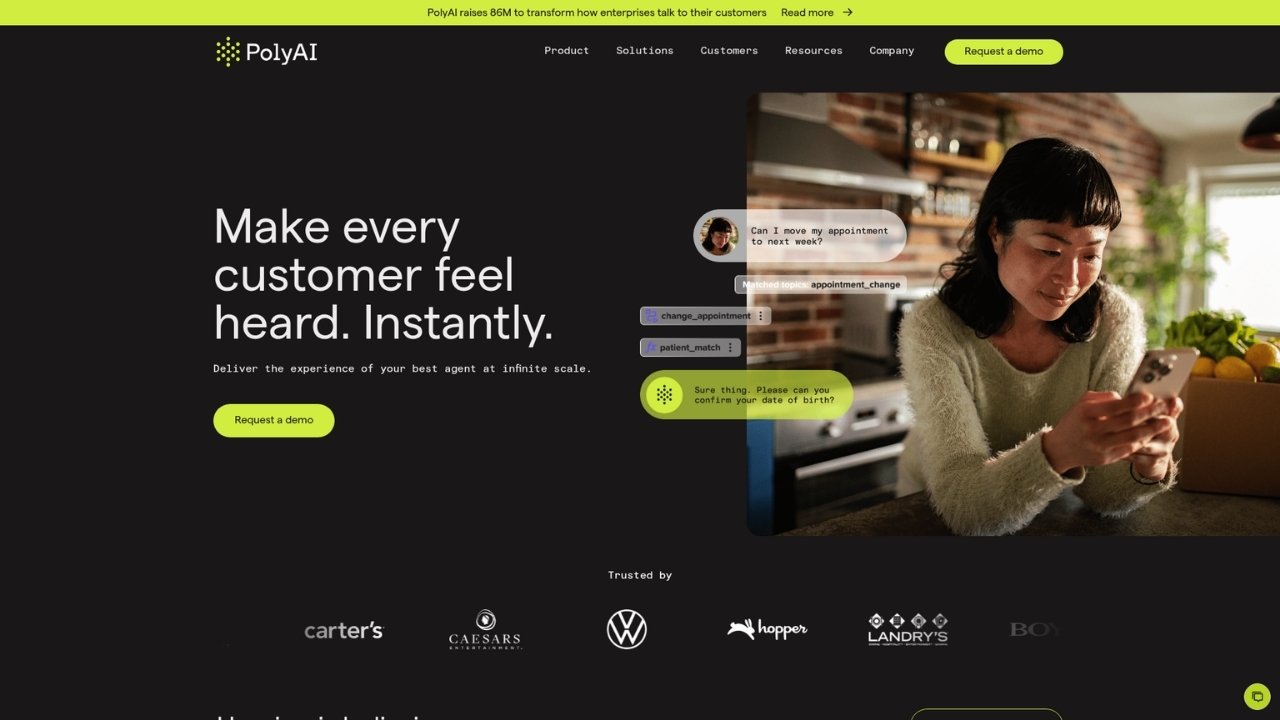
PolyAI builds what they call "the world's most lifelike voice AI agents." Founded by University of Cambridge speech scientists, they focus on creating natural-sounding conversational AI that can handle complex, multi-turn customer interactions.
Their platform is designed for enterprises that need to automate high volumes of customer service calls without sacrificing quality. The AI can handle interruptions, clarify ambiguous requests, and maintain context throughout long conversations.
Key features
- Natural, human-like voice conversations
- Scalable platform for high call volumes
- Integration with existing phone systems and contact centers
- Real-time reporting and conversation insights
- Custom voice options aligned with your brand
Pricing:Enterprise pricing (contact sales for custom quote)
Pros
- Highly natural, human-like conversations
- Enterprise-grade reliability and security
- Strong customer support and implementation assistance
Cons
- Pricing not publicly transparent
- Implementation typically takes weeks
PolyAI is ideal for large enterprises with complex customer service needs and the budget to match.
3. Kore.ai
Best for: Flexible enterprise deployments
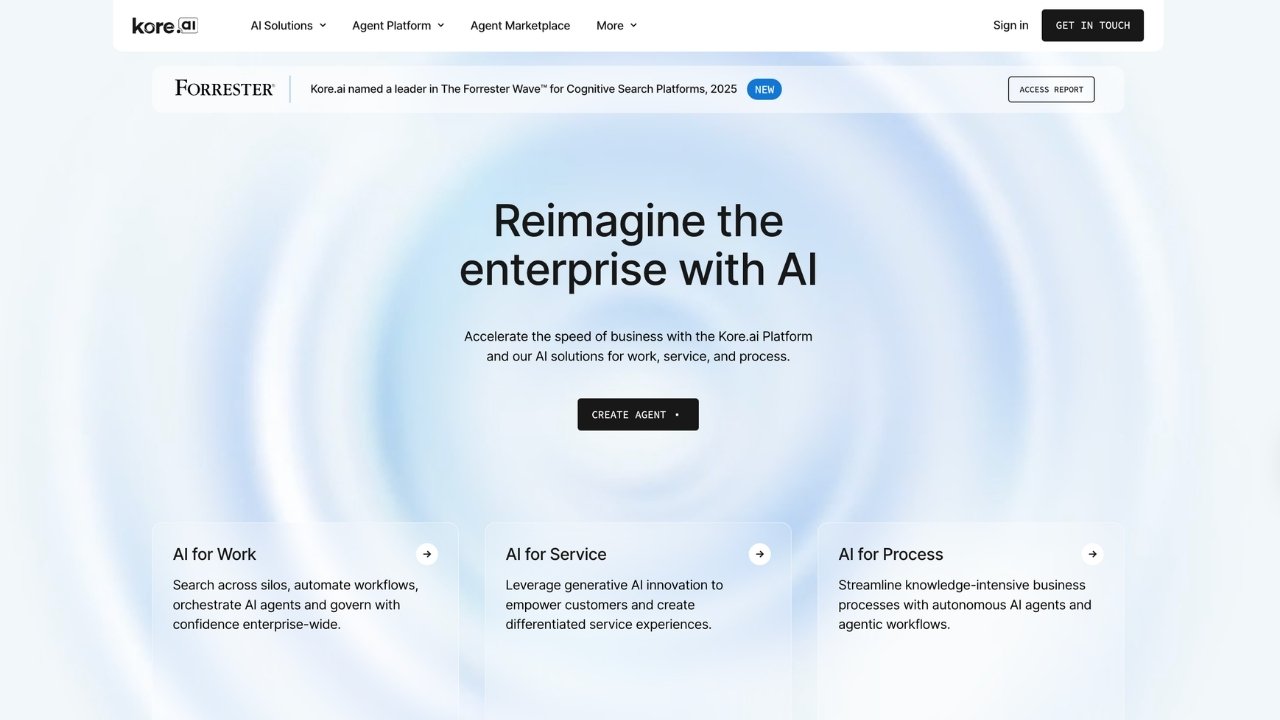
Kore.ai offers a comprehensive agentic AI platform for building conversational AI applications. They were named a Leader in the 2025 Gartner Magic Quadrant for Conversational AI Platforms, and their technology powers AI solutions across banking, healthcare, retail, and IT.
Their platform goes beyond simple chatbots to enable multi-agent orchestration where multiple AI agents collaborate, share memory, and handle complex decision-making tasks.
Key features
- Agentic AI platform for building autonomous AI agents
- Pre-built applications for Banking, Healthcare, Retail, IT, and HR
- Multi-agent orchestration with shared memory
- No-code and pro-code development tools
- 100+ pre-built connectors to enterprise systems
- Enterprise security with RBAC, audit logs, and compliance frameworks
Pricing:Enterprise pricing (contact sales for custom quote)
Pros
- Highly flexible and customizable platform
- Strong multi-agent capabilities
- Recognized by Gartner as a market leader
Cons
- Requires technical expertise to fully leverage
- Enterprise-focused pricing
Kore.ai is best for large organizations that need to deploy AI agents across multiple departments and use cases.
4. Deepgram
Best for: Developers needing speech-to-text APIs
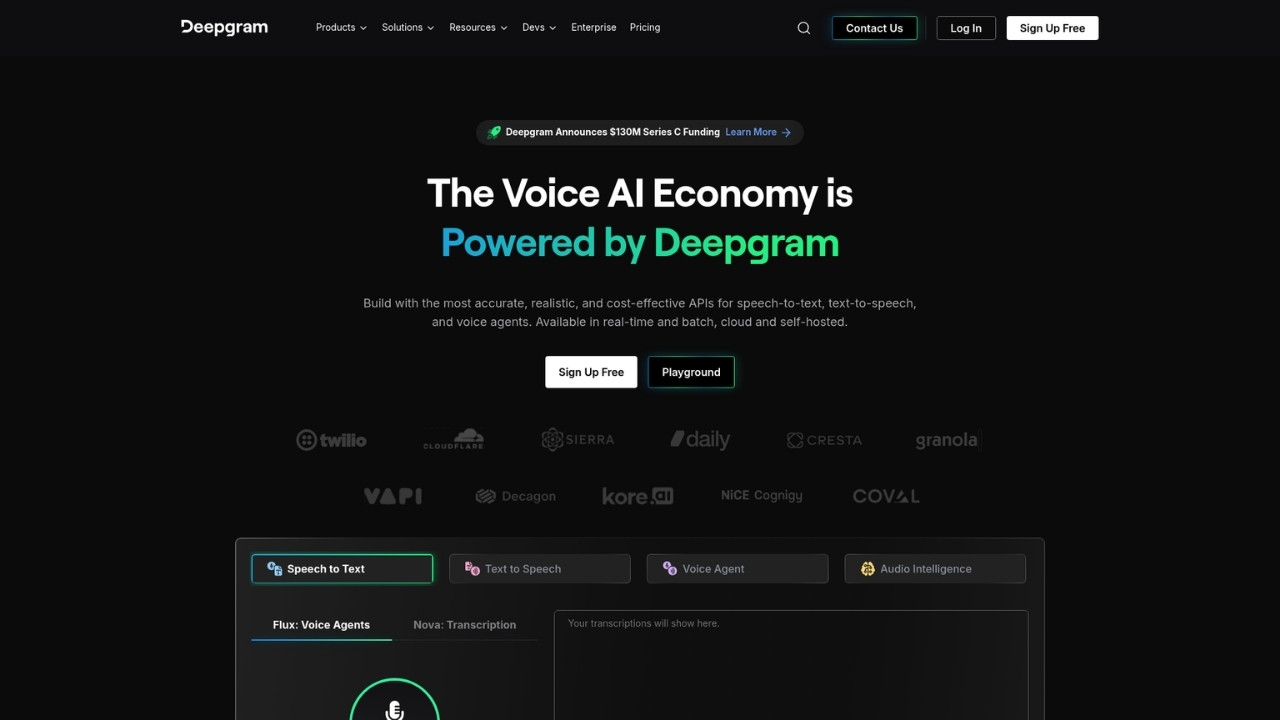
Deepgram takes a developer-first approach to speech AI. They provide APIs for speech-to-text, text-to-speech, and voice agents that developers can integrate into their own applications.
With multiple models optimized for different use cases from real-time streaming to high-accuracy batch transcription Deepgram offers flexibility for teams building custom voice experiences.
Key features
- Real-time and batch speech-to-text transcription
- Text-to-speech with natural-sounding voices
- Voice Agent API for building conversational AI
- 99+ language support
- On-premise deployment options for security-sensitive applications
- Multiple models: Nova-3 (best accuracy), Enhanced, Base, Flux (for voice agents)
Pricing
- Speech-to-Text: $0.0058-$0.0165/minute (pay-as-you-go)
- Voice Agent API: $0.05-$0.16/minute
- Text-to-Speech: $0.015-$0.030 per 1,000 characters
- Free tier: $200 credit to start
- Growth plan: $4,000/year (save up to 20%)
Pros
- Developer-friendly APIs with excellent documentation
- High transcription accuracy across multiple models
- Flexible deployment options
Cons
- Requires development resources to implement
- Not a complete out-of-the-box solution
Deepgram is perfect for development teams building custom voice applications who need reliable, accurate speech APIs.
5. AssemblyAI
Best for: Audio intelligence and transcription
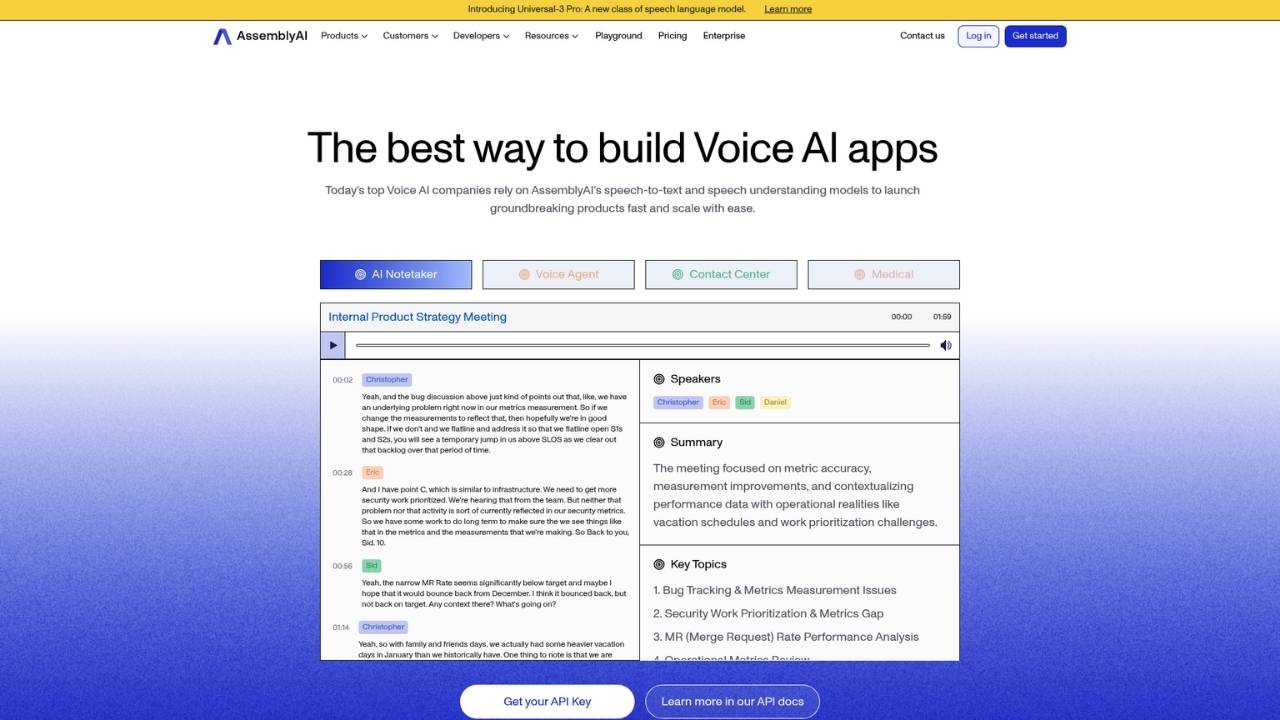
AssemblyAI provides production-ready AI models for speech-to-text and speech understanding. They process over 40 terabytes of audio daily and serve 600 million+ inference calls monthly.
Their Universal-3 Pro model represents a new class of speech language model that can be customized through prompting no retraining required. They also offer comprehensive audio intelligence features like sentiment analysis, entity detection, and summarization.
Key features
- Universal-3 Pro: Advanced speech model with prompt-based customization
- Universal-2: 99-language transcription
- Universal-Streaming: Ultra-low latency real-time transcription
- Speech understanding: Speaker identification, sentiment analysis, summarization
- Guardrails: PII redaction, profanity filtering, content moderation
- LLM Gateway: Apply language models directly to audio data
Pricing
- Universal-3 Pro: $0.21/hour
- Universal-2: $0.15/hour
- Universal-Streaming: $0.15/hour
- Add-ons (speaker ID, sentiment, etc.): $0.02-$0.08/hour
- Free tier: 185 hours pre-recorded + 333 hours streaming
Pros
- Industry-leading accuracy with Universal-3 Pro
- Rich audio intelligence features
- Strong enterprise security (SOC 2, GDPR, HIPAA)
Cons
- API-focused (not a complete voice agent solution)
- Learning curve for advanced features
AssemblyAI is ideal for companies that need to extract insights from voice data at scale.
6. Otter.ai
Best for: Meeting transcription and note-taking

Otter.ai has become the go-to AI meeting assistant for millions of users. It joins your Zoom, Teams, or Google Meet calls to provide real-time transcription, automated summaries, and action item extraction.
Recently, they've expanded beyond meeting notes into AI agents for sales (SDR Agent) and recruiting automating follow-ups and extracting insights from conversations.
Key features
- Real-time transcription for Zoom, Teams, and Google Meet
- Automated meeting summaries with action items
- Speaker identification by name
- Otter AI Chat to query across all your meetings
- CRM integration with Salesforce and HubSpot
- Collaboration tools: shared channels, comments, highlights
Pricing
- Basic: Free (300 minutes/month)
- Pro: $16.99/month ($8.33 annual) - 1,200 minutes
- Business: $30/month ($19.99 annual) - unlimited
- Enterprise: Custom pricing
Pros
- Easy to set up and use
- Affordable pricing with generous free tier
- Excellent for meeting productivity
Cons
- Not designed for customer-facing voice AI
- Limited automation compared to dedicated voice agents
Otter.ai is perfect for teams that want to eliminate note-taking and capture meeting insights automatically.
Comparison Table
| Tool | Best For | Pricing | Setup Time | Key Strength |
|---|---|---|---|---|
| Ringly.io | E-commerce phone support | $99/mo for the first 50 calls, then $1.99 per call | Under 1 hour | Shopify integration, up to 90% resolution |
| PolyAI | Enterprise conversational AI | Contact sales | Weeks | Human-like conversations |
| Kore.ai | Flexible enterprise deployments | Contact sales | Weeks | Multi-agent orchestration |
| Deepgram | Developer APIs | $0.0058-$0.16/min | Varies | Accurate transcription |
| AssemblyAI | Audio intelligence | $0.15-$0.21/hr | Varies | Universal-3 Pro model |
| Otter.ai | Meeting transcription | Free-$30/mo | Minutes | Easy note-taking |
How to Choose the Right Alternative
The best SoundHound AI alternative depends entirely on your specific situation:
For e-commerce and Shopify stores: Ringly.io is the clear winner. It's purpose-built for online stores, integrates deeply with Shopify, and can resolve up to 90% of calls without human intervention. The quick setup means you're live today, not next month.
For enterprise customer service: PolyAI or Kore.ai offer the scale and customization large organizations need. PolyAI excels at natural conversations, while Kore.ai provides broader agentic AI capabilities.
For developers building custom solutions: Deepgram or AssemblyAI provide the APIs and flexibility to build exactly what you need. Deepgram is more developer-friendly, while AssemblyAI offers richer audio intelligence.
For internal meetings: Otter.ai is affordable, easy to use, and eliminates the drudgery of meeting notes.
Before deciding, ask yourself:
- What's your primary use case?
- Do you need a complete solution or building blocks?
- What's your technical expertise?
- What's your budget and timeline?
Get Started with AI Phone Support Today
If you run an e-commerce store and phone calls are slipping through the cracks, Ringly.io lets you try it for free, and it comes with a 30-day money back guarantee. You'll have full access to the AI, their AI phone rep, and most stores see resolution rates around 73%.
That's 7 out of 10 calls handled without your team lifting a finger.
The right voice AI isn't the one with the most features it's the one that solves your specific problem. Choose based on your use case, and you'll see better results than forcing a general-purpose tool to fit.