
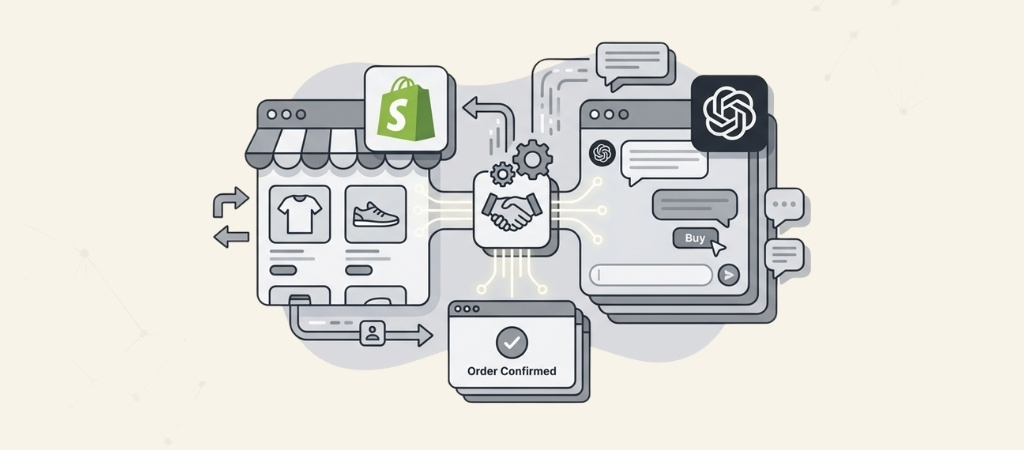
Shopify’s first-party plugin lets you build and manage the store from a ChatGPT conversation. Agentic Storefronts is how your products show up when people shop in ChatGPT.
In September 2025, OpenAI announced Instant Checkout in ChatGPT, starting with Etsy sellers, built on the Agentic Commerce Protocol, an open standard OpenAI describes as enabling a conversation between buyers, their AI agents and businesses to complete purchases. Shopify said then that merchants would be able to sell directly through ChatGPT conversations, no links or redirects. In March 2026 that plan changed. Instant Checkout never shipped for Shopify merchants. Pages about a Shopify Instant Checkout integration redirected to the Shopify homepage as of March 16 and 17, 2026, and Shopify emailed merchants that ChatGPT in Agentic Storefronts was coming later that month, on by default, with settings in the admin (Digital Commerce 360).
What is live now is the plugin for store work, plus Agentic Storefronts for discovery.
Editor’s note: Want to hear some sample AI support calls made for your Shopify store?
- Just paste your store URL
- Get sample calls in under 20 seconds (no email required)
- Listen to demo calls for my store
Run your store from ChatGPT with the Shopify plugin
Install the first-party Shopify plugin for ChatGPT once, then tag @Shopify in any message to build or manage your store from a conversation. Without the tag, ChatGPT answers from general knowledge. With it, the plugin reads your real products, orders and sales data and makes changes when you ask (Shopify).
The plugin is free. It works in the ChatGPT app’s Chat, Work and Codex modes, and in the web and desktop apps.
Set it up
- Install the Shopify plugin for ChatGPT.
- Connect an existing store, or create a new store from ChatGPT, preview designs, and claim one.
- Tag
@Shopifyin the message when you want live data or a real change. - If you manage more than one store, switch in a message. Each store needs approval.
You do not need a Shopify store to start. Claiming a new store from ChatGPT starts a 4-month Shopify plan trial.
What you can ask
Shopify’s own examples, grouped here as build, sell, and analyze.
| Job | Examples |
|---|---|
| Build | Start a business from a description (naturally scented candles); add or edit products (a vanilla bean candle for $24.95); organize collections; upload photos; manage variants |
| Sell | Show orders from the last 7 days; check stock; launch a sitewide 15% off promo starting today; check an order’s status; search the catalog; set all draft products to active |
| Analyze | Bestsellers last month; top countries in the last 30 days; how buyers found the store; slow movers; what a promo campaign brought in; how many people reached checkout but did not buy |
Sell through ChatGPT with Agentic Storefronts
ChatGPT shoppers find Shopify merchants through Agentic Storefronts. Eligible stores do not install a selling app. Shopify enables the channel by default. Manage it under Sales channels > Agentic in the Shopify admin, where each AI channel can be turned on or off (Shopify).
Buyers discover products inside ChatGPT, surfaced via Shopify’s Global Catalog, and complete the purchase on the merchant’s own online store, in an in-app browser in the ChatGPT mobile app or in a separate browser tab on web. Orders appear in the Shopify admin like any other sales channel. Merchants do not need to build an app. Agentic Storefronts syndicates data to ChatGPT through the Shopify Catalog (Digital Commerce 360).
All your customizations, branding, selling strategies and payment methods are supported (Shopify Help Center).
Shopify Catalog is the structured product data layer AI agents read. It provides the same schema fields automatically for all stores on Shopify, and Catalog Mapping lets you customize how products are listed.
When Agentic Storefronts orders land, they show full channel attribution in the admin, so you can see which AI platform drove each sale. You keep ownership of the customer relationship. Some AI platforms share only the information required to complete the order, which may exclude browsing data or email addresses. Give shoppers a way to opt into direct contact, for example with packaging inserts or a newsletter signup.
Brands on any ecommerce platform, even without a Shopify store, can use the Shopify Agentic Plan to list products in Shopify Catalog and sell through Agentic Storefronts. There is no monthly fee (Shopify).
On June 17, 2026, the Spring ’26 Edition opened Shopify’s agentic commerce layer to every developer (UCP plus Catalog API, no approval) and made the Shopify AI Toolkit generally available (Shopify). For a store owner, that means developers can now query Shopify's product catalog with an API key and no approval. The Universal Commerce Protocol is the open standard Shopify co-developed with Google for how AI agents transact with merchants, from discovery to carts to checkout, with support from Amazon, Meta, Microsoft, Salesforce, Stripe, Etsy, Target and Wayfair.
How ChatGPT checkout compares with Copilot, Gemini, and AI Mode
As of September 25, 2026, Shopify lists ChatGPT, Microsoft Copilot, AI Mode in Google Search, the Gemini app, and Meta as live Agentic Storefronts channels, all managed from the Shopify admin. Unlike Copilot, AI Mode and the Gemini app, ChatGPT has no checkout choice.
| Channel | Who Shopify says can use it | Where checkout happens |
|---|---|---|
| ChatGPT | Live for millions of Shopify merchants who sell to US buyers; stores selling to US buyers can use it regardless of where the store is based | Always on your online store (in-app browser on mobile, separate window on desktop) |
| Microsoft Copilot | Live for millions of Shopify merchants discoverable via Shopify Catalog; stores selling to US buyers, regardless of store location | You choose: inside the channel or sent to your store |
| AI Mode in Google Search | Available to select brands selling to US buyers; open to stores based in the US selling to US customers, with a broader rollout underway | You choose: inside the channel or sent to your store |
| Gemini app | Available to select brands selling to US buyers; open to stores based in the US selling to US customers, with a broader rollout underway | You choose: inside the channel or sent to your store |
| Meta | Listed as a live Agentic Storefronts channel as of September 25, 2026, managed from the admin | - |
If you sell to US buyers, check Sales channels > Agentic that ChatGPT is on, and set your checkout choice for Copilot, AI Mode and Gemini there.
Availability: Shopify. Checkout choices, US-buyer rules, and live channels as of September 25, 2026: Shopify.
Other assistants in market include Copilot Checkout (Microsoft), Instant Buy (PayPal with Perplexity), and Google’s agentic checkout inside AI Mode with eligible US retailers, which Google is extending to Canada, Australia and the UK and to the Gemini app.
Eligibility, fees, and how to opt out
Gemini and AI Mode still limit access to select US-based brands selling to US customers.
ChatGPT channel requirements
| Requirement | What you need |
|---|---|
| Shopify plan | A paid Shopify plan, plus an unlocked storefront, for Agentic Storefronts eligibility |
| Store policies | Terms of service, privacy, and return and refund completed in Settings > Policies |
| Supplemental terms | Agree to the Shopify Agentic Storefronts Supplemental Terms of Service |
| Where you sell | The store must sell to customers in the United States; the store can be based outside the US |
| Catalog product fields | Title, at least one image, a price, and shipping to the US or Canada to qualify for Shopify Catalog |
| Product types that will not show | B2B-only products are not supported; products in OpenAI’s prohibited products and services do not display |
Paid plan, unlocked storefront, Catalog fields, and US or Canada shipping: Shopify.
Put any legal disclosures in the first 6,000 characters of the product description. Nothing extra is required for products to be discovered through Shopify Catalog (Shopify Help Center).
Fees
There are no fees for selling in ChatGPT. You pay only your standard payment processing fees. When a sale runs through a channel that uses Shopify Checkout, such as Copilot or Google’s AI Mode, you pay Shopify’s standard payment processing rates on that order and nothing more. For ChatGPT, the payment runs through the processor you already use.
Turn ChatGPT off
- Go to
Sales channels > Agentic. - Deactivate
Allow Shopify to manage for me. - Click ChatGPT, deactivate Shopify Catalog access, and save.
It can take up to 7 days before product data stops being shared. Products may still be referenced by the AI channel through web crawling. Removing ChatGPT access does not affect other platforms such as Shop.
Product data, Catalog, and policies that get you recommended by AI shopping agents
A search engine ranks partly on popularity. An AI agent matches a request to the best-fitting product data, so a vertical hydroponic system that fits a nine-foot wall is matched on data. In Q2 2026, 75% of AI-attributed orders on Shopify were in categories ranked outside the top 100 by sales volume (Shopify). Prioritize complete, specific product records in the categories you already sell, including ones that are small by volume.
Audit structured product data
- Fill every standardized product field. AI agents rely on standard, machine-readable fields (title, material, dimensions, price).
- Write titles that name materials, sizes and use cases, such as
40L waterproof hiking backpack with laptop compartment. - Use Catalog Mapping if the automatic listing needs a different field mapping.
- Fix pitfalls: subjective marketing language, variants listed as separate products, product data trapped in display templates or JavaScript, thin or missing attributes.
- Run Shopify’s free audit tool that checks whether structured data and robots.txt are set up for AI shopping assistants.
Build the AI-facing brand presence
Agents pull from FAQs, return policies, shipping information and pricing to answer shopper questions. A shopper who tells an agent to buy only from brands with free returns is only matched if the free-returns policy is stated clearly. Put reviews and Q&As on product pages. Shopify stores can use Knowledge Base to review and customize the information AI platforms use and to set brand voice and policies. Publish policies and FAQs as dedicated pages with clear headings and plain language. Avoid accordions and JavaScript-only content. The Shopify customer support AI voice agent integration is the spoken counterpart when a shopper calls about those same policies.
Enable the channels, then monitor
Keep Agentic Storefronts on for the channels you want. Search for your products in ChatGPT, Google AI Mode, Gemini and Copilot the way a customer would (What's the best [category] under [price]?), verify the information shown, compare against the channel attribution on Agentic Storefronts orders, fix the gap (a product field, a policy page, a review section), and recheck.
The visibility guide covers this in more depth.
What ChatGPT does not do after the order
After the sale, callers still ask where an order is, how to return an item, and how a product works. Publish a storefront number with how to add a phone number to your Shopify store. A phone number is one way shoppers can contact you directly; the best Shopify calling integration is how you route those calls. Spoken order-status and return questions are a different channel; AI voice support for Shopify covers that.
Shopping agents and Agentic Storefronts cover discovery and checkout. Ringly.io is an AI phone agent for Shopify stores. It answers support calls, checks order status, and handles questions about returns and products, so the store does not need a person on the phone for every call.
Frequently asked questions
Did Shopify Instant Checkout ship for ChatGPT?
OpenAI announced Instant Checkout in ChatGPT in September 2025, starting with Etsy sellers. In March 2026 Shopify moved merchants to ChatGPT in Agentic Storefronts instead, with checkout on your own store (Digital Commerce 360). Instant Checkout never shipped for Shopify merchants.
Do I install anything to sell in ChatGPT?
No. Eligible stores do not install a selling app, and you manage channels under Sales channels > Agentic (Shopify). The Shopify plugin is a separate install for running the store from ChatGPT.
Do I pay extra fees to sell in ChatGPT?
No. You pay only your standard payment processing fees.
Is the Shopify plugin for ChatGPT free?
Yes. It works in Chat, Work and Codex in the ChatGPT app, plus web and desktop (Shopify).
Can I sell through Agentic Storefronts without a Shopify store?
Yes. The Shopify Agentic Plan lets brands on any ecommerce platform list products in Shopify Catalog and sell through Agentic Storefronts, with no monthly fee.