
81% of buyers try to answer their own question before they contact you. Only 14% actually get all the way through. That gap, between attempted self-service and finished self-service, is where most of your support cost lives.
The math is brutal in your favor when you close it. A self-service contact costs roughly $0.10. A live one costs around $8.01, according to self-service customer support statistics for 2026. For ecommerce specifically, a well-built self-service stack deflects 50% to 70% of tickets before they touch a human.
So the question isn't whether to invest in self-service support software. It's which tools, in what stack, for a Shopify ops lead who needs to ship by Friday.
This post ranks 9 self-service support tools for DTC and Shopify brands in 2026: knowledge base platforms, AI chat agents, return-aware automations, and interactive guides. Real pricing. Real Shopify-integration depth. The double-billing traps. And at the end, an honest answer to the question every listicle on this topic ducks: what about the 30% of contacts that still come in by phone?
Hear what AI support calls sound like for your store. Just paste your Shopify URL and get sample calls in under 20 seconds, no email required. Listen to demo calls for my store.
Why self-service is the cheapest layer to win in your stack
Self-service is where the cheap wins live. Ecommerce deflection rates land between 50% and 70% in most stores. The tech industry average sits at 23%. We win this category because the questions are predictable: where is my order, how do I return it, does it ship to Canada, what size am I.
The cost gap is the real argument. Every contact your knowledge base answers for $0.10 saves you roughly $8 versus a live agent. Spread that across a few thousand tickets a month and you're looking at the cost of an extra agent (or two) you don't have to hire.
What "self-service" actually means in 2026 is broader than an FAQ page. It's a stack:
- A knowledge base your customers can search
- An AI chat agent that pulls from the KB
- A return portal that processes returns without a ticket
- An order status tracker that kills WISMO before it starts
Most operators build this piece by piece. The tools below cover the first two layers and parts of the third. For the return-portal layer specifically, a dedicated tool can drive a 63% reduction in returns-related support tickets. Worth its own seat in your stack.
The reason most self-service deployments underperform isn't tool choice. It's maintenance debt. Articles rot, the AI starts hallucinating, nobody owns the help center, and a year later you're back to a flooded inbox. Pick a tool you'll actually keep alive.
How we evaluated these tools
For a Shopify brand, the right criteria look different than "best for enterprise IT." Here's how we ranked:
- Shopify-integration depth: Does the tool pull order data, returns, and customer history natively, or do you need Zapier and a Tuesday?
- AI deflection accuracy: Does the AI cite a real KB article, or invent answers from thin air? Hallucinations cost trust fast.
- Honest pricing: Published rates. We auto-downgrade tools that hide pricing behind a sales call for SMB tiers.
- Setup time: Live in a day, a week, or a month? Be honest with yourself about which one you can survive.
- Maintenance burden: How much ongoing KB upkeep does this need to stay accurate?
- What it explicitly does not do: Especially around voice, phone, and after-hours coverage. We'll come back to this.
Quick comparison: the 9 tools side by side
| Tool | Best for | Starting price | Free trial | Shopify-native | G2 score |
|---|---|---|---|---|---|
| Zendesk Guide | Teams 15+ agents already on Zendesk | $55/agent/mo | 14 days | Via app | 4.3 |
| Help Scout Docs | Small Shopify teams (<5 agents) | Free / $50/mo | 15 days | Via app | 4.4 |
| Gorgias Automate AI | Shopify brands on Gorgias wanting AI actions | $10/mo Starter | 7 days | Yes, native | 4.6 |
| Tidio Lyro | Stores under 1,000 orders/mo wanting chat AI | $0 / $29/mo + $39 Lyro | 7 days | Yes, app | 4.7 |
| Intercom Fin | Teams with budget, want best-in-class AI | $39/seat/mo + $0.99/resolution | 14 days | Via app | 4.5 |
| Document360 | Technical doc-heavy teams | Contact sales | 14 days | No | 4.7 |
| ProProfs KB | Solo founders building v1 KB | $49/author/mo | 15 days | No | 4.6 |
| Re:amaze | Shopify-first brands wanting all-in-one | $29/user/mo | 14 days | Yes, native | 4.5 |
| Stonly | Brands with complex step-based help flows | Free / $199/mo | 14 days | No | 4.6 |
The 9 best self-service support software in 2026
1. Zendesk Guide
Best for: large support teams already on the Zendesk Suite, where Guide is bundled into the broader ticketing platform and the AI Agent add-on does serious deflection work.
Zendesk owns the largest installed base in the support category. Guide is its knowledge-base module, but you can't buy it standalone, you buy it inside Suite Growth or above. The recent push has been on AI Agents pre-trained on 18 billion real interactions, which lands deflection rates that smaller tools struggle to match.
Pricing
| Plan | Price (annual) | Self-service included |
|---|---|---|
| Suite Team | $55/agent/mo | Basic help center |
| Suite Growth | $89/agent/mo | Self-service, multilingual, SLAs |
| Suite Professional | $115/agent/mo | Advanced analytics, HIPAA |
| Suite Enterprise | Custom | Custom roles, sandbox |
| Advanced AI add-on | +$50/agent/mo | AI Agents, intent detection |
Source: Zendesk pricing breakdown for 2026.
What works
- Mature AI Agents: pre-trained on billions of interactions, so deflection works on day one if your KB is solid.
- Scale: Suite handles tens of thousands of tickets a month without breaking.
- Configurability: macros, intents, multi-brand, multilingual. Anything you'd want is in there.
- Integration ecosystem: 1,500+ apps, including Shopify via the app marketplace.
What doesn't
- Per-agent pricing compounds: a 20-person team on Suite Professional runs $2,300/mo before the AI add-on.
- AI add-on is $50/agent/mo extra: stack it onto Professional and you're at $165/agent.
- Setup is heavier than the demo implies: most teams need 4-6 weeks to roll out properly.
Why it ranks first for big teams
If you're already on Zendesk and have the seats to justify it, Guide plus the AI add-on is still the most capable self-service combo on the market. If you're under 10 agents, look elsewhere. For more context, our Zendesk alternatives roundup covers what tools fit smaller teams better.
2. Help Scout (Docs)
Best for: small Shopify teams that want a clean help center, a real shared inbox, and pricing that doesn't punish you for adding the third teammate.
Help Scout's Docs module is its knowledge base, included on every plan including the free tier. The Beacon widget surfaces relevant articles inside your storefront, which is the best possible placement for deflection. The whole product is built around contact-based billing instead of per-agent, which makes the math friendlier for growing teams.
Pricing
| Plan | Price | Notes |
|---|---|---|
| Free | $0/mo | 50 contacts/mo, 1 inbox, 1 Docs site |
| Standard | $50/mo for 100 contacts | Multi-inbox, multi-Docs, API |
| Plus | $50/user/mo | Advanced reporting, custom roles |
| Pro | $65/user/mo | HIPAA, enterprise security |
Additional Docs sites cost $20/mo on annual. Source: Help Scout pricing.
What works
- Free tier with a real KB: 50 contacts and 1 Docs site at $0/mo is the most generous free plan in the category.
- Beacon widget: in-app help that suggests articles based on the page the customer is on. This is where deflection actually happens.
- AI drafts included: agents get suggested replies pulled from past tickets and KB articles.
- Clean UI: minimal training, most teams are productive in a day.
What doesn't
- Per-contact billing scales weird: high-volume stores hit overage costs that beat per-agent math.
- AI deflection less aggressive than Fin or Lyro: solid but not best-in-class.
- Shopify integration via app store: not as deep as Gorgias or Re:amaze for order actions.
Why it ranks high for small teams
Help Scout Docs is the cleanest, most fairly priced SMB option in this list. If you're under 5 agents and want self-service plus a shared inbox without negotiating a contract, start here. Our Help Scout alternatives roundup covers what changes once you outgrow it.
3. Gorgias Automate AI
Best for: Shopify brands already running Gorgias who want AI that can take actions, refund an order, cancel a subscription, update a shipping address, not just suggest an answer.
Gorgias is the Shopify-native helpdesk most operators default to. Its AI Agent layer (Automate AI) is built to act on order data, which is the difference between answering "where is my refund" and actually processing the refund. The catch is the billing model, which double-counts AI resolutions.
Pricing
| Plan | Price/mo | Tickets included | AI resolution fee |
|---|---|---|---|
| Starter | $10 | 50 | $0.90-$1.00 each |
| Basic | $60 | 300 | $0.90-$1.00 each |
| Pro | $360 | 2,000 | $0.90-$1.00 each |
| Advanced | $900 | 5,000 | $0.90-$1.00 each |
The catch: every AI resolution costs $0.90 (annual) or $1.00 (monthly) AND counts as a ticket against your plan limit. You pay twice for the same automated resolution. Source: Gorgias pricing breakdown 2026.
What works
- Best Shopify-native depth in the category: pulls order data, processes returns, native to Klaviyo and Recharge.
- AI takes actions, not just answers: refunds, cancellations, address updates without an agent.
- Revenue attribution per ticket: see which support conversations drove conversions.
- Active in Shopify ecosystem: regular product updates, lots of agency partners.
What doesn't
- Double-billing on AI resolutions: $0.90 fee plus the ticket counted against your plan. This is the most-cited complaint on Reddit threads.
- Starter tier is a trap: 50 tickets a month is nothing. Real value starts at Pro ($360/mo).
- AI maturity gaps versus Intercom Fin: closing fast, but not there yet.
Why it ranks third
If you're on Gorgias already, Automate AI is the best upgrade you can make. If you're starting from scratch, run the math on the double-billing before you commit. Our Gorgias alternatives roundup covers what else fits if the billing doesn't.
4. Tidio Lyro
Best for: small Shopify stores under 1,000 orders a month that want a chat widget plus an AI agent without committing to a full helpdesk.
Tidio is the live-chat platform; Lyro is its AI add-on. Together they're a popular Shopify app store install for early-stage brands. The product is fine; the pricing model is what trips people up.
Pricing
| Plan | Price | Notes |
|---|---|---|
| Free | $0/mo | 50 conversations/mo |
| Starter | $29/mo | 100 conversations |
| Growth | $59/mo | 500 conversations |
| Plus | $749/mo | Custom volume, multi-channel |
Lyro AI add-on starts at $39/mo for 50 AI conversations. Flows add-on starts at $29/mo. Source: Tidio pricing.
What works
- Easiest install in the category: Shopify app, 5-minute setup, KB is fine for v1.
- Lyro handles common questions well: order status, return policy, sizing.
- Fair entry pricing: $29/mo gets you a real chat widget, $39/mo on top adds the AI.
What doesn't
- The $59 to $749 plan gap: there's no mid-tier. Outgrow Growth and you're either downgrading features or jumping 12x in price.
- Three separate billing quotas: chat conversations, Lyro AI conversations, and Flow triggers each meter separately. Easy to overrun.
- Lyro can't take actions on orders: it can tell a customer the refund policy, it can't process the refund.
Why it ranks fourth
For stores under 1,000 orders/mo that just need chat plus a basic AI answer engine, Tidio Lyro is hard to beat on time-to-live. Plan the upgrade path before you grow into the price cliff. Our Tidio alternatives roundup covers what to migrate to.
5. Intercom Fin
Best for: teams with real budget who want the best-conversational-AI-agent on the market and can absorb per-resolution billing without flinching.
Intercom Fin is the most-talked-about AI agent in support right now. It claims a 67% resolution rate across 40M+ conversations, supports voice and image input, and connects to data sources via MCP. The billing model is honest, which is also why it scares people: $0.99 per outcome.
Pricing
| Plan | Price/seat/mo | Fin add-on |
|---|---|---|
| Essential | $39 | $0.99/outcome |
| Advanced | $85 | $0.99/outcome |
| Expert | $139 | $0.99/outcome |
Minimum 50 Fin resolutions/mo. Source: Intercom pricing.
What works
- Best-in-class resolution quality: the claimed 67% rate holds up in serious deployments.
- Voice and image input: customers can send photos of damaged products, Fin handles it.
- MCP and data connectors: pulls from real systems, not just static KB.
- Mature analytics: see exactly what Fin resolved and what escalated.
What doesn't
- Per-outcome billing means success raises spend: ironic, but real. The better Fin gets, the bigger the bill.
- Base seat fees on top of resolution fees: 8 agents on Advanced + 2,100 Fin resolutions = roughly $2,960/mo before any add-ons.
- 50 resolution/mo minimum: you pay even if Fin doesn't get used.
- Capterra Value for Money score: 3.95/5: notably weaker than the overall 4.5/5 rating, which says it all.
Why it ranks fifth
For Shopify SMBs, Fin's pricing is hard to justify. For 50+ agent operations with real ticket volume, it's the most capable AI agent on the market. Our Intercom alternatives roundup covers what's cheaper at scale.
6. Document360
Best for: product teams writing dense, technical documentation that needs version control and a real authoring workflow.
Document360 is a purpose-built knowledge-base platform. The product itself is strong: AI search, AI writing assistant, multi-language, version control. The problem is the pricing model.
Pricing
Document360 discontinued its free tier in November 2024 and went fully sales-only. There are three tiers (Professional, Business, Enterprise) and a 14-day trial, but no published rates anywhere. Source: Document360 pricing.
For a Shopify ops lead who wants to evaluate four tools in an afternoon, this is an auto-disqualifier. We've left it in the ranking because the product is good, not because we recommend it for most readers of this article.
What works
- Purpose-built knowledge base: cleanest authoring experience in the category.
- AI search and AI writing assistant: helps maintain articles, surfaces relevant content.
- Version control: rare in this category, useful if you ship product changes often.
What doesn't
- No published pricing: can't compare it to anything without a sales call.
- Not Shopify-native: no order data, no return actions, no integrations beyond standard Zaps.
- KB only: no chat, no ticketing, no return portal. You'll need 2-3 other tools.
Why it ranks sixth
The product is genuinely good. The sales-only pricing rules it out for most DTC brands evaluating self-service support software in an afternoon.
7. ProProfs Knowledge Base
Best for: solo founders or 2-3 person teams building their first help center, who want something cheap that works.
ProProfs Knowledge Base is a per-author KB platform. It's not flashy. It's not AI-first. It just lets you publish articles, structure them by category, and slap them on a help center. For a v1 KB on a small store, that's enough.
Pricing
| Plan | Price | Notes |
|---|---|---|
| Essentials | $49/author/mo | Core KB |
| Business | $79/author/mo | Up to 5 authors |
| Enterprise | $199.99+/mo | Custom |
15-day free trial. Custom domain + white-label is +$300/year on any plan. Source: ProProfs Knowledge Base.
What works
- Cheap per-author entry: $49/mo for the basics is reasonable.
- Easy to use: most operators can publish a first article in 10 minutes.
- Strong search: full-text, keyword, and tag-based filtering.
What doesn't
- No AI ticket deflection: this is a KB, not a chat agent. You'll still need a chat tool.
- Not Shopify-native: no order data, no integrations beyond basics.
- Custom domain costs $300/year extra: a tax most competitors don't charge.
Why it ranks seventh
Fine for a v1 help center on a small Shopify store. Won't scale to AI-driven deflection without bolting on a second tool.
8. Re:amaze
Best for: Shopify-first brands that want a help center, live chat, FAQ pages, and chatbots in one app, without buying four separate things.
Re:amaze is the all-in-one Shopify helpdesk most operators don't talk about, but should. It includes FAQ pages, a help center, live chat, chatbots, and a multi-channel inbox (email, IG, Messenger, SMS, Twitter). AI is built in, with caps per tier.
Pricing
| Plan | Price/user/mo | AI resolutions included |
|---|---|---|
| Basic | $29 | 20/mo |
| Pro | $49 | 50/mo |
| Plus | $69 | 100/mo |
14-day free trial, no credit card. Source: Re:amaze pricing.
What works
- Shopify-native: order lookup, customer history, returns context all live in the inbox.
- Everything in one app: KB, FAQ, chat, chatbot, multi-channel inbox.
- Fair per-user pricing: starts at $29/user/mo, no hidden double-billing.
- No contracts: month-to-month, easy to test.
What doesn't
- AI resolution caps hit fast: 20 on Basic, 50 on Pro, 100 on Plus. Most active stores blow through these by mid-month.
- SMS and voice via Twilio: extra cost, extra setup, extra account to manage.
- Smaller ecosystem than Gorgias: fewer agency partners, fewer pre-built workflows.
Why it ranks eighth
If you're under 10 agents, Shopify-first, and want everything in one tool without Gorgias's double-billing, Re:amaze is the under-discussed pick. Check our Shopify helpdesk app comparison for how it stacks up against Gorgias and Richpanel.
9. Stonly
Best for: brands with complex, branching help flows that don't fit a single article, sizing guides, fit finders, troubleshooting trees, returns wizards.
Stonly is not a full KB or chat tool. It's an interactive guide builder. Where a normal article tells the customer "here are 8 troubleshooting steps," a Stonly guide asks a question, branches based on the answer, and walks them through the right path. For complex DTC verticals (apparel, electronics, supplements with dosing questions), this can outperform static articles meaningfully on completion rate.
Pricing
| Plan | Price | Notes |
|---|---|---|
| Basic | Free | 400 views/mo, 5 guides, Stonly branding |
| Small Business | $199/mo annual ($249 monthly) | Removes branding, more views |
| Custom | Contact sales | Enterprise |
Source: Stonly pricing.
What works
- Interactive guides deflect complex questions better than articles: especially fit, sizing, troubleshooting, returns flow.
- Embed anywhere: KB, product page, post-purchase email, support widget.
- Clean editor: non-technical operators can build a guide in 20 minutes.
What doesn't
- Not a full KB or chat tool: you still need Help Scout, Gorgias, or Re:amaze for tickets.
- $249 entry is steep for an add-on: hard to justify until you have a specific complex flow to solve.
Why it ranks ninth
Best as an add-on to a primary helpdesk, not a standalone solution. If you've got one specific painful customer flow that articles aren't solving, Stonly is worth a trial.
Ready to see what AI phone support looks like for your store? Start your free trial. Setup takes under an hour.
What about the calls? The 30% your self-service stack misses
Here's the part every listicle on this topic ducks.
Even with the best stack from the list above, you're looking at 60% to 70% deflection. The other 30% to 40% has to go somewhere. Email is slow (people hate waiting two days). Phone is expensive (human BPO runs $7 to $16 per call).
The cases that don't self-serve tend to share a few traits:
- Angry or escalating customers: they want a voice, not a chat widget
- High-value pre-purchase questions: someone about to spend $400 will call before they buy
- Complex returns or exchanges: multi-item, partial refund, lost-in-transit
- Accessibility: older or vision-impaired customers, or just people who don't trust chat
- WISMO escalations: the article didn't answer it, they want a person
This is where the voice layer fits. Ringly.io is AI phone support for Shopify brands. The phone shouldn't be a tax on your support team. Instead of growing your support headcount every time call volume goes up, the AI takes the routine inbound calls so your team can focus on the work that actually moves revenue.
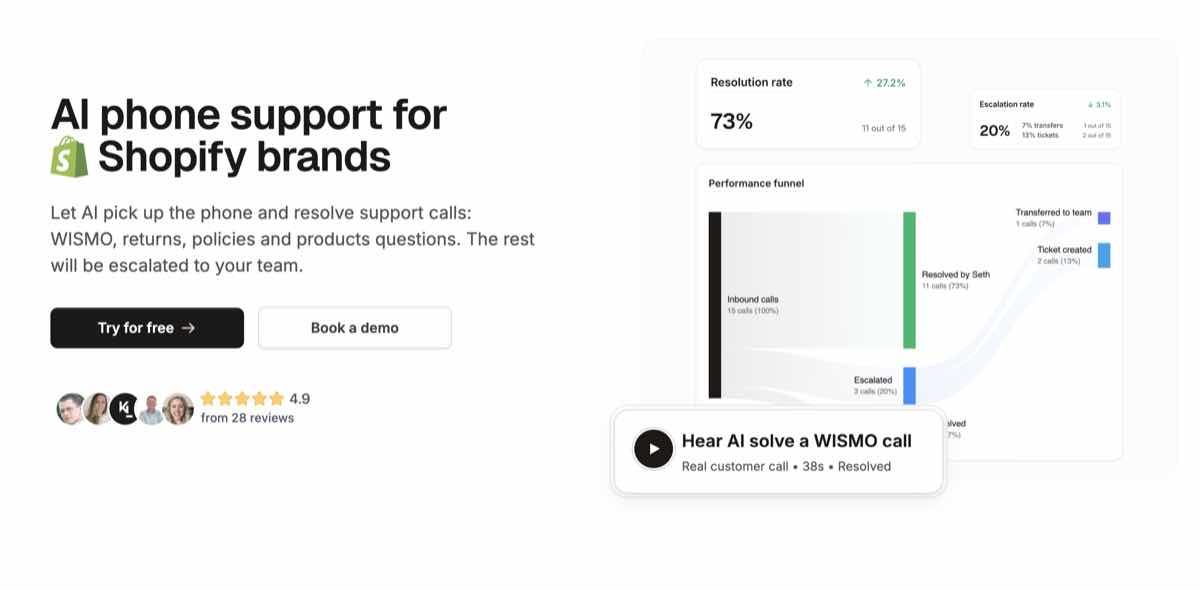
The AI answers inbound calls 24/7. It finds orders in your Shopify store, processes returns and exchanges, answers product questions from your knowledge base, and rescues abandoned carts via outbound follow-up. Across 50+ brands, the AI resolves 73% of calls autonomously at roughly $0.42 per resolved call. Calls that need a human escalate cleanly to Gorgias, Richpanel, Reamaze, or whatever helpdesk you already run.
Plans: Grow $349/mo (1,000 minutes), Pro $799/mo (2,500 minutes), Enterprise custom. 14-day free trial on Pro. Live in under an hour. 65% resolution guarantee: if the AI resolves under 65% of your calls in 90 days, we refund the last 3 months. See full plans on the pricing page.
This isn't a self-service tool. It's the voice layer that catches what self-service doesn't. Pair it with anything from the list above. For more on the voice side specifically, see our guide to Shopify voice agents and AI voice agents for ecommerce.
How to choose the right self-service tool for your Shopify store
Most readers come here trying to pick one tool. The honest answer is: pick the right primary, plan the upgrade, and add a voice layer.
Use these matchups:
- Choose Help Scout if you're under 5 agents, want clean and fast, and don't want to negotiate a contract.
- Choose Gorgias Automate AI if you're already on Gorgias and want AI that takes actions on Shopify orders.
- Choose Tidio Lyro if you're under 1,000 orders a month and want chat plus an AI agent without a helpdesk yet.
- Choose Intercom Fin if you have real budget and need the best-conversational-AI on the market.
- Choose Zendesk Guide if you're 15+ agents and need deep configurability.
- Choose Document360 only if you have a sales team to negotiate with and a complex product-doc need.
- Choose ProProfs if you're a solo founder building a v1 help center on a budget.
- Choose Re:amaze if you're Shopify-first and want everything (KB, chat, FAQ, multi-channel) in one app.
- Choose Stonly as an add-on for one specific interactive flow that articles aren't solving.
Then layer Ringly on top for the calls. Reducing ticket volume on the other side of the stack matters too; our guide to reducing support tickets in ecommerce covers the proactive plays (shipping notifications, return portals, status pages) that kill ticket creation upstream.
Frequently asked questions
What is self-service support software?
Software that lets customers find answers, track orders, or process simple actions like returns and refunds without contacting a human agent. It typically includes knowledge bases, AI chatbots, return portals, and help centers. The goal is ticket deflection.
What's a realistic self-service deflection rate for a Shopify store?
Most ecommerce stores land between 50% and 70%. Mature deployments with proactive notifications and a tuned AI chat agent can hit 80% or higher. Tech industry average is 23%, but ecommerce wins this category because WISMO, returns, and product questions are predictable.
How much does self-service support software cost?
Entry SMB plans range from $25 to $60 a month (Help Scout Standard, Re:amaze Basic, Tidio Starter). AI-heavy tools add per-resolution fees of $0.90 to $0.99. Enterprise tools (Zendesk, Document360) often start above $1,000 a month once you add seats and AI add-ons.
Does Ringly count as self-service support software?
No. Ringly is AI phone support for Shopify brands. It handles the calls your self-service stack does not deflect. Use it alongside a knowledge base or helpdesk, not instead of one.
What's the difference between containment rate and deflection rate?
Containment measures whether a customer escalated to a human. Deflection measures whether the issue actually got resolved without a human touching it. Containment is a vanity metric. Deflection is what saves you money.
Do AI chatbots actually work for Shopify stores?
Yes, for the predictable 60% to 70% of contacts: order status, return policy, sizing, product questions. They struggle with complex returns, escalations, and high-AOV pre-purchase questions. Pair AI chat with a clear human escalation path or the experience falls apart.
How long does it take to deploy self-service support software?
Help Scout and Re:amaze can go live in a day. Gorgias and Intercom typically take 1 to 2 weeks. Zendesk and Document360 often need 4 to 6 weeks if you set them up properly with content audits and AI tuning.
The honest takeaway
There is no single "best" self-service support software. There's the right primary for your team size and Shopify-fit, and there's an upgrade path you should plan now.
Help Scout for small. Re:amaze or Gorgias for Shopify-first. Intercom or Zendesk for scale.
Then accept what self-service doesn't cover. The 30% of contacts that still come in by phone need their own answer, and stacking another KB tool won't fix it. That's where the voice layer goes.
Try Ringly.io free for 14 days. Live in under an hour, 65% resolution guarantee, real Shopify integration.
Article by Ruben Boonzaaijer. Co-founder of Ringly.io. We build AI phone support for Shopify brands so they can scale support without hiring a phone team.