

Replo has built a reputation as a premium landing page builder for high-growth DTC brands.
The trade-off? A steep price tag that starts at $119 per month and climbs to $599 for unlimited pages. For many Shopify merchants, that math doesn't work.
The good news is that the page builder market has matured significantly.
Whether you're looking to cut costs, simplify your workflow, or find a tool that better fits your team's skills, there are solid alternatives worth considering.
Here's a breakdown of seven Replo alternatives that cover different use cases, budgets, and technical requirements.
Editor’s note: Want to hear some sample AI support calls made for your Shopify store?
- Just paste your store URL
- Hear sample calls for your store (no email required)
- Listen to demo calls for my store
What is Replo and why look elsewhere?
Replo positions itself as the page builder for serious ecommerce brands. It offers pixel-perfect design control, advanced animations, and A/B testing capabilities. The platform targets merchants running paid campaigns who need high-converting landing pages without developer involvement.
The pricing structure is where many merchants pause:
| Plan | Monthly Price | Page Limit |
|---|---|---|
| Basic | $119 | 15 published items |
| Growth | $599 | Unlimited |
Source: Replo pricing
For a store publishing regularly, the Basic plan's 15-page limit creates friction fast. The Growth plan unlocks unlimited publishing but at a cost that rivals some full marketing suites.
Common reasons merchants explore alternatives include budget constraints, simpler design needs, different workflow preferences, or wanting to avoid vendor lock-in. The right choice depends on what you're actually trying to accomplish.
How we evaluated these alternatives
We looked at tools that solve similar problems to Replo: building custom Shopify pages without coding. The evaluation focused on pricing transparency, ease of use, template quality, Shopify integration depth, and unique features that differentiate each platform.
All options on this list work with Shopify 2.0 themes and offer some form of visual editing. Here's how they stack up.
Quick comparison
| Tool | Starting Price | Free Plan | Best For |
|---|---|---|---|
| GemPages | $29/month | Yes (1 page) | CRO-focused stores |
| Instant | $31/month | Yes (1 page) | Fast workflows, Shopify Markets |
| PageFly | $18/month | Yes (1 slot) | Beginners, budget-conscious |
| Shogun | $39/month | No | Enterprise, multi-store |
| Liquiflow | $49/month | No | Agencies, developers |
| Zipify Pages | $19/month | 14-day trial | Performance marketers |
| EComposer | $19/month | Yes (1 page) | Template-focused stores |
1. GemPages
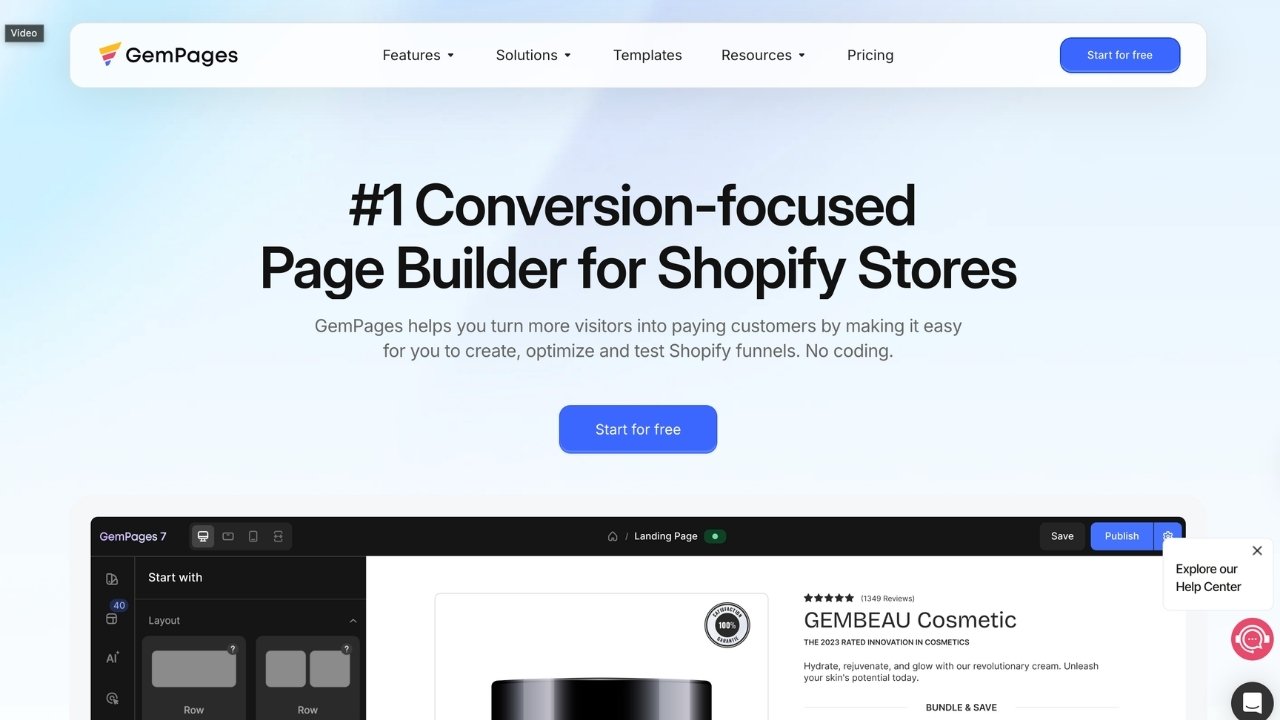
GemPages positions itself as the balanced alternative with strong conversion rate optimization features. At $29 per month for the Build plan, it undercuts Replo significantly while offering unlimited page publishing.
The platform includes over 400 prebuilt CRO sections, countdown timers, stock counters, and popups designed to drive conversions. The GemAI Image-to-Layout feature converts reference images into editable layouts, which speeds up design workflows.
| Plan | Monthly Price | Annual Price | Key Limits |
|---|---|---|---|
| Free | $0 | $0 | 1 page, 60 GemAI sections |
| Build | $29 | $23/month | Unlimited pages, 20 theme sections |
| Optimize | $59 | $47/month | Unlimited pages, 100 theme sections |
| Enterprise | $199 | $159/month | Unlimited everything |
Source: GemPages pricing
Pros:
- Strong template library with CRO focus
- Good value for the feature set
- Mobile optimization tools included
- Sales funnel builder with post-purchase upsells
Cons:
- Can feel overwhelming with so many options
- Learning curve for advanced features
Best for: Merchants wanting design flexibility plus built-in conversion tools without the Replo price tag.
2. Instant
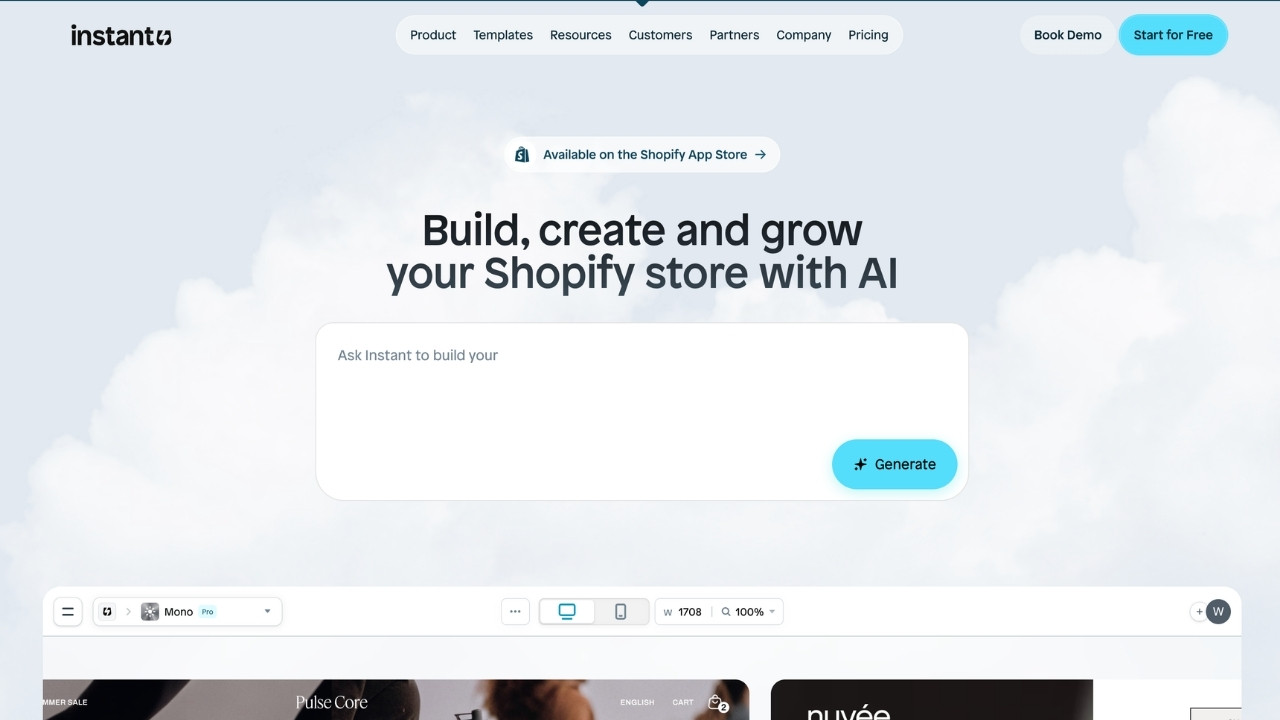
Instant takes a different approach by exporting clean Liquid code directly to your Shopify theme rather than running as a separate app overlay. This results in faster page speeds and better compatibility with Shopify's native features.
The pricing is aggressive: $31 per month for the Starter plan gets you unlimited pages and 5 published sections. That's a fraction of Replo's cost for comparable functionality.
| Plan | Monthly Price | Key Limits |
|---|---|---|
| Free | $0 | 1 page, 1 section, 1 blog post |
| Starter | $31 | Unlimited pages, 5 sections |
| Pro | $79 | Unlimited pages, 20 sections, 10K A/B sessions |
| Business | $199 | Unlimited pages, 50 sections, 100K A/B sessions |
Source: Instant pricing
Pros:
- 3-5× cheaper than Replo with unlimited publishing
- Clean Liquid output that lives in your theme
- 800+ templates included
- Built-in A/B testing on higher tiers
- Shopify Markets support for international selling
Cons:
- Less advanced animation options than Replo
- Section-based publishing model takes adjustment
Best for: Teams wanting fast workflows, design consistency, and stores using Shopify Markets for international expansion.
3. PageFly
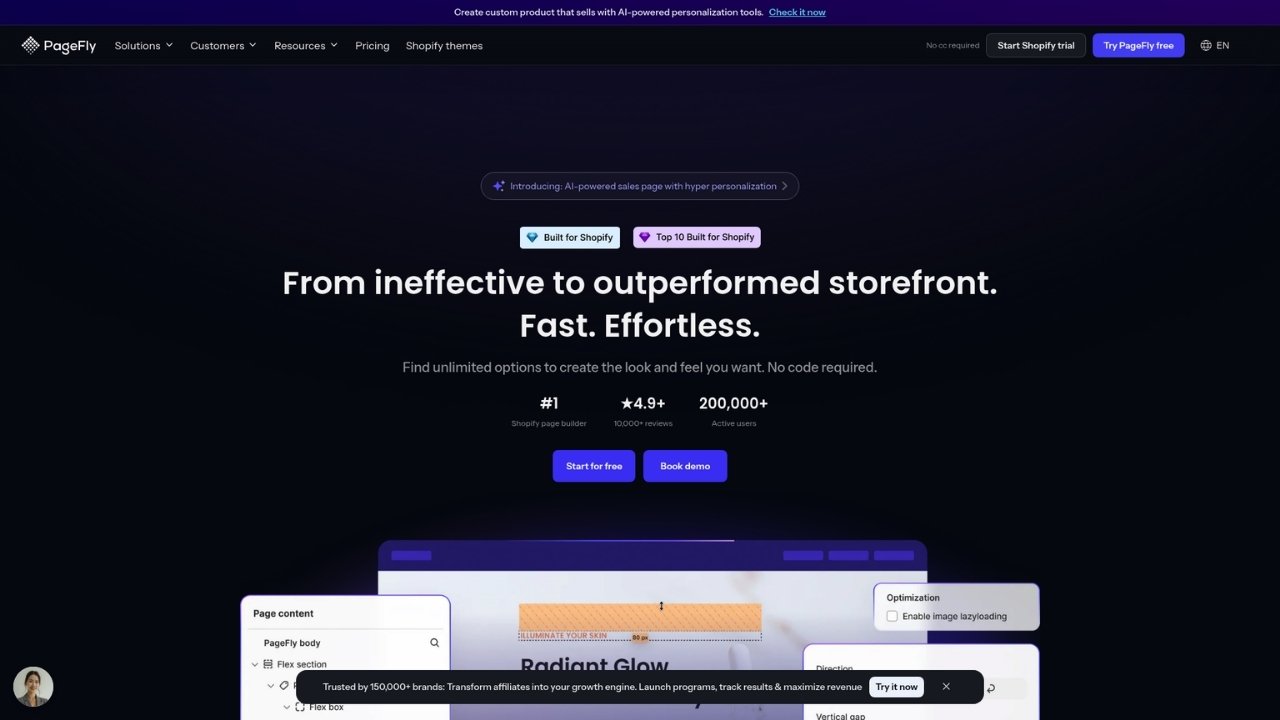
PageFly is one of the most established Shopify page builders with over 5,700 reviews averaging 4.9 stars. It's "Built for Shopify" certified, meaning it meets Shopify's highest standards for performance and integration.
The free plan lets you publish one page or section, making it ideal for testing before committing. Paid plans start at $18 per month.
| Plan | Monthly Price | Key Limits |
|---|---|---|
| Free | $0 | 1 published slot (page OR section) |
| Pay as you go | From $18 | From 3 published slots |
| Unlimited | $99 | Unlimited published slots |
Source: PageFly on Shopify App Store
Pros:
- Most affordable option with a solid free tier
- 100+ page templates and 100+ premade sections
- 130+ app integrations including Klaviyo and Judge.me
- Device-specific editing for mobile optimization
- 24/7 live chat support
Cons:
- Limited advanced features compared to premium builders
- Templates can feel generic without customization
Best for: Beginners and SMBs needing reliable, affordable customization without complexity.
4. Shogun
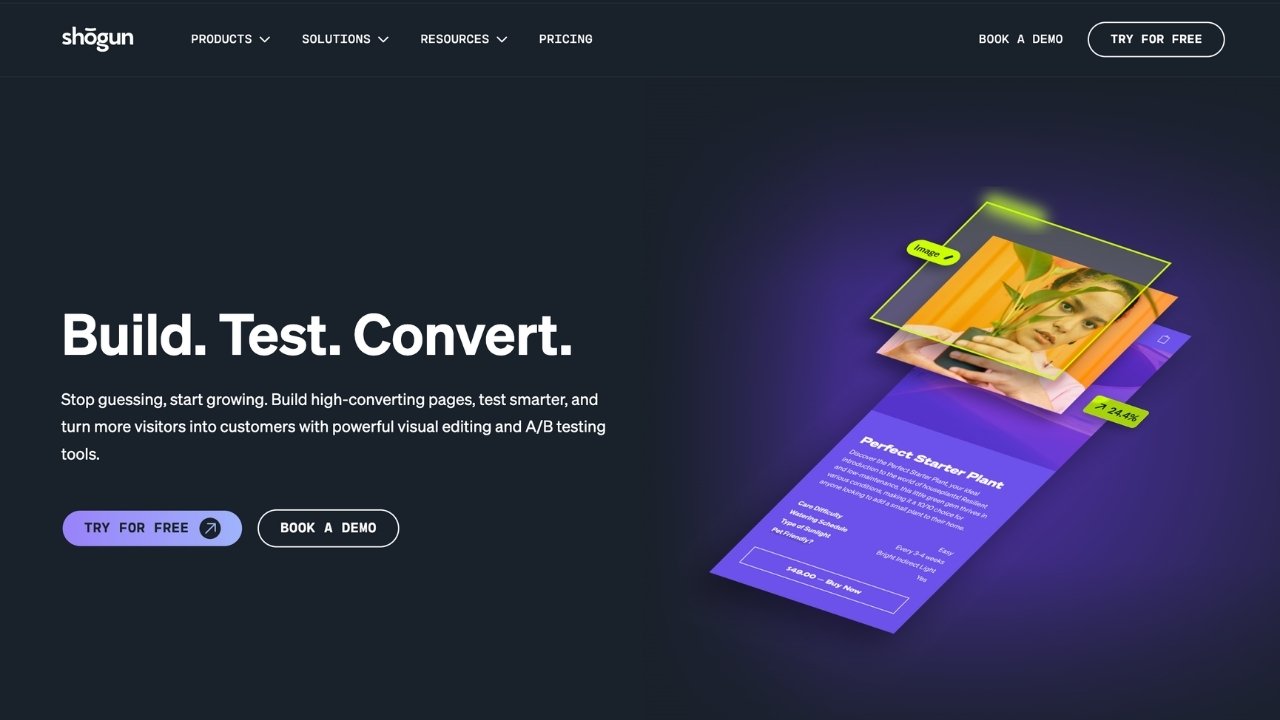
Shogun targets larger teams and scaling ecommerce operations. The platform emphasizes performance optimization, structured workflows, and multi-store management.
The Build plan starts at $39 per month with 25 published pages included. Higher tiers unlock unlimited publishing and advanced features like content syncing across stores.
| Plan | Monthly Price | Annual Price | Key Limits |
|---|---|---|---|
| Build | $39 | $31/month | 25 pages, 2,000 MTUs |
| Grow | $199 | $159/month | Unlimited pages, 10,000 MTUs |
| Advanced | $499 | $399/month | Unlimited pages, 50,000 MTUs |
Source: Shogun pricing
Pros:
- Theme-friendly approach with minimal bloat
- Strong analytics and page performance data
- Content scheduling for campaign management
- Global content sections for site-wide updates
- Multi-store content syncing on Advanced plan
Cons:
- Less design flexibility than Replo
- Can feel rigid for creative teams
- No free plan
Best for: Larger teams, scaling companies, and merchants managing multiple Shopify stores who need stability and structured workflows.
5. Liquiflow
Liquiflow occupies a unique niche. Instead of providing its own editor, it lets you design in Webflow and export native Liquid code to Shopify. This means you own the code outright and aren't dependent on an app to keep your pages running.
The Starter plan at $49 per month supports one project with unlimited conversions. The Pro plan at $89 per month unlocks unlimited projects.
| Plan | Monthly Price | Annual Price | Key Limits |
|---|---|---|---|
| Starter | $49 | $34/month | 1 project, unlimited conversions |
| Pro | $89 | $67/month | Unlimited projects |
| Enterprise | Custom | Custom | Custom requirements |
Source: Liquiflow pricing
Pros:
- Full code ownership (no app dependency)
- Design in Webflow's professional interface
- Shopify 2.0 theme and section builder
- GitHub integration for version control
- 1.2k+ developer community for support
Cons:
- Requires Webflow knowledge
- Different workflow than typical page builders
- Learning curve if you're new to Webflow
Best for: Agencies, developers, and designers who want full control over their code and prefer Webflow's design capabilities.
6. Zipify Pages
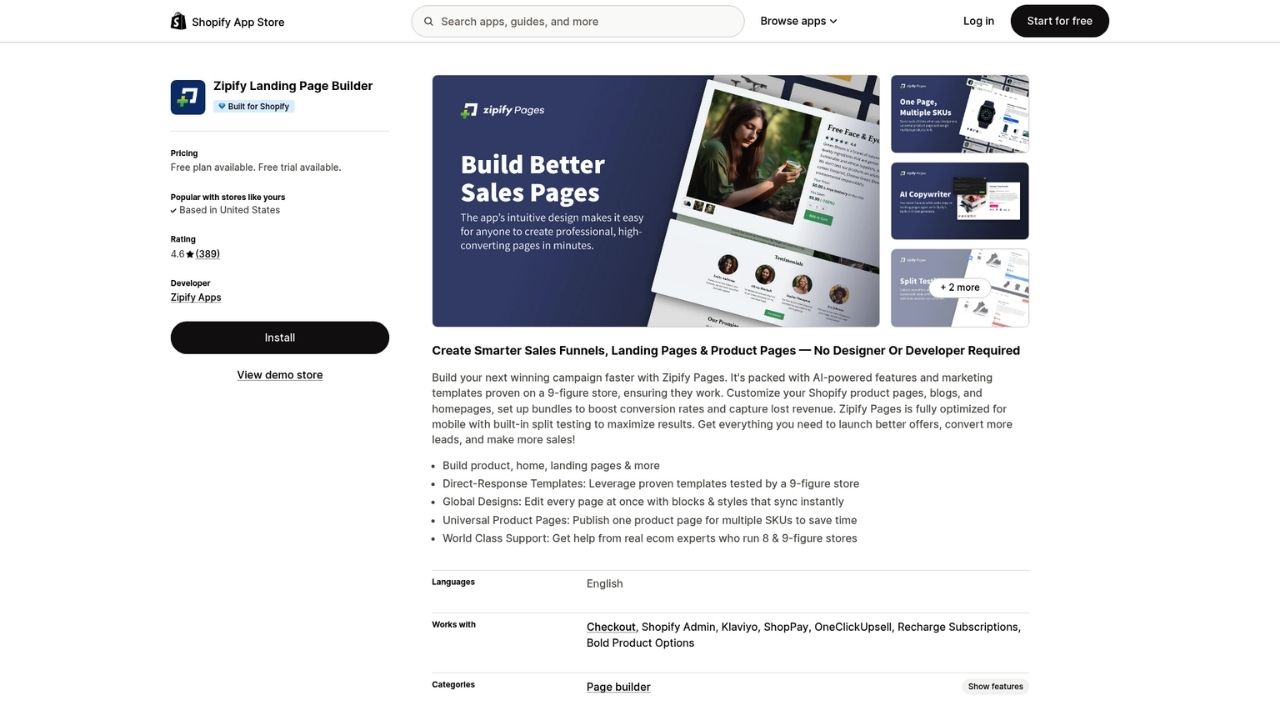
Zipify Pages was created by Ezra Firestone, a well-known ecommerce educator who runs a $180 million Shopify store. The templates are based on actual winning pages from his store and other high-performing merchants.
Pricing starts at $19 per month for the Starter plan, making it one of the more affordable options with proven conversion frameworks built in.
| Plan | Monthly Price | Key Limits |
|---|---|---|
| Starter | $19 | 5 landing pages, 1 product page, 50 AI generations |
| Basic | $39 | 15 landing pages, 5 product pages, 1 collection page |
| Advanced | $99 | Unlimited pages, unlimited split testing |
Source: Zipify Pages
Pros:
- Templates based on real 8-figure store data
- Built-in AI copywriter
- Native split testing and analytics
- OneClickUpsell integration for post-purchase offers
- Bundle builder buy box layouts
Cons:
- Higher tier needed for unlimited pages
- Design flexibility limited to proven frameworks
Best for: Performance marketers and stores running paid campaigns who want data-driven templates without the guesswork.
7. EComposer
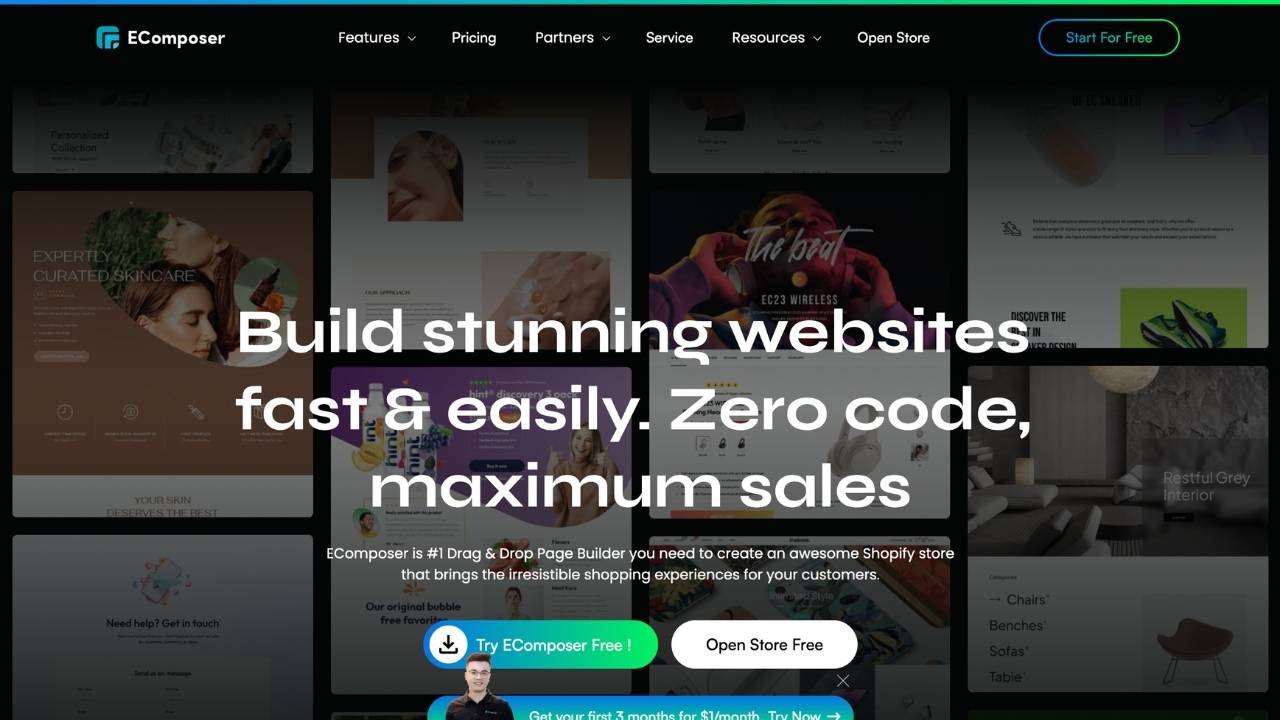
EComposer emphasizes template variety and ease of use. With over 300 templates and 100+ design elements, it's built for merchants who want to launch quickly without deep customization.
The platform holds a 4.9 rating from over 3,400 reviews and is "Built for Shopify" certified.
| Plan | Monthly Price | Key Limits |
|---|---|---|
| Free | $0 | 1 published page/section |
| Paid plans | From $19 | Additional published slots |
Source: EComposer on Shopify App Store
Pros:
- Large template library (300+)
- AI layout generator for quick starts
- Global blocks for consistent design
- Affordable entry point
- Beginner-friendly interface
Cons:
- Less unique output without customization
- Can produce similar-looking stores if templates aren't modified
Best for: New stores wanting fast setup without complexity and those who prefer working with pre-designed templates.
Which Replo alternative should you choose?
The right tool depends on your specific situation:
For CRO and conversion focus: GemPages or Zipify Pages offer the strongest built-in optimization features.
For tight budgets: PageFly at $18/month or Zipify Pages at $19/month provide solid value without breaking the bank.
For agencies and developers: Liquiflow is the clear choice if you want full code ownership and Webflow integration.
For speed and workflows: Instant excels at fast publishing and design consistency, especially for stores using Shopify Markets.
For enterprise needs: Shogun offers the structured workflows and multi-store management that larger teams require.
For template variety: EComposer provides the largest template library for quick launches.
Switching from Replo: what to expect
If you're currently using Replo and considering a move, here are the practical realities:
Can you migrate existing pages? Generally no. Page builders use proprietary formats, so you'll need to rebuild pages in the new tool. Plan for 1-2 weeks for a full transition depending on page count.
What transfers: Product data, images, and content copy over easily since these live in Shopify. Your theme settings remain intact.
What doesn't: Page layouts, animations, custom components, and Replo-specific elements need rebuilding.
Minimizing disruption: Most alternatives offer 14-day free trials. Set up the new tool alongside Replo, rebuild critical pages first, then switch over once everything is tested.
Frequently Asked Questions
Which Replo alternatives offer a free plan?
GemPages, Instant, PageFly, and EComposer all offer free plans with limited publishing. Zipify Pages and Shogun offer free trials instead.
Are Replo alternatives cheaper than Replo itself?
Yes, most alternatives start between $18-49 per month compared to Replo's $119 entry point. Only enterprise tiers from Shogun ($499) approach Replo's pricing.
Can I use Replo alternatives with any Shopify theme?
All the alternatives listed work with Shopify 2.0 themes. Some, like Instant and Liquiflow, export native Liquid code that lives directly in your theme for better compatibility.
Which Replo alternative is best for beginners?
PageFly and EComposer are the most beginner-friendly with intuitive interfaces and large template libraries to get started quickly.
Do any Replo alternatives include A/B testing?
Yes. GemPages includes GEMX for A/B testing. Instant has built-in A/B testing on Pro and Business plans. Zipify Pages includes split testing on the Advanced plan. Shogun offers A/B testing as a separate product.
Will switching from Replo hurt my SEO?
Not if done properly. Keep URLs the same when rebuilding pages, set up 301 redirects if URLs change, and ensure meta titles and descriptions transfer over. Most page builders include SEO controls to maintain rankings.