

GemPages is a capable page builder, but it isn't the right fit for every Shopify store.
Maybe you need faster page speeds, a lower price point, or specific features like built-in A/B testing.
Whatever your reason, there are plenty of alternatives worth exploring.
We researched and tested the top GemPages competitors to help you find the best match.
This guide breaks down seven alternatives, comparing their pricing, features, and ideal use cases so you can make an informed decision.
Editor’s note: Want to hear some sample AI support calls made for your Shopify store?
- Just paste your store URL
- Hear sample calls for your store (no email required)
- Listen to demo calls for my store
What to look for in a GemPages alternative
Before diving into the options, here's what separates a good page builder from a mediocre one:
- Page speed and SEO impact. A beautiful page means nothing if it loads slowly or hurts your search rankings. Look for builders with lazy loading, clean code, and SEO controls.
- Ease of use vs. customization depth. Some builders prioritize drag-and-drop simplicity, while others offer more advanced customization through custom code. Know which end of the spectrum you need.
- Pricing transparency. Many builders advertise low starting prices but limit key features to higher tiers. Check what you actually get at each level.
- Integration ecosystem. Your page builder should play nicely with your email marketing, reviews, and analytics tools.
- Support quality. When something breaks, responsive support matters. Look for 24/7 live chat if you aren't technically inclined.
Quick comparison of GemPages alternatives
| Builder | Starting Price | Free Plan | Best For | Key Differentiator |
|---|---|---|---|---|
| PageFly | $18/mo | Yes (1 slot) | SEO-focused stores | 130+ integrations, speed optimization |
| Shogun | $39/mo | No | CRO teams | Advanced A/B testing and personalization |
| EComposer | $19/mo | Yes | Beginners | Modern UI, 300+ templates |
| Zipify Pages | $19/mo | 14-day trial | DTC brands | Proven templates from $180M store |
| LayoutHub | $14.99/mo | No | Quick setup | 1500+ layout blocks |
| Beae | $19.99/mo | Yes (1 slot) | CRO focus | Video call support, A/B testing add-on |
| Foxify | $19/mo | Yes (1 page) | AI enthusiasts | AI Layout Generator, 200+ templates |
The 7 best GemPages alternatives
1. PageFly
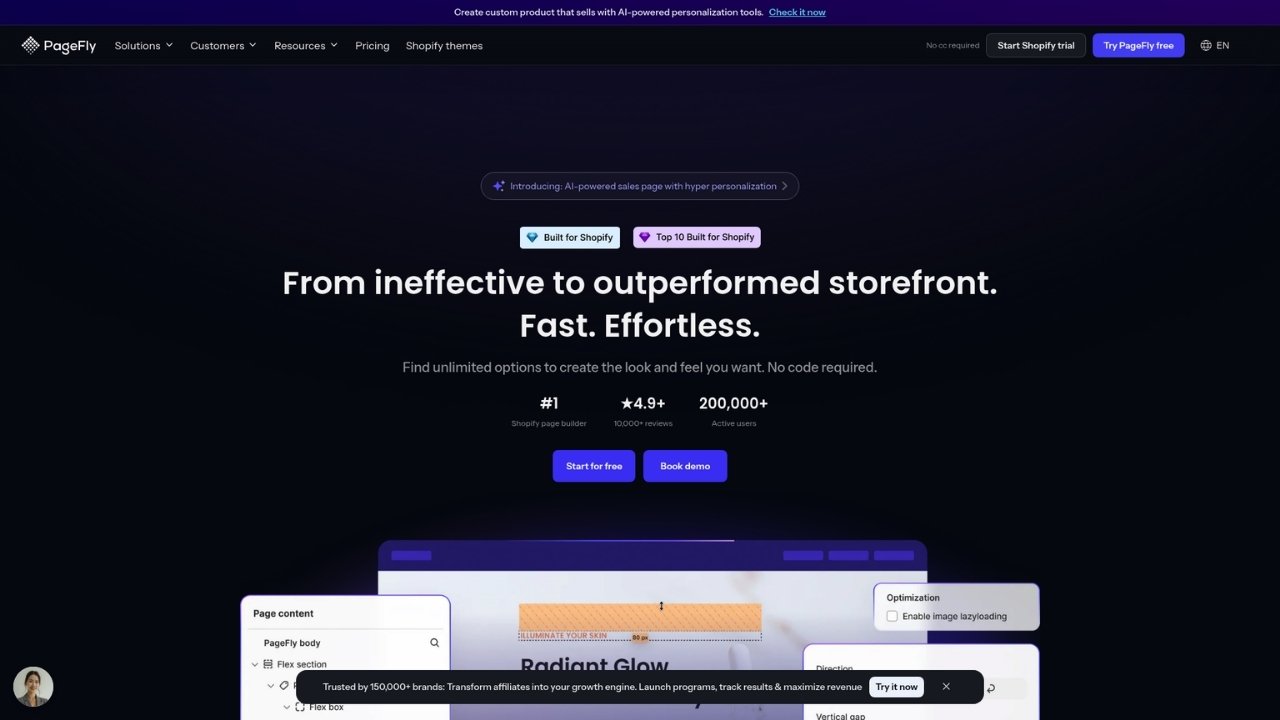
PageFly is the most popular GemPages competitor, with over 5,773 reviews and a 4.9-star rating on the Shopify App Store. It's "Built for Shopify" certified, meaning it meets Shopify's highest standards for performance and integration.
Pricing:
| Plan | Monthly Price | Key Limits |
|---|---|---|
| Free | $0 | 1 published slot (page or section) |
| Pay As You Go | $18/mo | From 3 published slots |
| Unlimited | $99/mo | Unlimited published slots |
Key features:
- 100+ page templates and 100+ premade sections
- 130+ app integrations including Klaviyo, Judge.me, and Loox
- Global sections and global styles for consistent branding
- A/B testing capabilities and page analytics
- Multi-language support (9 languages)
Pros: Fastest load times among major builders, generous free plan, extensive integration library
Cons: Grid-based editor limits creative freedom compared to free-form builders, no native A/B testing on lower tiers
Best for: SEO-focused stores, large catalogs, and merchants who prioritize page speed and integrations over pure design flexibility.
2. Shogun
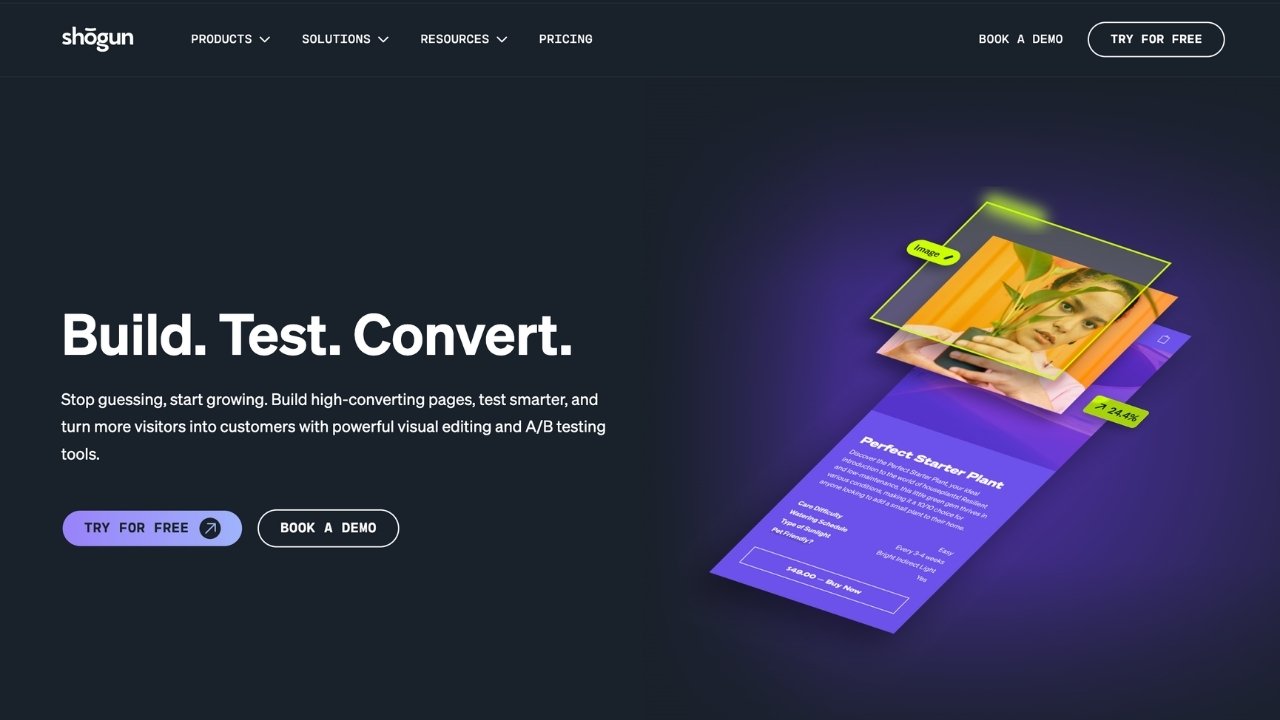
Shogun positions itself as a premium solution for scaling ecommerce brands. It goes beyond basic page building with advanced features like personalization and content scheduling.
Pricing:
| Plan | Monthly Price | Annual Price | Key Limits |
|---|---|---|---|
| Build | $39/mo | $31/mo | 25 published pages, 2,000 MTUs |
| Grow | $199/mo | $159/mo | Unlimited pages, 10,000 MTUs |
| Advanced | $499/mo | $399/mo | Unlimited pages, 50,000 MTUs |
MTU stands for Monthly Tracked User, counted for each unique shopper visiting pages with active A/B tests or personalized experiences.
Key features:
- Advanced visual builder with reusable content sections
- Built-in A/B testing and personalization on all paid plans
- Content scheduling for automated promotion launches
- Global content sections for store-wide updates
- Custom CMS collections (Advanced plan)
Pros: Powerful CRO features, professional templates, content syncing across multiple stores
Cons: Expensive compared to alternatives, no unlimited pages on entry tier, steep learning curve
Best for: Growth-focused brands, CRO teams, and agencies managing multiple stores who need advanced testing capabilities.
3. EComposer
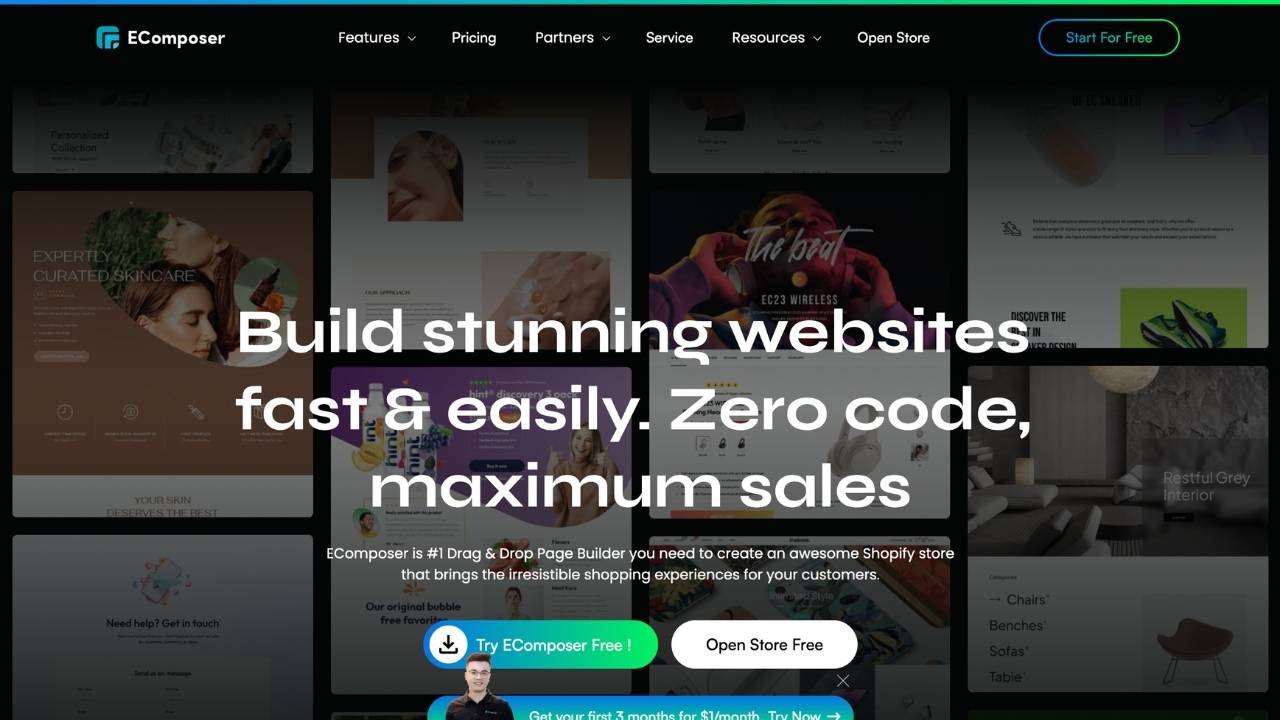
EComposer markets itself as the "#1 Drag & Drop Page Builder" for Shopify. With a 4.9-star rating from over 3,471 reviews, it emphasizes ease of use and modern design.
Pricing:
| Plan | Price | Key Limits |
|---|---|---|
| Free | $0 | 1 live page, 10 saved templates |
| Standard | $19/mo or $190/year | 15 live pages, 50 saved templates |
Key features:
- 100+ design elements and 300+ templates
- Live visual editor with real-time preview
- Lazy loading for improved page speed
- Sticky headers and footers
- Template sharing capabilities
Pros: Affordable pricing, modern and intuitive interface, good template variety
Cons: No built-in A/B testing, no page scheduling feature, fewer integrations than PageFly
Best for: Small to medium stores, beginners wanting a modern design interface, and merchants who prioritize ease of use over advanced features.
4. Zipify Pages
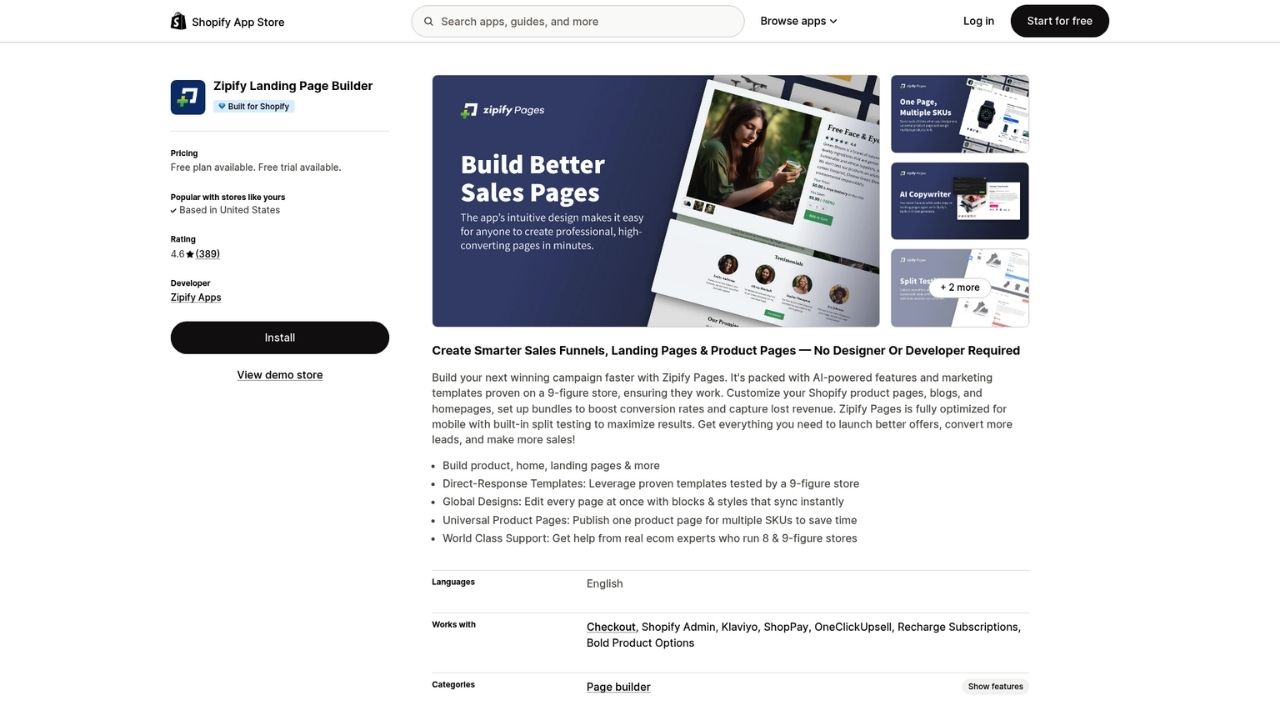
Zipify Pages was created by Ezra Firestone, who built it based on his experience running a $180 million Shopify store. The focus is on proven, high-converting templates rather than design flexibility.
Pricing:
| Plan | Monthly Price | Key Limits |
|---|---|---|
| Starter | $19/mo | 5 landing pages, 1 product page |
| Basic | $39/mo | 15 landing pages, 5 product pages |
| Advanced | $99/mo | Unlimited everything |
All plans include a 14-day free trial.
Key features:
- 70+ proven page templates based on real high-performing campaigns
- AI copywriter for generating page content
- Built-in split testing and analytics
- Global sections for store-wide updates
- Custom buy box layouts (optimized, bundle builder, cross-sell)
Pros: Templates are proven to convert, fast deployment for campaigns, built by marketers who understand ecommerce
Cons: Block-based rather than true drag-and-drop, limited pricing tiers, fewer customization options than competitors
Best for: DTC brands, funnel-focused stores, and marketers who want proven templates without extensive design work.
5. LayoutHub
LayoutHub takes a template-heavy approach, offering over 1,500 pre-designed blocks that you can mix and match to build pages quickly.
Pricing:
| Plan | Monthly Price | Key Features |
|---|---|---|
| Basic | $14.99/mo | Core features, limited blocks |
| Premium | $29.99/mo | More blocks, priority support |
| Enterprise | $49.99/mo | Full access, custom features |
Key features:
- 1500+ layout blocks across all page types
- Multi-language support for international stores
- SEO controls and mobile-friendly templates
- Custom code support for advanced users
- Quick setup with minimal learning curve
Pros: Massive template library, most affordable option, extremely fast setup
Cons: No flow actions or advanced automation, cannot transfer pages between templates, basic customization compared to competitors
Best for: Beginners, stores needing fast deployment, and international merchants who need multi-language support without complexity.
6. Beae
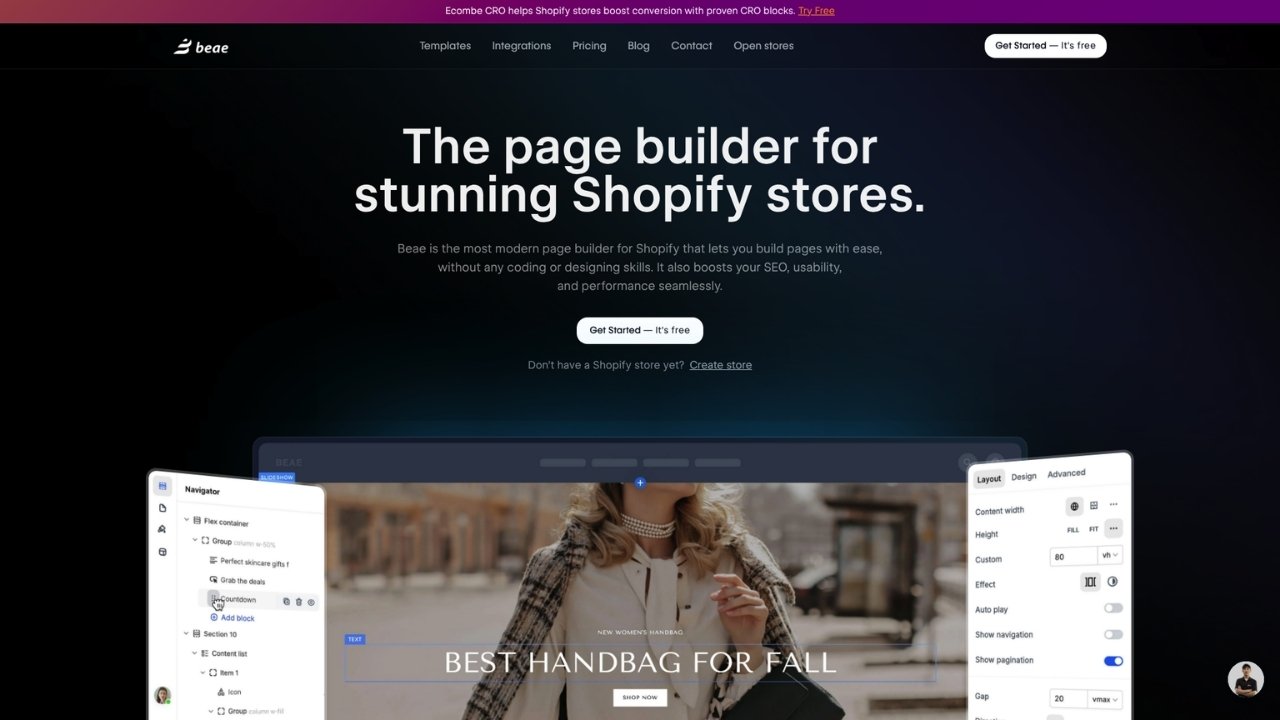
Beae focuses heavily on conversion rate optimization, offering A/B testing and analytics as core features rather than add-ons.
Pricing:
| Plan | Monthly Price | Key Limits |
|---|---|---|
| Free | $0 | 1 published slot, 10 draft pages |
| Pay As You Go | From $19.99/mo | From 10 published slots |
| Enterprise | $99.99/mo | Unlimited slots |
Add-ons available: +$49.99/mo for unlimited blog posts, sections, analytics, and A/B testing.
Key features:
- A/B testing and business growth tools (with add-on)
- Page and campaign analytics
- 24/7 live chat and video call support
- 14-day money-back guarantee
- Multiple-country markets support (Enterprise)
Pros: Strong CRO features, video call support is rare in this category, flexible add-on pricing
Cons: Smaller template library than competitors, newer player with less track record
Best for: Stores focused on conversion optimization, flash sales, urgency campaigns, and merchants who want premium support options.
7. Foxify
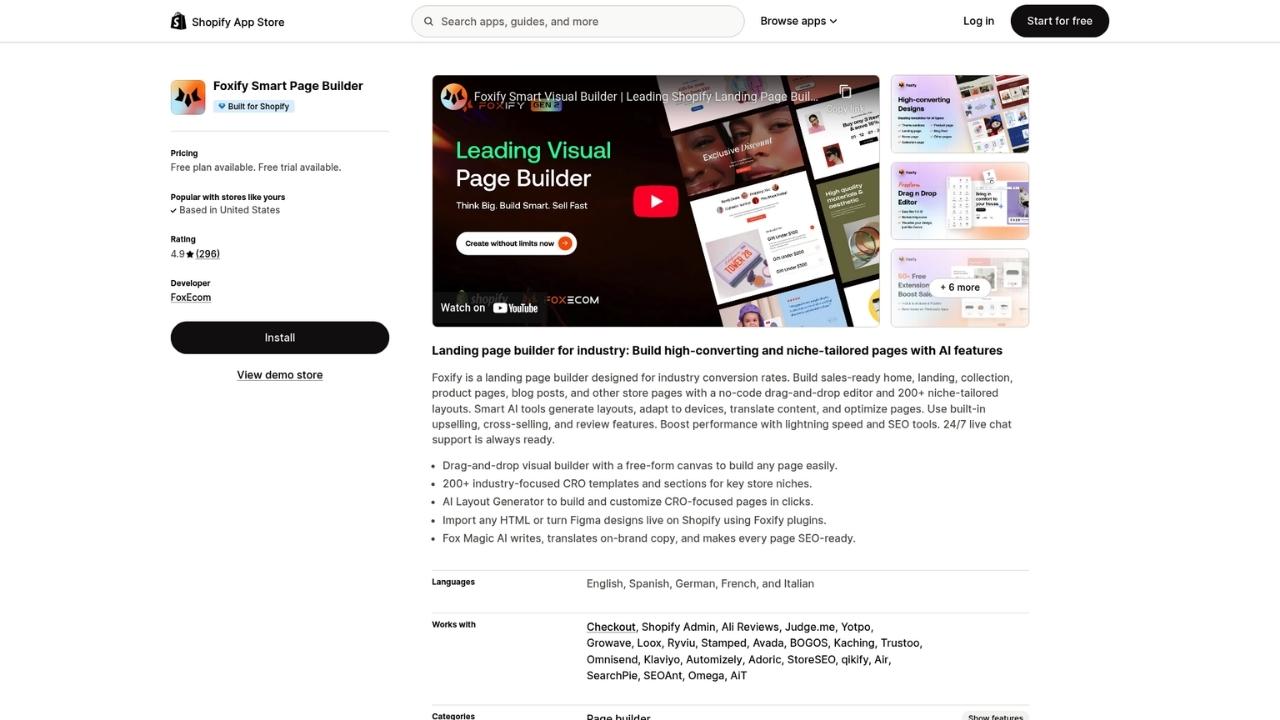
Foxify is a newer "Built for Shopify" certified builder that emphasizes AI-powered features and industry-specific templates.
Pricing:
| Plan | Monthly Price | Annual Price | Key Limits |
|---|---|---|---|
| Free | $0 | $0 | 1 page, 1 section, 20 AI credits |
| Starter | $19/mo | $182.40/year | 10 pages, 5 sections, 150 AI credits |
| Growth | $39/mo | $374.40/year | 100 pages, 100 sections, 1000 AI credits |
| Enterprise | $99/mo | $950.40/year | Unlimited, 5000 AI credits |
All paid plans include a 7-day free trial.
Key features:
- 200+ industry-focused CRO templates
- AI Layout Generator for quick page building
- Fox Magic AI for copywriting and translations
- Figma to Shopify plugin
- Built-in upsell and cross-sell features
Pros: Very affordable entry point, AI features actually useful, free extensions included
Cons: Limited advanced customization, newer to market with smaller user base
Best for: AI enthusiasts, budget-conscious stores, and merchants who want quick setup with industry-specific templates.
How to choose the right GemPages alternative
With seven capable options, how do you pick the right one? Here's a simple framework based on your store's needs:
Small or new stores: Start with EComposer, Foxify, or LayoutHub. All offer free plans or low entry prices, making them perfect for testing without commitment.
SEO-focused stores: PageFly is the clear winner. Its speed optimization and extensive integrations make it ideal for stores where search visibility is a priority.
CRO-focused stores: Shogun or Beae are your best bets. Both prioritize testing and optimization over pure design flexibility.
DTC brands and marketers: Zipify Pages offers proven templates that convert, saving you from testing everything from scratch.
Making the switch from GemPages
If you're currently using GemPages and considering a switch, here's what you need to know:
What transfers: Most builders let you export and import basic content, but page structures and styling will need to be rebuilt. Plan for some downtime or run both builders in parallel during transition.
What needs rebuilding: Custom sections, styling, and any GemPages-specific features will need to be recreated in your new builder. Budget time for this or consider hiring help.
Testing recommendations: Always test a new builder on a duplicate theme or development store first. Check mobile performance specifically, since that's where many page builders struggle.
Build better Shopify pages today
The right page builder depends on your specific goals. For SEO and integrations, PageFly leads the pack. For advanced CRO, Shogun is worth the premium. For beginners, EComposer or Foxify offer the best balance of features and affordability.
Start with the free trial of whichever option fits your needs. Most builders offer 14-day trials, giving you enough time to test performance and usability before you commit.
Frequently Asked Questions
Which GemPages alternative offers the best free plan?
PageFly and EComposer both offer solid free plans with one published page. PageFly's free tier includes all app features, making it the most generous for testing.
Are there any GemPages alternatives with built-in A/B testing?
Yes. Shogun includes A/B testing on all paid plans. Beae offers A/B testing as a $49.99/mo add-on. Zipify Pages includes split testing on Advanced plans.
What is the most affordable GemPages alternative for a small store?
LayoutHub starts at $14.99/mo, making it the cheapest option. PageFly and Foxify both offer capable free plans if you only need one page.
Which alternative is best for page speed and SEO?
PageFly consistently scores highest on page speed tests and offers the most SEO controls. It is 'Built for Shopify' certified, ensuring optimal performance.
Can I migrate my existing GemPages content to another builder?
Partially. You can export text and images, but page structures and styling will need to be rebuilt manually. Most builders offer import tools, but expect to spend time recreating your designs.
Which GemPages alternative is best for beginners with no coding experience?
EComposer and LayoutHub are the most beginner-friendly. Both prioritize simplicity over advanced customization, making them ideal for non-technical users.