

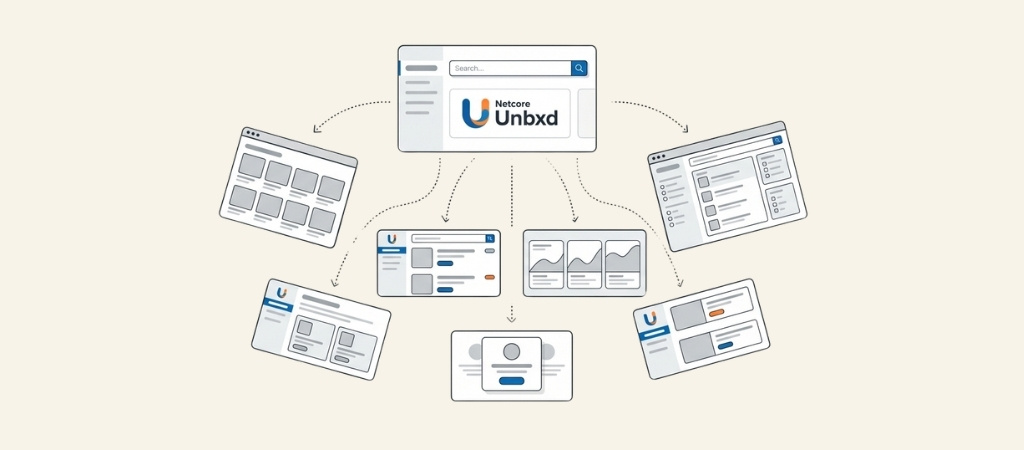
Netcore Unbxd has been a go-to choice for e-commerce businesses wanting AI-powered product discovery. But with custom pricing, complex implementation, and specific use cases in mind, many retailers are exploring what else is out there.
Whether you're looking for better pricing transparency, easier setup, or different features, this guide breaks down seven solid alternatives. Each one brings something unique to the table, from developer-friendly APIs to merchandiser-focused controls.
Editor’s note: Want to hear some sample AI support calls made for your Shopify store?
- Just paste your store URL
- Get sample calls in under 20 seconds (no email required)
- Listen to demo calls for my store
What is Netcore Unbxd?
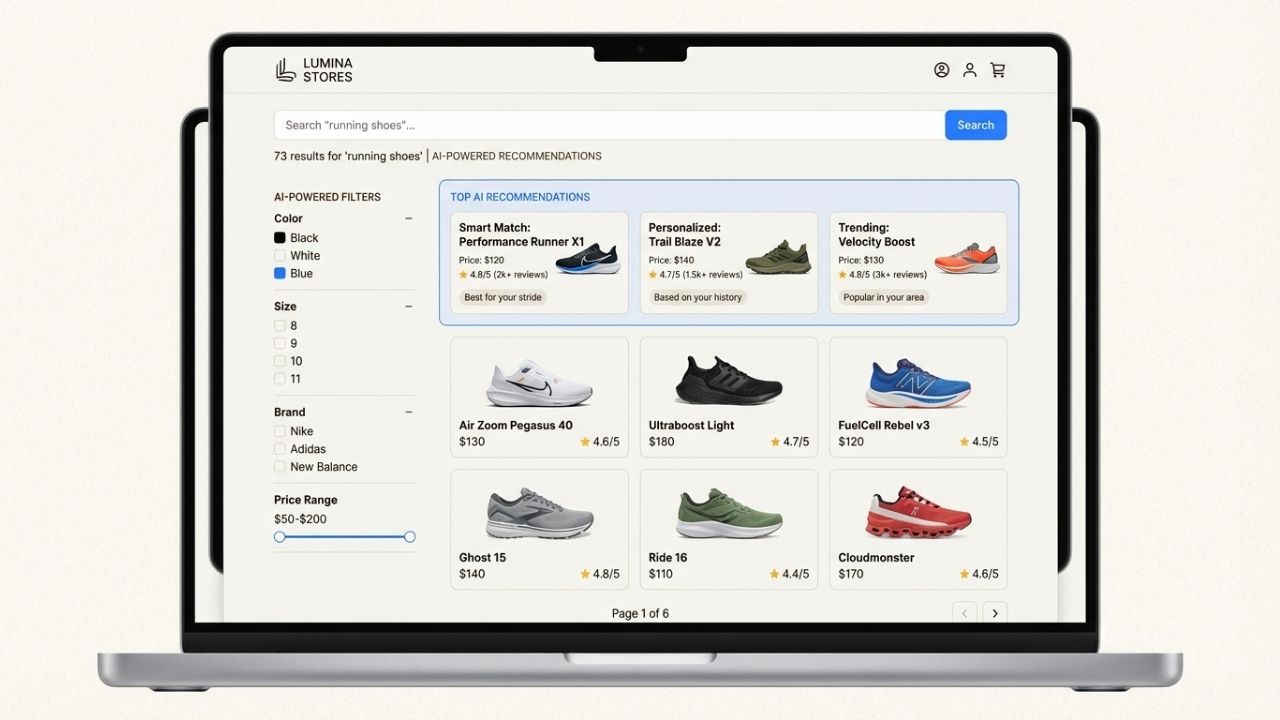
Netcore Unbxd is an AI-driven product discovery platform built for mid-market to enterprise e-commerce. It handles site search, recommendations, personalization, and merchandising through a single platform.
The platform scores a 4.4/5 on G2 and promises to resolve customer queries faster through AI. Common pain points include complex initial setup requiring technical expertise, custom pricing that can get expensive, and integration challenges with legacy systems. The average time to ROI sits around 8 months, which is reasonable but not the fastest in the market.
How we evaluated these Netcore Unbxd alternatives
To make this comparison useful, we looked at each platform through the lens of what actually matters when switching from Netcore Unbxd:
- AI capabilities how advanced are the search and recommendation engines?
- Ease of implementation can your team get it running without a massive engineering effort?
- Pricing transparency do you know what you'll pay before talking to sales?
- Customer support what do actual users say about getting help?
- Integrations does it work with your existing e-commerce stack?
Data comes from official vendor websites, G2 and Gartner reviews, and verified customer case studies.
Quick comparison: Netcore Unbxd alternatives
| Platform | Best For | Pricing | G2 Rating | Setup Complexity |
|---|---|---|---|---|
| Constructor | Enterprise AI search | Custom/Enterprise | 4.8/5 | High |
| Algolia | Developers, flexible pricing | Usage-based (from free) | 4.5/5 | Medium |
| Athos Commerce | Merchandising teams | Modular/Transparent | N/A | Low |
| ExpertRec | Budget-conscious retailers | $299-$699/month | N/A | Low |
| Bloomreach | Omnichannel personalization | Custom/Enterprise | 4.6/5 | High |
| Akeneo | PIM-first approach | Free to Enterprise | 4.8/5 | Medium-High |
| Coveo | Multi-site enterprise | Custom/Enterprise | 4.4/5 | High |
1. Constructor
Constructor positions itself as the AI-native alternative to legacy search platforms. The company claims it has never lost an A/B test, which is a bold statement backed by their focus on machine learning from day one.
The platform combines behavioral data with transformer-based models to deliver personalized search results. Customer willingness to recommend sits at 95%, and support satisfaction hits 98%, both significantly above industry averages.
Key features:
- AI search using behavioral data and transformer models
- Product recommendations powered by machine learning
- Built-in A/B testing framework
- Advanced merchandising controls
- Comprehensive analytics dashboard
Pros:
- True AI-native architecture (not retrofitted AI)
- Strong enterprise customer base
- Excellent support ratings
- Robust experimentation capabilities
Cons:
- Enterprise-only pricing (no self-serve option)
- Complex implementation requiring technical resources
- Overkill for smaller retailers
Pricing: Custom enterprise contracts only. No public pricing available.
Verdict: Best for large retailers with dedicated technical teams who want cutting-edge AI search and don't mind paying for it.
2. Algolia
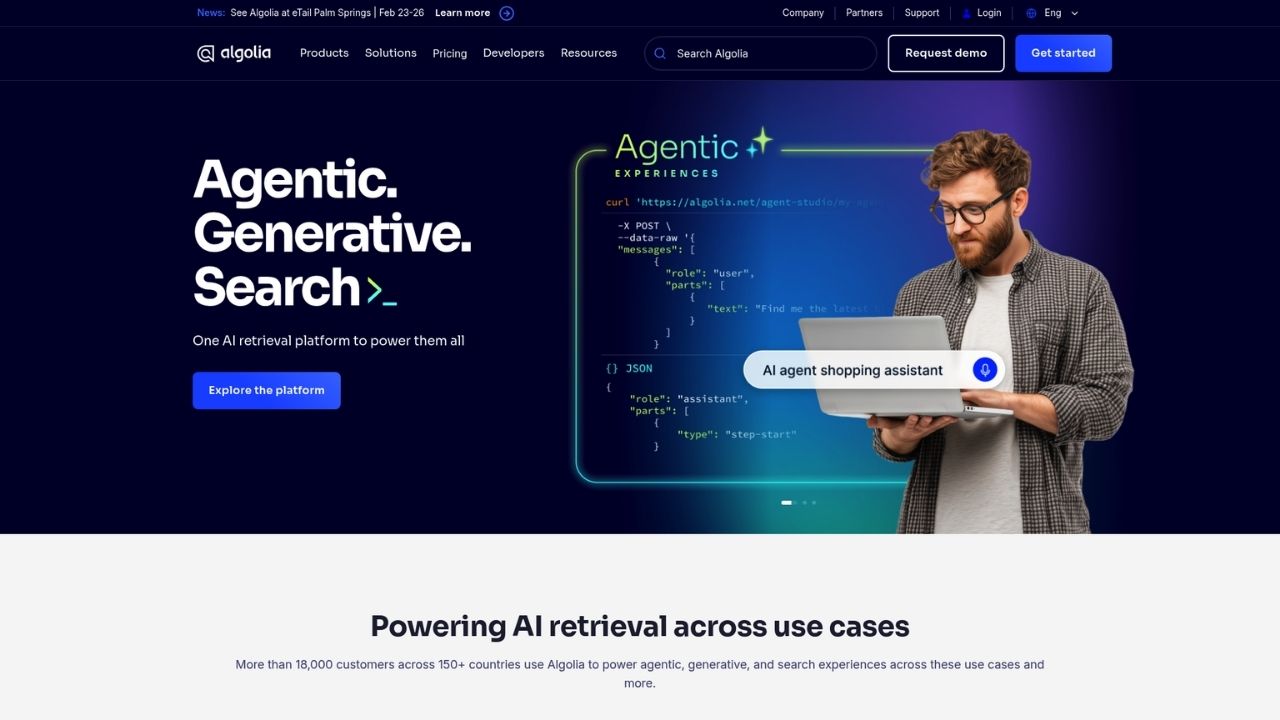
Algolia is the developer favorite for a reason. With over 18,000 customers across 150 countries, the platform offers the most flexible approach to implementing search. The 2025 Gartner Magic Quadrant named them a Leader in Search and Product Discovery.
The infrastructure spans 70+ data centers across 17 regions, making it one of the most reliable options for global businesses. Their NeuralSearch technology combines semantic understanding with keyword matching, so you get the best of both worlds.
Key features:
- NeuralSearch (semantic + keyword)
- Real-time personalization
- Merchandising Studio for business teams
- A/B testing built-in
- Voice search capabilities
- Agent Studio for AI agents
Pricing:
| Plan | Price | Key Limits |
|---|---|---|
| Build | Free | 10K searches, 1M records |
| Grow | $0.50 per 1K requests | 100K records included |
| Grow Plus | $1.75 per 1K requests | AI features included |
| Elevate | Custom | Enterprise SLA, SSO |
Pros:
- Transparent, usage-based pricing
- Developer-friendly API and documentation
- Global infrastructure with excellent uptime
- Free tier for development and small projects
Cons:
- Can get expensive at high volumes
- Requires technical expertise to implement well
- Some advanced features only on higher tiers
Verdict: Best for teams with developer resources who want flexibility and don't want to commit to annual contracts upfront.
3. Athos Commerce
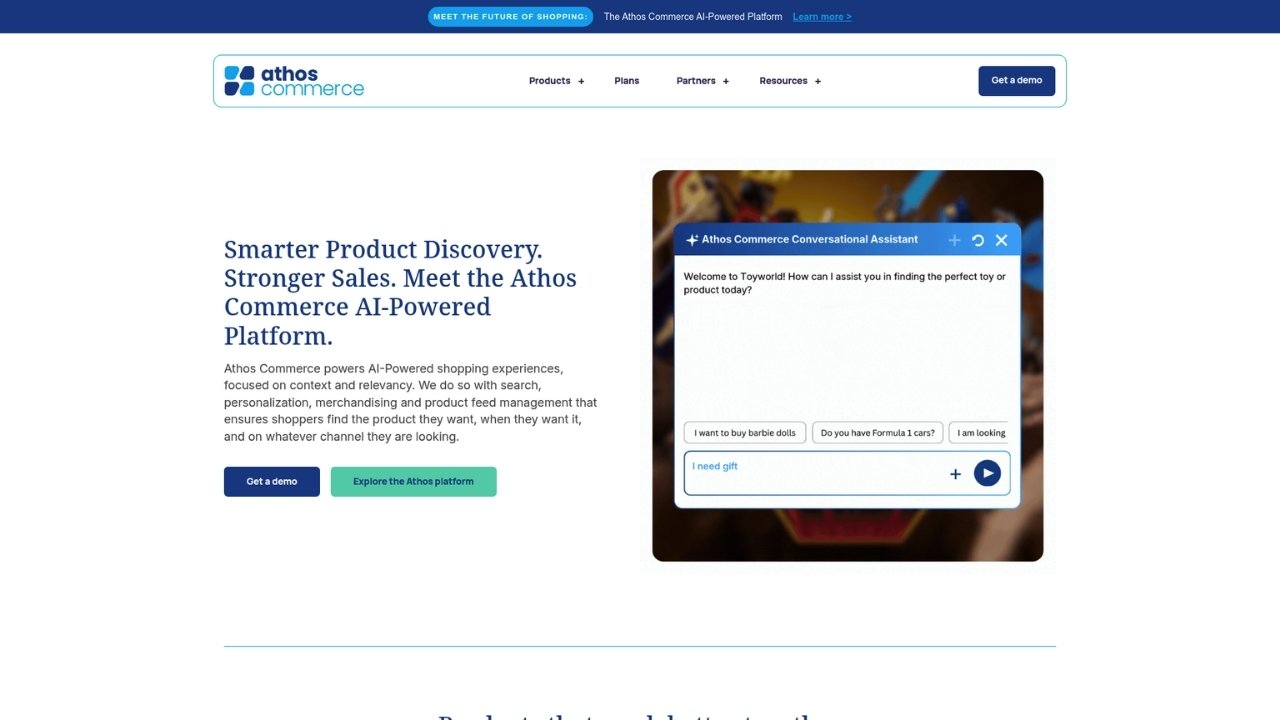
Athos Commerce (formerly Searchspring) built its reputation on being the easiest platform for merchandising teams to use. Setup scores 8.8/10, the highest among major competitors.
The platform recently expanded beyond search into a full AI-powered commerce platform with feed management, marketplace integration, and conversational shopping through their Asklo assistant.
Key features:
- AI site search with natural language understanding
- Visual merchandising with boost rules and banners
- Predictive product bundling
- ML-powered personalization
- Data feed management for 1,400+ channels
- Marketplace management across multiple platforms
Customer results:
- Up to 52% increase in search-led conversions
- AI merchandising doubles click-through rates
- Up to 6% revenue growth with personalization
Pros:
- Easiest setup in the category
- Merchandiser-friendly controls (less dev dependency)
- Modular pricing lets you buy what you need
- Strong e-commerce platform integrations
Cons:
- Smaller ecosystem than Algolia or Constructor
- Less brand recognition in enterprise
- Newer to the full-platform approach
Pricing: Modular packages with transparent pricing. Contact for specific quotes.
Verdict: Best for merchandising teams who want control without waiting on engineering for every change.
4. ExpertRec
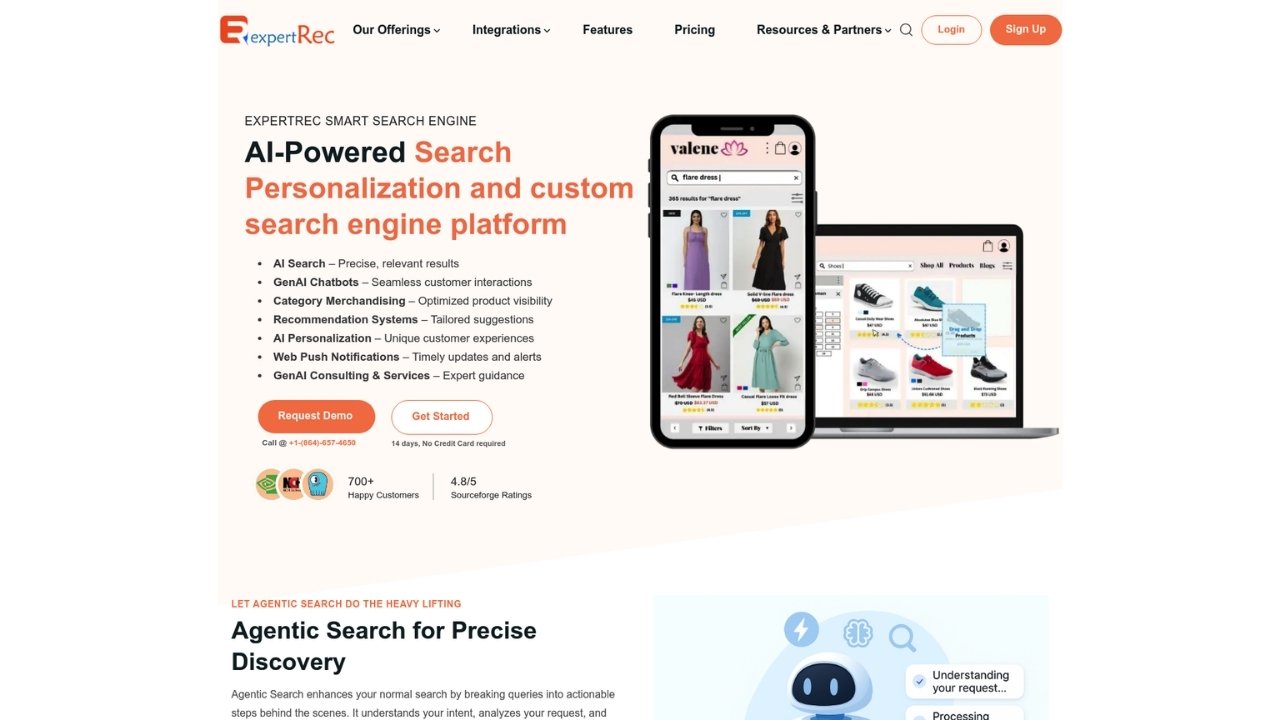
ExpertRec stands out for one simple reason: transparent, affordable pricing in a market where most competitors hide costs behind "contact sales" buttons. At $299-$699 per month, they claim 30-40% cost savings versus competitors.
The platform covers all the basics (AI search, recommendations, merchandising) plus newer features like voice search and GenAI chatbots. With 700+ customers and a 4.8/5 SourceForge rating, they've built a solid reputation, especially among mid-market retailers.
Key features:
- AI site search with semantic understanding
- Agentic Search that breaks complex queries into steps
- Voice search capabilities
- Visual merchandising controls
- ChatGPT-powered chatbot integration
- Real-time content indexing
Pricing:
| Plan | Monthly Price | Key Limits |
|---|---|---|
| Standard | $299 | 50K searches, 20 collections |
| Expert | $499 | 100K searches, AI merchandising |
| Premium | $699 | 300K searches, personalized AI |
| Enterprise | Custom | Unlimited everything |
Pros:
- Transparent pricing you can see upfront
- 30-40% cheaper than competitors
- Fast implementation
- Strong customer support reputation
Cons:
- Smaller brand recognition
- Fewer enterprise case studies
- May lack some advanced enterprise features
Customer results: SB Simpson saw conversion rates improve 30% in the first month, trending up to 45%. Zero-result searches drop by up to 90%.
Verdict: Best for budget-conscious businesses who want solid AI search without enterprise complexity or pricing.
5. Bloomreach
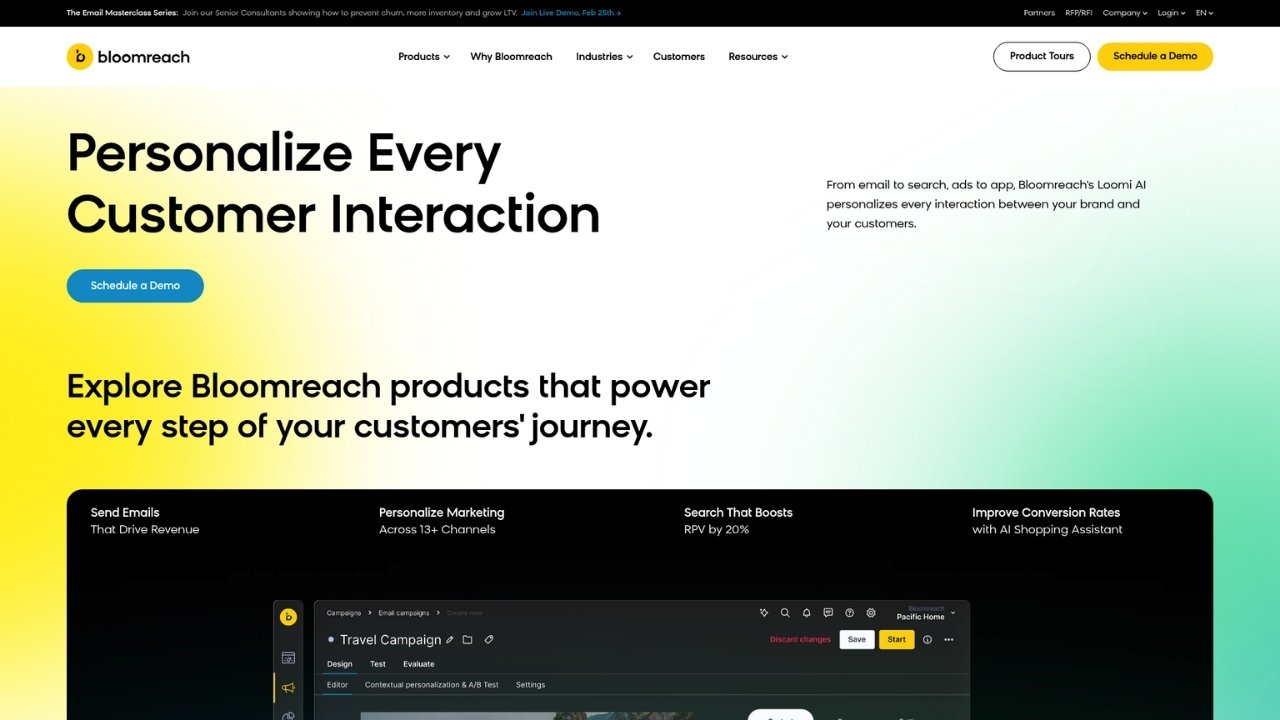
Bloomreach takes a different approach than pure search platforms. Their Loomi AI engine connects search, email, SMS, mobile apps, and advertising into a unified personalization platform.
With 1,400+ brands including Benefit Cosmetics, Pandora, and Puma, Bloomreach focuses on businesses that want to personalize across every touchpoint, not just site search.
Key products:
- Engagement (email and 13+ channel automation)
- Marketing Automation (predictive AI across channels)
- GenAI Product Discovery (self-learning search)
- Clarity (AI shopping assistant)
Customer results:
- Benefit Cosmetics: 40% revenue increase via personalized email
- TFG: 39.8% higher Revenue per Visit with conversational shopping
- Burton: Revenue outperformed visits by 21 percentage points
- N Brown: 59.73% increase in revenue per search user
Pros:
- Unified platform for content + commerce
- Real-time personalization (5ms-2s response)
- Strong omnichannel capabilities
- Proven ROI with major brands
Cons:
- Complex implementation
- Enterprise pricing (no self-serve)
- May be overkill if you only need search
Pricing: Custom enterprise contracts.
Verdict: Best for businesses wanting to unify search, content, and marketing automation rather than just replacing site search.
6. Akeneo
Akeneo approaches the problem from a different angle. Instead of starting with search, they start with product information management (PIM). If your biggest challenge is organizing and distributing product data across channels, Akeneo might be the answer.
The platform earned the #1 ranking in Info-Tech's PIM Data Quadrant and holds Leader status in G2's Enterprise Report. The open-source Community Edition makes it accessible for smaller businesses, while Enterprise editions handle complex requirements.
Key solutions:
- Akeneo PIM (product information management)
- Akeneo Activation (channel syndication)
- Supplier Data Manager (onboarding)
- Shared Catalogs (B2B management)
Customer results:
- Tiffany & Co: 7 new markets in 6 months
- Kitwave: Return rate dropped from 10% to 1.6%
- ABB: Catalog creation from 8 months to 18 hours
- Courir: 90% reduction in translation time
Pros:
- Free Community Edition available
- Open-source flexibility
- Strong data governance features
- AI-powered content enrichment
Cons:
- Search is secondary to PIM features
- Requires technical setup
- Not a direct search replacement
Pricing: Community Edition (free), Growth Edition (paid), Enterprise Edition (custom).
Verdict: Best when PIM is your primary need and search is secondary, or when you want open-source flexibility.
7. Coveo
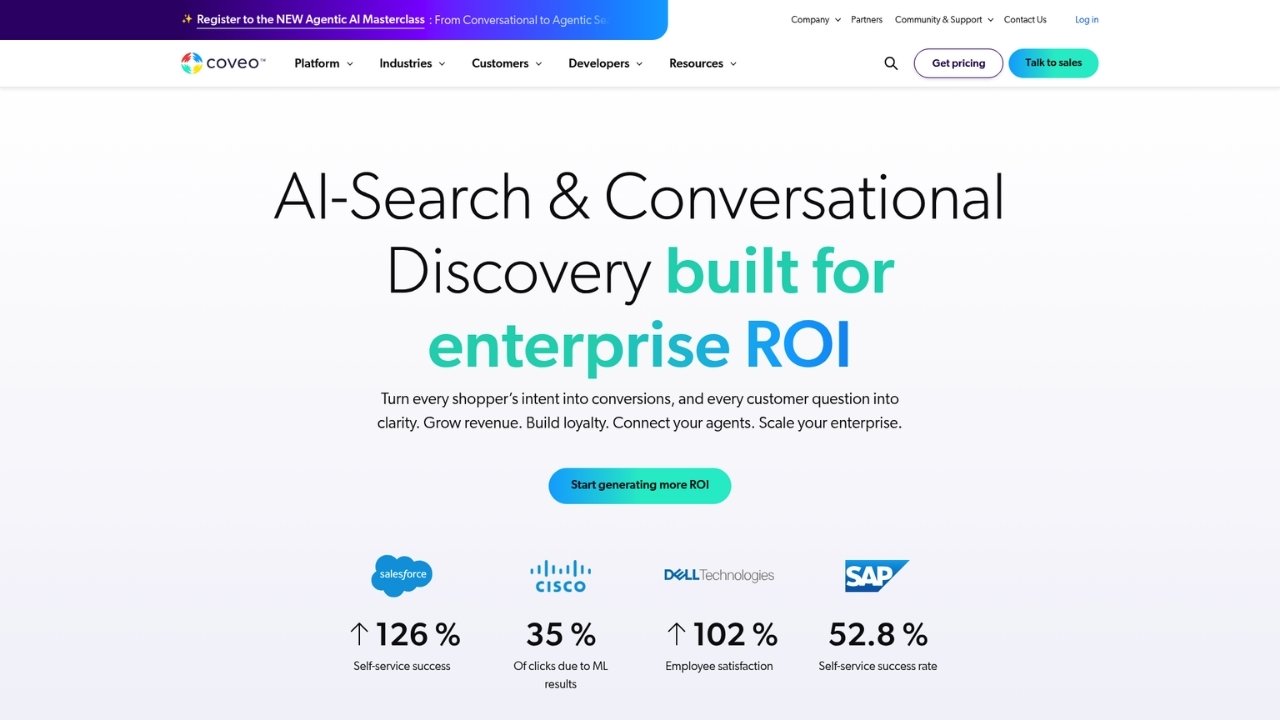
Coveo serves the enterprise market with a platform that unifies search across websites, commerce, customer service, and workplace applications. If you need one search solution that works everywhere, Coveo is worth considering.
Named a Leader in the 2025 Gartner Magic Quadrant for Search and Product Discovery, Coveo focuses on large organizations with complex, multi-system environments.
Core solutions:
- AI Commerce (B2B and B2C product discovery)
- AI Service (self-service and agent assistance)
- AI Website (personalized site search)
- AI Workplace (unified enterprise search)
Customer results:
- SAP: 83.5% self-service success rate
- Adobe: 231,000 hours of productivity saved annually
- SAP Concur: 31% decline in case submits per 1,000 searches
Pros:
- Unified search across all touchpoints
- Strong enterprise security and compliance
- 10+ years of AI relevance innovation
- MCP Server for AI agent connections
Cons:
- Enterprise-only pricing
- Complex implementation
- Overkill for single-site retailers
Pricing: Custom enterprise contracts.
Verdict: Best for large enterprises needing unified search across multiple properties, systems, and use cases.
Which Netcore Unbxd alternative should you choose?
The right choice depends on your specific situation:
Choose Constructor if: You're an enterprise retailer with technical resources who wants the most advanced AI search available.
Choose Algolia if: You have developers on staff, want flexible pricing, and need a platform that grows with you.
Choose Athos Commerce if: Your merchandising team wants control without depending on engineering for every change.
Choose ExpertRec if: Budget matters and you want transparent pricing without sacrificing core AI search features.
Choose Bloomreach if: You need unified personalization across search, email, and other channels, not just site search.
Choose Akeneo if: Product data management is your primary challenge, with search as a secondary need.
Choose Coveo if: You're a large enterprise with complex, multi-site search requirements across multiple systems.
Beyond search: completing your customer experience
Optimizing product discovery is crucial, but it's only part of the customer journey. Once shoppers find what they want, they still need support throughout the purchase process and beyond.
At Ringly.io, we help e-commerce businesses automate phone support with the AI, our AI phone agent. The AI handles order tracking, returns, and FAQs 24/7, resolving around 73% of calls without human intervention. For businesses investing in better product discovery, pairing that with automated support creates a seamless experience from browse to post-purchase.
Frequently Asked Questions
What are the best Netcore Unbxd alternatives for small businesses?
For small businesses, ExpertRec offers the best value with transparent pricing starting at $299/month. Algolia is also a strong choice with their free Build plan and usage-based pricing that scales with you.
Which Netcore Unbxd alternative has the easiest setup?
Athos Commerce scores highest for ease of setup at 8.8/10, making it the most accessible option for teams without extensive technical resources.
Are there any free Netcore Unbxd alternatives worth considering?
Algolia offers a free Build plan with 10,000 search requests and 1 million records monthly. Akeneo provides a free Community Edition for product information management.
What Netcore Unbxd alternative is best for enterprise retailers?
Constructor and Coveo are both built for enterprise. Constructor focuses purely on AI search excellence, while Coveo offers unified search across commerce, service, and workplace applications.
Which alternative offers the best merchandising controls?
Athos Commerce is specifically designed for merchandising teams, offering visual controls for boost rules, banners, and category optimization without requiring developer involvement.
How do I migrate from Netcore Unbxd to another platform?
Most alternatives offer migration support. Algolia and ExpertRec have the most straightforward migration paths with documented APIs and dedicated support teams. Plan for 2-4 weeks for a full migration depending on catalog size and customization needs.