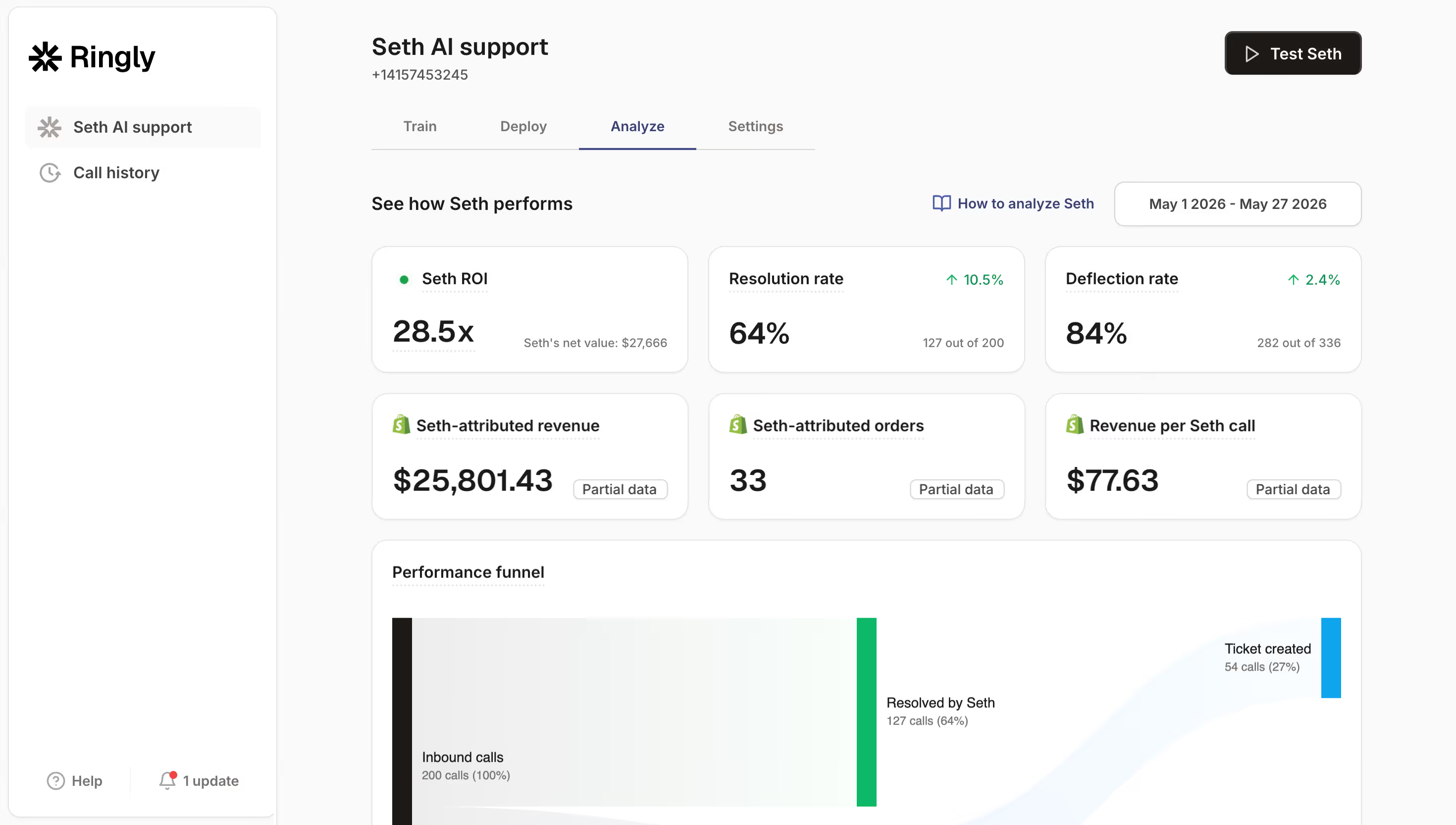


Enterprise search is having a moment. As companies drown in scattered documents, wikis, and support tickets, the pressure to find information fast has never been higher.
Coveo built its reputation as the go-to enterprise search platform, but that reputation comes with baggage: complex implementations, rising costs, and a learning curve that can stretch for months.
If you're here, you probably already know this. Maybe you're staring down a renewal quote that made your CFO wince.
Maybe your team is still waiting for that "quick" Coveo setup to go live. Or maybe you just want to see what else is out there before committing to another three-year contract.
Editor’s note: Want to hear some sample AI support calls made for your Shopify store?
- Just paste your store URL
- Get sample calls in under 20 seconds (no email required)
- Listen to demo calls for my store
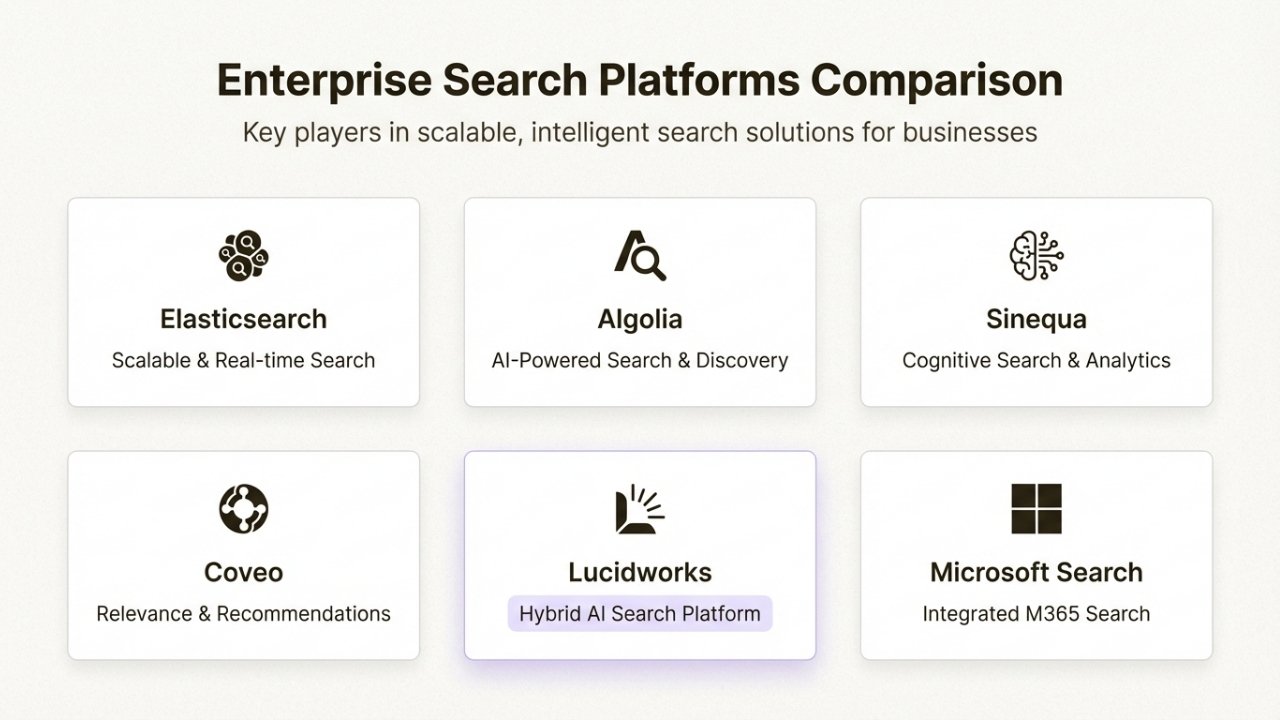
This guide cuts through the noise. We've analyzed the top Coveo alternatives based on real user reviews, pricing transparency, and use case fit.
Whether you need eCommerce search, internal knowledge discovery, or a developer-friendly API, there's an option here that fits better than Coveo.
What to look for in a Coveo alternative
Not every search platform solves the same problem. Before diving into the alternatives, let's clarify what actually matters when evaluating options.
Deployment flexibility tops the list for many teams. Coveo is cloud-only, which works fine until you hit regulatory requirements that demand on-premises data storage.
If you're in healthcare, finance, or legal, you might need hybrid or fully on-prem options.
AI and personalization capabilities separate modern platforms from legacy search. Basic keyword matching doesn't cut it anymore.
You want semantic search that understands intent, recommendations that improve with use, and ranking that adapts to user behavior.
Integration ecosystem determines how much engineering work stands between you and a working search experience.
More pre-built connectors mean faster time-to-value. Fewer connectors mean more custom development.
Pricing transparency matters more than vendors admit. Some platforms publish clear per-search or per-user pricing.
Others hide behind "contact sales" buttons and custom quotes that vary by the size of your company.
Implementation complexity is the hidden cost everyone forgets. A platform that promises the world but requires six months of professional services to deploy might not beat your current setup.
Comparison at a glance
Here's how the seven alternatives stack up across the criteria that matter most.
| Platform | Best For | Starting Price | G2/Gartner Rating | Deployment |
|---|---|---|---|---|
| Algolia | Developers, API-first teams | Free tier, then ~$0.50/1k searches | 4.5/5 (G2 Winter 2026) | Cloud only (70+ centers) |
| Glean | Internal knowledge search | ~$50/user/mo (100-seat min) | 4.8/5 | Cloud only |
| Bloomreach | Large retailers | Usage-based (Annual contracts) | 4.5/5 (G2 2026 Leader) | Cloud only |
| Elasticsearch | Technical teams, full control | Free (Self-hosted) or usage-based | 4.4/5 | Self-hosted, Cloud, Hybrid |
| Experro | Mid-market eCommerce | Flexible (Demo-driven) | 5.0/5 (Capterra 2026) | Cloud only (SaaS) |
| Luigi's Box | SMBs, simple use cases | From €79/mo (~$85) | 4.7/5 | Cloud only |
| BA Insight | Regulated industries | ~$105k/year (AWS Marketplace) | 4.0/5 (G2) | Cloud, On-prem, Hybrid |
The table tells part of the story, but each platform has nuances worth understanding. Let's break them down.
The 7 best Coveo alternatives
1. Algolia
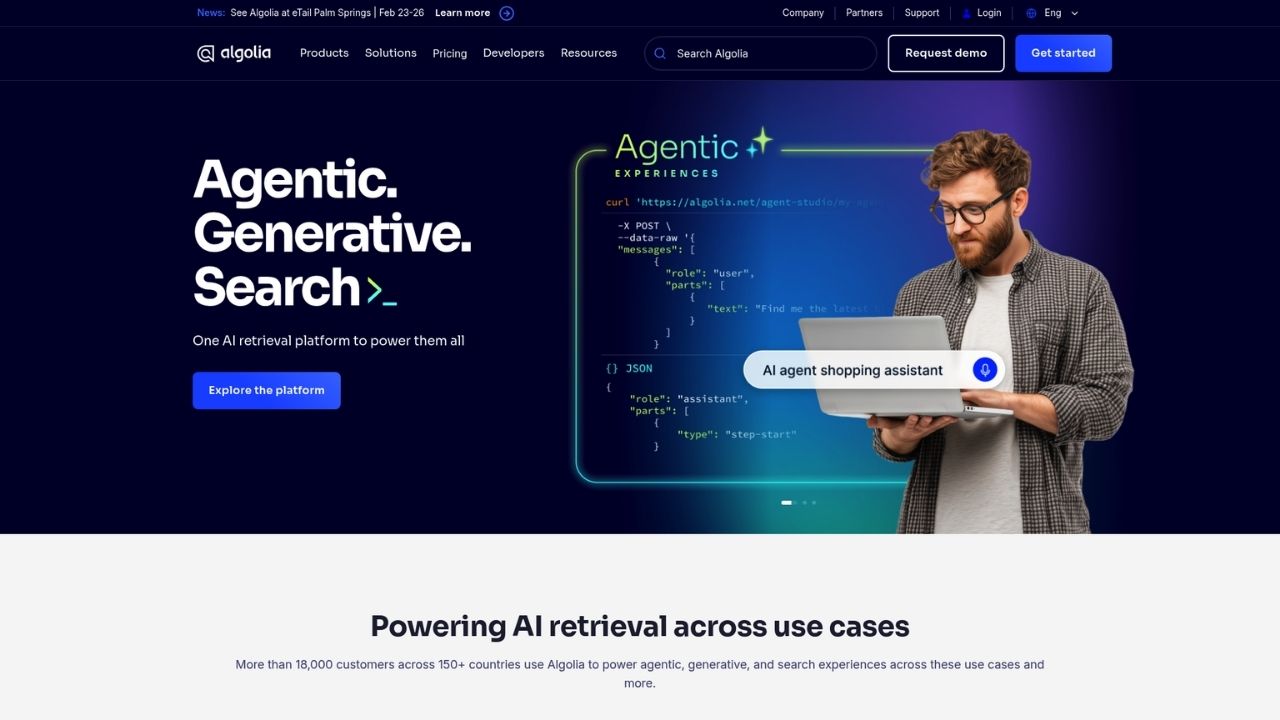
Algolia has become the default choice for developers who need fast, reliable search without the enterprise bloat.
It's an API-first platform that prioritizes speed and developer experience over bells and whistles.
The search performance is genuinely impressive. Algolia delivers sub-100ms response times globally, which matters when users expect instant results.
The documentation is excellent, SDKs cover every major language, and the dashboard gives you real-time visibility into search analytics.
Where Algolia differs from Coveo is scope. Coveo tries to be everything: search, recommendations, personalization, and knowledge management.
Algolia focuses on search first, with recommendations available as a separate add-on.
This modular approach keeps things simple but means you might need additional tools for a complete solution.
Pricing starts with a generous free tier covering 10,000 search requests monthly.
The Grow plan runs approximately $51 per month for small teams, but costs scale quickly with usage. High-traffic sites can see bills climb into thousands monthly.
Best for: Engineering-centric teams who want control over the search experience and don't mind building some components themselves.
G2 Rating: 4.5/5
Pros:
- Lightning-fast search performance
- Excellent developer documentation and SDKs
- Strong analytics and A/B testing tools
- Easy to customize ranking and relevance
Cons:
- Search and recommendations are separate products
- Costs escalate with traffic volume
- Requires developer involvement for setup
- No native merchandising for eCommerce
2. Glean
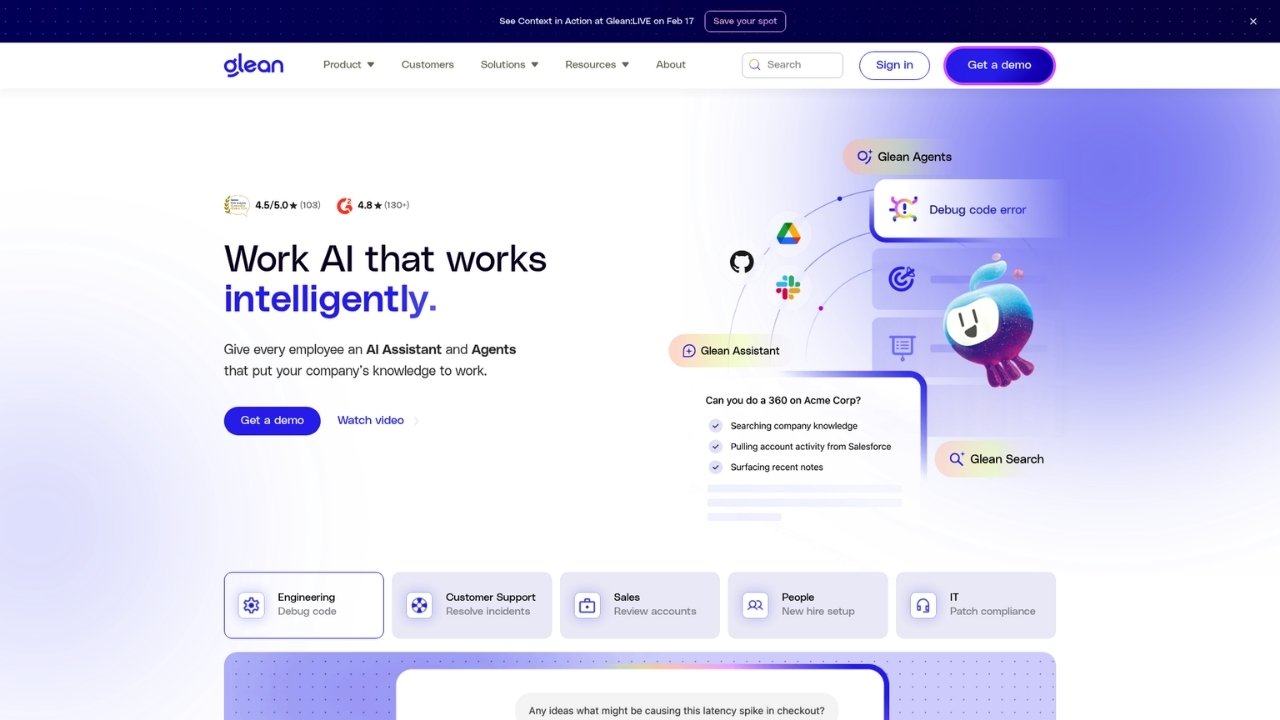
Glean approaches search from a different angle.
Instead of trying to power customer-facing search, it focuses entirely on internal knowledge: the documents, emails, Slack messages, and wikis scattered across your organization.
The platform connects to 100+ workplace applications and uses AI to understand not just what's in your content, but who wrote it, who accessed it, and how it relates to other information.
This context makes Glean particularly good at answering "where is that document?" questions that waste hours every week.
Glean's generative AI features are genuinely useful. It can summarize documents, draft responses based on your company's knowledge base, and surface relevant information before you even search for it.
The interface feels modern and intuitive, which helps with adoption across non-technical teams.
The catch is pricing and scope. Glean is enterprise-only with custom quotes that typically start in the five-figure range annually.
It's also not designed for customer-facing search, so eCommerce or public website use cases are out of scope.
Best for: Large enterprises with complex internal knowledge management needs and budget for premium tooling.
G2 Rating: 4.8/5
Pros:
- Excellent for internal knowledge search
- Strong generative AI capabilities
- Connects to 100+ workplace apps
- Modern, intuitive interface
Cons:
- Not built for eCommerce or customer-facing search
- Enterprise-only pricing (contact sales)
- IT-heavy implementation for large organizations
- Long implementation cycles
3. Bloomreach
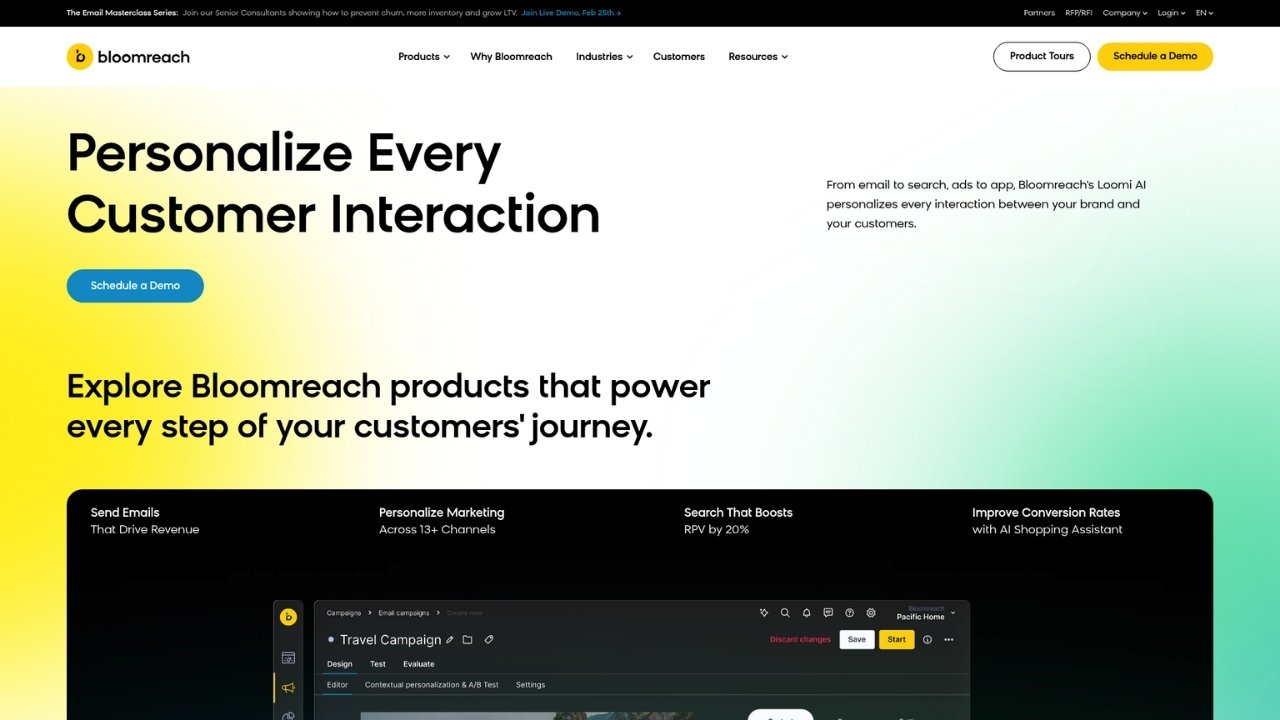
Bloomreach built its reputation in eCommerce search and merchandising.
While Coveo serves multiple industries, Bloomreach doubled down on retail, and that focus shows in the feature set.
The platform excels at product discovery. Visual merchandising tools let non-technical team members control search results, boost products, and create curated experiences without developer help.
Revenue attribution features connect search behavior to actual sales, which helps justify the investment to leadership.
Bloomreach also includes a customer data platform (CDP) that unifies shopper profiles across touchpoints.
This integration means search personalization can draw from browse behavior, purchase history, and email engagement, not just query patterns.
The trade-off is flexibility. Bloomreach is heavily optimized for retail scenarios.
If you're not selling products online, you'll pay for features you don't need and miss capabilities that would help your use case.
Pricing is enterprise-level custom pricing, typically requiring annual commitments.
Expect quotes to start around $50,000 annually for mid-market implementations.
Best for: Large retailers with complex catalogs who need deep merchandising control and can justify the investment.
G2 Rating: 4.3-4.8/5 (varies by product module)
Pros:
- Purpose-built for retail and eCommerce
- Visual merchandising dashboards for marketers
- Strong revenue attribution tools
- Integrated CDP for personalization
Cons:
- Narrow scope (retail focus)
- Not designed for cross-industry use
- Enterprise pricing with long contracts
- Complex implementation for large catalogs
4. Elasticsearch
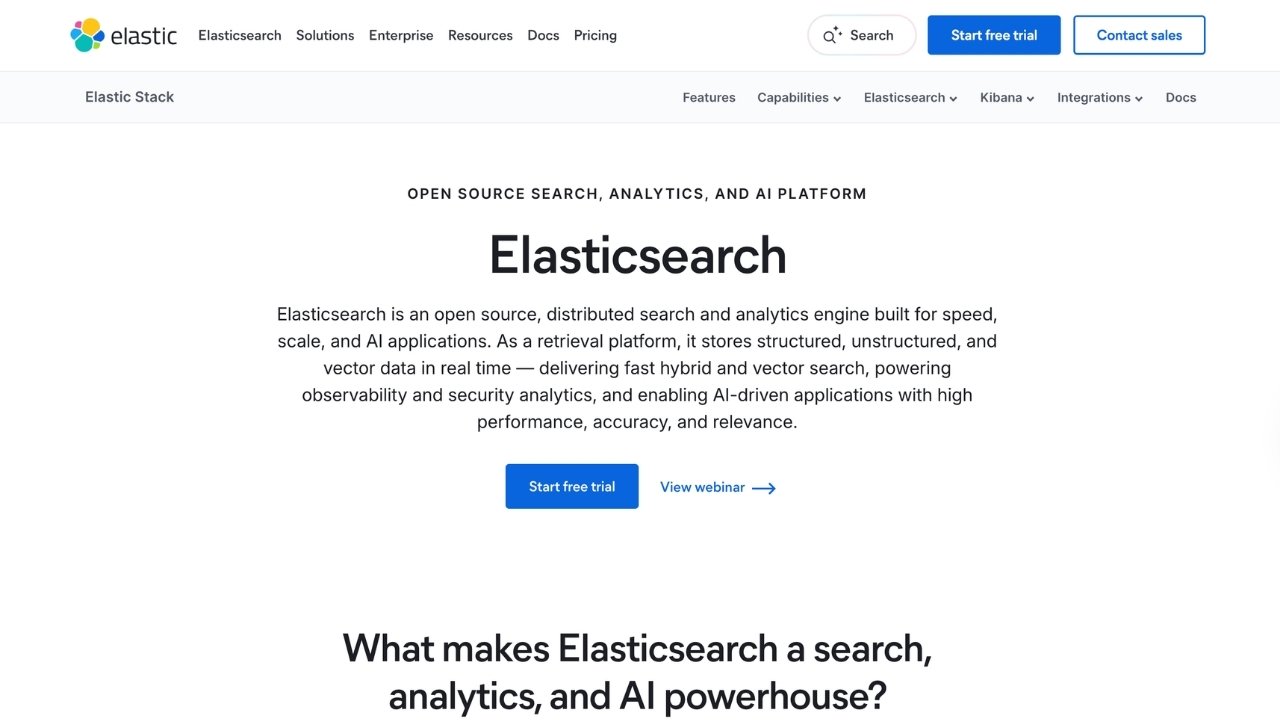
Elasticsearch is the open-source search engine that powers many of the other platforms on this list.
Using it directly means trading ease of use for complete control.
The platform handles everything from website search to log analytics to security monitoring. I
ts distributed architecture scales to billions of documents without breaking a sweat. If you have unusual requirements, need custom relevance algorithms, or want to avoid vendor lock-in entirely, Elasticsearch is worth considering.
The downside is operational overhead. Self-hosted Elasticsearch requires dedicated infrastructure, monitoring, and expertise.
Even Elastic Cloud, the managed service, expects you to understand index mapping, query DSL, and cluster sizing. This isn't a platform you set up in an afternoon.
Pricing for the open-source version is free (minus your infrastructure costs). Elastic Cloud runs on usage-based pricing that varies by deployment size and data volume.
Best for: Technical teams with DevOps resources who need maximum flexibility and don't mind managing infrastructure.
Gartner Rating: 4.4/5
Pros:
- Open source with no licensing fees
- Handles massive scale
- Real-time analytics capabilities
- Full control over relevance and ranking
Cons:
- Requires significant technical expertise
- Self-managed unless using Elastic Cloud
- Steep learning curve for query DSL
- Operational overhead for self-hosted deployments
5. Experro
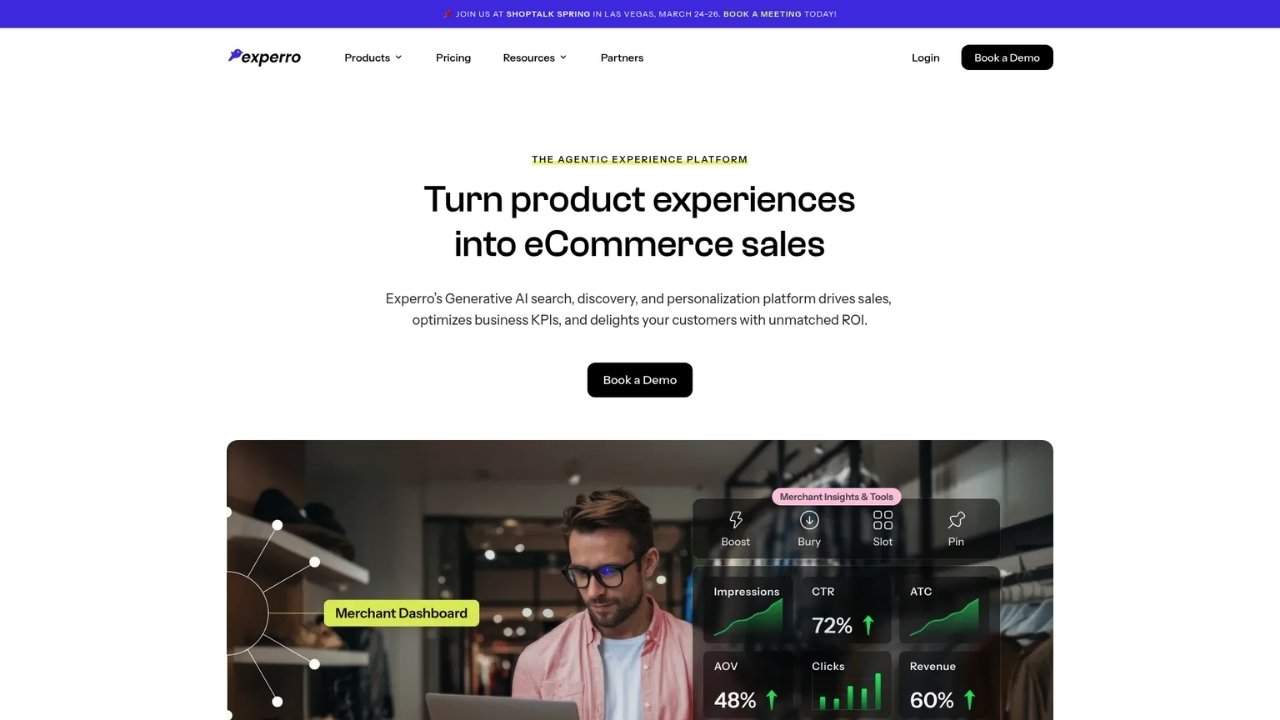
Experro positions itself as the anti-Coveo: fast to deploy, easy to use, and built specifically for eCommerce.
The platform combines site search, product recommendations, and personalization in a unified interface.
The GenAI-powered search understands natural language queries better than keyword matching alone.
"Blue running shoes under $100" returns relevant results even if product descriptions don't contain those exact words.
The no-code controls let merchandisers adjust rankings, create synonyms, and manage redirects without filing engineering tickets.
Experro also includes merchant intelligence features that surface insights about search performance, product gaps, and customer behavior.
This data helps teams optimize not just search, but the entire product catalog strategy.
Pricing uses flexible, scalable plans with a free demo available. Based on user reports, plans typically start lower than Coveo for similar functionality.
Best for: Mid-market to enterprise eCommerce brands who want Coveo's capabilities without the complexity.
G2 Rating: 4.8/5
Pros:
- GenAI-powered search with high intent accuracy
- No-code controls for merchandisers
- Real-time analytics included
- Built specifically for eCommerce
Cons:
- Primarily focused on eCommerce (not general enterprise search)
- Newer platform with smaller community than established players
- Some advanced features require higher-tier plans
6. Luigi's Box

Luigi's Box targets a different segment than most Coveo alternatives.
Instead of competing on enterprise features, it focuses on simplicity and affordability for small to mid-sized businesses.
The platform offers five products that work together: Search with Autocomplete, Recommender, Product Listing, Shopping Assistant, and Analytics.
You can start with search alone and add capabilities as needed. The self-learning algorithm improves relevance based on user behavior without requiring manual tuning.
Setup is straightforward compared to enterprise platforms. Most sites can implement Luigi's Box in days rather than weeks.
The interface is clean and approachable for teams without dedicated search engineers.
The limitations show when you try to scale. Enterprise catalogs with millions of products, complex merchandising rules, or multi-language requirements may outgrow the platform. Personalization depth is lighter than premium alternatives.
Pricing uses tiered plans that undercut Coveo significantly. Entry-level plans start around a few hundred dollars monthly.
Best for: SMBs and mid-market companies who need solid search without enterprise complexity or pricing.
G2 Rating: 4.7/5
Pros:
- Easy setup and clean user experience
- Affordable for smaller businesses
- Self-learning algorithm improves over time
- Modular product approach
Cons:
- Limited scalability for enterprise catalogs
- Personalization depth weaker than premium platforms
- Fewer AI models and relevancy tuning options
- Not ideal for multi-language or global brands
7. BA Insight
BA Insight stands out for one reason: deployment flexibility. While most competitors are cloud-only, BA Insight offers cloud, on-premises, and hybrid deployments.
This matters enormously for regulated industries.
The platform includes 95+ pre-built connectors compared to Coveo's 30+, covering everything from SharePoint and Microsoft 365 to ServiceNow, Salesforce, and specialized legal and life sciences systems.
The AutoClassifier tool automatically enriches metadata, making content more discoverable without manual tagging.
BA Insight's AI Enablement Platform lets organizations integrate their choice of generative AI engines rather than locking them into a single provider.
This flexibility appeals to companies with existing AI investments or specific compliance requirements.
The trade-off is that BA Insight is less focused on customer-facing personalization than Coveo. It's optimized for internal search and knowledge discovery rather than eCommerce or public website scenarios.
Pricing is enterprise-level and requires contacting sales for quotes.
Best for: Regulated industries (legal, healthcare, financial services) needing compliance flexibility and hybrid deployment options.
SoftwareReviews Rating: 8.0/10
Pros:
- 95+ connectors across enterprise systems
- Cloud, on-prem, and hybrid deployment options
- AutoClassifier for metadata enrichment
- AI engine flexibility (not locked to one provider)
Cons:
- Less focus on customer-facing personalization
- Enterprise-only pricing
- Longer implementation than cloud-native alternatives
- Smaller mindshare than mainstream competitors
How to choose the right Coveo alternative
With seven solid options, how do you decide? Start by mapping your primary use case.
For eCommerce and retail: Bloomreach, Experro, and Luigi's Box lead the pack. Bloomreach offers the deepest merchandising for large retailers.
Experro balances capability with usability for mid-market brands. Luigi's Box covers smaller budgets without sacrificing core functionality.
For internal knowledge and enterprise search: Glean and BA Insight are the clear choices. Glean excels at connecting modern workplace apps with minimal IT involvement. BA Insight wins when compliance, hybrid deployment, or legacy system integration matters.
For developer-centric teams: Algolia and Elasticsearch serve different needs. Algolia offers the fastest path to production with managed infrastructure.
Elasticsearch provides ultimate control for teams with DevOps resources.
Migration considerations deserve serious attention. Moving from Coveo means:
- Re-indexing all your content (plan for weeks, not days)
- Rebuilding relevance models and ranking rules
- Reconfiguring integrations and connectors
- Retraining teams on new interfaces
Run parallel systems during transition if possible. Test with a subset of traffic before cutting over completely.
And budget for unexpected complexity. Search migrations always reveal edge cases nobody anticipated.
When Coveo still makes sense
Not everyone should leave Coveo. The platform remains a solid choice in specific scenarios.
If you've already invested heavily in Coveo implementation and training, switching costs might outweigh benefits.
The platform's service and support scores higher than many competitors in Gartner reviews.
For teams that value vendor stability and comprehensive feature sets over cutting-edge agility, Coveo's maturity is an asset.
Coveo also makes sense when you need both customer-facing and internal search in a single platform.
Most alternatives specialize in one or the other. Coveo covers both, albeit with complexity trade-offs.
The honest assessment: if Coveo is working well and the pricing is acceptable, there's no urgent reason to switch.
But if you're facing renewal sticker shock or implementation headaches, the alternatives above offer compelling escape routes.
Switching from Coveo: What to expect
Migration timelines vary dramatically based on your setup. A simple website search with one content source might migrate in 4-6 weeks. Complex enterprise deployments with dozens of connectors, custom relevance models, and multiple use cases can stretch to 6 months.
Common challenges during migration include:
- Data export limitations: Coveo doesn't always make it easy to extract your indexed content and relevance configurations
- Relevance model rebuilding: Every platform ranks results differently. Expect to spend time tuning the new system to match (or improve) Coveo's result quality
- Integration reconfiguration: Connectors vary between platforms. Some integrations will need rebuilding from scratch
- User retraining: Even intuitive platforms require adjustment periods for teams used to Coveo's interface
The platforms that offer professional services or migration assistance (most enterprise options do) can reduce these risks.
Budget for this help rather than attempting pure self-service migration for complex setups.
Try Ringly.io for AI-powered customer support
While you're evaluating search platforms to help customers find information, consider what happens when they can't find answers on their own.
That's where Ringly.io fills the gap.
the AI, Ringly.io's AI phone support agent, handles inbound calls 24/7. It answers questions, looks up orders, processes returns and exchanges, and only escalates to your team when necessary.
The platform integrates directly with Shopify and resolves approximately 70-73% of calls without human intervention.
Think of it as the safety net beneath your search investment. When site search fails or customers prefer calling, the AI picks up.
The combination of better search plus AI phone support creates a comprehensive self-service experience that actually reduces support costs.
Start your free trial and see how AI phone support complements your search strategy.
Frequently Asked Questions
What are the best Coveo alternatives for small businesses?
For small businesses, Luigi's Box and Algolia offer the best balance of capability and affordability. Luigi's Box provides a complete search solution with simpler setup, while Algolia's free tier covers up to 10,000 monthly searches for sites just getting started.
Which Coveo alternatives offer on-premises deployment?
BA Insight is the standout choice for on-premises or hybrid deployment, offering cloud, on-prem, and mixed environments. Elasticsearch also supports self-hosted deployments if you have the technical resources to manage infrastructure.
Are there any free Coveo alternatives?
Elasticsearch offers a fully open-source version at no cost (minus infrastructure). Algolia provides a generous free tier covering 10,000 searches monthly. Most enterprise-focused alternatives like Glean and Bloomreach don't offer free plans.
What is the easiest Coveo alternative to implement?
Luigi's Box and Algolia are generally considered the fastest to implement. Most sites can get Luigi's Box running in days, while Algolia's excellent documentation helps developers integrate quickly. Enterprise platforms like Glean and BA Insight typically require longer implementation cycles.
Which Coveo alternative is best for eCommerce?
Bloomreach leads for large retailers needing deep merchandising, while Experro offers the best balance of capability and usability for mid-market eCommerce brands. Luigi's Box serves smaller eCommerce sites well at a lower price point.
How do Coveo alternatives compare on pricing?
Most Coveo alternatives are significantly cheaper. Algolia starts around $51/month, Luigi's Box offers tiered pricing well below Coveo, and Elasticsearch can run on open-source for infrastructure costs only. Enterprise options like Glean, Bloomreach, and BA Insight still require custom quotes but often undercut Coveo for similar functionality.
Can I migrate from Coveo without losing my search data?
Migration is possible but requires planning. You'll need to re-index content in your new platform and rebuild relevance configurations. Most alternatives offer migration guides or professional services to help. Budget 4-12 weeks depending on your setup complexity, and consider running parallel systems during transition.