
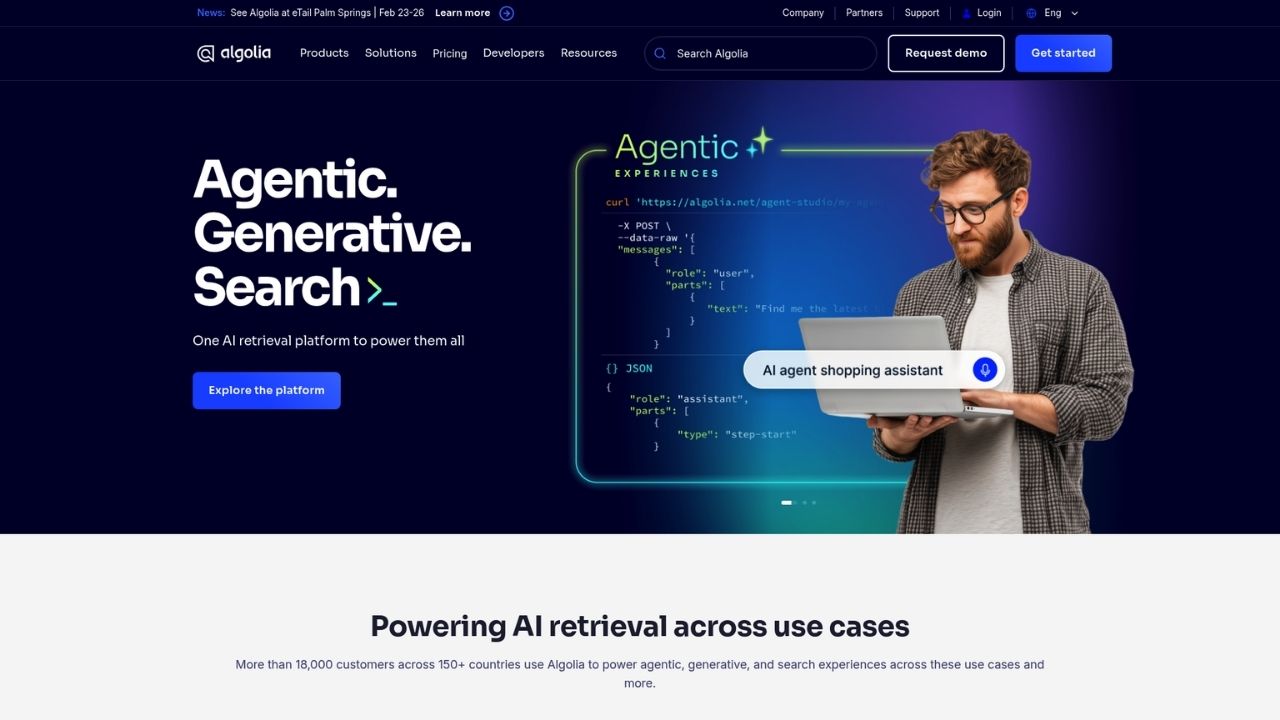
Algolia has been the go-to name in search-as-a-service for years.
But here's the thing: their pricing can escalate quickly, and the learning curve isn't exactly gentle. If you're running a growing e-commerce store or scaling a content platform, you might be looking for something that delivers similar results without the enterprise price tag.
The good news? The search engine landscape has evolved significantly.
Whether you need open-source flexibility, simpler setup, or just want to cut costs, there's likely an alternative that fits your needs.
Let's break down the seven best Algolia alternatives worth considering in 2026.
Editor’s note: Want to hear some sample AI support calls made for your Shopify store?
- Just paste your store URL
- Get sample calls in under 20 seconds (no email required)
- Listen to demo calls for my store
Why look for Algolia alternatives?
Before diving into the options, let's be clear about why teams switch.
Understanding your own motivations helps you pick the right replacement.
Pricing concerns top the list for most. Algolia uses usage-based pricing that starts reasonable but scales unpredictably. One G2 reviewer put it bluntly: "Understanding Algolia's pricing and how costs scale can be a challenge at times.
The cost structure isn't always immediately clear, which makes it harder to forecast as projects grow."
Complexity is another pain point. Algolia is powerful, but that power comes with configuration overhead. For teams without dedicated search engineers, getting the most out of it requires significant investment.
Vendor lock-in matters too. As a proprietary hosted solution, you're dependent on Algolia's infrastructure and pricing decisions.
Open-source alternatives give you control over your data and deployment.
That said, Algolia isn't bad, it's just not for everyone. Large enterprises with dedicated search teams and healthy budgets often find it worth the investment.
The ecosystem is mature, documentation is extensive, and support is solid.
But if you're looking for something different, here are seven alternatives worth your attention.
Comparison at a glance
Here's a quick reference to help you narrow down your options before we dive deeper.
| Tool | Best For | Pricing | Open Source | Standout Feature |
|---|---|---|---|---|
| Typesense | Developers wanting Algolia-like speed | Free (cloud available) | Yes | Sub-50ms search latency |
| Meilisearch | Teams wanting modern AI search | From $30/mo | Yes | Hybrid semantic + keyword search |
| Elasticsearch | Large enterprises with complex needs | From $95/mo | Yes | Massive scale and analytics |
| OpenSearch | AWS-centric teams | Free | Yes | Native AWS integration |
| Coveo | Enterprises needing AI personalization | Custom | No | Unified search across sources |
| Klevu | E-commerce stores | Custom | No | Shopify-native features |
| Qdrant | AI/ML applications | From $0 (1GB free) | Yes | Billions of vectors, GPU acceleration |
The 7 best Algolia alternatives
1. Typesense
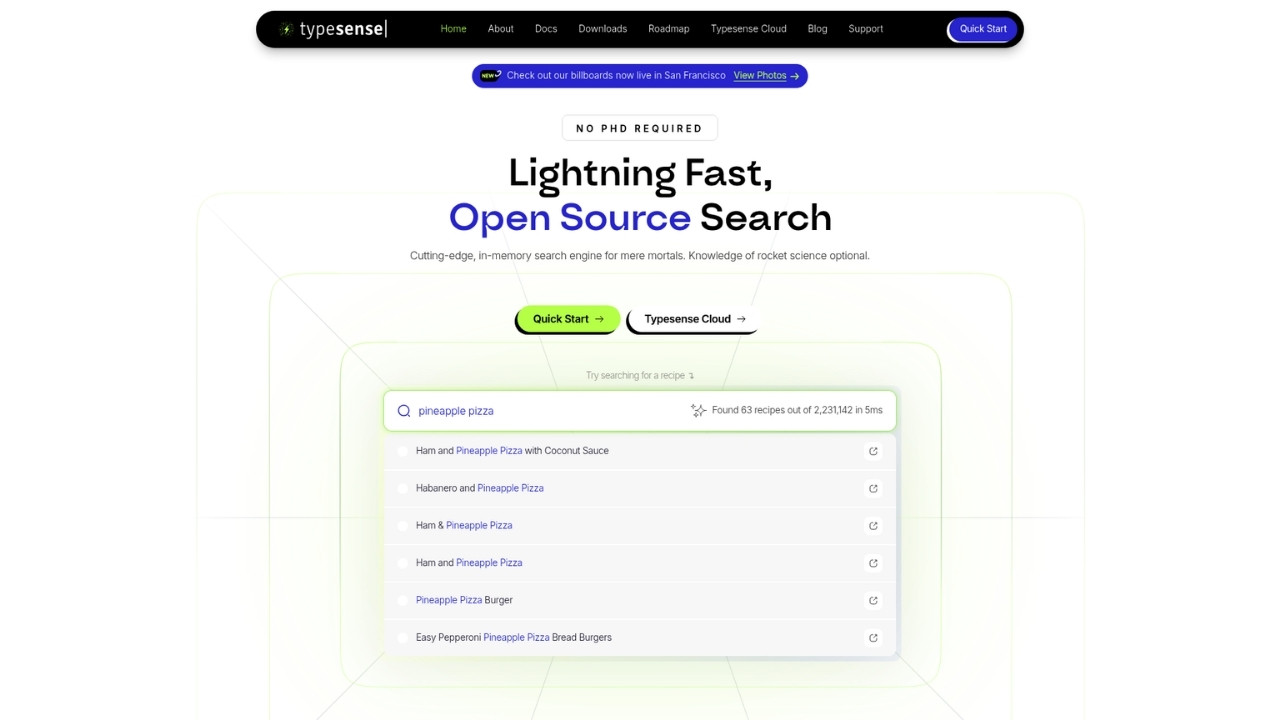
Typesense positions itself as the "Open Source Alternative to Algolia + Pinecone" and the "Easier-to-Use Alternative to ElasticSearch."
That's a lot to promise, but the numbers back it up: 25.2k GitHub stars, 20 million Docker pulls, and over 10 billion searches served monthly on Typesense Cloud.
What makes it special? Speed and simplicity. Typesense is built in C++ and optimized for sub-50ms search latency, even with millions of records.
One developer on Twitter noted: "Switched from elasticsearch to @typesense and I think these results speak for themselves. The best part? The ranking is better too!"
Key features:
- Typo tolerance out of the box
- Vector and semantic search built-in
- Federated search across multiple collections
- Geo search for location-based results
- Scoped API keys for multi-tenant apps
- Easy high availability setup
Pricing: The open-source version is completely free. Typesense Cloud offers managed hosting with pricing based on cluster configuration rather than usage, which means predictable costs as you scale.
Best for: Developers who want Algolia's speed without the usage-based pricing model. It's particularly popular among startups and mid-sized companies that need powerful search without enterprise complexity.
Pros: Lightning fast, incredibly easy to set up (single binary, no dependencies), excellent documentation, federated search, geo search capabilities.
Cons: Smaller ecosystem than Algolia means fewer third-party integrations, though the major ones (InstantSearch, DocSearch, Docusaurus) are covered.
2. Meilisearch
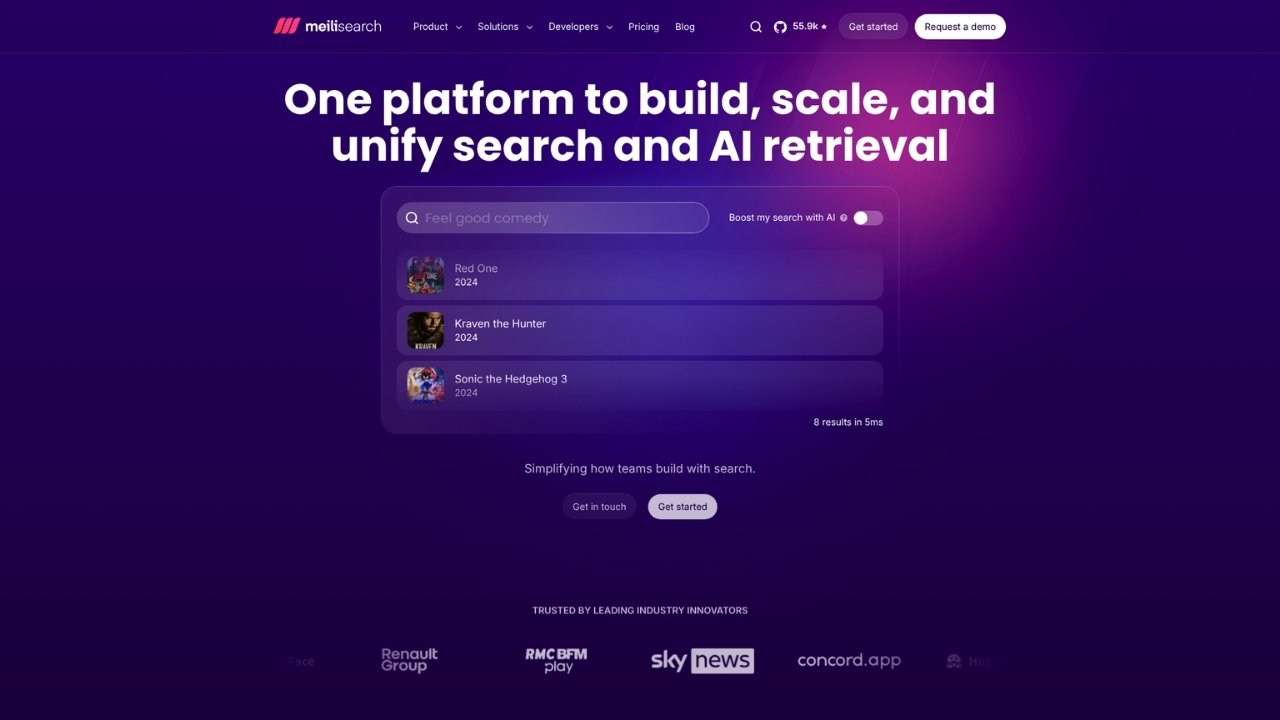
Meilisearch is another open-source contender that emphasizes developer experience and modern AI capabilities.
Built in Rust, it's designed to be deployable in minutes with smart presets that work well out of the box.
The platform has gained traction with companies like Qogita, Symfony, and OCTO Technology.
One engineering director noted: "Meilisearch empowers lightning-fast and relevant search results tailored to customer needs.
Seamless integration boosts developer experience, making setup, testing, and CI/CD automation efficient. It's cost-effective, leading to substantial savings."
Key features:
- AI embedders for vector search
- Hybrid search combining semantic and full-text
- Data visualization and analytics
- Multi-language support with automatic detection
- Custom relevancy tuning
- Geo search capabilities
Pricing: Open-source is free. Meilisearch Cloud starts at around $30/month, making it one of the more affordable managed options.
They also offer a 14-day free trial.
Best for: Teams that want modern search capabilities (including AI-powered semantic search) without wrestling with complex configuration.
The focus on developer experience makes it particularly appealing for smaller teams.
Pros: Extremely easy to set up, highly relevant results out of the box, vibrant community, hybrid search capabilities, comprehensive API clients for multiple languages.
Cons: Some users note the dashboard could use more sophisticated features, and recent pricing changes have raised concerns about long-term cost-effectiveness for certain use cases.
3. Elasticsearch
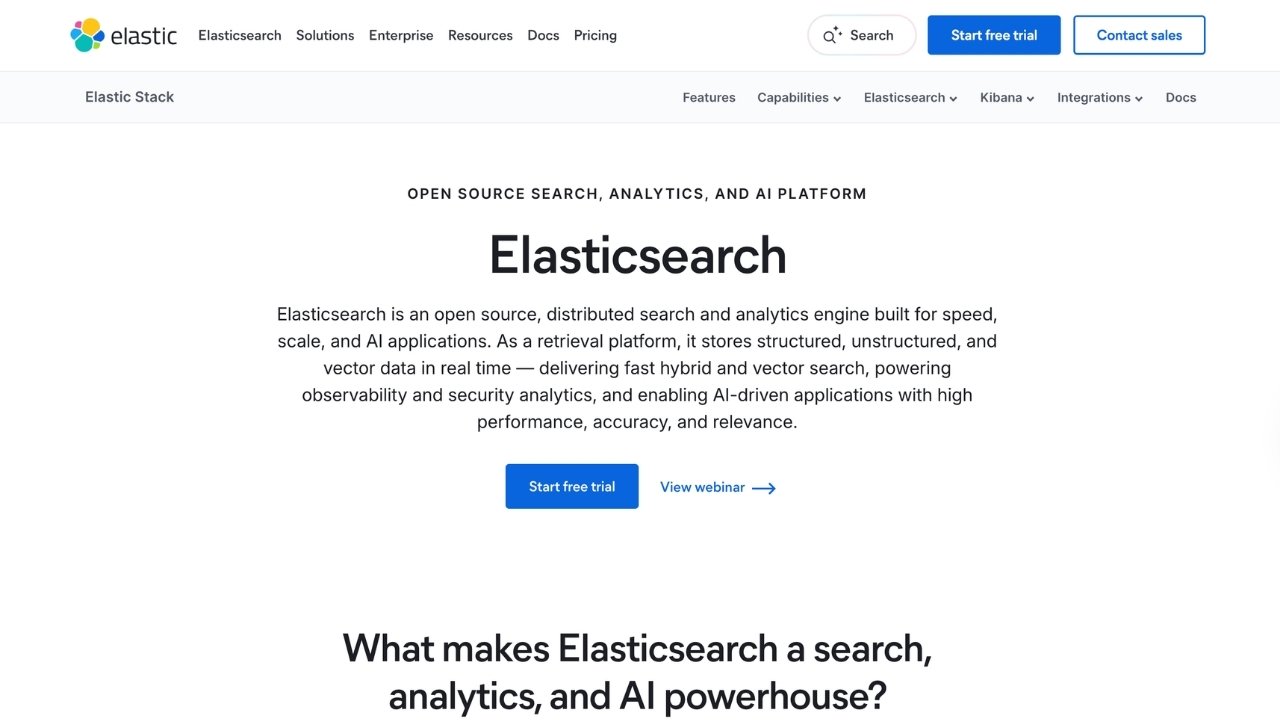
Elasticsearch is the 800-pound gorilla of search engines.
Built on Apache Lucene, it's the most widely used open-source search solution and powers everything from small blogs to massive enterprise deployments.
With a 4.5/5 rating on Gartner and over 133 reviews, it's clearly doing something right.
One reviewer explained: "Elastic Search has become the backbone of our search and observability use cases.
We use it to power merchant/transaction lookups with fuzzy matching and scoring, and to centralize logging for fast, reliable investigations. Performance has been consistently strong at scale."
Key features:
- Massive scalability (petabytes of data)
- Real-time analytics and visualization
- Machine learning for relevance tuning
- Horizontal scaling via distributed architecture
- Full-text search with advanced querying
- Observability and security analytics
Pricing: Open-source is free. Elastic Cloud (managed) starts at $95/month. The trade-off is that you'll need technical expertise to run it efficiently.
Best for: Large enterprises with complex search requirements, teams that need to store billions of documents, or organizations that want a unified platform for search, logging, and analytics.
Pros: Extremely powerful, massive community, extensive integrations, proven at scale, comprehensive feature set.
Cons: Steep learning curve, resource intensive (can strain CPU), operational complexity (tuning shards, upgrades, capacity planning), unclear pricing at scale.
4. OpenSearch
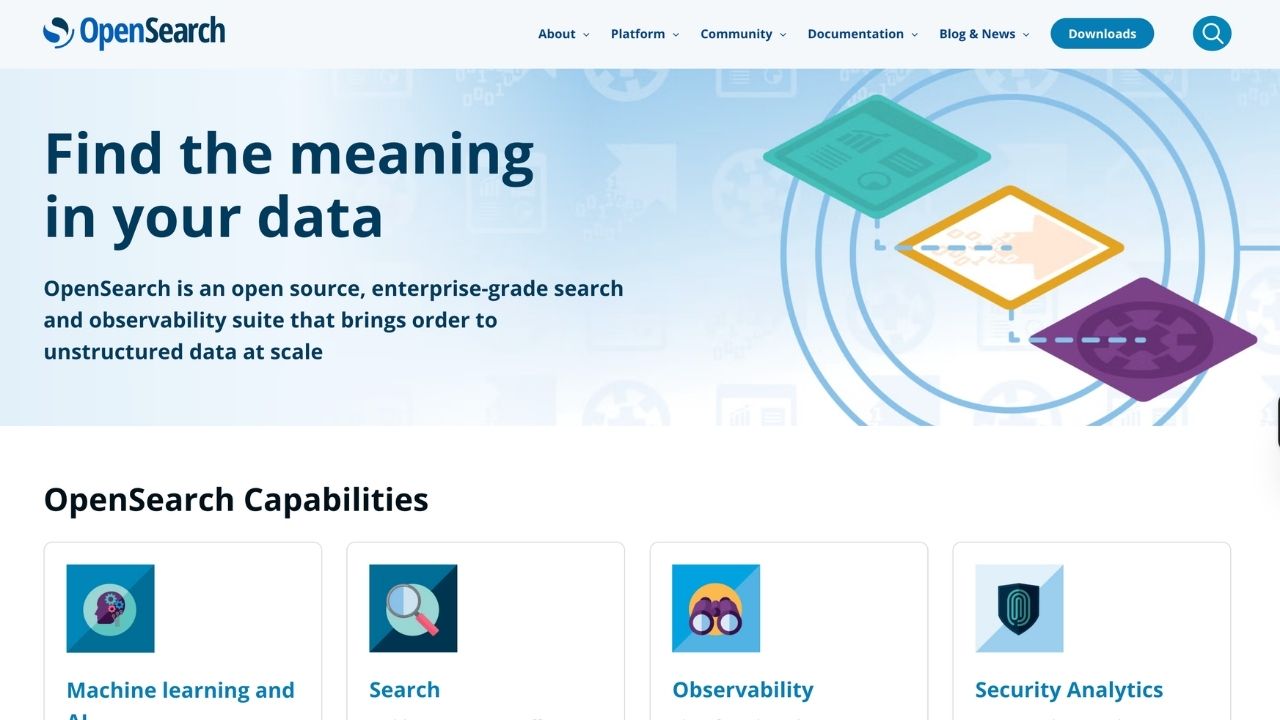
OpenSearch is the community-driven fork of Elasticsearch, created after Elastic changed its licensing.
Apache 2.0-licensed and fully open source, it's become the preferred choice for teams who want Elasticsearch's power without licensing concerns.
With 12,369 GitHub stars and strong AWS backing, it's a mature platform that emphasizes flexibility and vendor independence.
Key features:
- Full compatibility with Elasticsearch APIs
- Built-in observability and security analytics
- OpenSearch Dashboards for visualization
- Machine learning integrations
- Performance monitoring tools
- Threat intelligence capabilities
Pricing: Completely free and open source. You pay only for your own infrastructure costs.
Best for: AWS users who want Elasticsearch-like capabilities with fully open-source licensing.
It's particularly popular for log analytics, security monitoring, and applications where vendor lock-in is a concern.
Pros: No vendor lock-in, strong AWS ecosystem integration, free to use, good visualization tools, active community development.
Cons: Smaller community than Elasticsearch means fewer third-party plugins, some users report slower performance compared to Elastic's distribution, newer project with less mature ecosystem.
5. Coveo
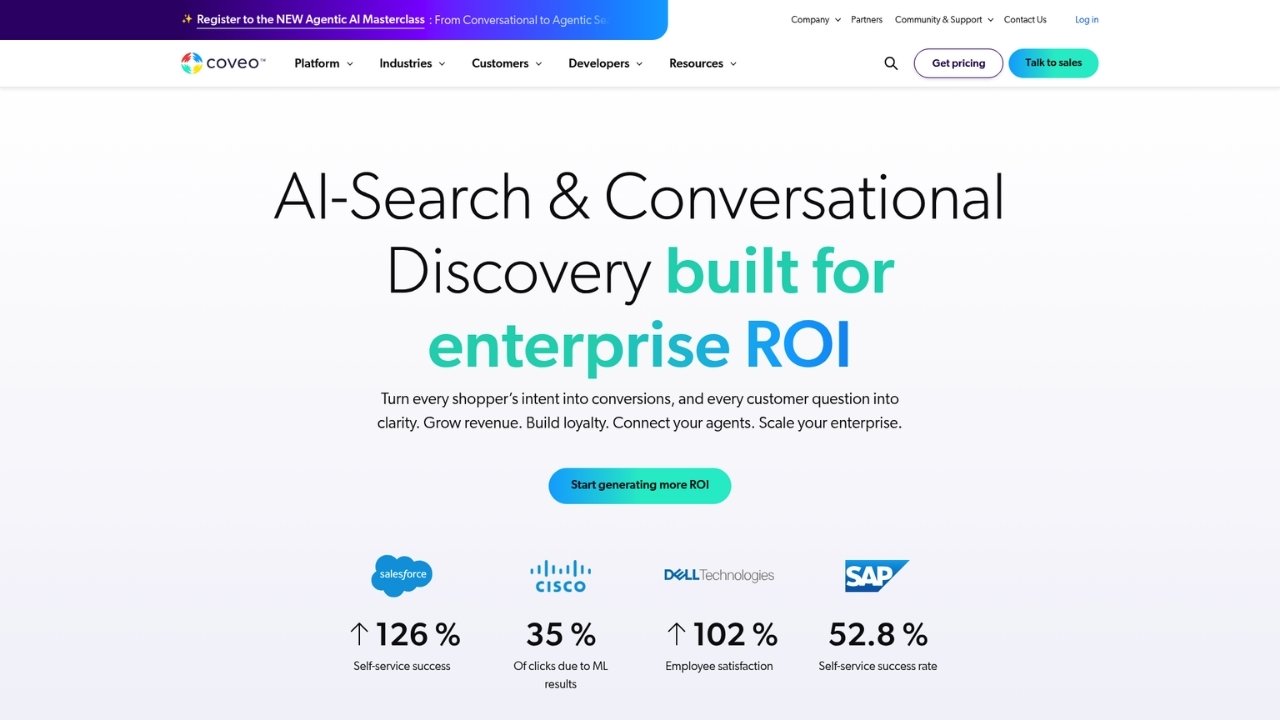
Coveo positions itself as an enterprise AI relevance platform rather than just a search engine.
With a 4.5/5 rating on Gartner and features like generative answering, it's designed for organizations that need sophisticated, AI-powered search experiences.
One Gartner reviewer shared: "Working with Coveo has been a very positive experience.
The implementation done by our external implementation partner was overall smooth and well supported by their professional services team.
The product is robust, simple to operate as a business user, with good embedded analytics."
Key features:
- Generative AI answering
- Unified search across multiple content sources
- Advanced personalization and recommendations
- In-product experience embedding
- Comprehensive merchandising controls
- Machine learning-powered relevance
Pricing: Custom pricing based on your requirements. You'll need to contact sales for a quote.
Best for: Enterprises with complex ecosystems that need AI-powered search across multiple data sources. It's particularly strong for e-commerce and knowledge management use cases.
Pros: Advanced AI capabilities, excellent support, robust analytics, strong enterprise features, unified search across sources.
Cons: Expensive for smaller teams, learning curve for implementation, may be overkill for simple search needs.
6. Klevu
Klevu focuses specifically on e-commerce search, with deep integrations for Shopify, BigCommerce, Magento, and other major platforms.
If you're running an online store and want search that understands product catalogs, it's worth considering.
Key features:
- Natural language processing for search queries
- Typo tolerance and synonym handling
- AI-powered product recommendations
- Faceted navigation
- Multi-language support
- Visual search capabilities
Pricing: Custom pricing based on catalog size and traffic. They don't publish standard rates, so you'll need to request a quote.
Best for: E-commerce businesses that want search optimized specifically for product discovery. The Shopify integration is particularly well-regarded.
Pros: E-commerce focused, easy integration with major platforms, good multi-language support, strong product discovery features.
Cons: Limited use cases outside e-commerce, pricing not transparent, may lack flexibility for non-retail applications.
7. Qdrant

Qdrant takes a different approach, positioning itself as a high-performance vector database rather than a traditional text search engine.
With 28,762 GitHub stars and a Rust-based architecture, it's built for AI applications that need to search by semantic meaning rather than just keywords.
Key features:
- Handles billions of vectors
- GPU acceleration for faster processing
- Dynamic filtering on vector searches
- Recommendation system APIs
- Retrieval Augmented Generation (RAG) support
- Built-in compression for memory efficiency
Pricing: Open-source is free. Qdrant Cloud offers a free tier (1GB cluster) with usage-based pricing beyond that.
Best for: Developers building AI applications, recommendation systems, or semantic search experiences. If you're working with embeddings from language models, Qdrant is purpose-built for that.
Pros: Extremely fast vector search, excellent documentation, scalable to billions of vectors, flexible deployment options, strong for AI/ML use cases.
Cons: Specialized for vector search (not traditional text search), initial learning curve, can be resource intensive for small use cases.
How to choose the right Algolia alternative
With seven solid options, how do you pick? Here's a decision framework based on your specific situation.
For developers who want simplicity: Start with Typesense or Meilisearch.
Both offer Algolia-like developer experiences with easier setup and more predictable pricing. Typesense edges ahead on raw speed; Meilisearch offers more modern AI features.
For enterprises with complex needs: Elasticsearch remains the gold standard for scale and flexibility.
If licensing is a concern, OpenSearch provides similar capabilities with fully open-source licensing. For AI-heavy applications, Coveo offers the most sophisticated enterprise features.
For e-commerce stores: Klevu is purpose-built for product search, though Typesense has become increasingly popular among Shopify merchants looking for more control.
For AI/ML applications: Qdrant is purpose-built for vector search and embeddings. Typesense and Meilisearch also offer vector capabilities if you want a hybrid solution.
Key criteria to evaluate:
- Hosting preference: Do you want self-hosted (full control, lower long-term costs) or managed (less operational overhead)?
- Pricing model: Per-query pricing (Algolia's model) vs. fixed infrastructure costs (most open-source options)
- Learning curve: How much time can your team invest in setup and optimization?
- Ecosystem: Do you need specific integrations that only certain platforms support?
Making the switch from Algolia
If you're currently using Algolia and considering a move, here's what to expect.
Migration considerations:
- Data export: Algolia lets you export your indices as JSON. Most alternatives can import this format directly.
- API differences: Each search engine has its own query syntax. Plan for some code changes, though the concepts (faceting, filtering, ranking) are largely the same.
- Relevance tuning: You'll need to re-tune relevance settings. What worked in Algolia may not translate directly.
- Testing strategy: Run both systems in parallel initially. Compare search results for the same queries to ensure quality doesn't drop.
Timeline expectations: Most migrations take 2-4 weeks for a production deployment, depending on your index complexity and query volume. The actual data migration is usually the easy part; tuning relevance to match or exceed Algolia's quality takes more time.
Tips for a smooth transition:
- Start with a non-critical index to learn the new platform
- Use A/B testing to compare search quality between systems
- Monitor query performance and user behavior metrics closely
- Keep Algolia as a fallback until you're confident in the new setup
Get started with better site search today
Choosing the right Algolia alternative comes down to understanding your priorities.
If cost predictability matters most, open-source options like Typesense or Meilisearch offer compelling value.
If you need enterprise-scale features, Elasticsearch or Coveo are proven at that level. For AI-powered search, Qdrant and the newer versions of Typesense and Meilisearch have you covered.
The best part? Most of these alternatives offer free tiers or open-source versions, so you can test before committing.
Set up a proof-of-concept with your actual data and see how each performs with your specific use case.
And while you're optimizing your site's search experience, consider what other customer touchpoints could benefit from AI automation.
Ringly.io offers AI phone support that handles customer calls 24/7, answering questions, looking up orders, and processing returns, just like a great search experience, it ensures your customers always find what they need.
Frequently Asked Questions
What are the best open-source Algolia alternatives?
The top open-source alternatives are Typesense, Meilisearch, Elasticsearch, and OpenSearch. Typesense and Meilisearch are easiest to set up, while Elasticsearch offers the most scalability. OpenSearch is ideal if you want Elasticsearch features with fully open-source licensing.
Which Algolia alternatives work best for e-commerce?
For e-commerce specifically, Klevu is purpose-built for product search with strong Shopify integration. Typesense is also popular among online stores for its speed and faceting capabilities. Meilisearch works well for smaller catalogs.
Are Algolia alternatives cheaper than Algolia itself?
Most alternatives offer more predictable pricing. Open-source options are free (you pay only for infrastructure), while managed services like Meilisearch Cloud start at $30/month compared to Algolia's usage-based model that can escalate quickly at scale.
Can I migrate from Algolia without losing search quality?
Yes, but expect a tuning period. While data migration is straightforward, you'll need to reconfigure relevance settings. Plan for 2-4 weeks of parallel testing to ensure the new system matches or exceeds Algolia's search quality.
Which Algolia alternative is easiest to set up?
Typesense and Meilisearch are both designed for easy setup. Typesense runs as a single binary with no dependencies, while Meilisearch offers smart presets that work well out of the box. Both can be deployed in minutes compared to Elasticsearch's more complex configuration.
Do any Algolia alternatives offer AI-powered search?
Yes, most modern alternatives include AI capabilities. Meilisearch offers AI embedders for semantic search, Typesense has built-in vector and semantic search, and Qdrant is specifically designed for AI applications with embeddings. Coveo leads on enterprise AI features.
What should I consider when choosing between self-hosted and managed search?
Self-hosted gives you full control and lower long-term costs but requires operational expertise. Managed services cost more but handle infrastructure, scaling, and maintenance for you. Choose self-hosted if you have DevOps capacity; managed if you want to focus on your product.
Also read: