

JivoChat has been a popular choice for live chat since 2012, but it's not the right fit for every business.
Maybe you're hitting limits on customization, finding the pricing unpredictable as you scale, or realizing you need more than just chat (like phone support or advanced AI).
The good news? There's no shortage of alternatives. The challenge is picking the right one.
This guide covers 7 JivoChat alternatives that span different use cases: AI phone support for e-commerce stores, free live chat for bootstrapped teams, enterprise-grade suites, and everything in between.
Each one was evaluated based on real-world factors like pricing transparency, ease of setup, automation capabilities, and scalability.
Editor’s note: Want to hear some sample AI support calls made for your Shopify store?
- Just paste your store URL
- Hear sample calls for your store (no email required)
- Listen to demo calls for my store
Let's break it down.
| Platform | Pricing | 14-day free trial | Best For | Key Features |
|---|---|---|---|---|
| Ringly.io | From $99 a month (50 conversations included) | Free to try | E-commerce phone support | AI phone agent for Shopify |
| Tidio | $0 | Yes | AI chat automation | 67% AI resolution rate |
| LiveChat | $20/agent/mo | No | Professional live chat | 200+ integrations |
| Crisp | $0 | Yes | Simple multichannel | Co-browsing, flat pricing |
| Zendesk | $55/agent/mo | Limited | Enterprise support | Complete support ecosystem |
| Tawk.to | $0 | Yes (unlimited) | Budget-conscious | Completely free |
| Intercom | $74/mo | No | Proactive engagement | AI-first platform |
1. Ringly.io
Best for: AI phone support for e-commerce stores

Most customer support tools focus on chat. Ringly.io takes a different approach: AI-powered phone support.
The product is the AI, an AI phone agent that handles inbound calls 24/7. It answers questions, looks up orders, processes returns and exchanges, and only escalates to humans when necessary. For Shopify stores, the AI pulls order data directly from your store so it can give customers real-time updates without any manual lookup.
Here's what makes it stand out:
- Up to 90% resolution rate: The AI resolves most calls without human intervention
- quick setup: No coding required. Connect your Shopify store, pick a phone number, and you're live
- 30 languages supported: Handle global customers without hiring multilingual agents
- Smart escalation: Transfers to humans when callers are frustrated or when the issue is outside the AI's training
| Plan | Monthly Price | Included | Key Features |
|---|---|---|---|
| Pay per call | $99 a month | 50 conversations, then $1.99 each | Seth on your support line 24/7; spam, hang-ups and wrong numbers are free |
Ringly.io is free to try, with full features, and comes with a 65% resolution guarantee: if Seth resolves under 65% of your calls in a month, that month comes back as credit (after 90 days on Pay per call).
The bottom line: If you're an e-commerce store dealing with phone calls (order tracking, returns, product questions), Ringly.io automates what chatbots can't touch. It's not a chat tool, and that's the point.
2. Tidio
Best for: AI-powered live chat with chatbots

Tidio combines live chat, help desk, and AI automation in one platform. The standout feature is Lyro, an AI agent that handles up to 67% of customer questions automatically.
Lyro isn't just a basic chatbot. It integrates with your Shopify store to check order status, process returns, and answer product questions using your actual data. When it can't handle something, it smoothly hands off to human agents with full context.
Key features include:
- Unified inbox: All conversations (chat, email, Messenger, WhatsApp, Instagram) in one place
- Flows: No-code automation for lead generation and sales follow-up
- Copilot: AI reply assistant that suggests responses for human agents
- 67% resolution guarantee: Tidio guarantees at least 50% resolution rate or your money back
| Plan | Monthly Price | Key Limits |
|---|---|---|
| Free | $0 | 50 billable conversations, 100 Flows visitors, 50 Lyro conversations (one-off) |
| Starter | $24.17/mo | 100 billable conversations, 50 Lyro conversations |
| Growth | $49.17/mo | From 250 billable conversations, advanced analytics |
| Plus | $749/mo | Custom limits, departments, OpenAPI, dedicated success manager |
| Premium | Custom | From 3,000 Lyro conversations, guaranteed 50% resolution rate |
Lyro AI starts at $32.50/mo as an add-on. The free plan is genuinely usable for small stores testing the waters.
The bottom line: Tidio is a solid middle ground. More AI capability than basic chat tools, more affordable than enterprise suites, and the modular pricing lets you pay only for what you need.
3. LiveChat
Best for: Professional live chat with extensive integrations

LiveChat has been around since 2002, and it shows in the depth of the platform. With 200+ integrations and a 4.6/5 rating on Capterra, it's the go-to choice for teams that need their chat tool to connect with everything else they use.
The platform covers the basics well: real-time messaging, customizable chat widgets, ticketing, and visitor monitoring. But where it really shines is the ecosystem. Whether you use Salesforce, HubSpot, Shopify, or a custom CRM, there's probably an integration ready to go.
Notable features:
- Proactive chat: Trigger messages based on visitor behavior (pages viewed, time on site, cart value)
- Video calls: Built-in video chat for complex issues that need face-to-face resolution
- AI chatbots: Handle routine inquiries automatically
- Mobile apps: iOS and Android apps for agents on the go
| Plan | Monthly Price | Key Features |
|---|---|---|
| Starter | $20/agent/mo | Basic live chat, 60-day chat history |
| Team | $41/agent/mo | Full widget customization, unlimited history |
| Business | $59/agent/mo | Advanced reporting, staffing prediction |
| Enterprise | Custom | Dedicated account manager, security features |
| 14-day free trial available. | ||
The bottom line: If you need a reliable, professional live chat tool that plays nice with your existing stack, LiveChat is a safe bet. Just watch the per-agent pricing if you have a large team.
4. Crisp
Best for: Streamlined multichannel messaging

Crisp is what you get when you strip customer messaging down to the essentials and polish what's left. It's used by over 500,000 brands and focuses on being user-friendly without the feature bloat that plagues enterprise tools.
The shared inbox brings together live chat, email, Messenger, WhatsApp, and Instagram in one clean interface. But the standout feature is co-browsing: you can view and control visitor screens without asking them to install anything. That's huge for troubleshooting complex issues.
What you get:
- Co-browsing: See and control visitor screens in real-time
- Chatbot: AI chatbot included in higher tiers
- Knowledge base: Built-in help center for self-service
- CRM: Basic customer relationship management included
- Flat-rate pricing: No per-agent fees, just straightforward monthly costs
| Plan | Monthly Price | Key Features |
|---|---|---|
| Free | $0 | Basic live chat, 2 seats, limited history |
| Pro | $25/mo | Unlimited history, 4 seats, integrations |
| Unlimited | $95/mo | 20 seats, co-browsing, video calls, chatbot |
Annual billing gets you a discount.
The bottom line: Crisp is the anti-enterprise tool. Fair pricing, clean interface, and the co-browsing feature alone is worth it for support teams dealing with technical issues.
5. Zendesk
Best for: Enterprise customer support ecosystem

Zendesk is the 800-pound gorilla of customer support. It's not just a chat tool; it's a complete support platform with ticketing, knowledge base, AI agents, voice, and workforce management. If you're running a large support operation, you've probably already looked at Zendesk.
The trade-off is complexity and cost. Zendesk takes time to set up properly, and the per-agent pricing adds up fast. But for teams that need enterprise-grade features, there's not much else that compares.
Key capabilities:
- AI-powered routing: Automatically route tickets to the right agent based on skills and workload
- Workforce management: Built-in tools for scheduling and staffing
- Advanced customization: Highly customizable workflows, triggers, and automations
- Mobile SDK: Integrate chat directly into your mobile apps
| Plan | Monthly Price | Key Features |
|---|---|---|
| Suite Team | $55/agent/mo | Ticketing, messaging, help center |
| Suite Growth | $89/agent/mo | Automation, AI agents, custom workflows |
| Suite Professional | $115/agent/mo | Advanced analytics, custom roles |
| Suite Enterprise | Custom | Advanced security, sandbox, dedicated support |
Free plan available with basic functionality.
The bottom line: Zendesk is overkill for small teams, but if you're managing a complex support operation with dozens of agents, it's the standard by which others are measured.
6. Tawk.to
Best for: Free live chat with unlimited agents
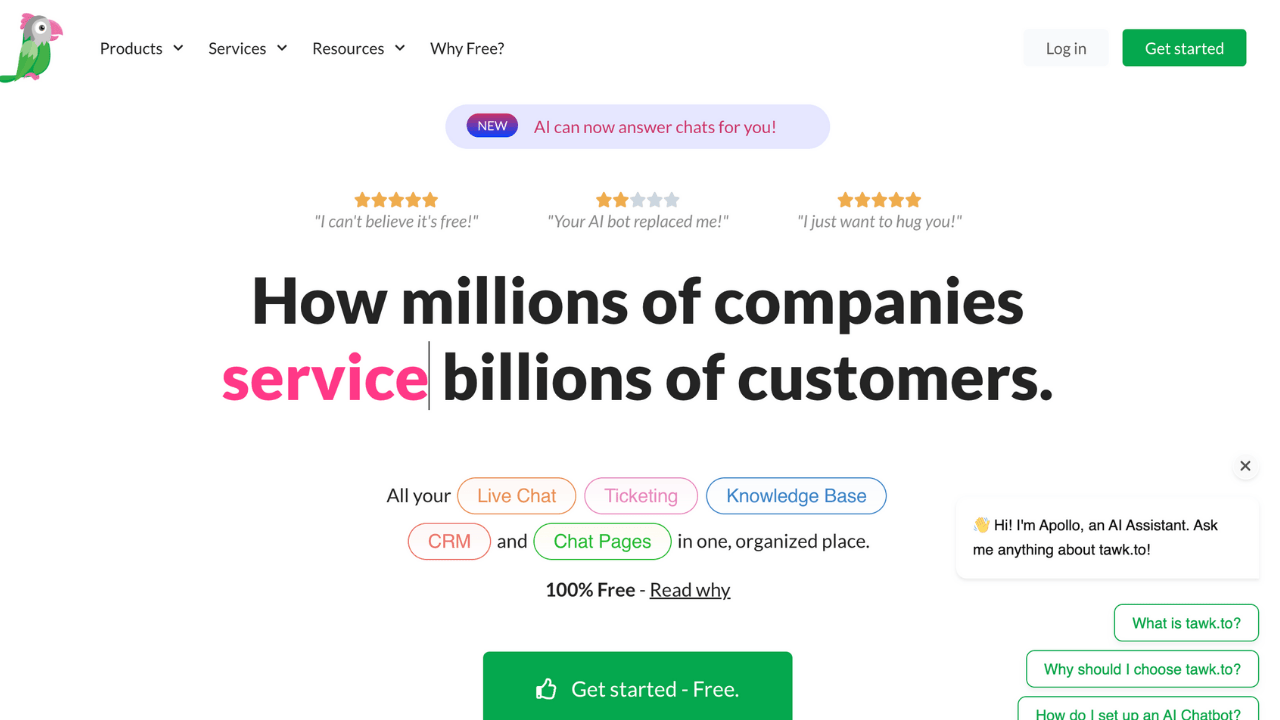
Tawk.to is completely free. Not "free trial" free. Not "free up to X agents" free. Actually free, forever, with unlimited agents, unlimited chats, and unlimited sites.
So what's the catch? There really isn't one, unless you need premium features like removing the Tawk.to branding ($19/mo) or adding video/voice calls ($29/mo). The core live chat functionality costs nothing.
Features included for free:
- Unlimited everything: Agents, chats, sites, history
- Ticketing system: Convert chats into trackable tickets
- CRM: Basic customer management
- Knowledge base: Self-service help center
- Real-time monitoring: Track visitor activity and engagement
- Mobile apps: iOS, Android, Windows, and Mac apps
- Screen sharing: Share screens during chats
| Plan | Price | Key Features |
|---|---|---|
| Free | $0 | Unlimited agents, unlimited chats, all features |
Add-ons:
- Remove branding: $19/month
- Video + voice: $29/month
- Hire chat agents: Starting at $1/hour
The bottom line: If budget is your primary constraint, Tawk.to is a no-brainer. It handles the basics well enough that many businesses never need to upgrade. Just be prepared for the Tawk.to branding on the 14-day free trial.
7. Intercom
Best for: Proactive customer engagement and onboarding
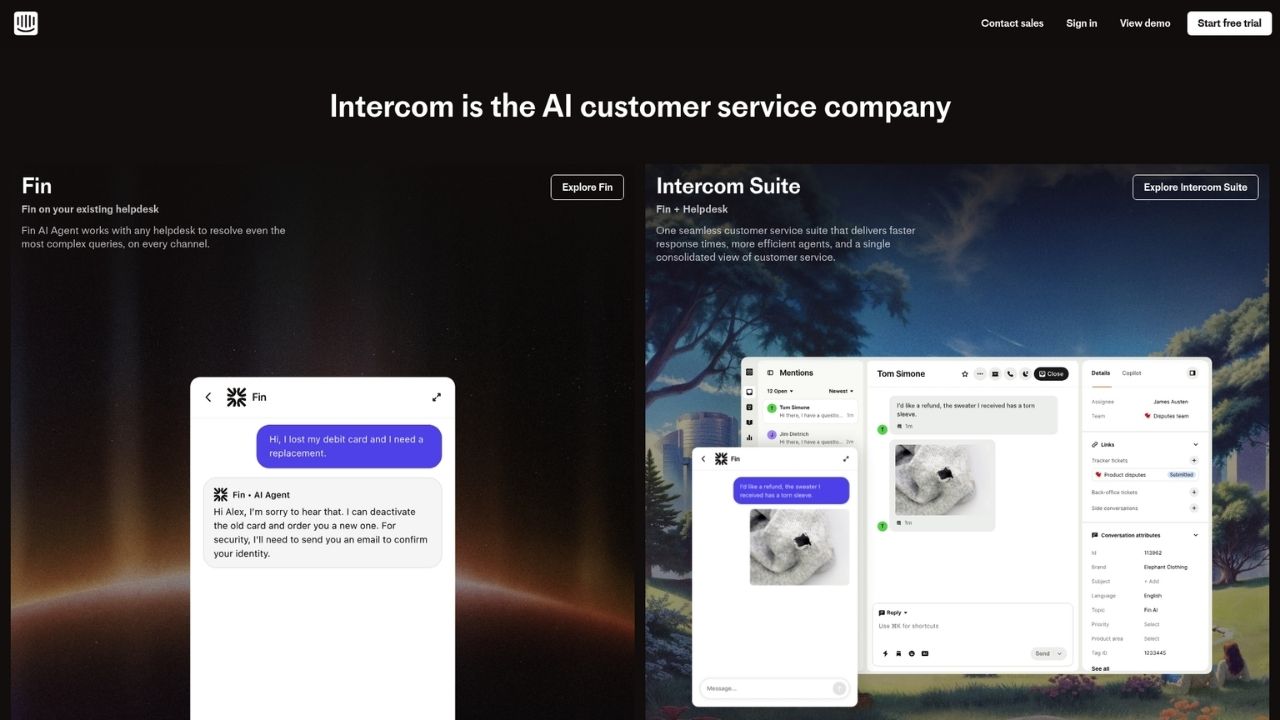
Intercom was one of the first platforms to treat customer messaging as a continuous conversation rather than just support tickets. It's built around proactive engagement: reaching customers before they ask for help, guiding them through onboarding, and nurturing them throughout their lifecycle.
The AI-first approach means automation is woven throughout, not bolted on. You can trigger messages based on behavior, send targeted product tours, and use AI chatbots that actually understand context.
Key features:
- Proactive messaging: Behavior-based targeted messages
- In-app messaging: Communicate inside your product where customers are already engaged
- Product tours: Guide users through features step-by-step
- AI chatbots: Customizable bots that handle complex conversations
- Surveys: Capture feedback at key moments
| Plan | Monthly Price | Key Features |
|---|---|---|
| Essential | $74/mo (3 seats) | Shared inbox, basic automation, $29/additional seat |
| Advanced | $139/mo (3 seats) | Advanced automation, AI features, $49/additional seat |
| Expert | $229/mo (3 seats) | Premium features, dedicated support, $79/additional seat |
14-day free trial available.
The bottom line: Intercom is expensive and the pricing can be confusing. But for SaaS companies focused on customer onboarding and proactive engagement, it's hard to beat. Just make sure you'll actually use the advanced features before paying the premium.
Which JivoChat Alternative Should You Choose?
The right choice depends on what you're actually trying to solve.
Choose Ringly.io if: You run an e-commerce store and want to automate phone support. The AI handles order tracking, returns, and FAQs while escalating complex issues to your team. The 73% resolution rate means most calls never reach a human.
Choose Tidio if: You want affordable AI chat automation with solid e-commerce integration. The 67% resolution rate and modular pricing make it a safe middle ground.
Choose LiveChat if: You need extensive integrations and professional-grade live chat. The 200+ app ecosystem means it'll work with almost anything in your stack.
Choose Crisp if: You want simple, fair-priced multichannel messaging. The co-browsing feature is genuinely useful for technical support.
Choose Zendesk if: You're an enterprise needing a complete support ecosystem. Just be prepared for the complexity and cost.
Choose Tawk.to if: Budget is your primary concern. It's completely free and handles the basics well.
Choose Intercom if: You need proactive engagement and customer onboarding. The AI-first approach and in-app messaging are powerful for SaaS companies.
Getting Started with AI-Powered Customer Support
Chat and phone support serve different purposes. Chat is great for quick questions and multitasking agents. Phone support converts better, handles complex issues faster, and feels more personal to customers.
For e-commerce stores, the combination matters. A customer might browse on chat, but when they're ready to buy or have a problem with an order, they want to talk to someone. That's where AI phone agents like the AI change the game: you get 24/7 coverage without hiring a night shift.
If you're curious how AI phone support would work for your store, try Ringly.io for free. The 14-day trial includes full features, and you only pay once the AI proves it can handle your call volume.
Frequently Asked Questions
What are the best JivoChat alternatives for small businesses?
For small businesses, Tidio and Crisp offer the best balance of features and affordability. Both have free plans to get started. Tawk.to is completely free if budget is tight. If you need phone support specifically, Ringly.io's Pay per call plan starts at $99 a month, which suits smaller stores.
Which JivoChat alternative offers the best AI automation?
Tidio's Lyro AI resolves up to 67% of conversations, with a money-back guarantee if it doesn't hit 50%. Ringly.io's The AI resolves up to 90% of phone calls without human intervention. Intercom is also AI-first but at a higher price point.
Are there any completely free JivoChat alternatives?
Tawk.to is completely free forever with unlimited agents and chats. Tidio and Crisp both offer free plans with limitations. The free options work well for startups and small teams testing the waters.
What JivoChat alternative is best for e-commerce stores?
For chat-based support, Tidio has strong Shopify integration. For phone support, Ringly.io is built specifically for e-commerce with native Shopify connectivity, order lookup, and returns handling. Both pull real-time data from your store.
Which alternative should I choose if I need phone support, not just chat?
Ringly.io is the only option on this list focused on AI phone support. While other tools like Zendesk offer voice modules, Ringly.io's the AI is purpose-built for handling inbound calls, order tracking, and returns automation for e-commerce stores.
How do JivoChat alternatives compare for enterprise teams?
Zendesk is the standard for enterprise with comprehensive features, workforce management, and advanced customization. Intercom works well for SaaS enterprises focused on proactive engagement. LiveChat can scale but gets expensive with many agents.
What should I look for when evaluating JivoChat alternatives?
Focus on: (1) Pricing transparency and how costs scale with your team, (2) Integration with your existing tools (especially your e-commerce platform), (3) AI automation capabilities and resolution rates, (4) Setup complexity and time-to-value, and (5) Whether you need chat, phone, or both.