
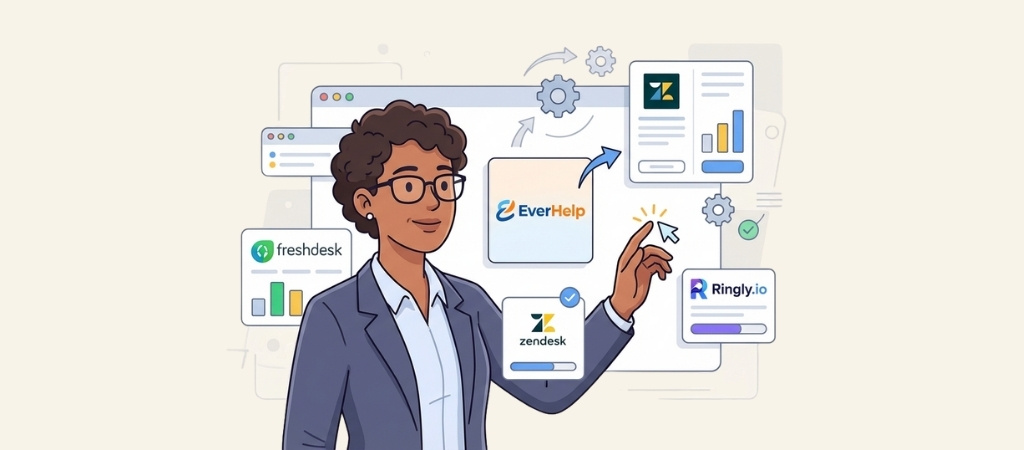
EverHelp has built a reputation for providing 24/7 outsourced customer support with dedicated teams.
But outsourcing isn't the right fit for every business. Some teams want more control over their support experience.
Others need AI capabilities that EverHelp doesn't offer. And for many, the pricing model simply doesn't scale.
If you're evaluating alternatives, you're in the right place. We researched and compared seven customer support platforms that offer different approaches to handling customer inquiries.
Whether you want to bring support in-house, add AI automation, or find a more cost-effective solution, this list covers the best options available in 2026.
Editor’s note: Want to hear some sample AI support calls made for your Shopify store?
- Just paste your store URL
- Get sample calls in under 20 seconds (no email required)
- Listen to demo calls for my store
What to look for in an Ever Help alternative
Before diving into the options, let's establish what actually matters when choosing a support platform.
Pricing transparency tops the list. Some tools advertise low starting prices but hide essential features behind expensive tiers. Look for clear pricing that scales predictably as your team grows.
AI and automation capabilities have become table stakes. The best platforms now offer AI that can resolve tickets without human intervention, suggest responses to agents, and route inquiries intelligently.
Multichannel support means handling email, chat, phone, and social from one inbox. Customers expect to reach you on their preferred channel, and your team needs a unified view of every conversation.
Integration ecosystem determines how well the tool fits your existing workflow. Native integrations with your CRM, ecommerce platform, and communication tools save hours of manual work.
Setup complexity varies dramatically. Some platforms require weeks of implementation and dedicated admins. Others let you go live in minutes. Be realistic about your team's technical capacity and timeline.
For ecommerce businesses specifically, Ringly.io offers an interesting angle: AI phone support that integrates directly with Shopify and resolves around 70% of calls without human intervention.
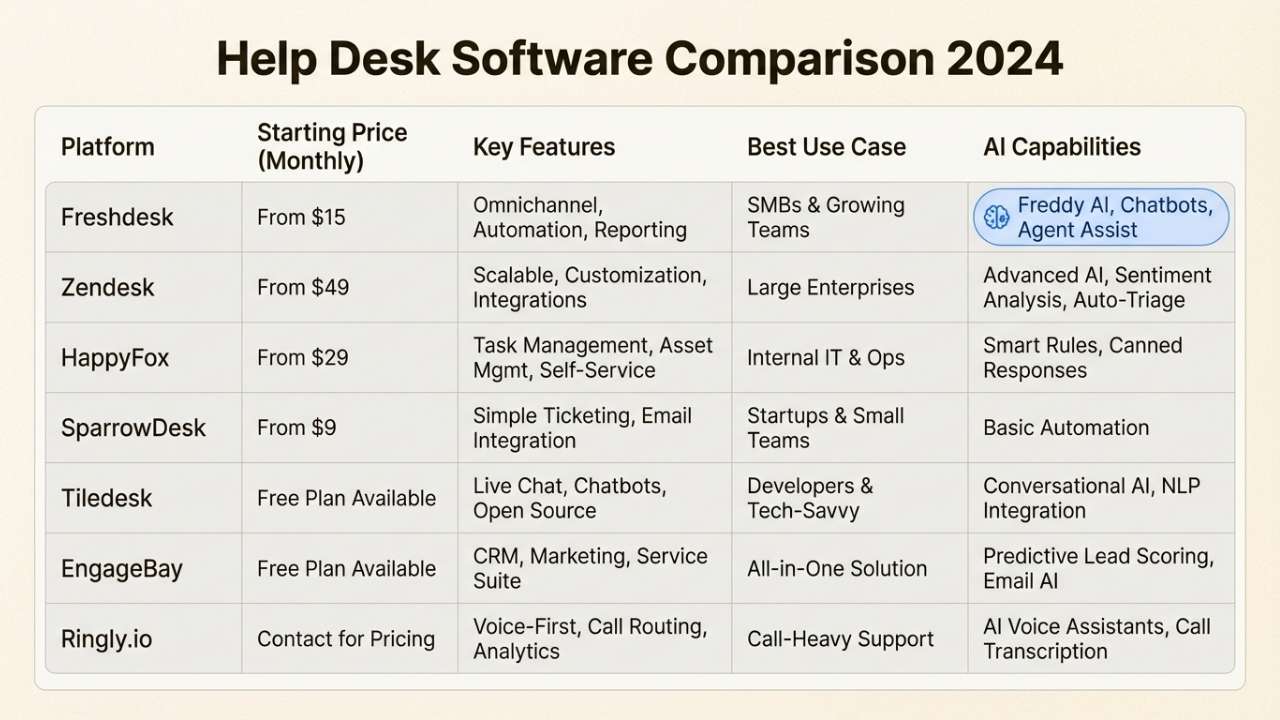
1. Freshdesk

Freshdesk has become the go-to choice for small to mid-sized businesses that want a proven platform without enterprise complexity.
The interface feels intuitive from day one, which matters when you're training new team members.
The platform covers all the basics: ticketing, live chat, knowledge base, and automation workflows.
The free tier supports up to 10 agents with email ticketing and a knowledge base, making it genuinely useful for startups testing the waters.
Paid plans start at $19 per agent per month. At that tier, you get automation rules, collision detection, and custom ticket fields.
The $49 Growth plan adds time tracking, SLA management, and custom apps. Enterprise features like IP whitelisting and advanced analytics require the $79 Pro plan or $129 Enterprise plan.
Freshdesk's AI assistant, Freddy, suggests ticket responses and can automate routine tasks. It's not as sophisticated as some newer AI-first platforms, but it handles the essentials well.
Pros:
- Intuitive interface with minimal learning curve
- Strong free tier for small teams
- Extensive integration marketplace (500+ apps)
- Reliable uptime and established infrastructure
Cons:
- Advanced features require expensive tiers
- Can get costly as you add agents
- Reporting features feel dated compared to newer tools
Freshdesk works best for teams that want a reliable, no-surprises platform.
If you need phone support, that requires a separate add-on, which pushes the total cost higher.
2. Zendesk Suite

Zendesk has dominated the customer support space for over a decade, and for good reason.
The platform handles everything from simple ticket tracking to complex enterprise workflows with thousands of agents.
The Suite plan starts at $55 per agent per month, which includes ticketing, chat, voice, and knowledge base.
The $89 Professional plan adds custom dashboards, advanced routing, and light agents. Enterprise plans at $115 and $169 per agent unlock advanced AI, custom objects, and dedicated support.
What sets Zendesk apart is the depth of customization. You can build complex workflows, create custom apps, and integrate with virtually any business system.
The app marketplace contains over 1,000 integrations.
Zendesk AI can automatically classify tickets, suggest responses, and route conversations to the right team.
The AI capabilities have improved significantly in recent releases, though they still require some configuration to work well.
Pros:
- Enterprise-grade reliability and scale
- Massive integration ecosystem
- Highly customizable workflows
- Strong analytics and reporting
Cons:
- Higher price point than competitors
- Steep learning curve for advanced features
- Setup can take weeks for complex configurations
Zendesk makes sense for mid-market and enterprise teams that need advanced customization and can justify the premium pricing. Smaller teams often find it overkill.
3. HappyFox

HappyFox positions itself as the simpler alternative to Zendesk.
The platform strips away complexity while keeping the features that matter for most support teams.
Pricing starts at $14.99 per agent per month for the Mighty plan, which includes ticketing, a self-service portal, and basic automation.
The $24.99 Fantastic plan adds asset management, canned actions, and custom fields.
Enterprise features like SLA management and advanced reporting require the $49.99 Enterprise plan or $69.99 Enterprise Plus.
The interface feels clean and modern. Setting up a basic help desk takes minutes, not days.
The knowledge base builder is particularly well-designed, making it easy to create self-service resources that actually help customers.
HappyFox includes smart rules for automation, but the AI capabilities are more limited than competitors.
You won't find AI-generated responses or advanced natural language processing here.
Pros:
- Easy setup and intuitive interface
- Good value for the feature set
- Strong knowledge base capabilities
- Clean, modern design
Cons:
- Limited advanced automation
- Fewer native integrations than Zendesk or Freshdesk
- AI capabilities lag behind newer platforms
HappyFox fits teams that want a capable help desk without the complexity of enterprise platforms. It's particularly popular among small businesses and teams transitioning from email-based support.
4. SparrowDesk
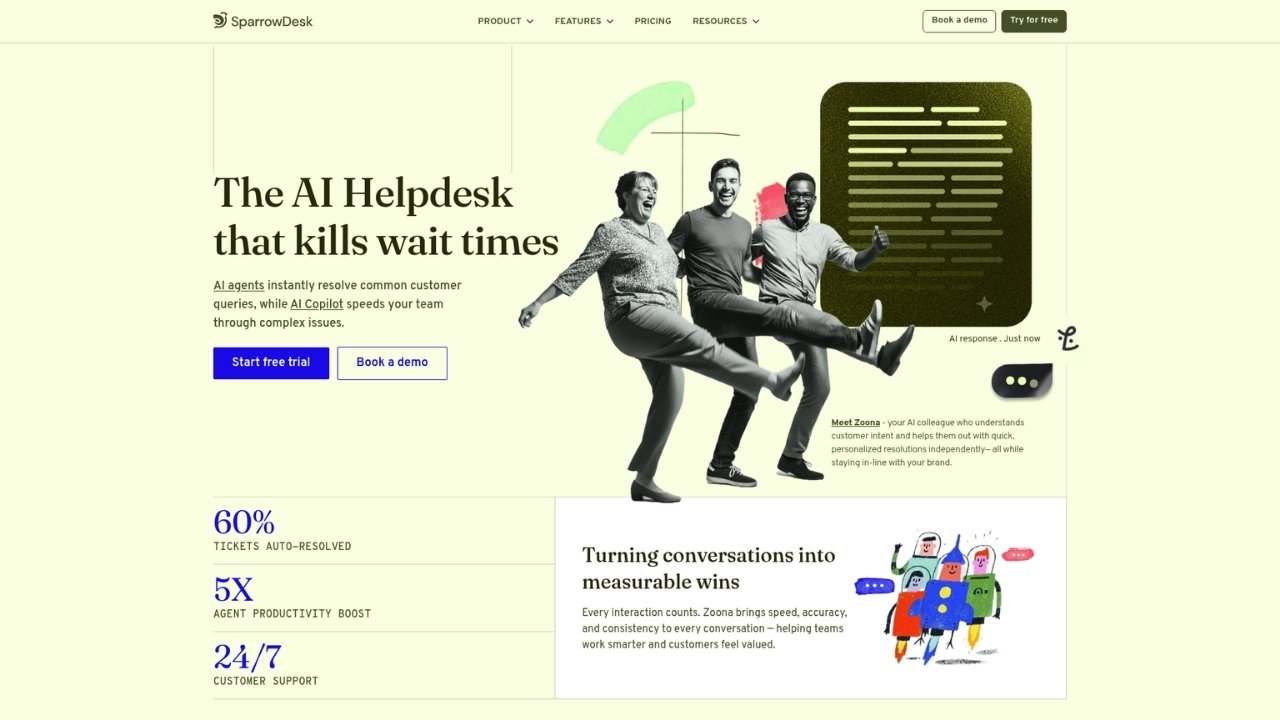
SparrowDesk represents the new wave of AI-first customer support platforms.
Instead of bolting AI onto existing software, they built the entire experience around intelligent automation.
The platform centers on Luna, an AI Agent that automatically resolves up to 60% of incoming tickets without human intervention. Luna handles routine inquiries, looks up information, and processes common requests.
When a ticket needs human attention, Luna Copilot assists agents with suggested responses, ticket summaries, and quick knowledge access.
Pricing starts at $16 per seat per month, making it one of the more affordable options on this list.
The platform includes a unified inbox for email and live chat, self-service portals, and a no-code workflow builder.
SparrowDesk integrates conversations from multiple channels into a single workspace, preserving context across every interaction.
Managers get real-time dashboards and custom reports to track performance metrics.
Pros:
- Strong AI resolution rates (60% auto-resolved)
- Affordable pricing compared to competitors
- Modern, clean interface
- No-code workflow automation
Cons:
- Newer player with smaller ecosystem
- Limited enterprise case studies
- Fewer third-party integrations than established platforms
SparrowDesk suits teams that want AI-powered support without paying enterprise prices.
The focus on automation makes it particularly attractive for businesses looking to scale support without proportionally scaling headcount.
5. Tiledesk
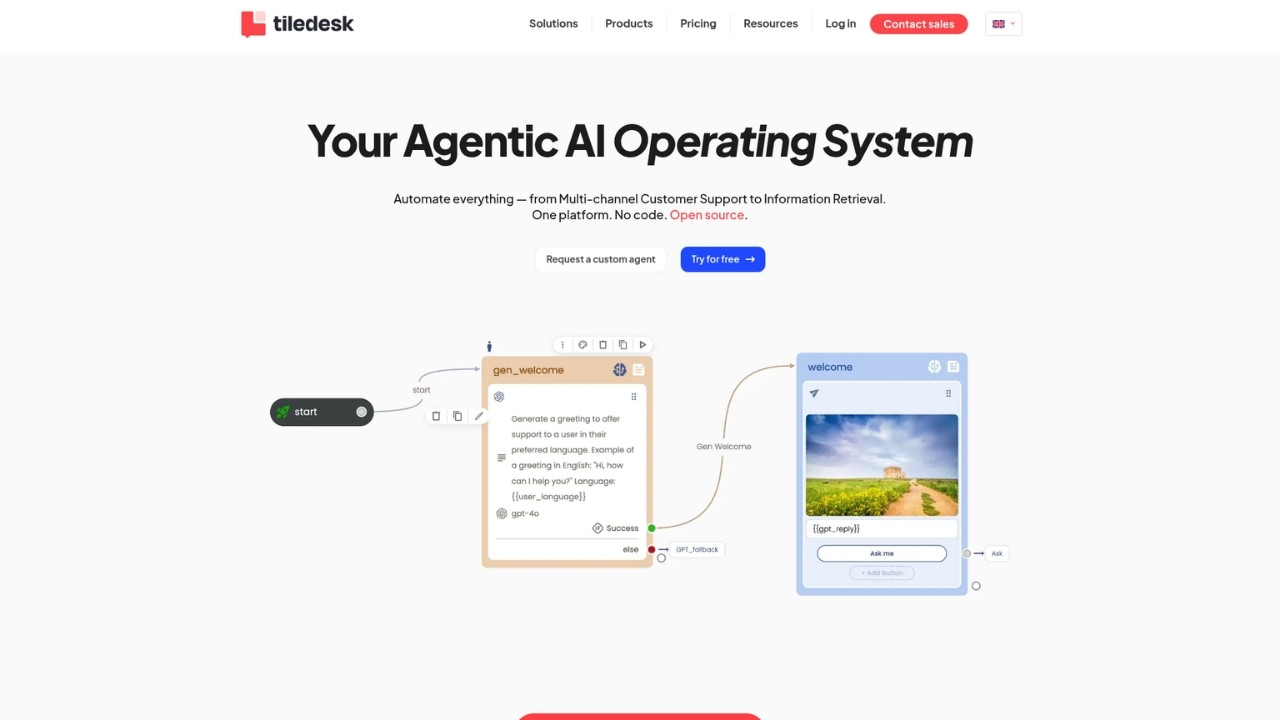
Tiledesk takes a different approach as an open-source messaging platform.
This gives technical teams full control over their support infrastructure while still providing modern features like AI chatbots and multichannel support.
The platform offers a free tier with basic live chat and ticketing features.
Paid plans start at €25 per month, which includes unlimited conversations, advanced chatbots, and priority support. Higher tiers add features like custom branding, advanced analytics, and dedicated infrastructure.
Tiledesk's Resolution Bot can handle common customer questions automatically.
The platform integrates with major AI platforms including DialogFlow and RASA, giving technical teams flexibility to build sophisticated conversational experiences.
The multichannel capabilities cover web chat, mobile apps, WhatsApp, Facebook Messenger, and Telegram.
A unified inbox brings all conversations together regardless of channel.
Pros:
- Open-source flexibility for customization
- Strong chatbot builder with AI integrations
- Good multichannel support
- Active development community
Cons:
- Requires technical knowledge for customization
- Smaller ecosystem than commercial alternatives
- Self-hosting requires infrastructure management
Tiledesk appeals to technical teams and developers who want open-source control over their support stack. Businesses without technical resources may find the setup challenging.
6. EngageBay
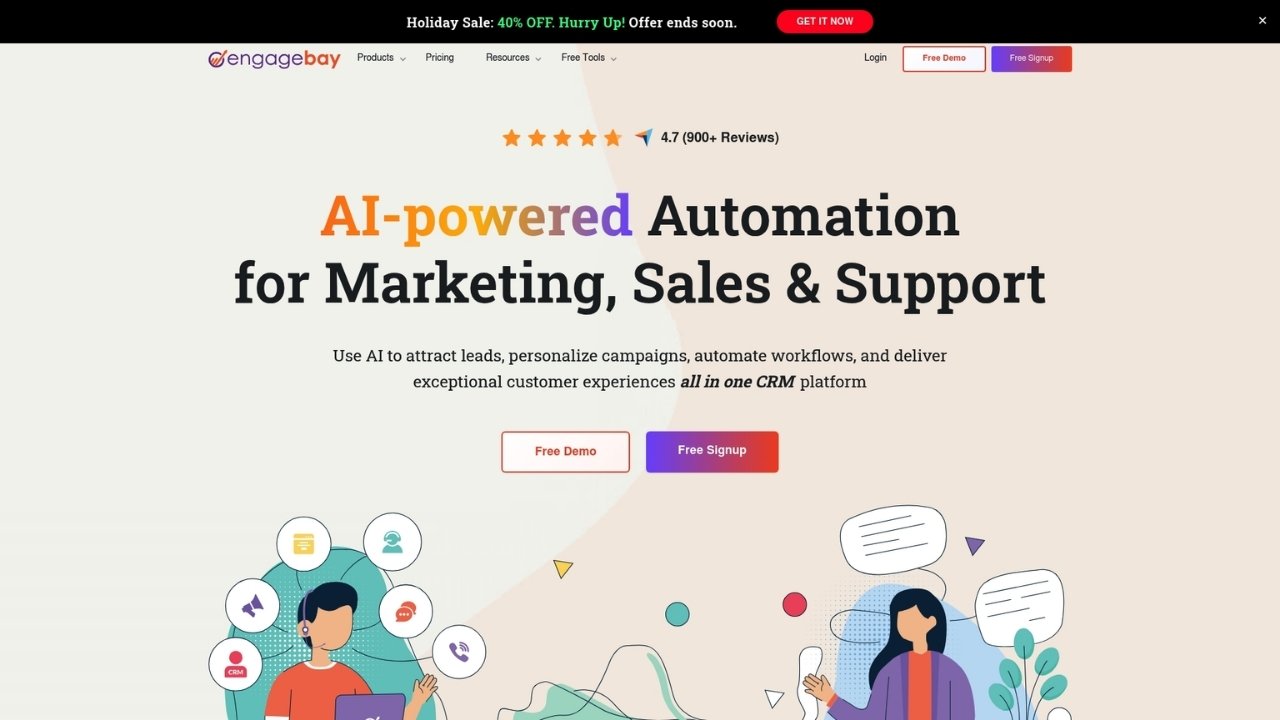
EngageBay takes an all-in-one approach, combining CRM, marketing automation, and customer support in a single platform.
For small businesses that want unified customer data across sales and support, this integration can save significant time and money.
The free plan includes CRM, help desk, and live chat for up to 15 users, making it genuinely useful for small teams.
Paid plans start at $10.79 per user per month when billed biennially, or $14.99 monthly. The $49.99 Growth plan adds marketing automation and custom reporting.
The help desk features include ticketing, canned responses, and basic automation.
While not as robust as dedicated support platforms, the integration with CRM data means agents see full customer history including sales interactions and marketing engagement.
EngageBay includes basic AI for predictive lead scoring and some automation suggestions.
The AI capabilities are less advanced than dedicated support platforms, but sufficient for routine tasks.
Pros:
- Affordable all-in-one solution
- Generous free tier
- Unified CRM and support data
- Good for small businesses consolidating tools
Cons:
- Support features less robust than dedicated help desks
- Learning curve for the all-in-one approach
- AI capabilities are basic compared to competitors
EngageBay works well for small businesses that want CRM and support in one platform. Teams with complex support needs may outgrow it as they scale.
7. Ringly.io

Ringly.io offers something unique on this list: AI phone support specifically designed for ecommerce stores.
While other platforms focus on tickets and chat, Ringly handles voice calls with an AI agent named the AI.
the AI answers calls 24/7, looks up orders, processes returns and exchanges, and escalates to human agents only when necessary.
The platform integrates directly with Shopify, pulling real-time order data to answer "where's my order" questions instantly.
Pricing starts at $349 per month for the Grow plan, which includes 250 call minutes.
The $349 Grow plan includes 1,000 minutes plus self-learning AI and deeper analytics. Enterprise plans start at $1,099 for high-volume stores.
The setup takes about three minutes: connect your Shopify store, choose a phone number, and the AI starts handling calls.
The platform supports 30 languages, making it viable for international ecommerce.
Ringly's AI resolves approximately 70-73% of calls without human intervention.
When the AI can't handle a request, the call transfers to your team with full context including the customer's order history and what was already discussed.
Pros:
- Resolves ~70-73% of calls autonomously
- quick setup with no technical knowledge needed
- Native Shopify integration
- 30 languages supported
Cons:
- Phone-only (no chat or email support)
- Ecommerce-focused (less relevant for other industries)
- Newer platform with shorter track record
Ringly.io makes sense for ecommerce businesses that receive significant phone support volume and want to automate routine calls.
The focus on voice fills a gap that most help desk platforms ignore.
How to choose the right Ever Help alternative
With seven solid options, how do you pick? Let's break it down by what matters most to your situation.
Budget-conscious teams should look at EngageBay's free tier or Tiledesk's open-source option. Both offer genuine functionality without upfront costs.
AI-first approach points toward SparrowDesk for ticket-based support or Ringly.io for phone automation. Both platforms built AI into their core rather than adding it as an afterthought.
Enterprise needs favor Zendesk or Freshdesk. Both have the scale, reliability, and integration ecosystems that large organizations require.
All-in-one solution seekers should evaluate EngageBay. The unified CRM and support data works well for small sales and support teams.
Phone support focus clearly leads to Ringly.io. While other platforms treat voice as an afterthought, Ringly built their entire product around AI phone support.
Consider your team's technical capacity too. Zendesk and Tiledesk reward technical investment with deep customization. Freshdesk, HappyFox, and SparrowDesk prioritize ease of use.
Tips for migrating from Ever Help
Switching support platforms requires planning. Here's how to make the transition smoother.
Export your existing ticket data and customer history before ending your EverHelp contract.
Most platforms offer import tools, but having raw data as backup prevents surprises.
Set up your knowledge base before going live. Self-service resources reduce ticket volume immediately and help customers adjust to the new support experience.
Train your team on new workflows during the trial period.
Don't wait until launch day to discover confusion about ticket routing or escalation rules.
Start with one channel, then expand. Launching email, chat, and phone simultaneously creates too many variables. Master one channel, then add others.
Monitor resolution rates and customer satisfaction during the transition. Expect a temporary dip as agents learn the new system.
If metrics don't recover within 30 days, investigate whether configuration issues are blocking efficiency.
Get started with AI-powered customer support
Ever Help alternatives range from $10 to $55+ per agent per month, with AI capabilities now standard across most platforms.
The right choice depends on your channels, team size, and technical requirements.
For ticket-based support, SparrowDesk offers the strongest AI automation at an affordable price point.
For established teams wanting reliability, Freshdesk and Zendesk remain safe choices. And for ecommerce businesses drowning in phone calls, Ringly.io provides a specialized solution that most competitors can't match.
If phone support is your bottleneck, try Ringly.io free for 14 days. the AI starts handling calls immediately, and you only pay once the AI resolves at least 65% of your calls.
Frequently Asked Questions
What are the best Ever Help alternatives for small businesses?
For small businesses, EngageBay offers a generous free tier that includes CRM and help desk features. Freshdesk's free plan supports up to 10 agents with core ticketing capabilities. HappyFox provides an affordable entry point at $14.99 per agent with an intuitive interface that requires minimal training.
Which Ever Help alternatives offer the strongest AI capabilities?
SparrowDesk leads with Luna AI that auto-resolves 65% of tickets, while Ringly.io's The AI handles approximately 70-73% of phone calls without human intervention. Zendesk and Freshdesk have also invested heavily in AI features, though their implementations require more configuration to achieve similar resolution rates.
Are there any free Ever Help alternatives worth considering?
Yes, several platforms offer usable free tiers. EngageBay's free plan supports up to 15 users with CRM and help desk features. Freshdesk's free tier covers 10 agents with email ticketing and knowledge base. Tiledesk offers a free plan with basic live chat and open-source flexibility for technical teams.
How do Ever Help alternatives compare for ecommerce businesses?
Ringly.io specializes in ecommerce with native Shopify integration and AI phone support. Freshdesk and Zendesk offer strong ecommerce integrations through their app marketplaces. EngageBay combines CRM and support, which benefits stores wanting unified customer data across sales and service.
What should I consider when switching from Ever Help to an alternative?
Export all ticket data and customer history before your contract ends. Set up self-service resources before launch to reduce ticket volume. Train your team during the trial period rather than after go-live. Start with one support channel, master it, then expand to additional channels. Monitor metrics closely during the first 30 days to catch any configuration issues.
Which Ever Help alternative is easiest to set up?
HappyFox and Freshdesk offer the quickest setup for traditional help desks, with most teams operational within hours. SparrowDesk emphasizes fast deployment for AI-powered support. Ringly.io claims quick setup for phone support, which is accurate if you have a Shopify store connected. Zendesk typically requires the most implementation time due to its depth of customization options.