
Most online sellers hit a wall with their current platform eventually.
Maybe the transaction fees are eating into margins. Maybe you've outgrown the basic features and need something that scales.
Or perhaps you're just tired of hitting sales caps that force expensive upgrades.
The good news? There's no shortage of sales supply alternatives in 2026.
The challenge is finding the right one for your specific situation.
Editor’s note: Want to hear some sample AI support calls made for your Shopify store?
- Just paste your store URL
- Get sample calls in under 20 seconds (no email required)
- Listen to demo calls for my store
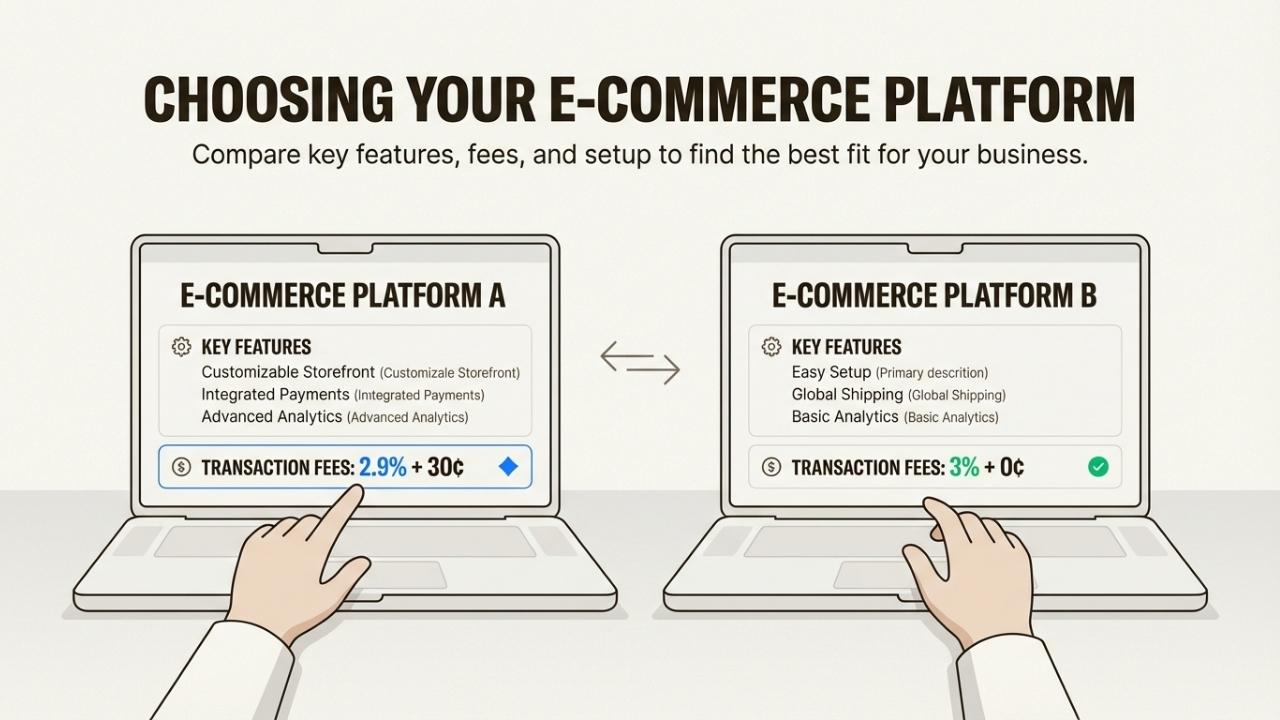
This guide breaks down 7 proven alternatives, from free options for beginners to enterprise-grade solutions for high-volume stores.
Each platform was evaluated on real-world criteria: total cost of ownership, ease of setup, scalability, and the features that actually matter for growing businesses.
What is a sales supply platform?
A sales supply platform is any tool that helps businesses sell products online.
These range from simple link-in-bio storefronts to full-featured e-commerce ecosystems.
Most fall into two categories:
- E-commerce store builders like Shopify and WooCommerce that give you a complete online storefront
- Sales management tools focused on CRM, order tracking, and customer communication
The right platform depends on what you're selling, your technical skills, and where you plan to be in 12 months.
A creator selling digital downloads has very different needs than a retailer managing thousands of SKUs.
How we evaluated these sales supply alternatives
Each platform on this list was tested through the complete setup process: account creation, store configuration, product listing, and checkout flow.
We also analyzed pricing structures to uncover hidden costs that don't show up in the marketing materials.
Here's what we prioritized:
- Total cost transparency - including transaction fees, monthly subscriptions, and overage charges
- Setup speed - how long from signup to first sale
- Scalability - whether the platform grows with you or forces painful migrations
- Integration ecosystem - how well it connects with tools you already use
The result is a list that prioritizes practical value over marketing hype.
Comparison table: All 7 sales supply alternatives at a glance
| Platform | Best For | Starting Price | Transaction Fee | Key Strength |
|---|---|---|---|---|
| Shopify | Scalable stores | $39/month | 0% (with Shopify Payments) | App ecosystem |
| Fourthwall | Creators/merch | Free | 0% on physical, 5% digital | No platform fees |
| Gumroad | Simple digital sales | Free | 10% | Fastest setup |
| Sellfy | All-in-one creators | $22/month | 0% | Built-in POD |
| WooCommerce | WordPress users | Free (hosting extra) | 0% | Full customization |
| BigCommerce | High-volume stores | $348/year | 0% | Built-in features |
| Systeme.io | Free all-in-one | Free | 0% | Most features free |
Now let's dive into each platform in detail.
1. Shopify

Shopify remains the gold standard for e-commerce stores that need room to grow.
It powers millions of stores worldwide and has the infrastructure to handle everything from side hustles to enterprise operations.
The platform's real strength is its app ecosystem. With over 3,000 apps available, you can customize nearly every aspect of your store without touching code.
Need advanced email marketing? There's an app for that. Want to add subscription billing? Dozens of options exist.
Multi-channel selling is another major advantage.
Shopify connects directly to Amazon, eBay, Facebook, Instagram, and TikTok, letting you manage inventory and orders from one dashboard.
Pricing
| Plan | Monthly Price | Annual Price | Key Features |
|---|---|---|---|
| Basic | $39/month | $29/month | 2 staff accounts, basic reports, up to 4 inventory locations |
| Shopify | $105/month | $79/month | 5 staff accounts, professional reports, up to 5 inventory locations |
| Advanced | $399/month | $299/month | 15 staff accounts, advanced reports, third-party calculated shipping rates |
Important note: If you don't use Shopify Payments, you'll pay an additional 2% transaction fee on top of your credit card processing fees.
This can add up quickly for high-volume stores.
Pros
- Scales from startup to enterprise without platform migration
- Excellent inventory management with multi-location support
- Strong analytics and reporting built-in
- 24/7 phone, chat, and email support
- Huge library of professional themes
Cons
- Apps add monthly costs quickly (many essential apps cost $10-50/month each)
- Transaction fees without Shopify Payments
- Learning curve for beginners
- Customization requires Liquid coding knowledge for advanced changes
Best for
Shopify works best for stores planning significant growth, businesses needing advanced features, and anyone who values reliability and support over the lowest possible price.
2. Fourthwall

Fourthwall is built specifically for creators who want to sell merchandise and digital products without the headache of managing inventory or fulfillment.
It's the platform behind many successful YouTuber and Twitch streamer stores.
The standout feature is the zero platform fee on physical products. You only pay for the base cost of goods and shipping.
Fourthwall makes money on the markup you set, not by taking a percentage of every sale.
The platform handles global fulfillment across the US, UK, EU, and Australia, and acts as the merchant of record for sales tax.
This removes a major administrative burden for creators who just want to focus on making content.
Pricing
| Plan | Monthly Price | Transaction Fee | Key Features |
|---|---|---|---|
| Free | $0 | 0% physical, 5% digital | 370+ customizable products, global fulfillment, YouTube/TikTok/Twitch integrations |
| Pro | $19/month | 0% on all sales | Everything in Free plus custom domain, advanced analytics, priority support |
Pros
- No platform fees on physical products (you keep 100% of markup)
- Built-in print-on-demand with 370+ products
- Native integrations with YouTube, TikTok, and Twitch
- Handles sales tax compliance automatically
- Free tier is genuinely usable for small creators
Cons
- No built-in marketplace for organic discovery (you bring your own audience)
- Less suited for corporate or B2B sales
- Product customization limited to available print methods
- Digital product fees (5%) on free plan
Best for
Fourthwall is ideal for content creators, influencers, and artists selling merchandise and digital products to an existing audience.
3. Gumroad
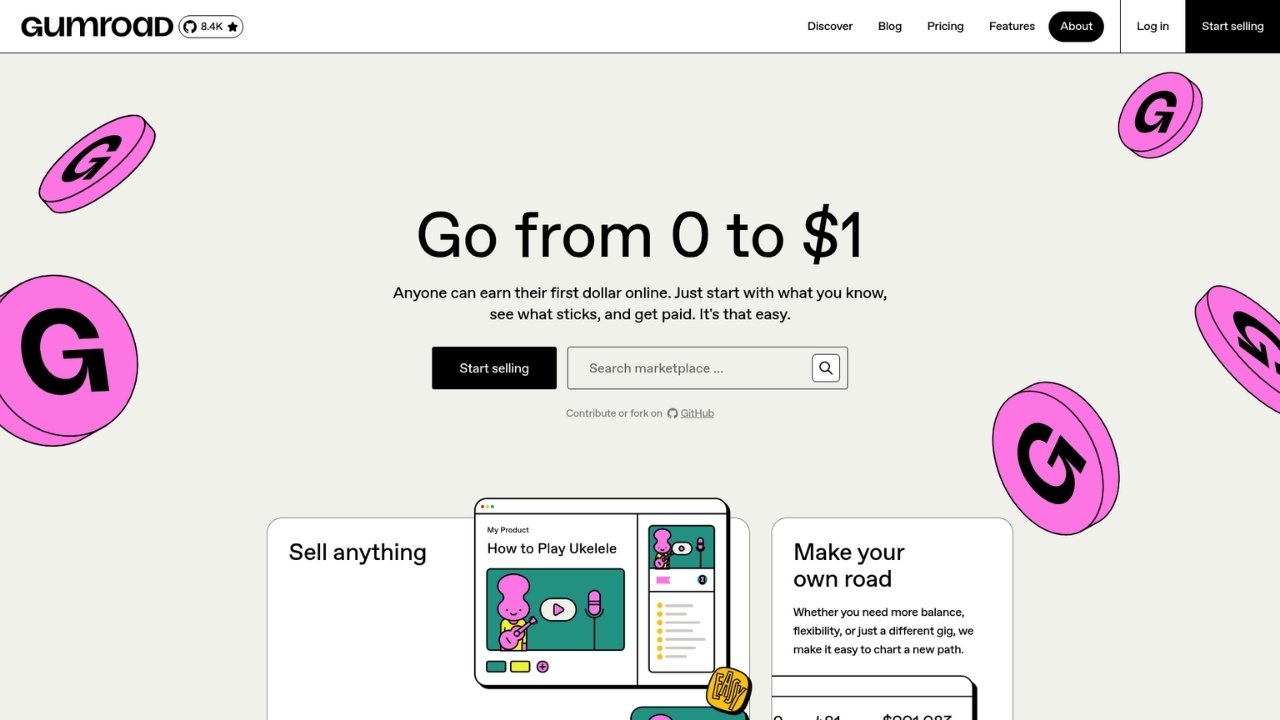
Gumroad is the fastest way to start selling digital products online. You can go from signup to first sale in under 10 minutes, which explains its popularity among writers, musicians, and indie creators.
The platform's simplicity is its superpower. Upload your product, set a price (or use "pay what you want"), and share your link. No store builder, no theme customization, no complex settings.
Gumroad Discover is a built-in marketplace that can drive organic sales. While you shouldn't rely on it as your primary traffic source, many creators report meaningful revenue from discovery alone.
Pricing
| Plan | Monthly Price | Transaction Fee | Key Features |
|---|---|---|---|
| Free | $0 | 10% + processing fees | Unlimited products, Gumroad Discover, memberships, global tax handling |
The 10% fee is Gumroad's only charge on the free plan. There are no monthly fees, no listing fees, and no hidden costs.
Pros
- Fastest setup of any platform on this list
- Built-in marketplace for organic discovery
- Automatic global tax compliance (VAT, GST, etc.)
- "Pay what you want" pricing option
- Supports memberships and subscriptions
- No monthly fees
Cons
- 10% transaction fee cuts significantly into margins
- Limited storefront customization
- No advanced marketing tools (email sequences, abandoned cart recovery)
- Not suitable for physical product catalogs
- Basic analytics compared to competitors
Best for
Gumroad works best for writers, artists, musicians, and developers selling digital downloads who prioritize speed and simplicity over advanced features.
4. Sellfy
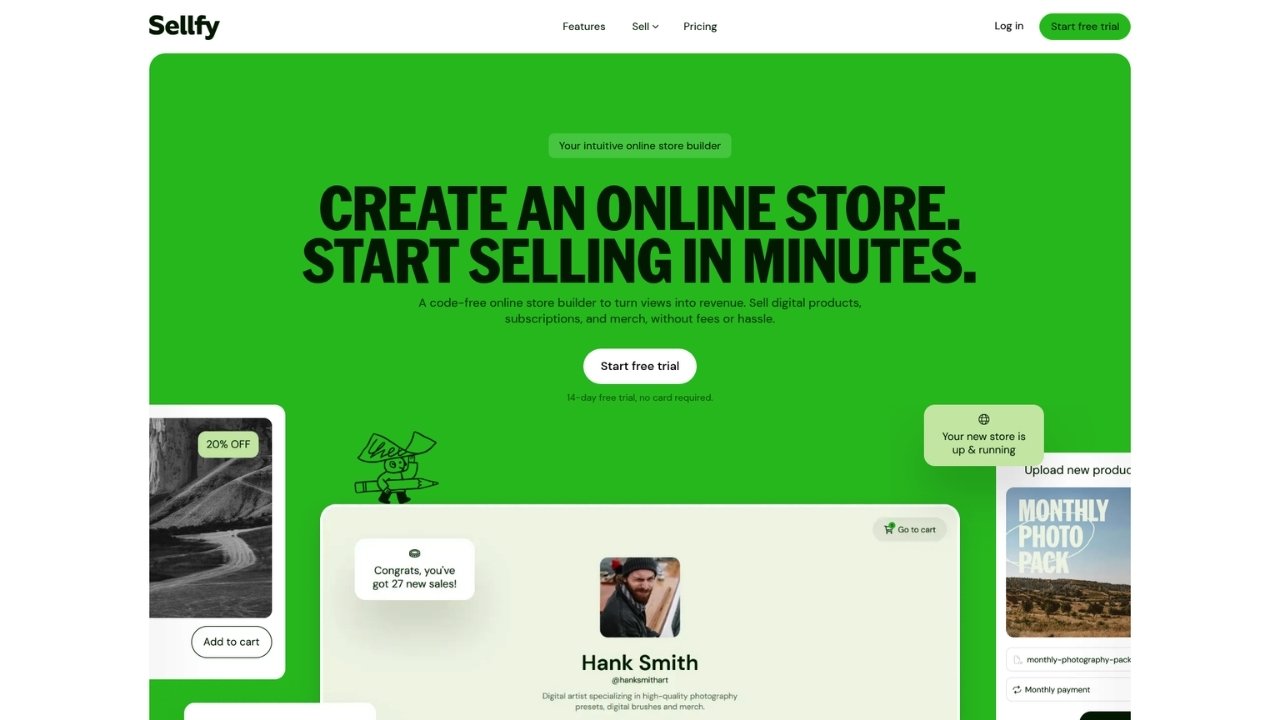
Sellfy positions itself as an all-in-one platform for creators who want to sell digital products, physical goods, and print-on-demand merchandise from a single dashboard.
It's been around since 2011 and has evolved from a simple digital download tool to a full e-commerce solution.
The built-in print-on-demand service sets Sellfy apart from pure digital platforms.
You can sell t-shirts, hoodies, mugs, and other merchandise without integrating third-party services like Printful or Printify.
Email marketing is included on all plans, even the entry-level Starter plan.
This is rare, most competitors gate email tools behind higher-tier subscriptions.
Pricing
| Plan | Monthly Price | Annual Sales Limit | Key Features |
|---|---|---|---|
| Starter | $22/month | Up to $10k/year | Digital, physical, POD products, email marketing, discounts |
| Growth | $59/month | Up to $50k/year | Everything in Starter plus upselling, cart abandonment, affiliate marketing |
| Premium | $159/month | Up to $200k/year | Everything in Growth plus product migration, priority support |
The sales caps are Sellfy's biggest limitation. Hit $50k in annual sales on the Growth plan, and you're forced to upgrade to Premium.
Pros
- True all-in-one (digital + physical + POD in one platform)
- Email marketing included on all plans
- Instant payouts via Stripe or PayPal
- Mobile app for store management
- Built-in affiliate marketing system
Cons
- Sales caps force expensive upgrades
- Limited third-party integrations compared to Shopify
- No free plan (14-day trial only)
- Basic theme customization options
Best for
Sellfy is best for creators who want one platform for all product types without managing multiple tools and integrations.
5. WooCommerce
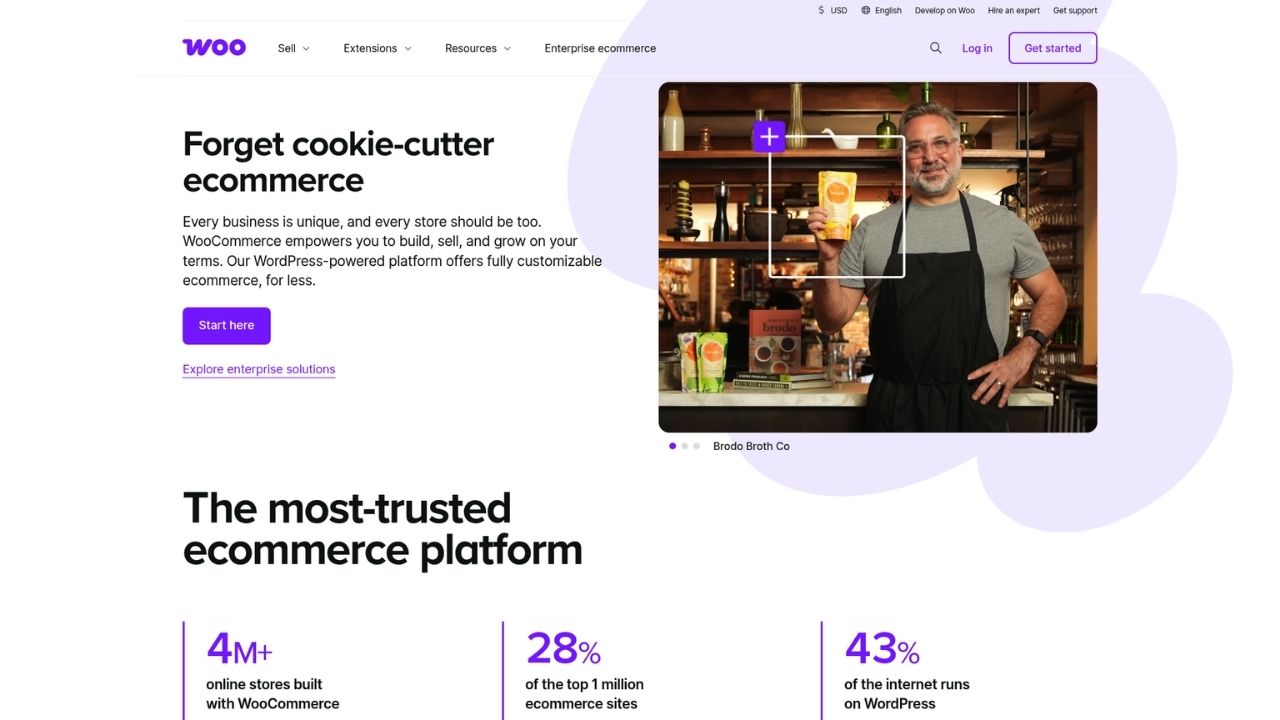
WooCommerce is the e-commerce plugin that turns any WordPress site into a fully functional online store.
It's open-source, which means complete ownership of your data and unlimited customization potential.
The platform powers over 3 million websites and has a massive ecosystem of extensions and themes.
If you can imagine a feature, there's probably a plugin for it.
But this flexibility comes with responsibility. You're in charge of hosting, security, updates, and backups.
WooCommerce itself is free, but the total cost of ownership includes hosting (typically $10-50/month), premium themes, and any paid extensions you need.
Pricing
| Component | Typical Cost | Notes |
|---|---|---|
| WooCommerce plugin | Free | Core functionality |
| Hosting | $10-50/month | Shared to managed WordPress hosting |
| Premium theme | $0-100 one-time | Many free options available |
| Essential extensions | $0-300/year | Payment gateways, shipping calculators, etc. |
| Total monthly | $10-100/month | Varies based on needs |
Pros
- Complete ownership of your store and data
- No platform transaction fees
- Massive developer community and documentation
- Works with any WordPress site
- Unlimited customization through code
Cons
- Requires technical knowledge or willingness to learn
- You're responsible for hosting, security, and updates
- Support is community-based (no official support without paid plans)
- Performance depends entirely on hosting quality
- Extension costs can add up
Best for
WooCommerce is ideal for WordPress users, developers, and businesses that want full control over their store's functionality and data.
6. BigCommerce
BigCommerce is an enterprise-grade e-commerce platform that competes directly with Shopify but takes a different approach to pricing and features.
Instead of relying heavily on apps, BigCommerce includes more functionality out of the box.
The platform offers headless commerce capabilities, meaning you can use BigCommerce as the backend while building a custom frontend experience.
This is valuable for brands that need unique shopping experiences.
Multi-storefront management lets you run multiple brands or regional stores from a single dashboard.
This is a feature that typically requires expensive enterprise plans on other platforms.
Pricing
| Plan | Annual Price | Monthly Equivalent | Sales Limit | Key Features |
|---|---|---|---|---|
| Standard | $348/year | $29/month | $50k/year | Unlimited products, staff accounts, 24/7 support |
| Plus | $948/year | $79/month | $180k/year | Everything in Standard plus customer groups, abandoned cart saver |
| Pro | $3,588/year | $299/month | $400k/year | Everything in Plus plus Google customer reviews, faceted search |
| Enterprise | Custom | Custom | Unlimited | Everything in Pro plus custom features, dedicated support |
Unlike Shopify, BigCommerce charges no transaction fees on any plan.
Pros
- Feature-rich out of the box (less reliance on paid apps)
- No transaction fees on any plan
- Strong SEO capabilities built-in
- 1,400+ integrations available
- Unlimited staff accounts on all plans
- Headless commerce support
Cons
- Higher starting cost than competitors
- Complex setup for beginners
- Annual sales thresholds force upgrades
- Smaller app ecosystem than Shopify
Best for
BigCommerce works best for growing businesses, high-volume sellers, and B2B operations that need enterprise features without enterprise complexity.
7. Systeme.io
Systeme.io is the surprise entry on this list. It's a free all-in-one business platform that includes e-commerce, course creation, email marketing, sales funnels, and affiliate management. The free tier is remarkably generous.
The platform was founded by Aurelien Amacker, a French entrepreneur who wanted to create an affordable alternative to expensive marketing tools. It's gained significant traction in the creator economy for its value proposition.
While not as polished as dedicated e-commerce platforms, Systeme.io offers surprising depth.
You can build complete sales funnels, automate email sequences, and manage affiliates without paying a monthly fee.
Pricing
| Plan | Monthly Price | Contacts | Key Features |
|---|---|---|---|
| Free | $0 | Up to 2,000 | Unlimited emails, sales funnels, courses, affiliate program |
| Startup | $27/month | Up to 5,000 | Custom domains, automation rules, A/B testing |
| Webinar | $47/month | Up to 10,000 | Evergreen webinars, custom automation |
| Enterprise | $97/month | Unlimited | 1-on-1 coaching, custom integrations |
Pros
- Most generous free plan in the industry
- All core features unlocked on free tier
- Built-in course creation and student management
- Marketing automation included
- Affiliate management system
- Sales funnel builder
Cons
- Less polished interface than competitors
- Learning curve for beginners
- Limited design templates
- Smaller community and fewer tutorials
- Support can be slow on free plan
Best for
Systeme.io is ideal for budget-conscious entrepreneurs, course creators, and startups that need multiple business tools without the typical price tag.
Key features comparison: What you actually get
Here's how these sales supply alternatives stack up on specific capabilities:
Payment processing
All platforms support major credit cards and PayPal. Shopify and BigCommerce offer their own payment processors (Shopify Payments and no additional fees, respectively).
WooCommerce requires third-party payment gateways like Stripe or PayPal.
Marketing automation
Systeme.io and Sellfy include email marketing on all plans.
Shopify requires third-party apps for advanced email automation. Gumroad offers basic email capabilities but no sequences or automation.
Multi-currency and language support
Shopify and BigCommerce lead here with native multi-currency support and extensive language options.
WooCommerce can achieve the same through plugins. Gumroad and Systeme.io have more limited international capabilities.
Mobile app availability
Shopify, Sellfy, and BigCommerce offer robust mobile apps for store management.
WooCommerce has limited mobile functionality. Gumroad and Systeme.io are web-only for management.
How to choose the right sales supply alternative
The best platform depends on your specific situation. Here's a quick decision framework:
For beginners: Start with Gumroad or Systeme.io. Both have free tiers that let you test the waters without commitment. Gumroad is simpler for digital products; Systeme.io offers more features if you plan to expand.
For creators with existing audiences: Fourthwall or Sellfy make the most sense. Fourthwall if you're primarily selling merchandise, Sellfy if you need digital + physical + POD in one place.
For growth-focused businesses: Shopify or BigCommerce are the safe bets. Shopify has the larger app ecosystem; BigCommerce includes more features out of the box.
For WordPress users: WooCommerce is the obvious choice. The integration is seamless and you maintain full control.
Consider these factors:
- Current monthly revenue - High-volume sellers need platforms that scale without forced upgrades
- Product types sold - Digital-only sellers have different needs than those managing physical inventory
- Technical skill level - Some platforms require more technical knowledge than others
- Growth plans - Choose a platform that can grow with you for at least 2-3 years
Migration checklist: Switching platforms without losing sales
Moving from one platform to another is stressful, but proper planning minimizes risk. Here's a practical checklist:
Before the switch:
- Export all customer data, order history, and product information from your current platform
- Set up URL redirects for all product pages (critical for SEO)
- Create a backup of your current store
- Choose a low-traffic time for the migration
During the switch:
- Import products and customer data to the new platform
- Configure payment processing and shipping settings
- Test the entire checkout flow with a real transaction
- Set up email notifications and automated responses
After the switch:
- Communicate the change to existing customers via email
- Monitor for any issues with orders or payments
- Check that all redirects are working properly
- Update any external links (social media, email signatures, etc.)
Plan for 2-4 hours of downtime during the actual migration, though many platforms allow you to prepare everything in advance and just flip the switch.
Start selling with the right sales supply alternative today
Choosing a sales supply platform is a decision that affects your business for years.
The right choice depends on where you are now and where you want to be.
For most creators and small businesses, Fourthwall or Sellfy offer the best balance of features and cost.
If you're building something bigger, Shopify or BigCommerce provide the infrastructure to scale. And if budget is your primary concern, Systeme.io delivers surprising value at no cost.
The key is to test before you commit. Most platforms offer free trials or free tiers.
Set up a test store, upload a product, and run through the entire customer experience. You'll quickly discover which platform feels right for your workflow.
Ready to scale your e-commerce support?
As your store grows, so does your customer support burden. Ringly.io offers an AI phone agent named an AI agent that handles order tracking, returns, and common questions automatically. the AI integrates directly with your Shopify store and resolves about 73% of calls without human intervention. You get your last 3 months refunded if the AI resolves under 65% of calls in 90 days during the trial period.
Frequently Asked Questions
What is the best sales supply alternative for beginners?
For beginners selling digital products, Gumroad is the easiest starting point with no monthly fees and a 10-minute setup. For those wanting more features, Systeme.io's free plan includes tools that competitors charge $50+/month for.
Which sales supply alternative has the lowest transaction fees?
Fourthwall charges 0% platform fees on physical products (you only pay for the base cost of goods). Shopify and BigCommerce also charge 0% transaction fees when using their native payment processors. Gumroad has the highest at 10%.
Can I migrate my existing store to a sales supply alternative without losing SEO?
Yes, but it requires careful planning. Set up 301 redirects from all old product URLs to the new ones. Most platforms offer import tools for products and customers. Expect some temporary ranking fluctuations, but proper redirects preserve most of your SEO value.
Do I need technical skills to use these sales supply alternatives?
It depends on the platform. Gumroad, Fourthwall, and Sellfy require no technical knowledge. Shopify and BigCommerce are beginner-friendly but have learning curves. WooCommerce requires the most technical skill for setup and maintenance.
Which sales supply alternative is best for selling both digital and physical products?
Sellfy is built specifically for this use case, offering digital downloads, physical products, and print-on-demand in one platform. Shopify and BigCommerce also handle both well but require apps for optimal digital product delivery.
Are there any truly free sales supply alternatives?
Systeme.io offers the most comprehensive free plan with no transaction fees. Gumroad is free but takes 10% of sales. Fourthwall is free for physical products with 0% fees. All three let you start selling without any upfront investment.
How do I know when it's time to switch to a different sales supply alternative?
Consider switching when you consistently hit sales caps that force expensive upgrades, when transaction fees exceed $100/month, when you need features your current platform lacks, or when you're spending too much time on workarounds. Most successful stores outgrow their first platform within 12-24 months.