
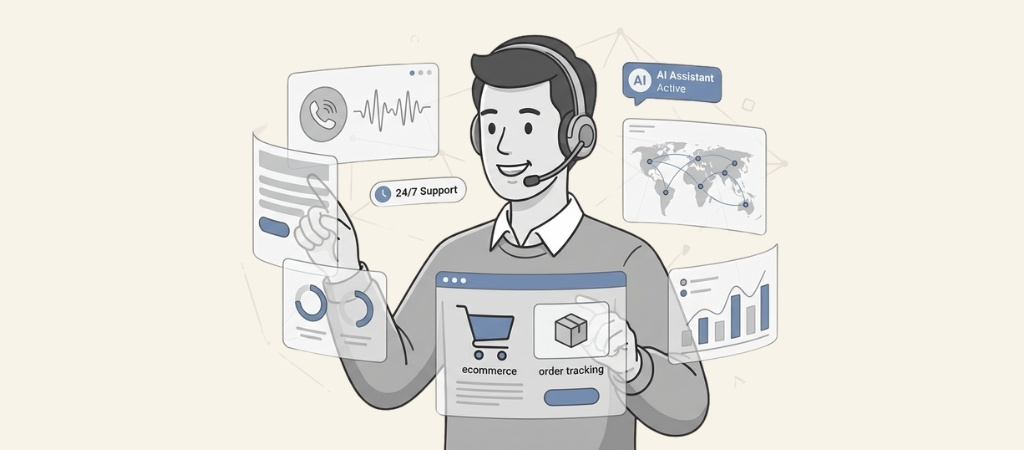
A single missed call might cost you a customer, but hiring a full team to answer every ring could cost you your profit margins.
You are stuck in a hard place.
You need to give your customers fast help, but the cost of hiring, training, and managing a big support team is starting to weigh you down.
This guide will show you how to hire an phone support operator for your store that actually work.
First, we will look at the cost of hiring a phone support operator in 2026.
Then, we will show you how AI agents can handle your Shopify orders and returns for a fraction of the price.
Editor’s note: Want to hear some sample AI support calls made for your Shopify store?
- Just paste your store URL
- Get sample calls in under 20 seconds (no email required)
- Listen to demo AI calls for my store
Understanding the role of an e-commerce phone support operator
A phone support operator for an online store is the voice of your brand. They are on the front lines, turning customer problems into positive experiences.
When someone calls your business, they are the person who picks up.
Their day is usually packed with a few key tasks. They're always answering "Where is my order?" (WISMO) questions, explaining return and exchange policies, answering product questions, and handling the occasional unhappy customer.
The role requires patience, product knowledge, and a focus on helping customers.

This role is critical for retaining the customers you have worked to acquire. A positive support experience builds trust and can turn one-time buyers into repeat customers. If support is handled poorly, you risk damaging your brand's reputation.
How you decide to fill this role will directly affect your budget, your ability to grow, and the overall customer perception of your brand.
The traditional approach: Hiring human support operators
When you think about filling a support role, your mind probably goes to the usual methods. This is the path most businesses have taken for decades: finding a real person to answer the phone.
In-house employees, freelancers, or BPOs
You have a few options here. You could hire a full-time, in-house employee who becomes part of your team. Or, you could use the gig economy and find a freelancer on a platform like Upwork.
Another common route is to outsource the entire operation to a Business Process Outsourcing (BPO) company, which is a call center that handles support for many different businesses.
A quick search on job boards like ZipRecruiter or Indeed shows thousands of listings for remote customer service reps, so the talent pool is wide.
The benefits of a human touch
Human agents have distinct strengths, which is why this has been the standard approach for so long. People are great at showing genuine empathy.
They can read between the lines, pick up on frustration in a caller's voice, and handle nuanced emotional conversations.
They can also come up with creative solutions for unique problems that do not fit a script. For high-touch brands where building a personal connection is part of the appeal, a skilled human agent can be a huge asset.
Challenges and limitations of human support
However, this approach comes with several challenges, especially for a growing e-commerce business.
- Cost: The financial side can be steep. According to ZipRecruiter, the average annual pay for a remote customer service representative in the U.S. is about $39,098. That's around $18.80 an hour, and this does not include the extra costs for benefits, payroll taxes, equipment, software, and training.
- Scalability: What happens during high-volume periods like Black Friday, or when a marketing campaign goes viral and call volume triples overnight? Scaling a human team is slow and resource-intensive. You cannot instantly have new, fully-trained agents ready to go. The hiring and training process takes weeks, and then you may have the opposite problem when things quiet down.
- Availability: Customers shop at all hours, so they may need help at all hours. Offering real 24/7 support with a human team presents logistical challenges. It means juggling multiple shifts, paying more for overnight and weekend work, or outsourcing to a BPO in another time zone. Each option adds more complexity and cost.
- Consistency: The quality of support can vary depending on the agent, their workload, or other factors. Keeping a consistent brand voice and ensuring policies are followed the same way every time is a constant management challenge.
The modern approach: Using an AI agent
An alternative approach involves using AI agents. This involves a virtual agent that connects directly to your store and starts working instantly. Modern conversational AI can understand natural language, have a conversation, and solve problems.
What an AI operator can do for a Shopify store
Modern AI agents for e-commerce are specialized tools. For example, Ringly.io offers an AI agent named the AI, which is designed specifically for Shopify stores.
This means it can handle the majority of calls that tie up support lines on its own.
Here's a sample of what the AI can do right away:
- Look up real-time order status and tracking info by getting an order number or customer email.
- Start returns and exchanges automatically, based on the specific rules you've set for your store.
- Answer hundreds of common questions about your products, shipping policies, or anything else you've added to its knowledge base.
- Serve a global customer base by speaking over 40 different languages fluently.
Key advantages of an AI operator
When you compare this to the traditional model, the benefits for a growing store become apparent.
- 24/7 Instant Availability: An AI agent does not need sleep. It works around the clock, on weekends, and through every holiday. Every single call gets answered right away, which means hold times can be eliminated.
- Cost-Effectiveness: Instead of a recurring salary of nearly $40,000 per person, you're looking at a predictable monthly subscription. AI agents can reduce support costs, with platforms like Ringly.io reporting that their agent resolves an average of 73% of all calls without human help.
- Instant Scalability: Remember that Black Friday traffic spike? An AI operator can handle 15+ calls at the same time without any issue. Whether you have 10 calls or 1,000, it scales instantly to meet demand, no hiring rush needed.
- Seamless Shopify Integration: A notable advantage is direct integration. Platforms like Ringly.io plug directly into your Shopify backend. This gives the AI live access to order information, customer history, and product details, letting it give accurate, personalized answers.
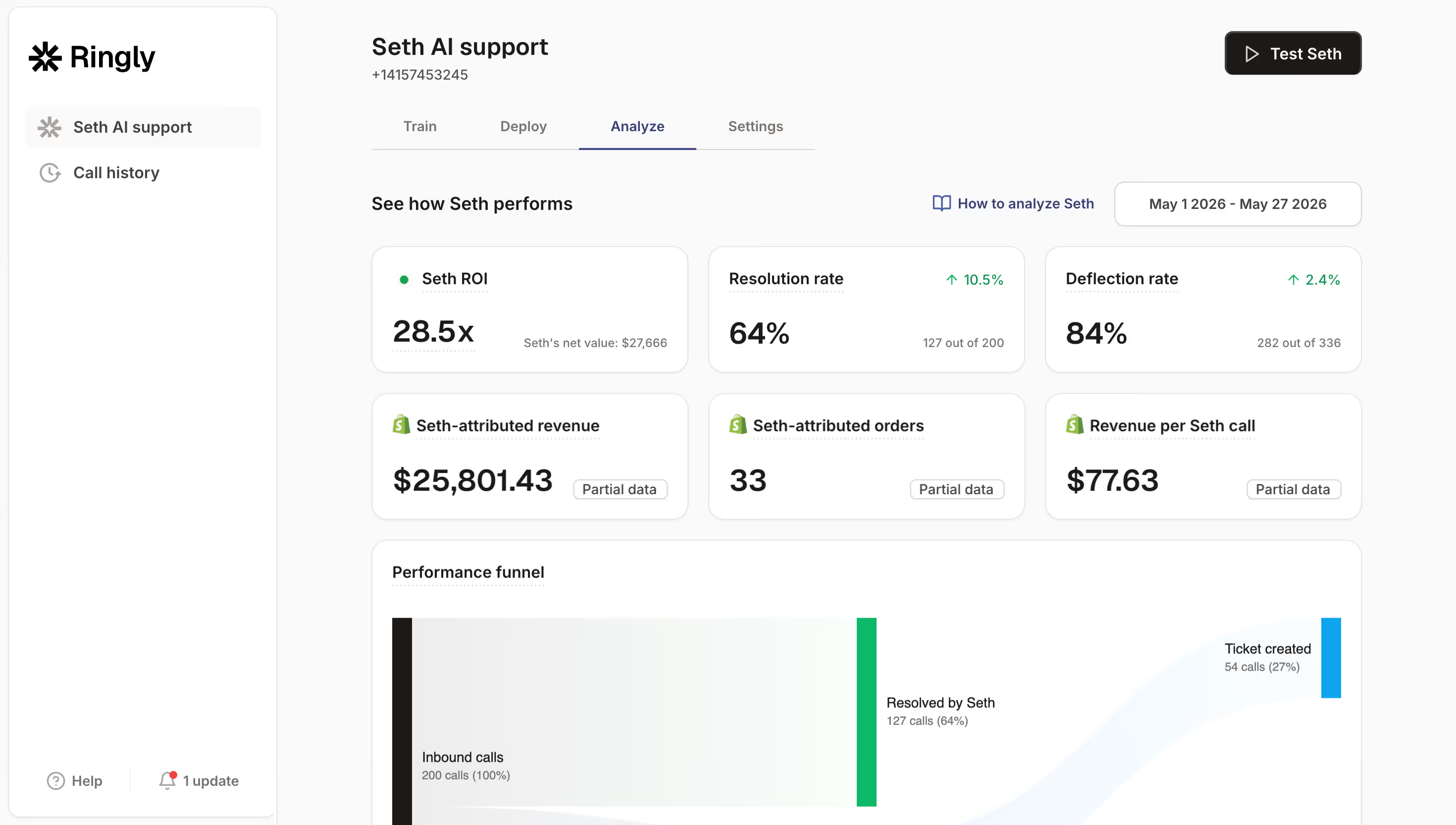
- Data and Insights: An AI platform provides useful data. You get full call transcripts, analysis of why customers are calling, and a performance funnel showing exactly how many calls are being resolved automatically.
How AI handles escalations
A common consideration is how an AI handles situations it cannot resolve. A well-designed AI has a defined process for this.
An AI like the AI agent from Ringly.io is built with safety rules. It is programmed not to guess or provide information it doesn't have. Instead, it can tell when a caller is getting frustrated or when a question is outside its scope. When that happens, it smoothly passes the call to a human agent on your team.
This creates an effective hybrid setup: AI handles the high volume of repetitive questions with speed, and your human experts are freed up to focus on the complex, high-value conversations.

Key considerations for phone support operators
So, how do you decide which path is right for your store? It comes down to understanding your specific needs, your budget, and your long-term goals. The following table compares the two options.
Comparing human operators and AI agents
Here's a quick breakdown of how a traditional human hire compares to a modern AI operator.
| Feature | Human Operator (In-house/Freelance) | AI Operator (like Ringly.io) |
|---|---|---|
| Availability | Typically 8-hour shifts; 24/7 is costly and complex | 24/7/365, instantly |
| Cost | ~$39,098/year per agent, plus benefits and overhead | Starts at a predictable monthly fee (e.g., $349/mo) |
| Scalability | Slow; requires weeks for hiring and training | Instant; handles unlimited concurrent calls |
| Setup Time | Weeks to hire and onboard | Under 3 minutes |
| Multilingual Support | Requires hiring specialized, more expensive agents | Built-in; supports 40 languages out of the box |
| Consistency | Varies by agent, mood, and time of day | Perfectly consistent brand voice and policy adherence |
| Shopify Integration | Requires manual login and data lookup | Deep, native integration for real-time data access |
When to choose each model
Based on that comparison, here are some guidelines:
- Choose a Human Operator if: Your call volume is extremely low (just a few calls a day), and almost every single one is a highly complex, emotional issue. It might also make sense if you need one person to wear many hats, handling emails, social media, and other tasks besides the occasional phone call.
- Choose an AI Operator if: You run a growing Shopify store where a lot of your calls are repetitive questions about orders and returns. If you want to offer 24/7 support without breaking the bank, or if you need a support solution that can scale up and down instantly for sales and promotions, AI is a suitable option.
This video provides tips on hiring virtual assistants and e-commerce strategies that can help scale your business.
Pricing comparison: Human vs. AI operators
The cost structures for these two options differ significantly.
The cost of a human operator
As we've mentioned, the average salary for a single remote support representative is around $39,098 per year, based on data from ZipRecruiter. But the real cost is always higher.
You need to factor in benefits, payroll taxes, hiring costs, equipment, and training, which can easily add another 20-30% on top of that base salary. And if you need 24/7 coverage, you'll need to multiply that cost by at least three or four agents.
The cost of an AI operator
AI platforms offer a different pricing model, with predictable, subscription-based pricing that is a fraction of a human salary. For instance, here's a look at the core plans from Ringly.io:
- Grow Plan: For $349/month, you get 1,000 call minutes, a self-learning AI that connects to your store data, call recordings, and full analytics. Any minutes over your allowance are billed at a clear $0.19/minute.
- Enterprise: custom pricingnth, this plan is for high-volume stores and includes 3,000+ minutes, a private Slack channel for dedicated support, and options for custom integrations.

The future of e-commerce support
The approach to phone support in 2026 is different from previous years. A few years ago, the only real choice was to post a job ad and start interviewing. Today, that's just one part of the equation.
While talented human agents will always have a place for handling complex and sensitive issues, relying on them alone may not be the most efficient or scalable strategy for all businesses.
AI phone operators have evolved into a practical and accessible solution for many Shopify stores. They provide the instant, 24/7 service that modern customers expect, all while freeing up your team to focus on work that drives real growth.
The question for many store owners is shifting from if they should adopt AI for phone support to how to best integrate it to build a smarter, more resilient, and customer-focused business.
Implementing an AI operator
To see how an AI phone agent might work for your business, you can explore available platforms. For example, Ringly.io allows for the deployment of its AI agent, the AI, which integrates with Shopify to answer customer calls, handle order lookups, and process returns 24/7.
According to the company, it is used by over Shopify stores. Exploring the pricing and trial options of such platforms can provide insight into how to scale support while managing costs.
Frequently Asked Questions
What is the main cost difference between an AI and a human phone support operator?
The cost difference can be substantial. A full-time human operator's salary is a significant annual expense plus benefits. An AI operator is typically priced as a monthly subscription, which can be a fraction of a full-time salary. For example, some AI plans start at a few hundred dollars per month.
How fast can an AI phone support operator be implemented?
Implementation is typically very fast. While hiring a person can take weeks, an AI agent from a platform like Ringly.io can be set up in minutes, as it integrates directly with e-commerce platforms like Shopify.
How do AI operators handle multilingual support compared to human agents?
Hiring a human team for multilingual support requires finding specialized agents, which can be difficult and expensive. In contrast, many AI agents have built-in multilingual capabilities. For example, some platforms support over 30 languages by default.
What happens when an AI operator cannot answer a customer's question?
Well-designed AI operators are programmed to escalate calls they cannot handle. If a question is outside its scope or if it detects customer frustration, the AI will transfer the call to a human agent. This creates a hybrid model for support.
What kind of integration is important for an e-commerce AI operator?
A deep, native integration with your e-commerce platform (like Shopify) is important. This allows the AI to access real-time data such as order information, customer history, and product details, enabling it to provide accurate and personalized responses.