

Managing customer questions across email, chat, and social feels like playing whack-a-mole. One minute you're answering a shipping question on Instagram, the next you're digging through Shopify for an order status. Without the right tools, ecommerce support becomes a constant context-switching nightmare.
Ecommerce helpdesk software exists to solve this. These platforms pull all your customer conversations into one place, connect directly to your store data, and automate the repetitive stuff so you can focus on actually helping customers.
We tested and compared the top 7 options for 2026. Whether you're a growing Shopify brand or a marketplace seller juggling Amazon and eBay, there's something here for you.
Editor's note: Want to hear some sample AI support calls made for your Shopify store?
- Just paste your store URL
- Get sample calls in under 20 seconds (no email required)
- Listen to demo calls for my store
What is ecommerce helpdesk software?
Ecommerce helpdesk software is a centralized platform that manages all your customer conversations across channels. Think of it as mission control for support.
Unlike generic ticketing systems, ecommerce helpdesks come with features built specifically for online stores:
- Order context: Agents see customer purchase history, shipping status, and order details without leaving the ticket
- Returns automation: Process refunds and exchanges directly from the helpdesk
- Ecommerce integrations: Native connections to Shopify, WooCommerce, and marketplaces like Amazon
- Multichannel support: Handle email, live chat, social media, SMS, and phone from one inbox
Standard helpdesks force you to toggle between your store admin and support tickets. Ecommerce helpdesks bring that data into the conversation automatically. When a customer asks "where's my order?", your agent sees the tracking number instantly instead of asking for it.
Ecommerce helpdesk software comparison
| Here's how all 7 platforms stack up at a glance: | Platform | Starting Price | Best For | AI Included | Free Trial |
|---|---|---|---|---|---|
| Ringly.io | $349/mo | Phone-heavy stores | Yes (unlimited) | 14 days | Gorgias |
| $29/mo | Shopify stores | $0.60/resolution | 7 days | Zendesk | $19/mo |
| Enterprise teams | Add-on ($50/agent) | 14 days | Freshdesk | $0/mo | Budget-conscious teams |
| Add-on ($49/100 sessions) | Free plan | eDesk | $39/mo | Marketplace sellers | $0.99/resolution |
| 14 days | Help Scout | $0/mo | Human-first support | $0.75/resolution | Free plan |
| Richpanel | $0/mo | Self-service focused | Yes (on Pro+) | Free plan | Now let's dive into each platform in detail. |
Top 7 ecommerce helpdesk software platforms
1. Ringly.io
Best for: Ecommerce stores drowning in phone calls

Most ecommerce helpdesks focus on tickets, chat, and email. Ringly.io is different, it solves the phone problem. If your customers still call (and they do), Ringly's AI agent Seth handles those calls so your team doesn't have to.
Seth integrates directly with Shopify to look up orders, process returns, answer FAQs, and escalate only when necessary. The AI resolves around 73% of calls without human intervention, which means you can offer 24/7 phone support without hiring a night shift.
Setup takes about 3 minutes. You get a phone number (or port your existing one), connect your Shopify store, and Seth starts answering calls. The AI speaks 40 languages, so global expansion doesn't require multilingual hires.
Key features:
- AI phone agent with ~73% resolution rate
- Native Shopify integration for order lookups and returns
- 24/7 availability with no human agents required
- 40 language support
- Call recordings and analytics
- Escalation to human agents when needed
| Pricing: | Plan | Monthly Price | Minutes Included | Best For |
|---|---|---|---|---|
| Grow | $349 | 1,000 | Small to medium stores | Scale |
Overage: $0.19 per minute. Add-ons include custom integrations ($500+) and dedicated Slack channels ($299/mo).
Pros:
- Handles phone calls automatically (unique among helpdesks)
- No per-agent pricing, just minutes used
- Quick setup, no technical expertise needed
- Real Shopify integration, not just a sidebar app
- AI included, not a paid add-on
Cons:
- Voice-only (no email/chat ticketing)
- Higher starting price than ticket-based tools
- Requires Shopify (other platforms coming)
Verdict: If phone support is a significant channel for your store, Ringly.io is the obvious choice. It's the only platform on this list that actually solves the phone problem instead of just logging voicemails. Use it alongside a ticket-based helpdesk for complete coverage.
2. Gorgias

Best for: Shopify stores wanting deep ecommerce integration
Gorgias is the helpdesk built specifically for ecommerce, and it shows. The Shopify integration goes deeper than competitors, letting you edit orders, cancel shipments, and process refunds directly from the ticket view.
The platform centralizes email, live chat, voice, SMS, and social media (WhatsApp, Instagram, Facebook) into one inbox. AI features include automated responses to common questions, intent detection, and sentiment analysis.
One standout feature is the customer sidebar. When viewing a ticket, you see complete Shopify data: order history, tracking info, subscription status, and even loyalty points. No tab-switching required.
Key features:
- Deep Shopify, BigCommerce, and Magento integrations
- Multichannel inbox (email, chat, social, SMS, voice)
- AI Agent for automated responses ($0.60/resolution)
- Order editing and refund processing from tickets
- 100+ app integrations
| Pricing: | Plan | Monthly Price | Tickets/Month | AI Included | Basic |
|---|---|---|---|---|---|
| $29 | 50 | No | Starter | $49 | 300 |
| No | Basic (higher tier) | $79 | 600 | Optional add-on | Pro |
| $153 | 2,000 | Optional add-on | Advanced | $306 | 5,000 |
| Optional add-on | Enterprise | $509 | 10,000 | Optional add-on | AI Agent costs $0.60 per resolution on top of base pricing. |
Pros:
- Best-in-class Shopify integration
- Handles high ticket volumes well
- AI features actually work for ecommerce
- Good for teams of all sizes
Cons:
- AI is a paid add-on, not included
- Ticket-based pricing can mean overage surprises
- Instagram integration can be glitchy
- Voice features are basic compared to Ringly.io
Verdict: For pure ticket and chat support, Gorgias is hard to beat. The ecommerce-specific features justify the price, especially if you're processing hundreds of tickets monthly. Just watch those overage fees.
3. Zendesk
Best for: Large enterprises with complex requirements
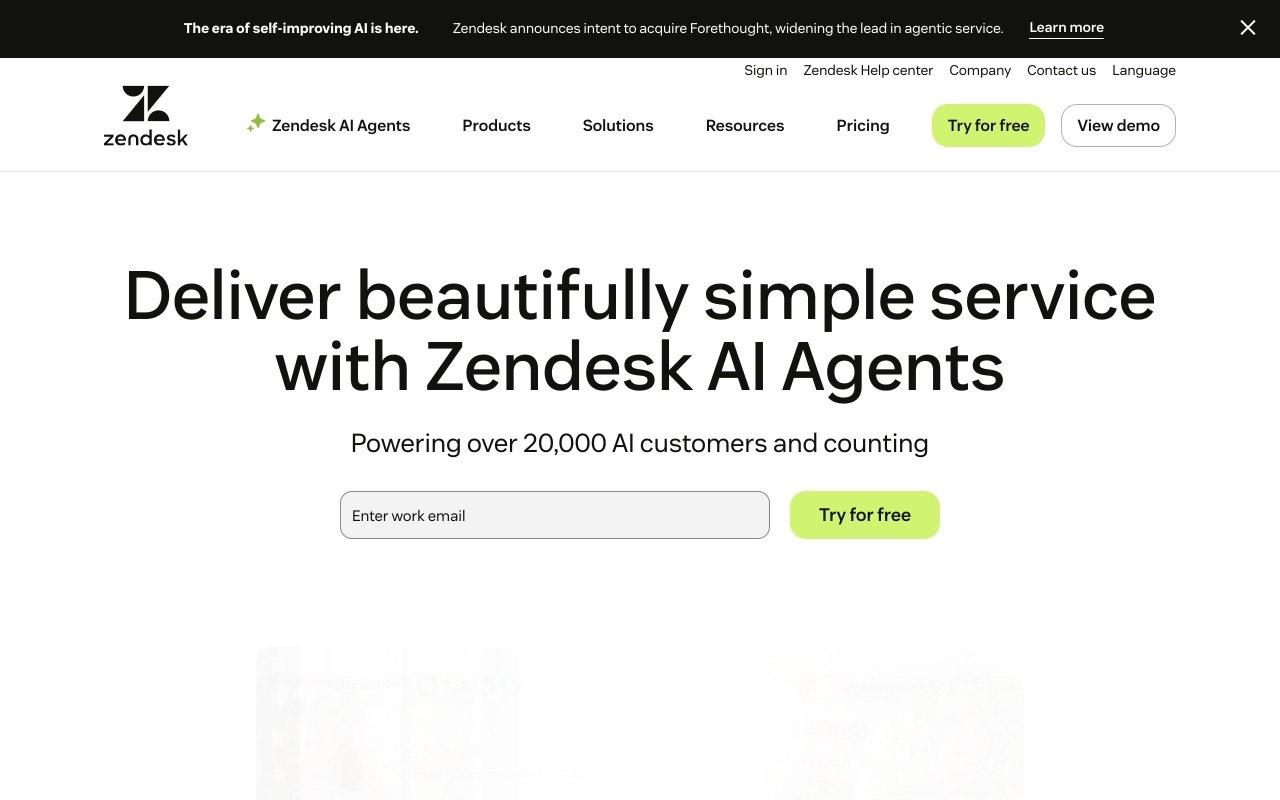
Zendesk is the 800-pound gorilla of customer service software. It's not ecommerce-specific, but its massive ecosystem and enterprise-grade features make it a common choice for large retailers.
The platform handles everything: email, chat, phone, social, messaging, and self-service. With 1,200+ app integrations, you can connect virtually any tool in your stack. The AI capabilities include macro suggestions, automated ticket routing, and copilot features for agents.
The trade-off is complexity. Getting Zendesk configured properly requires time and expertise. You'll need someone on your team who can navigate the extensive customization options or budget for their professional services.
Key features:
- Omnichannel ticketing across all channels
- 1,200+ app integrations
- Advanced analytics and custom dashboards
- Workforce management and quality assurance
- Enterprise-grade security and compliance
| Pricing: | Plan | Price per agent | Key Features | Support Team | $19/mo | Basic ticketing |
|---|---|---|---|---|---|---|
| Suite Team | $55/mo | Messaging, help center | Suite Growth | $89/mo | Automation, custom reports | Suite Professional |
Add-ons like Copilot ($50/agent/mo), Quality Assurance ($35/agent/mo), and Workforce Management ($25/agent/mo) push costs higher.
Pros:
- Mature, reliable platform
- Massive integration ecosystem
- Enterprise-grade security
- Handles complex workflows and customizations
Cons:
- Not ecommerce-specific (Shopify integration via app)
- Costs escalate quickly with add-ons
- Complex setup and configuration
- Overkill for small teams
Verdict: Zendesk makes sense if you're a large operation with dedicated IT resources and complex requirements. For smaller ecommerce stores, it's probably more tool than you need.
4. Freshdesk
Best for: Small teams on tight budgets wanting solid basics

Freshdesk by Freshworks is the budget-friendly option that doesn't skimp on core features. The free tier supports up to 2 agents for 6 months, making it perfect for stores just starting out.
The platform covers all the essentials: multichannel support, knowledge base, automation rules, and basic reporting. Freddy AI handles ticket routing and can summarize conversations for agents. Higher tiers add collision detection, custom roles, and more advanced features.
The Shopify integration comes via marketplace app rather than native connection, so it's not as seamless as Gorgias or Ringly. But for the price, it's hard to complain.
Key features:
- Free plan for small teams
- Multichannel support (email, chat, phone, social)
- Knowledge base and self-service portal
- Freddy AI for routing and summaries
- 74,000+ businesses worldwide
| Pricing: | Plan | Price per agent | Key Features |
|---|---|---|---|
| Free | $0 | 2 agents for 6 months | Growth |
| $19/mo | Automation, custom fields | Pro | $55/mo |
| Multiple products, custom roles | Enterprise | $89/mo | Sandbox, advanced security |
Freddy AI Agent costs $49 per 100 sessions after the first 500 included sessions.
Pros:
- Free tier for testing and small teams
- Affordable paid plans
- Straightforward setup
- Solid feature set for the price
Cons:
- Ecommerce features require third-party apps
- AI is a paid add-on
- Limited order context compared to native Shopify solutions
- Freddy Copilot pricing not transparent
Verdict: Freshdesk is the entry-level choice that gets you started without breaking the bank. Plan to upgrade as you grow, but it's a fine place to begin.
5. eDesk
Best for: Marketplace sellers managing Amazon, eBay, and Walmart

eDesk is built specifically for sellers who make most of their sales through marketplaces rather than their own stores. If you're juggling customer messages from Amazon, eBay, Walmart, and Shopify simultaneously, eDesk centralizes everything.
The AI Agent automates up to 65% of support across all channels. The Smart Inbox uses AI to group similar tickets and route them intelligently. A unique feature is the Pre-sales mailbox, which helps convert product questions into sales.
With 300+ integrations including all major marketplaces, eDesk is the most channel-agnostic platform on this list. The reporting focuses on operational metrics rather than deep analytics, which is fine for most sellers.
Key features:
- Unified inbox for marketplaces and direct-to-consumer
- AI Agent with 65% automation rate
- Pre-sales support tools
- 300+ integrations
- Feedback management for reviews
| Pricing: | Plan | Price per agent | Stores/Marketplaces |
|---|---|---|---|
| Essential | $39/mo | 1 | Growth |
| $89/mo | 5 | Professional | $119/mo |
| 10 | Enterprise | Custom | Unlimited |
AI add-ons: AI Automation ($0.99/resolution), AI Assist ($39/user/mo), AI Translations ($21/user/mo).
Pros:
- Centralizes marketplace messages
- Strong Amazon/eBay focus
- Organized ticket views with AI grouping
- Good for multi-channel sellers
Cons:
- Less ideal for pure direct-to-consumer brands
- Reporting is operational, not analytical
- AI features are add-ons
- Can get expensive with multiple AI tools
Verdict: If you sell primarily on Amazon and eBay with some Shopify mixed in, eDesk is purpose-built for your workflow. Pure DTC brands should look elsewhere.
6. Help Scout
Best for: Small teams prioritizing human touch over heavy automation

Help Scout takes a different approach than most platforms on this list. Instead of leading with AI and automation, they focus on making human-powered support as efficient and personal as possible.
The shared inbox feels more like email than a ticketing system, which customers appreciate. AI Answers handles routine questions, but the emphasis is on giving your team tools to respond quickly and personally. Features like collision detection prevent duplicate replies, and customer profiles show full conversation history.
The platform integrates with Shopify to show purchase history in the sidebar. It's not as deep as Gorgias, but it covers the basics.
Key features:
- Clean, email-like shared inbox
- AI Answers for routine questions (~70% resolution rate)
- Beacon embeddable support hub
- Knowledge base and live chat
- Collision detection
| Pricing: | Plan | Price per user |
|---|---|---|
| Key Features | Free | $0 |
| 5 users, 1 inbox, 1 docs site | Standard | $25/mo |
| 5 users, unlimited inboxes | Plus | $45/mo |
| 10 users, custom fields | Pro | $75/mo |
| 25 users, advanced permissions | AI Answers costs $0.75 per resolution. | Pros: |
- Clean, intuitive interface
- Quick to implement
- Human-centered approach
- 99% of support emails answered within 24 hours
- 80% customer retention after 4 years
Cons:
- Limited automation compared to competitors
- No native voice support
- Lacks advanced ecommerce features
- Shopify integration is basic
Verdict: Help Scout is for teams that believe great support comes from people, not bots. If your brand voice is personal and high-touch, this platform supports that philosophy.
7. Richpanel
Best for: Brands wanting to maximize self-service and reduce ticket volume

Richpanel is an AI-first platform that focuses on one thing: getting customers to resolve their own issues without contacting support. They guarantee 30% fewer tickets within 60 days or you get a full refund.
The self-service portal lets customers track orders, request returns, and find answers without creating a ticket. Sidekick AI helps your agents draft responses faster. The visual workflow builder makes automation accessible without coding.
Richpanel also includes unique AI Employees, like a social media moderator and voice of customer analysis tool. These go beyond standard helpdesk features.
Key features:
- Self-service portal (30% ticket reduction guarantee)
- Sidekick AI for agent assistance
- Visual workflow builder
- AI Employees (social moderator, VoC analysis)
- 1-click migration from other helpdesks
| Pricing: | Plan | Monthly | Annual |
|---|---|---|---|
| Key Features | Free | $0 | $0 |
| 3 seats, basic features | Starter | $29/mo | $20/mo |
| 10 seats, basic automations | Pro | $69/mo | $50/mo |
| Unlimited seats, AI features | Pro Max | $349 per month | $85/mo |
Advanced AI, custom integrations
Self-service portal add-on: $99-$500/month depending on order volume.
Pros:
- 30% cost savings guarantee vs competitors
- 30% automation guarantee in 60 days
- Strong self-service reduces ticket volume
- AI included at no extra cost on Pro+ plans
- Easy migration from Zendesk, Gorgias, Help Scout
Cons:
- Self-service portal is a separate add-on
- Agent interface less polished than Help Scout
- No native voice support
- Relatively newer player in the market
Verdict: Richpanel is the choice if you want to aggressively reduce support volume through self-service. The guarantees show confidence, and the AI features are genuinely included rather than nickel-and-dimed.
How to choose the right ecommerce helpdesk
With 7 solid options, how do you pick? Here's a simple decision framework:

Start with your primary channel:
- Phone is your biggest pain point? Go with Ringly.io
- Email and chat heavy? Gorgias, Help Scout, or Richpanel
- Marketplace messages? eDesk
Consider your team size and budget:
- Solo founder testing the waters? Freshdesk free tier or Richpanel free tier
- Small team (2-5 agents)? Help Scout or Gorgias Basic
- Growing team (5-20 agents)? Gorgias Pro or Richpanel Pro
- Enterprise (20+ agents)? Zendesk or custom Richpanel
Evaluate your AI needs:
- Want AI included? Ringly.io, Richpanel
- Okay paying per resolution? Gorgias, eDesk, Help Scout
- Prefer human-first? Help Scout
Watch out for overage charges:Gorgias and other ticket-based systems can surprise you with overage fees during busy months. If you hate billing surprises, consider per-agent pricing or Ringly.io's minute-based model.
Our recommendation
For most growing Shopify stores, we recommend starting with Gorgias or Richpanel. Both offer deep Shopify integration, reasonable pricing, and room to grow.
If phone support is a significant channel for you, add Ringly.io to handle calls while your helpdesk handles everything else. The combination of Ringly for voice and Gorgias for tickets covers most ecommerce support needs.
Enterprise retailers with complex requirements should evaluate Zendesk, but be prepared for implementation costs and ongoing customization work.
Start automating your ecommerce support
The right helpdesk depends on your channels, volume, and growth stage. But one thing is clear: doing support through Gmail or Shopify's basic inbox doesn't scale.
If phone calls are eating up your team's time, start your free trial with Ringly.io and see Seth resolve calls in minutes. For stores drowning in tickets, the other options on this list offer solid paths to more efficient support.
Whatever you choose, the goal is the same: spend less time on repetitive questions and more time building your business.
Frequently Asked Questions
Do you need a paid plan to get good ecommerce helpdesk software?
Not necessarily. Freshdesk, Help Scout, and Richpanel all offer free tiers that work for small teams. However, ecommerce-specific features like Shopify order editing typically require paid plans.
How much should you budget monthly for ecommerce helpdesk software?
Budget $25-$75 per agent for most platforms. AI features often cost extra ($0.75-$1.00 per resolution). If you handle phone support, add Ringly.io's $349/month Grow plan.
Can you use ecommerce helpdesk software with multiple sales channels?
Yes. Most platforms support Shopify, WooCommerce, and marketplaces. eDesk specializes in marketplace sellers (Amazon, eBay, Walmart), while Gorgias and Richpanel excel with Shopify.
What AI features should you look for in ecommerce helpdesk software?
Look for automated responses to common questions (WISMO, returns), AI drafting for agents, and smart routing. Be wary of platforms that charge separately for every AI interaction, costs add up fast.
How long does it take to set up ecommerce helpdesk software?
Simple setups take a few hours. Ringly.io claims for voice. Complex Zendesk implementations can take weeks. Most Shopify-focused tools (Gorgias, Richpanel) get you live in a day.
Is it worth switching helpdesks if you're already using one?
If you're hitting limits, paying too much in overages, or missing ecommerce features, yes. Richpanel and others offer migration tools and white-glove migration services to make switching painless.
Looking for data to back up your strategy? Check out our latest research: 50 ecommerce customer support statistics for 2026 and 45 live chat statistics for 2026.