
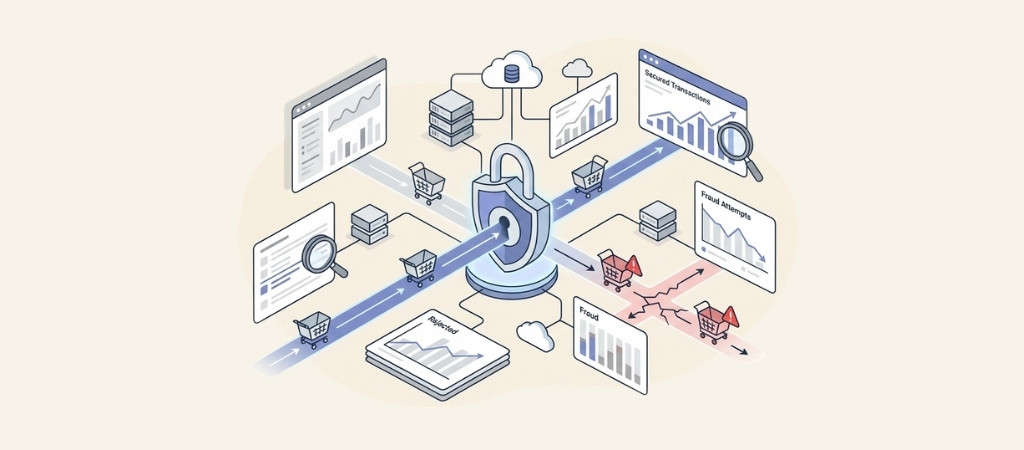
Online retailers lost $48 billion to fraud in 2024. By 2029, that number is projected to hit $107 billion.
If you're running a growing ecommerce store, those statistics aren't just numbers.
They represent real money walking out the door, chargeback fees eating into margins, and the operational headache of fighting disputes.
The good news? You don't need an enterprise security team to protect your business.
This guide breaks down the fraud types targeting online stores, the warning signs to watch for, and practical prevention strategies you can implement today.
Whether you're processing a hundred orders a month or ten thousand, you'll find actionable steps to reduce your fraud risk without creating a checkout experience that drives legitimate customers away.
Editor’s note: Want to hear some sample AI support calls made for your Shopify store?
- Just paste your store URL
- Get sample calls in under 20 seconds (no email required)
- Listen to demo calls for my store
Understanding ecommerce fraud types
Ecommerce fraud isn't one thing. It's a collection of tactics fraudsters use to exploit online businesses.
Understanding the different types helps you spot vulnerabilities in your own operation.
Payment fraud
Card-not-present (CNP) fraud is the most common threat. Fraudsters use stolen credit card details to make purchases on your site, and because the physical card isn't present, verification is harder.
According to DataDome, CNP fraud was projected to represent 74% of all card payment fraud losses in 2024, exceeding $10 billion.
Card testing is a related problem. Fraudsters make small purchases with stolen card numbers to see which ones work.
Once validated, they move on to larger purchases or sell the verified cards on dark web markets. You might not notice until you see an unusual spike in small transactions on your payment processor statement.
Account-based fraud
Account takeover (ATO) happens when criminals gain access to existing customer accounts using stolen credentials from data breaches.
Sift's research shows ATO accounted for 29% of ecommerce fraud in 2023.
Once inside an account, fraudsters can make purchases using saved payment methods, steal gift card balances, or scrape personal information for identity theft.
Account creation fraud is equally damaging. Fraudsters create fake accounts to exploit introductory offers, referral programs, or promotional discounts.
They might create dozens of accounts to abuse a "20% off your first order" promotion.
Post-transaction fraud
Chargeback fraud, also called "friendly fraud," occurs when legitimate customers dispute charges for products they actually received.
Sift reports this accounts for 34% of fraud cases. Customers might claim they never received the item, say it was damaged, or report the transaction as unauthorized.
Return fraud and refund abuse are growing problems too. Customers return used or damaged items claiming they're defective, or request refunds for products they never actually shipped back.
Automated threats
Bot-driven attacks have exploded. DataDome observed a 135% surge in malicious bot requests during the 2025 holiday season.
These bots perform credential stuffing (testing stolen username/password combinations at scale), inventory hoarding (adding items to carts to prevent real customers from buying), and scraping (harvesting pricing and product data).
Warning signs that signal potential fraud
Spotting fraud early gives you the best chance to stop it. Here are the red flags that should trigger additional scrutiny.
Transaction red flags
Unusually large orders from first-time customers warrant a closer look, especially if your typical customer makes smaller initial purchases.
Multiple credit cards used for a single purchase is another warning sign. Legitimate customers don't usually try several different cards to complete one transaction.
Watch for rush orders with expedited shipping, particularly to addresses that don't match the billing address.
Fraudsters want goods shipped quickly before the fraud is detected. Multiple separate orders placed in rapid succession from the same customer or IP address can indicate automated attacks or card testing.
Orders shipping to PO boxes or international destinations outside your normal customer base deserve extra attention.
According to Bank of America's guidance, "Do you usually get small, repeat orders from locals but suddenly receive a very large order from a new customer and location where you don't typically do business?
If it's unusual for your business, it could be an indication of fraud."
Behavioral indicators
Mismatched billing and shipping addresses are common in fraud, though plenty of legitimate customers (like gift buyers) do this too.
Context matters. Orders from IP addresses in high-risk regions or known for fraud activity should raise flags.
Unusual navigation patterns, like rushing straight to checkout without browsing, can indicate automated attacks.
The LexisNexis Cybercrime Report found that one in every eight password resets leads to fraud.
If you see multiple password reset requests for the same account, investigate further.
Ecommerce fraud prevention strategies that work
Prevention doesn't require a massive budget. Start with these foundational tactics, then layer on more sophisticated tools as your business grows.
Immediate actions (no cost)
Enable CVV verification and Address Verification Service (AVS) checks through your payment processor.
These basic tools verify that the customer has the physical card and that the billing address matches what the card issuer has on file. Most processors support this at no extra cost.
Set up 3D Secure 2.0 if your payment processor supports it.
This adds an extra verification layer where customers authenticate directly with their bank, shifting some fraud liability away from you.
Create clear refund and return policies and enforce them consistently.
Document everything. When you do need to fight a chargeback, having detailed records of delivery confirmation, customer communication, and return policy acceptance strengthens your case.
Train your customer service team to recognize fraud indicators.
They should know when to escalate orders for manual review and what questions to ask suspicious callers.
Technical implementations
Multi-factor authentication (MFA) for customer accounts adds a significant barrier to account takeover attempts.
Require email or SMS verification for password changes, new device logins, or high-value purchases.
Device fingerprinting tracks the devices used to access your store, building risk profiles over time.
If a customer always shops from an iPhone in New York and suddenly places an order from a laptop in Eastern Europe, that's worth investigating.
Bot detection is increasingly essential. DataDome's research found that 61.2% of websites were completely unprotected against simple bot attacks in 2025, while only 2.8% of global domains are fully protected against advanced threats.
Specialized bot detection can differentiate between legitimate customers and automated attacks.
Payment tokenization replaces sensitive card data with unique tokens, reducing your PCI compliance scope and limiting damage if your database is breached.
Operational best practices
Progressive friction means starting with minimal verification for trusted customers and only adding steps when risk indicators appear.
A customer with a two-year purchase history and no disputes gets a smoother checkout than a first-time buyer with a mismatched address.
Establish clear order screening criteria. Which orders require manual review?
Common triggers include orders over a certain dollar amount, international shipping, mismatched addresses, or unusual purchasing patterns. Document your criteria so your team applies them consistently.
The key insight from DataDome applies here: "Balance robust security with customer experience by implementing progressive friction measures only when suspicious activity is detected."
Choosing fraud prevention tools for your business
At some point, manual processes won't scale. Here's how to know when to invest in dedicated fraud prevention software and what to look for.
When to invest in fraud prevention software
Consider dedicated tools when you're processing enough volume that manual review becomes a bottleneck, or when fraud losses exceed what you could spend on prevention.
A rough rule of thumb: if you're spending more than a few hours per week reviewing suspicious orders, automation will likely pay for itself.
Growth trajectory matters too. If you're scaling rapidly, implementing fraud prevention before fraud becomes a serious problem is easier than retrofitting it later.
Types of solutions available
Built-in platform features are the easiest starting point. Shopify includes basic fraud analysis that flags risky orders. WooCommerce has fraud prevention plugins. Payment processors like Stripe offer Radar, their fraud detection tool, included with standard processing.
Dedicated fraud prevention platforms offer more sophisticated protection:
- Sift uses machine learning to analyze behavioral patterns and flag suspicious activity in real-time
- Signifyd offers guaranteed fraud protection with financial coverage on approved orders that turn out to be fraudulent
- Kount combines supervised and unsupervised machine learning for fraud detection
- DataDome specializes in bot and fraud protection with a false positive rate of 0.00091%
Chargeback management tools like Chargeflow focus specifically on disputing and recovering from chargebacks, which complements fraud prevention rather than replacing it.
Selection criteria
Integration with your ecommerce platform should be seamless. If the tool doesn't work natively with your store, implementation complexity increases dramatically.
False positive rates matter as much as detection rates.
A tool that blocks 99% of fraud but declines 10% of legitimate orders will cost you more in lost revenue than it saves. Ask vendors for their false positive statistics.
Pricing models vary. Some charge per transaction, others have monthly fees.
For high-volume stores, per-transaction pricing can get expensive quickly. Calculate your effective cost at your current volume and projected growth.
Chargeback guarantees can be valuable, but read the fine print.
What conditions must you meet? Are there coverage limits? Does the guarantee apply to all fraud types or just specific categories?
Balancing security with customer experience
The hardest part of fraud prevention isn't stopping fraudsters. It's stopping fraudsters without frustrating legitimate customers.
The friction problem
Every security measure adds friction. CAPTCHAs, additional verification steps, and declined transactions all create points where customers might abandon their purchase.
Research consistently shows that checkout friction directly impacts conversion rates.
But the alternative isn't great either. Excessive fraud leads to higher payment processing fees, chargeback penalties, and in extreme cases, payment processors terminating your account. Finding the right balance is essential.
Smart friction strategies
Risk-based authentication applies different security levels based on customer behavior.
A returning customer using their usual device and shipping address gets minimal friction.
A new customer with a mismatched billing address gets additional verification.
Trusted customer recognition builds profiles over time. Once a customer has established a clean history, they get streamlined checkout.
This rewards loyalty while maintaining security for unknown entities.
Clear communication helps too. When you do require additional verification, explain why. "We're protecting your account" is more palatable than an unexplained delay.
Real-world results support this approach. Harry's, the grooming brand, implemented Sift and saw an 85% reduction in chargebacks while maintaining a smooth checkout experience.
Signifyd's customers report a 9% increase in conversion through automated decision-making that reduces false declines.
Building your ecommerce fraud prevention plan
You don't need to implement everything at once. Here's a phased approach.
Phase 1: Foundation (Week 1)
Enable basic verification through your payment processor: CVV checks, AVS verification, and 3D Secure if available. Review and tighten your refund and return policies. Set up basic monitoring alerts in your payment gateway for unusual transaction patterns.
Phase 2: Automation (Month 1-2)
Implement automated fraud detection rules in your ecommerce platform or payment processor. Configure which orders get flagged for manual review. Train your team on the new processes and criteria.
Phase 3: Optimization (Ongoing)
Track your false positive rate and adjust thresholds accordingly. Monitor chargeback ratios and fraud attempt trends. As your volume grows, evaluate whether dedicated fraud prevention tools make financial sense.
Protect your business beyond fraud prevention
Fraud prevention is just one piece of protecting your ecommerce operation.
The customer journey extends beyond the transaction, and vulnerabilities exist at every touchpoint.
Consider what happens when a customer calls about a suspicious charge or needs help with a return.
These post-purchase interactions are opportunities to catch fraud early or provide excellent service that reduces chargeback disputes.
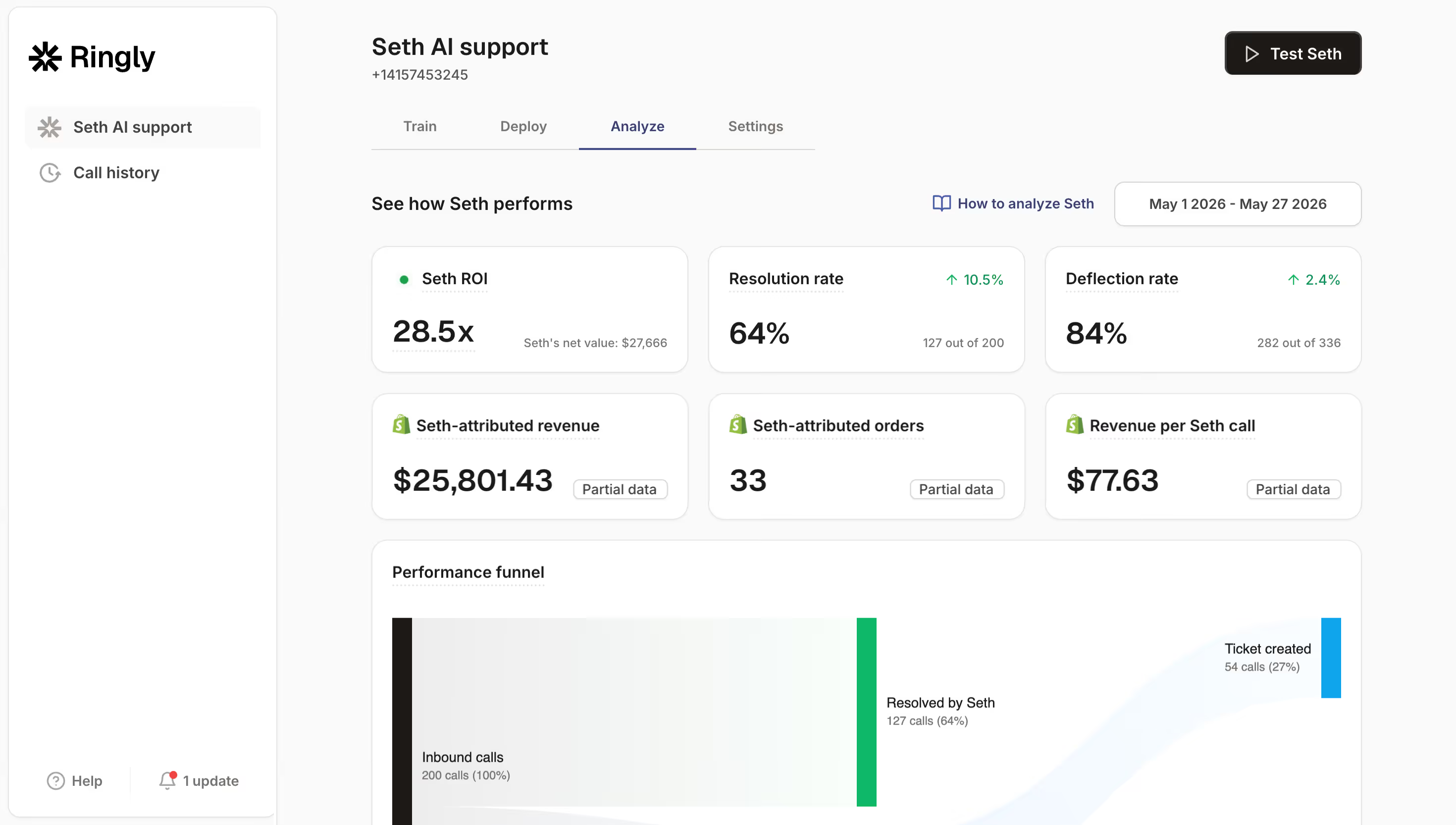
But many growing stores struggle to handle phone support at scale.
This is where Ringly.io fits into your fraud prevention strategy. the AI, their AI phone support representative, handles inbound customer calls 24/7.
When customers call about order issues, potential fraud, or refund requests, the AI can look up orders, process returns, and escalate complex situations to your team.
The connection to fraud prevention is clear. Fast, helpful phone support can resolve disputes before they become chargebacks.
When a customer calls about an unrecognized charge, the AI can verify their identity, review the order details, and either confirm legitimacy or flag it for investigation.
This immediate response window is often the difference between a resolved issue and a costly chargeback.
Ringly.io integrates directly with Shopify, pulling order and customer data in real-time.
The AI resolves approximately 70-73% of calls without human intervention, handling the repetitive "where's my order" and return requests that otherwise consume your team's time.
When fraud patterns are detected, the AI escalates to your team with full context.
For growing stores, this means you can offer phone support (which builds trust and reduces fraud disputes) without hiring a full call center.
the AI supports 30 languages, so you can serve international customers without language barriers becoming a vulnerability.
If you're building out your fraud prevention strategy, consider how phone support fits into the bigger picture.
You can start a free trial of Ringly.io and see how The AI handles your customer calls.
Frequently Asked Questions
What is ecommerce fraud prevention?
Ecommerce fraud prevention encompasses the strategies, tools, and practices online retailers use to detect and stop fraudulent transactions. It includes technical measures like CVV verification and machine learning detection, operational practices like order screening, and business policies like clear return guidelines. Effective ecommerce fraud prevention balances security with customer experience to stop fraudsters without creating excessive friction for legitimate customers.
How can small businesses implement ecommerce fraud prevention without a big budget?
Start with free and low-cost measures available through your payment processor. Enable CVV and AVS verification, set up 3D Secure authentication, and create clear fraud screening criteria for manual review. Many ecommerce platforms like Shopify include basic fraud analysis at no extra cost. Focus on operational improvements like training your team to spot red flags and documenting everything for chargeback disputes. As your volume grows, reinvest a portion of fraud loss savings into automated tools.
What are the most common types of ecommerce fraud?
The most common types include card-not-present fraud (using stolen credit card details online), account takeover (gaining unauthorized access to customer accounts), chargeback fraud (legitimate customers falsely disputing charges), and bot-driven attacks (automated credential stuffing and inventory hoarding). According to recent data, CNP fraud represents 74% of card payment losses, account takeover accounts for 29% of ecommerce fraud, and chargeback fraud makes up 34% of cases.
How do I balance ecommerce fraud prevention with customer experience?
Use progressive friction by applying minimal verification to trusted customers and only adding steps when risk indicators appear. Implement risk-based authentication that recognizes returning customers and their usual behavior patterns. When additional verification is required, communicate clearly why it's happening. A/B test security measures to measure their impact on conversion rates. The goal is making most transactions feel frictionless while applying scrutiny to genuinely risky orders.
When should I invest in dedicated ecommerce fraud prevention software?
Consider dedicated tools when manual review processes become a bottleneck (typically when you're spending several hours per week reviewing orders), when fraud losses exceed what you'd spend on prevention, or when you're scaling rapidly and need automated protection. Calculate your break-even point by comparing monthly software costs against current fraud losses plus the labor cost of manual review. Many businesses find the investment pays for itself through reduced chargebacks and freed-up team time.
What red flags should I watch for to detect ecommerce fraud?
Key warning signs include unusually large orders from new customers, multiple credit cards used for a single purchase, rush orders with expedited shipping to addresses different from billing addresses, multiple orders placed in rapid succession, and orders shipping to PO boxes or high-risk international destinations. Behavioral indicators include orders from unusual IP locations, rapid account creation, and repeated declined transactions. Context matters, so establish what's normal for your business and investigate deviations.
How does ecommerce fraud prevention relate to customer service?
Fraud prevention and customer service are closely connected. Fast, helpful support can resolve disputes before they become chargebacks. When customers call about unrecognized charges or order issues, effective phone support can verify legitimacy, provide refunds when appropriate, and document interactions for dispute resolution. Poor customer service actually increases fraud losses because frustrated customers are more likely to file chargebacks rather than seek resolution directly. Consider how your support channels fit into your overall fraud prevention strategy.
Also read: